
RAG retrieves documents. Agents need to retrieve beliefs.
Bella is the visual brand; the Python package and CLI remain
bellamem.pipx install bellamem, thenbellamem save.
The problem
Your AI agent is like a brilliant intern with amnesia. Every morning you re-explain the project. Every afternoon it re-introduces the bug you fixed yesterday. It smiles and nods and produces confidently wrong output. Fluent, agreeable, and fundamentally untrustworthy.
Loses continuity. Today's session suggests the exact bandaid you rejected yesterday. Yesterday doesn't exist.
Hits the wall. /compact and /clear evaporate the specifics —
rejected approaches, causal chains, small invariants that took ten
messages to earn.
Confabulates with conviction. When it forgets, it doesn't ask to be reminded. It re-asserts the wrong approach with full confidence, and you're the one who has to catch it every time.
One root cause: agents only have working memory. The context window is the memory. When a turn falls out, it's gone — and the agent carries on unaware, filling the gap with plausible defaults. You can't guardrail a system that doesn't own its own beliefs.
Bella is the long-term memory layer. It extracts the structure
of every conversation — decisions, rejected approaches, causes,
self-observations — into a belief hypergraph that survives /clear,
new sessions, and new days. When tomorrow's session asks about the
flaky test, it loads what yesterday decided, what yesterday rejected,
and why.
Measured across 15 real Claude Code projects on a developer's machine, Bella compresses the conversation portion of the context window by median 17.6× (range 3.6×–90×). The biggest sample (132k raw tokens) hit 90× — see the production curve.
Before and after
A real debugging session — twenty turns of dead-ends, side-questions,
acknowledgments, and the actual fix at the end. Left column is what
the context window holds. Right column is what Bella extracts
alongside it — and what survives after /clear.
| Flat session — what the context window holds | Bella hypergraph — what survives |
|---|---|
user:      test flaked again, 3rd time
assistant: which one — auth or sync?
user:      sync_external_api, like last time
assistant: ok, looking at retry.py
assistant: timeout hardcoded to 2s. bump to 5s?
user:      bandaid, don't paper over it
user:      we need to know WHY it times out
assistant: fair. tracing retry logic
assistant: sync retries with 200ms backoff
assistant: huh, only one retry — that's tight
user:      CI load? Mondays spike hard
assistant: checking metrics dashboard...
assistant: yes — CI hits the rate-limiter
assistant: first retry hits same limit, fails
assistant: 2s window exceeded before retry
user:      real fix: retry jitter, not timeout
assistant: agreed. patching: backoff ± jitter
user:      good
assistant: add latency metrics too?
user:      not now, focus on the fix
|
[retry-jitter is the fix]
   m=0.74  v=2  (user + assistant)

  ⇒ cause chain
     CI load → rate-limiter → first retry
     → 2s window exceeded before retry

  ⊥ rejected
     "bump timeout from 2s to 5s"
     (user: "bandaid, not a fix")

  __self__  observation
     "I reach for timeout bumps when retry
      semantics are the real problem"
|
|
~220 tokens · 20 turns · ordered by time · dies at |
~50 tokens · 4 beliefs · ordered by evidence mass · persists |
Same information content, different geometry. The left column lets an agent reconstruct what was said. The right column lets it reconstruct what was decided, what was rejected, and what caused what — in far fewer tokens, and across the session boundaries where the left column can't go.
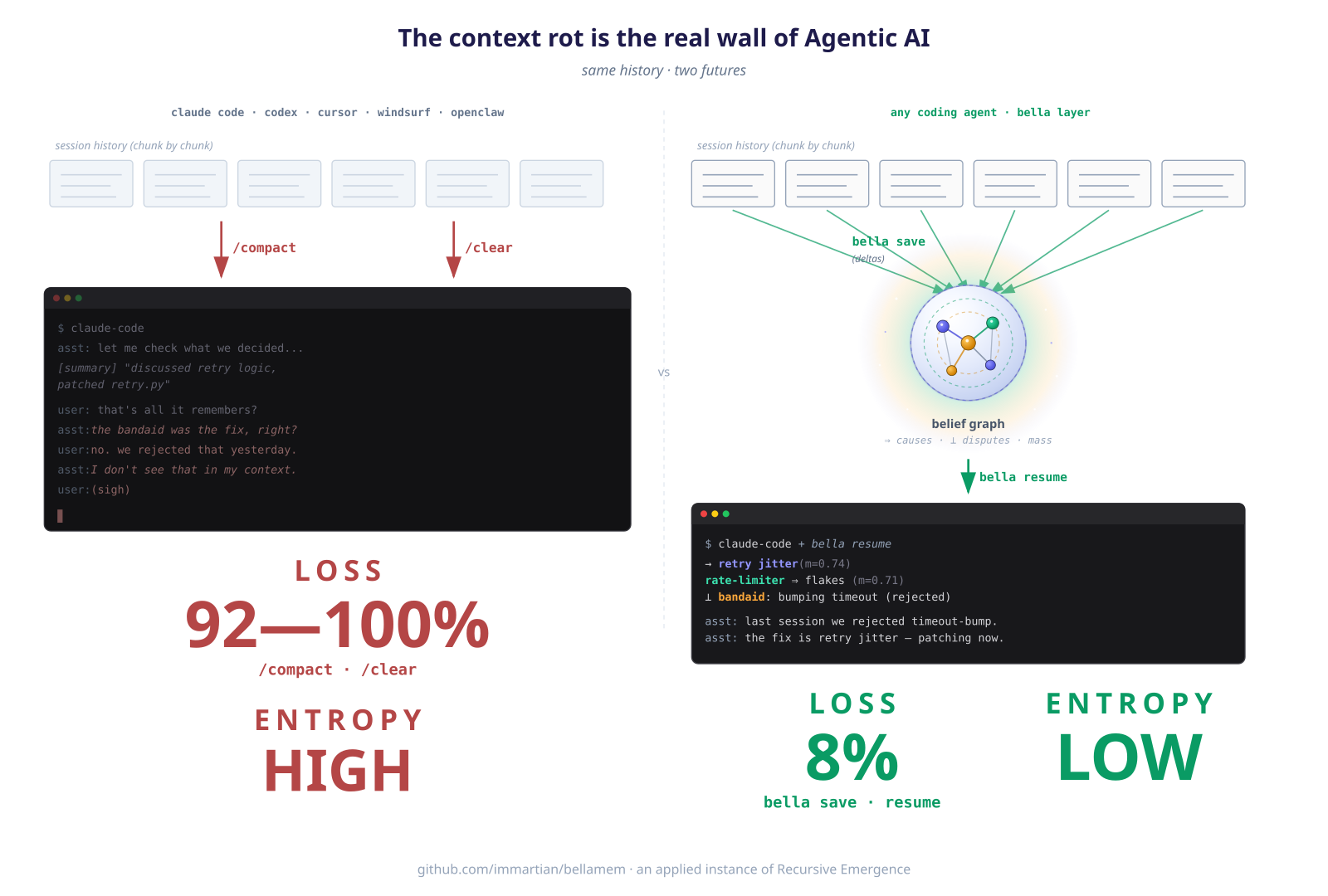
And the four items on the right are exactly the ones the agent would otherwise forget, re-suggest, or confabulate about tomorrow: a ratified decision (mass earned from two voices), a causal chain (the why), a dispute (the rejected bandaid, which Bella's edit guard will block if the agent tries it again), and a self-observation about its own reasoning pattern.
The ontology
Every concept in Bella is classified along two orthogonal axes. The axes aren't decorative — they drive retrieval, decay, and dispute handling differently. A normative decision about testing style doesn't decay the way an ephemeral observation about yesterday's build does.
Class — where does it come from and how is it used?
| class | shape | meaning |
|---|---|---|
| invariant | hexagon | time-invariant principles and facts — they don't decay |
| decision | diamond | a commitment that constrains future action — revisable |
| observation | ellipse | a single empirical record — a snapshot |
| ephemeral | rounded square | pinned for short-term use, has an open→consumed/retracted/stale lifecycle |
Nature — what kind of claim is this?
| nature | color | meaning |
|---|---|---|
| metaphysical | amber | what the system IS — self-model, architectural facts |
| normative | blue | what we commit to — rules, preferences, policies |
| factual | green | measurable, checkable facts about the world |
The 12 cells are a full typology — invariant × metaphysical is the
deepest bedrock ("the graph is append-only"), ephemeral × factual is
throwaway ("yesterday's CI was red"). Mass accumulates on every cell
the same way (Jaynes log-odds from each ratifying voice), but the
retrieval guard, the decay curve, and the dispute resolution read
each cell differently.
You can see the full ontology rendered live on your own graph:
python -m bellamem.proto viz # .graph/v02.html (interactive)
Shape encodes class, color encodes nature, node size encodes mass, turn-hubs make the hypergraph structure visible as rosettes.
Install
pipx is the recommended path — a single global bellamem command,
no .venv to remember, no PATH surgery:
pipx install bellamem
# or, from a local clone:
git clone https://github.com/immartian/bellamem
pipx install -e ./bellamem                  # editable install, still global
Per-project venv also works:
cd your-project
python3 -m venv .venv
.venv/bin/pip install bellamem
Optional extras:
pipx inject bellamem 'sentence-transformers>=2.2'   # local embeddings
pipx inject bellamem 'openai>=1.0'                  # OpenAI embeddings + LLM EW
# or with pip:
pip install 'bellamem[st]'      # sentence-transformers
pip install 'bellamem[openai]'  # OpenAI
pip install 'bellamem[all]'     # both
Copy .env.example → .env in your project and fill in the backends
you enabled. .env is gitignored.
Requirements: Python 3.10+. Git (Bella scopes per-project state via the git repo root). No other system dependencies.
Quickstart
Three retrieval modes — one for each question you actually ask about your memory. Most workflows live in these three commands:
| Command | Question |
|---|---|
bellamem expand "X" |
What do we believe about X, ranked by importance? |
bellamem surprises |
What just changed — what mattered? |
bellamem replay [X] |
What did we say — in what order? |
Plus utility commands for ingest, audit, render, prune, and bench:
# Ingest Claude Code sessions for the current project.
# Auto-runs R3 consolidation (merges near-duplicates) on new claims.
bellamem save

# Three retrieval modes — same memory, different questions:
bellamem expand "what did we decide about persistence"
bellamem surprises                                      # top jumps, sign flips, disputes
bellamem replay                                         # narrative timeline
bellamem replay "ad-hoc bandaid pattern"                # focused narrative

# The pre-edit pack: no recency, surfaces invariants + disputes + causes
bellamem before-edit "should I wrap this in try/except" --entity embed.py

# Health report: bandaid piles, duplicates, garbage field names, mass limbo
bellamem audit

# Render the graph as a picture (needs the [viz] extra or graphviz CLI)
bellamem render --out graph.svg                           # whole forest
bellamem render --out disputes.svg --disputes-only        # just ⊥ edges
bellamem render --out auth.svg --focus "auth tokens"      # subgraph around a focus

# Forget orphan leaves that never earned their place (dry run by default)
bellamem prune                        # preview candidates
bellamem prune --apply                # actually remove them

# Empirically compare context strategies (flat, compact, RAG, Bella)
bellamem bench
Every command except save, emerge, prune --apply, and scrub is
read-only.
Use with  Claude Code
The flow that lets you keep working past the context window without losing the thread is packaged into four slash commands.
Bella is built for — and tested daily against — Claude Code. Other coding agents (Codex, Cursor, Windsurf, OpenClaw) will need their own adapter; see #1 for the lifecycle hooks we're tracking.
Install the slash command — once, globally
bellamem install-commands # writes ~/.claude/commands/bellamem.md
/bellamem now works in every Claude Code project on your
machine. Per-project install (--project) is also supported if you
want to commit the slash command into a specific repo.
The commands
| Command | What it does |
|---|---|
/bellamem or /bellamem resume |
Working-memory replay tail + long-term expand pack + top surprises. Run at session start. |
/bellamem save |
Ingest the current session (auto-consolidates), run audit, report top new surprises. Run before /clear or at end of day. |
/bellamem recall <topic> |
Mass-ranked beliefs about a topic, disputes included. Mid-session lookup. |
/bellamem why <topic> |
Pre-edit pack: invariants, disputes, causes, entity bridges. Run before a risky change. |
/bellamem replay / /bellamem audit |
Raw CLI output when you want to look at it directly. |
The save → clear → resume flow
/bellamem save     ← captures this session into the graph
/clear             ← wipe the context window (Claude Code built-in)
/bellamem resume   ← fresh assistant reconstructs where you were
On a well-tuned project, /bellamem resume comes back in ~30k
tokens and contains enough to pick up the next decision without
re-asking questions already answered. If it's much larger, run
bellamem emerge to consolidate near-duplicates.
The edit guard (v0.0.4)
Install bellamem-guard as a Claude Code PreToolUse hook and an
advisory pack (invariants + disputes + causes for the focus) is
injected automatically before every Edit / Write / MultiEdit
call — no manual invocation needed. The guard exit-2s when the edit
re-suggests a rejected approach (a ⊥ dispute), refusing the tool
call at the boundary.
Hook registration (once per project) in .claude/settings.json:
{
  "hooks": {
    "PreToolUse": [
      { "matcher": "Edit|Write|MultiEdit", "hooks": [{ "type": "command", "command": "bellamem-guard" }] }
    ]
  }
}
Where your data lives
~/.claude/commands/
  bellamem.md            installed once (global slash command)

<your-project>/
  .claude/settings.json  PreToolUse hook registration (optional)
  .graph/
    default.json          belief graph (gitignored by default)
    default.emb.bin       belief embeddings, v3 binary sidecar
    embed_cache.json      embedding cache (pruned to live beliefs on save)
    llm_ew_cache.json     LLM EW cache (if BELLAMEM_EW=hybrid)
  .env                    your API keys + embedder choice (never commit)
.graph/ is gitignored by default.
Bella vs /compact
Both compress a long session. The difference is load-bearing:
/compact |
Bella | |
|---|---|---|
| Output | One narrative summary (~2000 tokens) | Queryable belief graph (~3k per retrieval) |
| Shape | Prose | Beliefs + typed edges (→, ⊥, ⇒) + mass + voices + sources |
| Usage | Replaces history; summary becomes new context | Load on demand per turn; three retrieval modes |
| Preserves | Broad topics, major decisions, flow | Paraphrased decisions, rejected approaches, cause-effect chains, self-observations, line numbers |
| Loses | Identifiers, ⊥ corrections, causal structure | Tool outputs, file contents, conversational texture |
| Cross-session | None — dies with the session | Full — graph persists, next session inherits it |
On our 13-item bench, compact scored 8% LLM-judge; Bella's
expand scored 92%. Narrative summaries preserve themes;
structured retrieval preserves decisions. The two are complementary:
/compact keeps the feel inside one session; Bella keeps the
decisions across sessions.
See the graph
A real Bella belief hypergraph — roughly 1,800 beliefs from a month
of Claude Code sessions on Bella itself, across eight topical fields.
Typed edges (→ support, ⊥ rejected approach, ⇒ cause) and
mass-weighted nodes are the structure that flat context can't preserve.
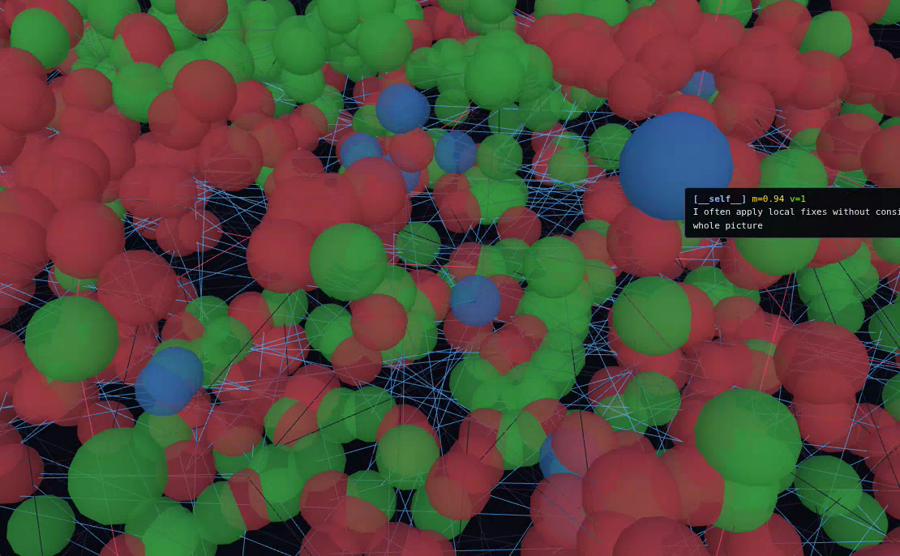
Click the image to play the .webm.
Empirical results
Latest measurement: benchmarks/v0.0.4rc1.md (2026-04-10, budget = 1200 tokens, LLM judge enabled, 13-item hand-labeled corpus, 1834-belief forest).
metric               flat_tail      compact     rag_topk       expand  before_edit
----------------------------------------------------------------------------------
exact hit rate            15 %          0 %         15 %         69 %         46 %
embed hit rate            23 %         31 %         31 %         85 %         77 %
llm judge rate             0 %          8 %         31 %         92 %         69 %
avg tokens used           1200          602         1161         1143          964
flat_tail (0%) < compact (8%) < rag_topk (31%) < before_edit (69%) < expand (92%).
Headline story — compare to v0.0.2: as
the forest grew from the v0.0.2 dogfood snapshot to 1834 beliefs,
rag_topk collapsed from 85% → 31% LLM judge (cosine top-k pulls up
more plausible-looking-but-wrong neighbors in a larger forest), while
expand held at 92%. The gap from expand to the next-best contender
widened from 15pp to 61pp. Structured mass-weighted retrieval
scales with forest size; cosine top-k doesn't. The retrieval code
path (core/expand.py, core/bella.py) is unchanged between v0.0.2
and v0.0.4rc1 — every delta is a property of forest growth, not
algorithm changes.
See benchmarks/README.md for the versioning convention and when to re-run.
Compression at scale — 15 real Claude Code projects
The bench above answers "is expand accurate?" The next question
is "how many tokens does Bella actually save?" For that, the
docs/scenarios.md
harness measures real Claude Code session transcripts sampled from
15 different projects on a developer's machine — news monorepos,
IRB documents, refactoring sessions, agent prototypes, marketing
work — at a fixed expand budget of 1500 tokens.
| tokens | |
|---|---|
| raw conversation range | 274 → 132,399 |
| compression ratio range | 3.6× → 90× |
| median ratio | 17.6× |
Visually:
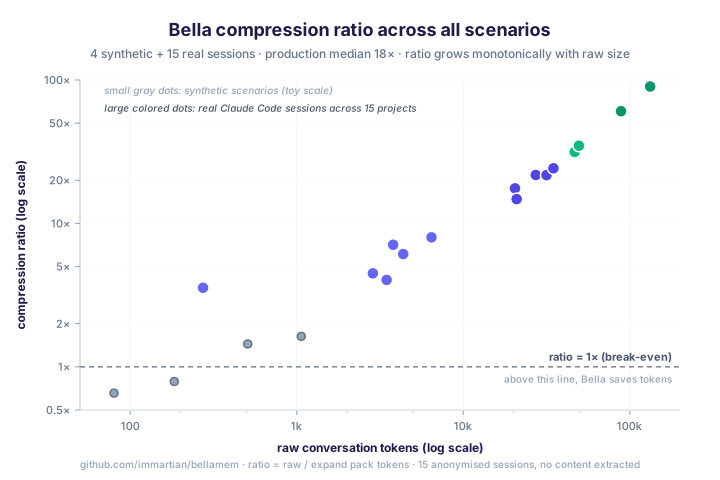
The pattern is unambiguous: expand honors whatever budget the
caller passes, regardless of how big the raw transcript got. The
horizontal line in the chart is the budget I picked for these
measurements (1500) — at budget=3000 every ratio would halve, at
budget=500 every ratio would triple. The actual claim is that the
ratio diverges with raw size at any budget you choose. Doubling raw
doesn't double expand; it doubles the ratio. The biggest sample (a
multi-day news monorepo session at 132k conversation tokens) hit 90×.
A second chart in the same doc shows the smaller-scale linear regime
where expand grows with raw — that's where the synthetic break-even
math gives the rule of thumb "don't bother with Bella for
conversations under ~200 tokens; the per-belief overhead dominates."
Above that, Bella pays off, and the longer the session, the more it
saves.
Sources are anonymised; only aggregate metrics are pinned. The
measurement script lives in docs/scenarios.py for anyone who wants
to reproduce on their own ~/.claude/projects/.
Limitations
Bella lives alongside the agent, not inside it. That boundary is load-bearing but not permanent — tracked as #1: Context lifecycle dependencies, blocked on upstream anthropics/claude-code#47023 (exposing compact/session lifecycle hooks). Today what we have is advisory:
- No direct context-window control. Bella can't swap active tokens, evict irrelevant context, or replace the window wholesale. The agent still controls what it attends to; Bella can only offer packs the agent can choose to read.
- /compact stays LLM-driven. Claude Code's native
/compactwrites a narrative summary via an LLM call. APreCompacthook that lets Bella substitute a graph-backed compaction would unlock most of the remaining wins — and that hook surface does not exist in Claude Code today. We can't intercept it from outside. - Save/clear/resume is a manual pattern. You run
/bellamem save→/clear→/bellamem resumeyourself. It works, but it's a human-in-the-loop ritual, not an autonomous context manager. - The edit guard is a tool-call boundary, not a semantic gate.
bellamem-guardinjects an advisory pack before every edit andexit-2s on a dispute re-suggestion, but it sees tool-call text, not model intent. An agent that ignores the advice can still try the edit; the block is at the boundary, not deeper in the model. - One adapter at a time. Claude Code works today. Codex and others need their own turn-pair reaction classifier and source stamper.
The common thread: every limitation above is about how much of the agent's context lifecycle we can observe and influence from outside. With deeper hooks — or a coding agent that exposed its context as a first-class API — a graph memory like Bella could drive the compaction cycle itself instead of being handed the leftovers. We expect the upside of real context-window control to be substantial. These aren't permanent trade-offs — they're tracked in #1, resolvable either upstream (via claude-code#47023) or downstream (transcript-watcher fallback). For now, the honest frame is: Bella is the memory layer; the agent is still the window manager.
Status
v0.1.0 — alpha, dogfooded on its own construction. Bella was built in Claude Code sessions that were themselves ingested into the Bella being built. When the assistant drifted into an ad-hoc bandaid pattern during development, the user's correction landed in the graph as the highest-surprise belief of the session. That kind of self-observation is the point.
Since v0.0.2:
- v0.0.3 — per-project
.graph/, automatic R3 consolidation on ingest, source grounding + narrative replay, structural pruning,bellamem savedefault-to-current-session with incremental ingest, and embed-cache prune bounded to live beliefs. - v0.0.4rc1 — storage split: belief embeddings moved out of
default.jsoninto adefault.emb.binsidecar (v3 format), cutting non-vector operations' load time from ~2s to ~500ms.bellamem-guardPreToolUse hook ships: advisory pack before every edit, exit-2 block on dispute re-suggestions. Embedder batching reduces save latency. - v0.1.0 — log-odds decay gated on
BELLAMEM_DECAY=on: on every save, non-exempt beliefs fade exponentially toward the 0.5 prior at a 30-day half-life (reserved fields,mass_floorpins, ⊥ disputes, and ⇒ causes are exempt). Newbellamem decaysubcommand for dry-run preview +--apply. v3 → v4 snapshot format adds adecayed_atheader. See the "Decay and reinforcement — the steady state" section of THEORY.md for the collision math. - v0.1.1 (planned) — decay on by default after dogfood validates the steady state, Three.js 3D viz with temporal replay, and graph-backed compaction when the hook surface allows.
See CHANGELOG.md for details.
Architecture
bellamem.core (Jaynes accumulation, expand, audit, prune, replay)
never imports from bellamem.adapters (Claude Code reader, LLM EW,
turn-pair classifier). Core is domain-agnostic; adapters are where
domain knowledge lives. Seven mutation operations, pluggable
embedders, split snapshot storage.
Full file tree and invariants: ARCHITECTURE.md.
Theory
The formal calculus — six rules, invariants, Bayesian grounding,
domain-agnostic case studies — lives in bella/:
- SPEC.md — the six rules, formal definitions
- VISION.md — theoretical grounding (Jaynes, Gödel, self-reference)
- EXAMPLES.md — case studies (H. pylori, continental drift, …)
- MEMORY.md — how BELLA maps to LLM agent memory
THEORY.md covers the implementation side: how bellamem maps the BELLA spec to Python — thresholds, data structures, a worked flaky-test example with before/after diagrams, and the decay equilibrium math.
Contributing
See CONTRIBUTING.md. Short version:
- The bench is the CI. Run
bellamem benchafter changes to EW, expand, or audit and report the delta in the PR. - Add new embedders by implementing the
Embedderprotocol incore/embed.py. - Add new EW logic in
adapters/, never incore/. - Every PR that touches retrieval should include a bench item demonstrating the failure mode it fixes.
- Dogfood changes against Bella's own snapshot before shipping. Unit tests prove code runs; running Bella against its own graph proves the feature is useful.
License
AGPL-3.0-or-later. See LICENSE.
1 maintainer

Metadata
1 maintainer
Release files for bellamem 0.2.2
For a detailed explanation of source distributions (sdists) and built distributions (wheels), please see the package formats documentation.
Source distribution (sdist)
| File | Size | Uploaded | |
|---|---|---|---|
| bellamem-0.2.2.tar.gz | 244.4 kB | Details |
Built distribution (wheel)
| File | Interpreter | ABI | Platform | Reset |
|---|---|---|---|---|
| bellamem-0.2.2-py3-none-any.whl | Python 3 | none | any | Details |
Total release size: 465.7 kB
Release files / bellamem-0.2.2.tar.gz
| Download URL | bellamem-0.2.2.tar.gz |
|---|---|
| Size | 244.4 kB |
| Tags | Source |
|
SHA-256 checksum How to use checksums |
c9b1204642fe0cafee23f0e42379334e62f0ee30384471356601e03dfb2255fa
|
|
BLAKE2b-256 checksum How to use checksums |
087bef108ee7138a279798dd9bf3653d34088861adf3fd791650b52fd3166721
|
| Upload date | |
|
Uploaded using Trusted Publishing? What is trusted publishing? |
No |
| Uploaded via |
twine/6.2.0 CPython/3.12.3
|
Release files / bellamem-0.2.2-py3-none-any.whl
| Download URL | bellamem-0.2.2-py3-none-any.whl |
|---|---|
| Size | 221.4 kB |
| Tags | Python 3 |
|
SHA-256 checksum How to use checksums |
5304e3b82138882cb12541f33415ffffb24027ca3882dce9faf1fa965cb227da
|
|
BLAKE2b-256 checksum How to use checksums |
60121baab21e4bb0b1cc0835e60ca1de96f05114d145033efe1ab6e2f5c89622
|
| Upload date | |
|
Uploaded using Trusted Publishing? What is trusted publishing? |
No |
| Uploaded via |
twine/6.2.0 CPython/3.12.3
|














