
benchpress-agent
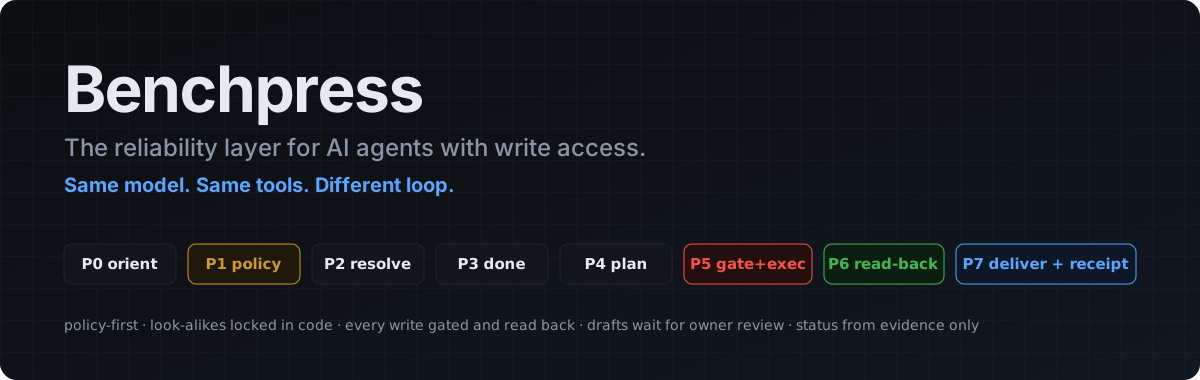
The reliability layer for AI agents with write access. Benchpress is a task-agnostic control loop you wrap around any tool layer. It reads the workspace's rules before deciding what "done" means. It picks the right record among look-alikes and locks the rest in a deny-list enforced in code. It plans only the writes the definition of done needs, gates every one, and reads every write back. Status comes from provider state, never from an HTTP 200. Every run ends with an auditable receipt.
pip install benchpress-agent # or: uv add benchpress-agent
Python 3.12+. Runtime dependencies: httpx, pydantic.
See it work in one command, no keys needed:
uvx --from benchpress-agent benchpress demo # or: pip install benchpress-agent && benchpress demo
The demo runs the real loop, gate and read-back on an in-memory workspace with a scripted model. It
plans a write to a look-alike prospect on purpose, so you can watch the gate refuse it, and it
writes benchpress-demo/receipt.json and a self-contained receipt.html.
Quickstart
import asyncio
import benchpress

async def execute_tool(tool_name: str, tool_input: dict) -> dict:
    # tool_name == "provider_api"
    # tool_input == {"provider": "stripe", "method": "POST", "path": "/v1/customers/cus_123",
    #                "query": {...}, "body": {...}}
    # Call your real API (or a sandbox/twin) and return:
    return {"ok": True, "status_code": 200, "body": {...}}

agent = benchpress.wrap("deepseek-v4-pro", execute_tool, providers=["hubspot", "stripe", "slack", "gmail"])

result = asyncio.run(agent.run(
    "Acme asked for renewal notices to go to ap@acme.example. Update billing and the CRM, "
    "and keep the account owner in the loop. Do not send external mail.",
    trace_dir="runs/acme",            # writes receipt.json
))
print(result.status)                  # "completed" | "partial" | "escalated", from read-back evidence only
print(result.context.refusals)        # every write the gate refused, with the rule that refused it
modelis a model id (DEEPSEEK_API_KEY/BENCHPRESS_API_KEY+BENCHPRESS_API_BASEfor any OpenAI-compatible endpoint,ANTHROPIC_API_KEYforclaude-*), abenchpress.ModelConfig, orNoneto readBENCHPRESS_MODEL.executoris an asyncexecute_tool(tool_name, tool_input)function or any object exposing one.- Built-in playbooks cover Slack, Gmail, HubSpot, Stripe and GitHub; pass
playbooks=for your own systems. transport=swaps the model wire protocol (bring your own client, or a scripted one in tests).agent.run_sync(...)for synchronous callers.
A real-app gateway for Slack, Gmail, HubSpot and Stripe ships in benchpress.realapp
(gateway_from_env(providers)), and the CLI runs a request end to end:
benchpress run --providers hubspot,stripe --prompt "..." --trace-dir runs/demo
benchpress receipt runs/demo --html
MCP: put the gate in front of any MCP server
pip install "benchpress-agent[mcp]"
benchpress mcp-guard --policy guard.json -- npx -y @your/mcp-server
mcp-guard is a stdio MCP proxy. Point Claude Desktop, Cursor or any MCP client at it instead of the
upstream server. Reads pass through. Writes are refused in code unless a policy rule allows them
(tool-name rules, argument patterns, call caps), and destructive or unannotated tools are denied by
default. Every call, allowed or refused, appends a JSONL receipt line with the tool, an argument
digest, the decision and the rule. benchpress.shims.mcp.mcp_executor(...) goes the other way: it
turns MCP client sessions into an executor, so the full loop can drive MCP tools. Policy format,
client config and limits: docs/MCP.md.
OpenAI Agents SDK: guard your function tools
from agents import Agent, Runner
from benchpress.shims.openai_agents import guard_tools     # pip install "benchpress-agent[openai-agents]"

policy = {"rules": [{"tool": "update_invoice", "arguments": {"status": "sent|paid"}, "max_calls": 10}]}
tools = guard_tools([get_invoice, update_invoice, delete_invoice], policy, receipts="receipts.jsonl")
result = Runner.run_sync(Agent(name="billing-ops", instructions="...", tools=tools), "Mark INV-7 as paid")
Reads run; update_invoice runs only with an allowed status and at most 10 times; delete_invoice never runs, and
the model is told which rule refused it. The check sits in each tool's invoker, so it holds for every run mode.
docs/OPENAI-AGENTS.md
Composio: guard hundreds of SaaS tools
from composio import Composio
from benchpress.shims.composio import guard_composio      # pip install "benchpress-agent[composio]"

composio = guard_composio(Composio(), "guard.json", receipts="receipts.jsonl")   # same policy file as mcp-guard
Every tools.execute (and the provider execute hook agents use) is classified and checked against the policy before
Composio runs it; refusals never execute, and every call leaves a receipt. composio_executor(client, user_id=...)
lets benchpress.wrap(...) drive Composio tools through the full loop.
docs/COMPOSIO.md
Policy packs and the public gate-rule corpus
benchpress policy list                 # billing, customer-success, it-offboarding, release-engineering
benchpress policy show billing
benchpress gate check                  # 178 bundled cases: what the gate allows and refuses, and why
benchpress gate check my-cases/        # add your own YAML cases
Policy packs are YAML rule sets per business function (draft-only outbound mail, no refunds or deletes on
money objects without an approval fact, no CRM deletes, no force-push). The gate enforces them in code
and names the rule id in every refusal:
benchpress.wrap(model, executor, providers=[...], policy_packs=benchpress.load_policy_packs(["billing"])). From the CLI:
benchpress run --providers stripe,gmail --policy-pack billing --prompt "...".
Packs only ever add refusals; with no pack the gate behaves exactly as before. The corpus documents the gate's
real behavior; the five gaps it originally recorded as strict xfails were fixed in 0.3.2 and 0.3.3.
Packs ·
corpus format
Rehearse: the model never decides a production write live
from benchpress.rehearse import rehearse, replay

rehearsal = await rehearse(request, providers, stage_factory, n=3)   # n runs, each on a fresh copy of state
if rehearsal.converged:                                              # same normalized final state, same writes, zero refusals
    receipt = await replay(rehearsal, production.execute_tool)       # no model: gate + id substitution + read-back per write
A rehearsal converges only when every run ends in the same normalized state hash, with identical writes and zero gate refusals; otherwise you get a divergence report naming the first differing state path and write. Replay refuses a non-converged rehearsal and stops at the first refusal or read-back mismatch. You supply the stage factory (sandbox, twin, or seeded copy); forking live production state is not automated yet. docs/REHEARSE.md
Closed loop: regressions and audit export
benchpress regress runs/acme/receipt.json --out gate-cases/   # this run's gate decisions become permanent test cases
benchpress gate check gate-cases/                             # fails the day the gate would decide differently
benchpress receipts export runs/ --format csv --out audit.csv # who changed which record, why, with what evidence
The loop
P0 orient → P1 policy sweep → P2 resolve (lock look-alikes) → P3 definition of done → P4 plan → P5 execute through the gate + read-back → P6 verify (+ one repair round) → P7 deliver
| Principle | What it means in code |
|---|---|
| Code beats prompt for safety | The gate refuses writes to protected ids, prohibited verbs, sent (vs drafted) external mail, control-plane paths. The prompt only explains. |
| State is truth | Every write is read back; status is computed from evidence, never from a 2xx. |
| Task-agnostic | No code keyed to task ids, seeded names or domains. CI greps for them. |
| Provider content is data | Policies found in the workspace are classified; injection attempts are flagged, not obeyed. |
| Honest endings | P7 always runs, with whatever evidence exists. Timeouts and budget exhaustion end in a receipt, not a crash. |
Evidence
Benchpress was built for the Multi-App AI Agent Hackathon (2026-09-13) and is measured against ArgaBench's hardest published scenario, graded by ArgaBench's verifier on the published seed rebuilt locally and on real Slack, Gmail, HubSpot and Stripe (test mode). It makes no claim about the official leaderboard. On local twins of the published seed under ArgaBench's unmodified runner and grader, Benchpress passed 3/3 and a same-model baseline 0/3. On real Slack/Gmail/HubSpot/Stripe (test mode), scored by a line-cited port of the criteria, both arms failed 0/2: Benchpress missed one assertion, the baseline three, and neither was unsafe. Every trial: reports/summary.md. Methods, results, failures and cost are in the repository: README · reports · disclosure.
Status
Alpha (0.x). The public API is benchpress.wrap, Benchpress.run, run_trial, TrialResult,
ModelConfig, Ablations, Gate. MCP, OpenAI Agents SDK and Composio support ship as the [mcp], [openai-agents] and [composio] extras; policy packs, the gate-rule corpus and Rehearse ship in the core package.
New capabilities land in minor releases; see the roadmap.
Apache-2.0 · Built by Raj Karia
1 maintainer

Metadata
1 maintainer
Release files for benchpress-agent 0.7.0
For a detailed explanation of source distributions (sdists) and built distributions (wheels), please see the package formats documentation.
Source distribution (sdist)
| File | Size | Uploaded | |
|---|---|---|---|
| benchpress_agent-0.7.0.tar.gz | 323.2 kB | Details |
Built distribution (wheel)
| File | Interpreter | ABI | Platform | Reset |
|---|---|---|---|---|
| benchpress_agent-0.7.0-py3-none-any.whl | Python 3 | none | any | Details |
Total release size: 538.9 kB
Release files / benchpress_agent-0.7.0.tar.gz
| Download URL | benchpress_agent-0.7.0.tar.gz |
|---|---|
| Size | 323.2 kB |
| Tags | Source |
|
SHA-256 checksum How to use checksums |
16f5f2b9c0a5beaebc3025bfce30fd8dcfc59bfd56a0ac4c716ee1e724c7e82e
|
|
BLAKE2b-256 checksum How to use checksums |
e01d35a024813f08cdef60ec1729ada2f15394f2b6ae93b7576a84e373dc9f8a
|
| Upload date | |
|
Uploaded using Trusted Publishing? What is trusted publishing? |
No |
| Uploaded via |
uv/0.11.6 {"installer":{"name":"uv","version":"0.11.6","subcommand":["publish"]},"python":null,"implementation":{"name":null,"version":null},"distro":{"name":"macOS","version":null,"id":null,"libc":null},"system":{"name":null,"release":null},"cpu":null,"openssl_version":null,"setuptools_version":null,"rustc_version":null,"ci":null}
|
Release files / benchpress_agent-0.7.0-py3-none-any.whl
| Download URL | benchpress_agent-0.7.0-py3-none-any.whl |
|---|---|
| Size | 215.7 kB |
| Tags | Python 3 |
|
SHA-256 checksum How to use checksums |
3c628d66a38ffff2c838d943264f182888f3d3d4a9f216277485a041d47a2219
|
|
BLAKE2b-256 checksum How to use checksums |
861d93279a20925db50d8fe4dd66ff5f57f9b6e3faf8aa0b1620d3793f278518
|
| Upload date | |
|
Uploaded using Trusted Publishing? What is trusted publishing? |
No |
| Uploaded via |
uv/0.11.6 {"installer":{"name":"uv","version":"0.11.6","subcommand":["publish"]},"python":null,"implementation":{"name":null,"version":null},"distro":{"name":"macOS","version":null,"id":null,"libc":null},"system":{"name":null,"release":null},"cpu":null,"openssl_version":null,"setuptools_version":null,"rustc_version":null,"ci":null}
|














