
This release has been yanked by its maintainers, and will be ignored by installers, except when explicitly specified.
Consider using release 1.1.7 instead.

INTERLACE AI
Best-of-N
Sample a frozen model N times, and find out whether selection is your problem




pip install bestofn
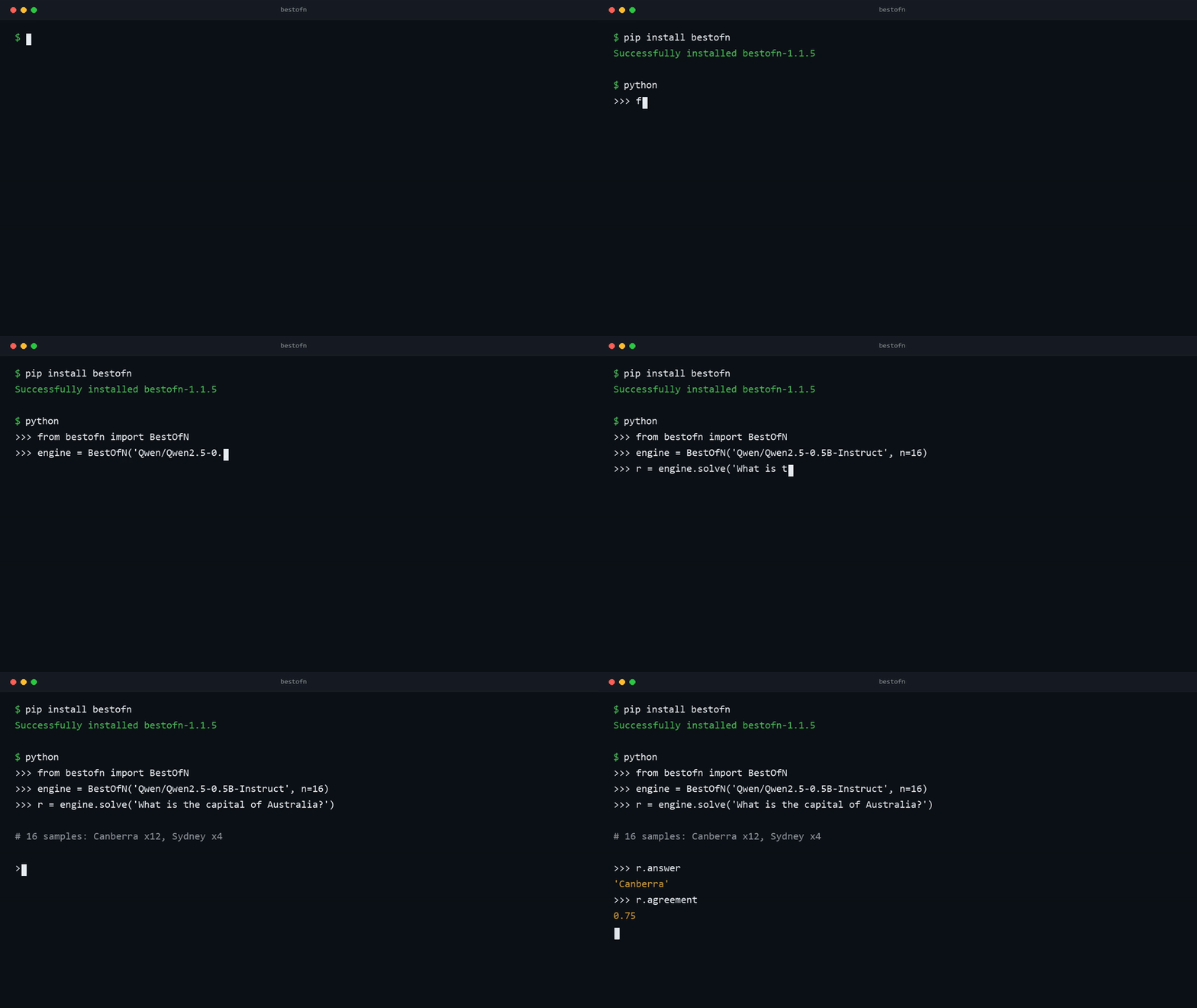
The question this answers
Your small model gets a problem wrong. There are two possible reasons, and they need opposite fixes:
- It never knew the answer. Sampling more will not help. You need a different model.
- It found the answer and you didn't return it. Sampling more will help, and so will a better way of choosing.
Most tooling cannot tell you which one you are looking at. This library measures both halves separately, on your own task, and tells you which:
from bestofn import BestOfN

engine = BestOfN("Qwen/Qwen2.5-0.5B-Instruct", n=16)
r = engine.solve(problem)

r.answer            # what the system returns
r.is_correct(gold)  # did it match? (equivalence-aware, unlike ==)
r.covered(gold)     # whether any of the 16 trajectories found it
r.effective_n       # how many actually voted -- often fewer than you paid for
| returned | reachable | Diagnosis | Fix |
|---|---|---|---|
| ✗ | ✗ | Generation problem | Better model or prompt. More samples will not help |
| ✗ | ✓ | Selection problem | A verifier can recover it |
| ✓ | ✓ | Working | Ask whether you need this much N |
Everything else in this library exists to make those three numbers trustworthy.
Quickstart
from bestofn import BestOfN

engine = BestOfN("Qwen/Qwen2.5-0.5B-Instruct", n=16)
r = engine.solve("A train travels at 60 km/h for 3 hours. How far does it go?")

r.answer          # '180'
r.agreement       # 0.81   how much the voters agreed
r.effective_n     # 13     how many of the 16 produced a usable answer
r.n_truncated     # 3      how many ran out of tokens
Works with any causal LM, at any N:
BestOfN("deepseek-ai/DeepSeek-R1-Distill-Qwen-1.5B", n=32)
BestOfN("meta-llama/Llama-3.1-8B-Instruct", n=16)
BestOfN("/path/to/your/local/model", n=64)
Measured results
Qwen2.5-0.5B-Instruct on GSM8K, 200 problems, 16 trajectories each,
weights frozen, one RTX 3060. Every figure below is recomputed from the
published trajectories by scripts/analyse.py, which re-runs extraction over
the raw reasoning text.
| N | random | majority | 95% CI | coverage |
|---|---|---|---|---|
| 1 | 36.1% | 36.1% | [31.0, 44.0] | 36.1% |
| 2 | 40.4% | 40.6% | [30.5, 44.0] | 47.2% |
| 4 | 42.4% | 47.1% | [39.0, 52.5] | 57.3% |
| 8 | 43.2% | 52.8% | [48.5, 62.0] | 66.8% |
| 16 | 43.5% | 54.8% | [49.0, 62.5] | 74.5% |

Majority voting at N=16: 54.8%. Against random selection at the same N, exact McNemar gives p = 4.2 × 10⁻⁷ — majority wins on 32 problems where random loses, and loses on 3.
Where the gain actually comes from
This is the part most reports leave out, and it changes how the headline should be read:
| N=1, a single sample | 36.1% | |
| N=16, random among the trajectories that answered | 43.5% | +7.3 |
| N=16, majority vote | 54.8% | +11.3 |
| +18.7 total |
Random selection improves with N without selecting anything, because with more trajectories there is almost always one that did not abstain. Of the 18.7 points, 7.4 are simply avoiding abstention and only 11.3 come from voting.
Comparing a single-sample baseline against an N-sample system counts the first part as if it were method. It is not, and this library reports the two separately.
The accounting nobody publishes
| Trajectories generated | 3,200 |
| Cast a vote | 2,281 — 71.3% |
| Abstained | 919 — 28.7% |
| Truncated at the token limit | 768 — 24.0% |
| Tokens generated | 985,545 |
| Re-extraction drift on replay | 0 |
Effective N is 11.4, not 16. Nearly a third of the compute produced nothing usable. In version 1.0.0 those 919 trajectories voted anyway, with whatever number happened to appear last in an unfinished chain of thought.
Coverage at N=16 is 74.5% against 54.8% returned. Some of that 19.7-point distance is a selection problem a verifier could attack; some of it is single correct answers among sixteen, which no selector can identify without the label.
The habit this library tries to build
Compare every selector against random.
r = engine.solve(problem, n=16)

r.select_with("random", seed=0)     # the baseline
r.select_with("majority")           # is it actually better?
Re-running a selector over an existing result costs nothing — generation is the expensive part. And a selector that cannot beat picking a trajectory at random is not selecting: it is adding noise, and it should be removed rather than tuned.
This matters more than it sounds. Published implementations of confidence-based
selection routinely land below the random baseline on small models, because
mean token log-probability rewards fluent, repetitive text — which correlates
with being cut off mid-reasoning, not with being right. random is one line
and it catches that immediately.
| Method | Needs | What it is for |
|---|---|---|
random |
nothing | The baseline. Print it every time |
majority |
nothing | The sensible default |
self_certainty |
logprobs=True |
Fluency, not correctness. Verify before trusting |
verifier |
a verifier callable | The only one that can promote a minority answer |
verifier_argmax |
a verifier callable | Single best trajectory, no vote |
oracle |
the gold answer | Diagnostic ceiling only |
Using a reward model
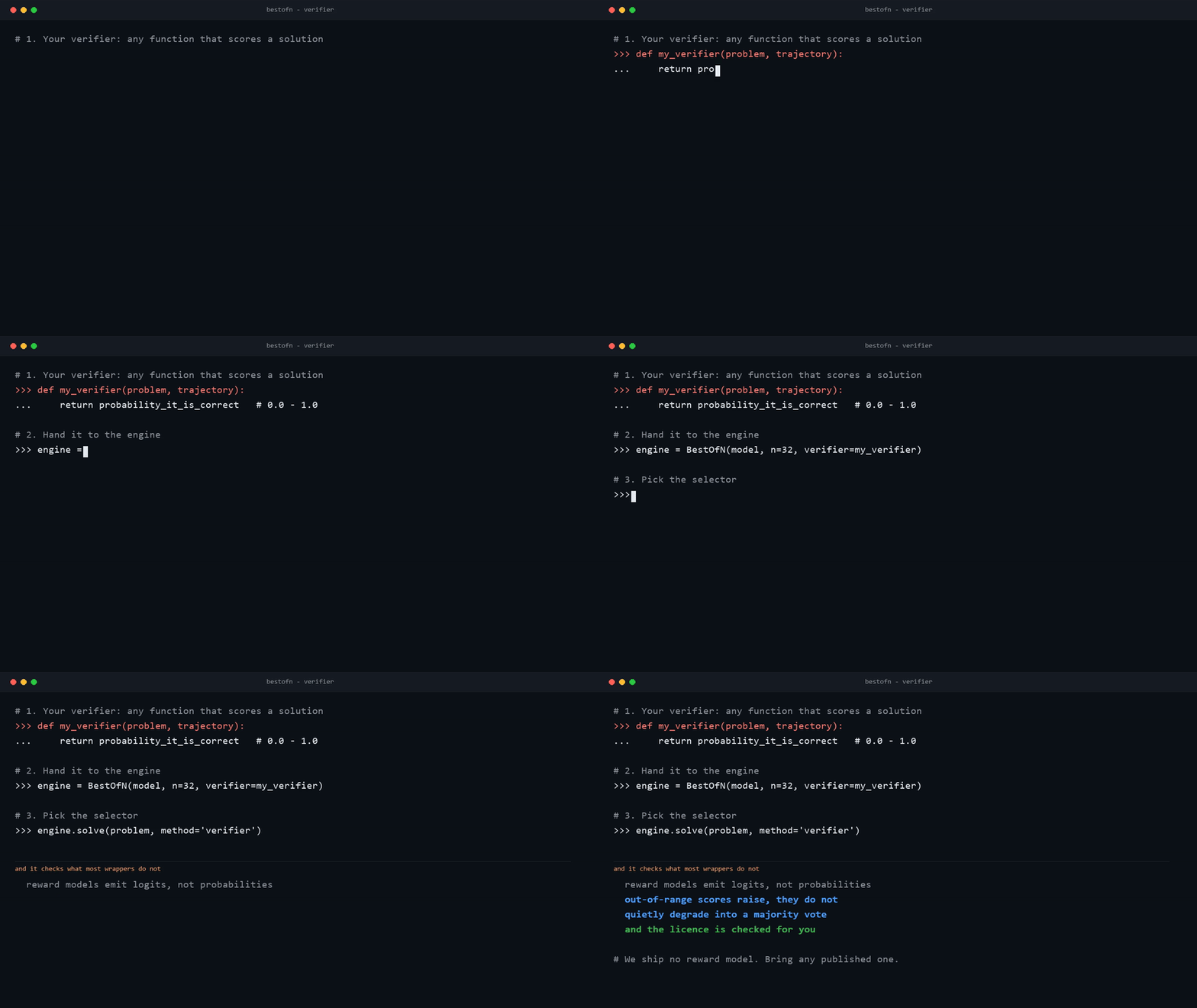
This project does not ship a reward model. It works with published ones, and it makes them work correctly:
from bestofn import BestOfN
from bestofn.verifiers import from_hub

verifier = from_hub("openbmb/Eurus-RM-7b")          # Apache-2.0
engine = BestOfN("your/model", n=16, verifier=verifier)
engine.solve(problem, method="verifier")
Reward models emit unbounded logits, not probabilities, and weighting a vote
by -3.7 is meaningless. Passing raw logits raises a clear error instead of
silently degrading to a majority vote — which is what a naive implementation
does, leaving you convinced you are running your verifier when you are not.
Licences are not uniform and they govern how you may use the scores. from_hub
warns on anything non-permissive, and verifiers.license_of(model_id) checks
the Hub live. See USAGE.md for the
table.
Worth knowing before you invest in one: no small discriminative reward model is known to work well.
Skywork-o1-Open-PRM-1.5Bscores below chance on PRMBench in its own published evaluation. Measure any verifier againstrandomon your task before trusting it.
What it does not do
- It cannot invent knowledge. If the model never reaches the answer,
1 − (1−p)^Nis zero for every N. Checkcovered()before spending compute. - Coverage is not headroom. The gap between coverage and accuracy looks like available improvement, but the problems sustaining its tail are single correct answers among N — never the mode, and indistinguishable from noise without the label. Some of that gap is structurally unreachable.
- Cost is linear in N. N=128 means 128 generations. This is compute traded for accuracy, deliberately, and the trade is only worth it when your GPU would otherwise be idle.
- It is not for open-ended text. There is no well-defined vote over an essay.
n=2is a waste. No majority exists with two trajectories; ties break arbitrarily. Start at 8.
Reproducing every number here
python scripts/analyse.py # no GPU needed
The published trajectory file contains the complete reasoning text of every
sample, with finish_reason, log-probabilities and token counts — not answers
that were extracted earlier. analyse.py re-runs extraction over that raw text,
so if extraction breaks, the numbers move and the check fails.
That distinction is the point. A replay that re-counts pre-extracted answers cannot detect an extraction bug, and extraction is where these systems actually go wrong.
To regenerate from scratch:
python scripts/run_gsm8k.py # ~3 hours on an RTX 3060
Built on existing work
Inference-time compute is one of the most active areas in the field, and this sits inside it rather than beside it:
- Cobbe et al., Training Verifiers to Solve Math Word Problems, 2021 — verifier reranking of N samples
- Wang et al., Self-Consistency Improves Chain of Thought Reasoning, 2022 — majority voting
- Lightman et al., Let's Verify Step by Step, 2023 — process vs outcome supervision
- Snell et al., Scaling LLM Test-Time Compute Optimally, 2024 — compute versus parameters
- Brown et al., Large Language Monkeys, 2024 — coverage scaling with repeated sampling
Related tooling worth knowing about, because you may want it instead:
lighteval has pass@k, maj@n
and avg@n as first-class metrics if you need evaluation rather than
inference; its_hub
implements a wider set of search strategies including particle filtering and
beam search.
What this adds: the selection layer the serving stacks deliberately leave out
(vLLM removed best_of in 2025, SGLang discourages n>1, LMDeploy supports
only 1), a single small API over six interchangeable selectors, and the raw
trajectories behind every published number.
Citation
@software{arecesrivera2026bestofn,
  title  = {Best-of-N: inference-time compute for language models},
  author = {Areces Rivera, Alejandro},
  year   = {2026},
  doi    = {10.5281/zenodo.21936832},
  url    = {https://github.com/voidlinestudios12-jpg/Interlace-AI}
}
License
Apache License 2.0 — free to use, modify and redistribute, including commercially.
Copyright 2026 Alejandro Areces Rivera — Interlace AI
Questions and collaboration: interlaceIA@gmail.com
Changes in this release: CHANGELOG.md
1 maintainer

Metadata
1 maintainer
Release files for bestofn 1.1.1
For a detailed explanation of source distributions (sdists) and built distributions (wheels), please see the package formats documentation.
Source distribution (sdist)
| File | Size | Uploaded | |
|---|---|---|---|
| bestofn-1.1.1.tar.gz | 39.8 kB | Details |
Built distribution (wheel)
| File | Interpreter | ABI | Platform | Reset |
|---|---|---|---|---|
| bestofn-1.1.1-py3-none-any.whl | Python 3 | none | any | Details |
Total release size: 77.2 kB
Release files / bestofn-1.1.1.tar.gz
| Download URL | bestofn-1.1.1.tar.gz |
|---|---|
| Size | 39.8 kB |
| Tags | Source |
|
SHA-256 checksum How to use checksums |
d73d5775a389c423e43ff81ce06fa46edb35bfc778302c46c3aee9a1ca15d46a
|
|
BLAKE2b-256 checksum How to use checksums |
f779a1fa2c3d5c4f86efefdac991df05bbf4e1393fd49bdb346e295217b32e03
|
| Upload date | |
|
Uploaded using Trusted Publishing? What is trusted publishing? |
No |
| Uploaded via |
twine/7.0.0 CPython/3.14.2
|
Release files / bestofn-1.1.1-py3-none-any.whl
| Download URL | bestofn-1.1.1-py3-none-any.whl |
|---|---|
| Size | 37.4 kB |
| Tags | Python 3 |
|
SHA-256 checksum How to use checksums |
0e55f2008b7876d52e430694953906ebbc1901b1877424faced4300636964df7
|
|
BLAKE2b-256 checksum How to use checksums |
f420975f82c5e99297b9eeb862db112de219158f8ac6a3a84f78d8134abc1b8b
|
| Upload date | |
|
Uploaded using Trusted Publishing? What is trusted publishing? |
No |
| Uploaded via |
twine/7.0.0 CPython/3.14.2
|














