

betaSieve
EPICv2 probe designs analysis
betaSieve is a Python package that identifies HumanMethylationEPIC v2.0 BeadChip (EPICv2) probes that exhibit high variability between measurements of different probe designs. To do so, the package evaluates probe design agreement by analyzing β-value differences for each (CpG site, sample) pair.
Why should I care?
EPICv2 can measure the same CpG site with several probe designs. Those designs appear as separate IlmnID rows, and we observed that their β-values can disagree for the same sample.
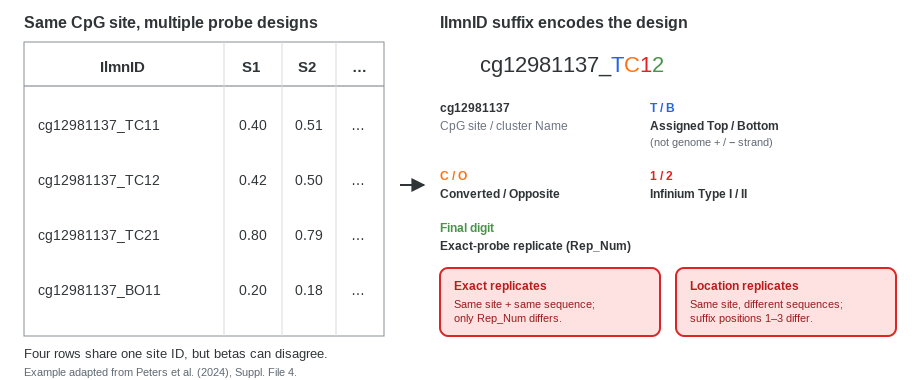
IlmnID naming and replicate definitions adapted from Peters et al. (2024), BMC Genomics 25:251, and Supplementary File 4 (doi:10.1186/s12864-024-10027-5).
betaSieve finds sites where design disagreement is larger than expected from exact technical replicates. It can thus may help to refine downstream analyses.
Please have a look at the wiki for a more detailed explanation of the background and theory behind this package.
Features
- Analysis of EPICv2 IlmnIDs with different probe designs.
- Optional threshold sweep across user-defined absolute β-value differences.
- Cohort-specific calibration against exact technical replicates.
- Empirical upper-tail testing with multiple-testing correction.
- An HTML report comparing empirical, binomial, and β-binomial null distributions.
- Identification of highly variable candidate IlmnIDs that can be reviewed for masking.
Method overview
Probe-design groups
betaSieve parses EPICv2 IlmnIDs and classifies duplicate measurements into:
- Pair type: two designs from the same chemistry family (
TC1/TC2orBC1/BC2); - Pair design: any other CpG site with exactly two design types;
- Triplet: three design types;
- Quadruplet: four design types;
- Exact replicates: repeated measurements using the same design.
These categories are not mutually exclusive. A CpG site can contribute both a design-comparison row and an exact-replicate row.
Max-min differences and threshold calibration
For every CpG site-sample pair, betaSieve calculates the max-min β-value difference across the probes in the relevant group. Given a threshold $t$, an exceedance is recorded when this difference is strictly greater than $t$.
The empirical background exceedance rate is
$$ p_0 = \frac{\text{exact-replicate CpG site-sample pairs with difference}>t} {\text{all exact-replicate CpG site-sample pairs}}. $$
When a threshold sweep is requested, betaSieve selects the smallest evaluated threshold for which $p_0$ is less than or equal to target_p0. If none of the evaluated thresholds reaches the target, it selects the threshold with the smallest observed $p_0$.
CpG site level exceedance rate
For CpG site $i$, betaSieve calculates
$$ \hat p_i = \frac{\text{number of samples with difference}>t} {\text{number of samples}}. $$
The primary empirical upper-tail p-value compares $\hat p_i$ with the observed exact-replicate reference distribution. Then, multiple-testing correction is applied across non-exact-replicate comparisons, and p_empir_adj_flagged is the current primary flag.
Installation
From GitHub
pip install betasieve
Dependencies are installed automatically.
Quick Start
Python API
In-memory analysis
For an in-memory pandas DataFrame:
import pandas as pd
from betasieve import SieveConfig, sieve_betas

betas = pd.read_csv("betas.csv", index_col="IlmnID")
config = SieveConfig(
    threshold_min=0.03,
    threshold_max=0.07,
    threshold_step=0.01,
)

results = sieve_betas(betas, config)

print(f"Threshold: {results.threshold}")
print(f"Candidates: {len(results.candidate_cpgs)}")
Or load the same matrix with epicv2-io, which keeps cg rows only and directly assigns the index column:
from epicv2io import BetasLoader
from betasieve import SieveConfig, sieve_betas

betas = BetasLoader("betas.csv").load_data()
config = SieveConfig(
    threshold_min=0.03,
    threshold_max=0.07,
    threshold_step=0.01,
)

results = sieve_betas(betas, config)
load_data() also accepts optional manifest filters such as
exclude_sex_chromosomes=True or exclude_mismatch_pos=True.
sieve_betas validates that the DataFrame has unique EPICv2 IlmnIDs in its
index, unique sample columns, numeric beta values in [0, 1], and the
probe groups required by the statistical model. Missing or infinite beta values
produce a warning. It performs no file or report output.
File-based pipeline
To load the beta matrix and write configured outputs through the file-based pipeline:
from pathlib import Path
from betasieve import SieveConfig, PipelineConfig, run_sieve_pipeline

config = PipelineConfig(
    betas_path=Path("betas.csv"),
    analysis=SieveConfig(threshold=0.05),
)
results = run_sieve_pipeline(config)
run_sieve_pipeline loads betas_path, calls sieve_betas, and optionally writes
CSV files, a pickle, and an HTML report. Disable all output while retaining
file loading with:
config = PipelineConfig(
    betas_path=Path("betas.csv"),
    analysis=SieveConfig(threshold=0.05),
    csv_files=False,
    report=False,
    pkl=False,
)
results = run_sieve_pipeline(config)
Command Line
betasieve \
  --betas-path betas.csv \
  --analysis.threshold-min 0.03 \
  --analysis.threshold-max 0.07 \
  --analysis.threshold-step 0.01
Run betasieve --help for the full list of options.
Citation
If you use betaSieve in published work, please cite:
Streicher M. betaSieve. GitHub repository. 2026.
For EPICv2 probe naming and replicate definitions (as used in the overview figure above), please also cite:
Peters TJ, Meyer B, Ryan L, Achinger-Kawecka J, Song J, Campbell EM, Qu W, Nair S, Loi-Luu P, Stricker P, Lim E, Stirzaker C, Clark SJ, Pidsley R. Characterisation and reproducibility of the HumanMethylationEPIC v2.0 BeadChip for DNA methylation profiling. BMC Genomics. 2024;25:251. https://doi.org/10.1186/s12864-024-10027-5
License
BSD 3-Clause License (see [LICENSE](LICENSE)).
Parameters
Statistical settings belong to SieveConfig. The file-based pipeline wraps
that configuration in PipelineConfig, which additionally controls input and
output paths. The command-line interface is generated from those dataclasses
with tyro, so every field is available as an
option: PipelineConfig fields are top level (--betas-path, --out-dir) and
SieveConfig fields are prefixed (--analysis.threshold, --analysis.fdr).
Required Parameters
betas_path
Path to the input β-value matrix.
Expected format:
- Rows correspond to CpG probes.
- Columns correspond to samples.
- Values must be beta values between 0 and 1.
Example:
betas_path=Path("betas.csv")
Threshold Selection
betaSieve requires either:
- A fixed threshold (
threshold) - An automatic threshold search (
threshold_min,threshold_max,threshold_step)
threshold
Fixed β-value max-min threshold. A CpG site-sample observation is an exceedance when its difference is strictly greater than this value.
difference:
(0, 1]
Example:
threshold=0.05
threshold_min
Minimum threshold evaluated during automatic threshold search.
Example:
threshold_min=0.03
threshold_max
Maximum threshold evaluated during automatic threshold search.
Example:
threshold_max=0.07
threshold_step
Increment between tested thresholds.
Example:
threshold_step=0.01
The above configuration evaluates:
0.03, 0.04, 0.05, 0.06, 0.07
Statistical Parameters
fdr
Method used for multiple-testing correction. Despite the parameter name, the supported choices include both false-discovery-rate and family-wise-error-rate procedures. betaSieve passes the selected method to [statsmodels.stats.multitest.multipletests](https://www.statsmodels.org/stable/generated/statsmodels.stats.multitest.multipletests.html).
Default:
fdr="fdr_bh"
Available methods (as supported by statsmodels.stats.multitest.multipletests):
| Method | Description |
|---|---|
| bonferroni | Bonferroni correction |
| sidak | Sidak correction |
| holm-sidak | Holm-Sidak procedure |
| holm | Holm procedure |
| simes-hochberg | Simes-Hochberg procedure |
| hommel | Hommel procedure |
| fdr_bh | Benjamini-Hochberg FDR |
| fdr_by | Benjamini-Yekutieli FDR |
| fdr_tsbh | Two-stage Benjamini-Hochberg |
| fdr_tsbky | Two-stage Benjamini-Krieger-Yekutieli |
confidence
Defines the testing level as alpha = 1 - confidence and supplies the normal quantile used by the Wilson calculation. With the default value of 0.95, the implementation uses a one-sided 95% lower-bound criterion.
Default:
confidence=0.95
target_p0
Target empirical background exceedance rate used during automatic threshold selection. It is not itself a CpG site-level false-positive rate.
Default:
target_p0=0.05
Set this parameter through the Python API or with the command-line option --analysis.target-p0.
Output Parameters
out_dir
Root directory for enabled file outputs. No output directory is created when
csv_files, report, and pkl are all disabled.
Default:
out_dir=Path("results")
Generated structure:
results/
├── csv/
├── figures/
├── report/
└── pkl/
csv_files
Write CpG site-level statistics, candidate CpGs, and—when applicable—the threshold sweep summary as CSV files.
Default:
csv_files=True
Disable CSV output:
csv_files=False
report
Generate an HTML summary report.
Default:
report=True
Disable report generation:
report=False
pkl
Save intermediate Python objects as pickle files.
Default:
pkl=False
Examples
Fixed Threshold
config = PipelineConfig(
    betas_path=Path("betas.csv"),
    analysis=SieveConfig(threshold=0.05),
)
Automatic Threshold Search
config = PipelineConfig(
    betas_path=Path("betas.csv"),
    analysis=SieveConfig(
        threshold_min=0.03,
        threshold_max=0.07,
        threshold_step=0.01,
        target_p0=0.05,
    ),
)
Outputs
Both sieve_betas and run_sieve_pipeline return a SieveResults object.
The file-based pipeline additionally writes selected fields to disk.
SieveResults
| Field | Content |
|---|---|
threshold |
Applied max–min β-value threshold $t$. |
diff_frame |
Per CpG site, per-sample max–min ranges, plus the design group. |
statistics_frame |
Site-level exceedance rates, p-values, and confidence intervals at $t$. |
flagged_frame |
statistics_frame plus boolean flag columns. The primary flag is p_empir_adj_flagged. |
candidate_cpgs |
IlmnIDs of all probes at sites with p_empir_adj_flagged=True. |
sieved_betas |
Copy of the input β-value matrix with candidate_cpgs removed. The original file is not modified. |
null_models |
Empirical, binomial, and beta-binomial null models fitted from exact replicates. Used in the HTML report; they do not determine the candidate list. |
sweep_df |
Per-group flagging rates at each candidate threshold. None when $t$ was set directly. |
Principal statistical columns
These columns live on flagged_frame (and therefore in min_max_difference_{threshold}.csv):
above_threshold: number of samples whose max–min difference exceeds $t$;p_hat: CpG site-level sample exceedance rate;p0: pooled exact-replicate background exceedance rate;p_empir: empirical upper-tail p-value;p_empir_adj: multiple-testing-adjusted empirical p-value;p_empir_adj_flagged: primary discordance flag.
Files
By default, run_sieve_pipeline writes:
results/csv/min_max_difference_{threshold}.csv:flagged_frame;results/csv/candidate_cpgs.csv:candidate_cpgs;results/csv/threshold_sweep_summary.csv:sweep_df, when a sweep was performed;results/report.html: interactive analysis and null-model diagnostics.
Set pkl=True to also pickle PipelineConfig and SieveResults under results/pkl/.
sieved_betas is returned in memory only; it is not written as a CSV.
Statistical considerations
- The empirical test assumes that exact-replicate sites provide an appropriate reference distribution for non-replicate design comparisons.
- The current implementation assumes a complete sample matrix; missing β-values require careful preprocessing.
1 maintainer

Metadata
1 maintainer
Release files for betasieve 1.0.1
For a detailed explanation of source distributions (sdists) and built distributions (wheels), please see the package formats documentation.
Source distribution (sdist)
| File | Size | Uploaded | Provenance | Actions |
|---|---|---|---|---|
| betasieve-1.0.1.tar.gz | 2.2 MB | With provenance | Details for betasieve-1.0.1.tar.gz |
Built distribution (wheel)
| File | Interpreter | ABI | Platform | Actions Reset |
|---|---|---|---|---|
| betasieve-1.0.1-py3-none-any.whl | Python 3 | none | any | Details for betasieve-1.0.1-py3-none-any.whl |
Total release size: 4.3 MB
Release files / betasieve-1.0.1.tar.gz
| Download URL | betasieve-1.0.1.tar.gz |
|---|---|
| Size | 2.2 MB |
| Tags | Source |
|
SHA-256 checksum How to use checksums |
57b40f820beca5165dacb8e97818368b437ae0e60dbb31e8da84eb8c14de6a9a
|
|
BLAKE2b-256 checksum How to use checksums |
dac9ab1a1b491fbb73c975bab51ba20f7edb2068d6e0d13599c5004aee3742c8
|
| Upload date | |
|
Uploaded using Trusted Publishing? What is trusted publishing? |
Yes |
| Uploaded via |
twine/7.0.0 CPython/3.13.16
|
Provenance
Provenance describes where a file came from. On PyPI, provenance is shared via attestations, which provide a verifiable record of the build or publishing details. View details, limitations and caveats.


PyPI Publish Attestation
PyPI verified that this artifact, at this checksum, originated from the publisher listed below.
Signed by GitHub Actions, verified by PyPI on Oct 30, 2026.
Transparency logRelease files / betasieve-1.0.1-py3-none-any.whl
| Download URL | betasieve-1.0.1-py3-none-any.whl |
|---|---|
| Size | 2.1 MB |
| Tags | Python 3 |
|
SHA-256 checksum How to use checksums |
e62ca6b2bb224c4cf6082310e92869d4cfec7f061777d06c063df1899c72b54f
|
|
BLAKE2b-256 checksum How to use checksums |
98a8214fdbd984b490b460d6b59329fce5cc5cd846fa3e1db0e94e3a363cf4ac
|
| Upload date | |
|
Uploaded using Trusted Publishing? What is trusted publishing? |
Yes |
| Uploaded via |
twine/7.0.0 CPython/3.13.16
|
Provenance
Provenance describes where a file came from. On PyPI, provenance is shared via attestations, which provide a verifiable record of the build or publishing details. View details, limitations and caveats.
PyPI Publish Attestation
PyPI verified that this artifact, at this checksum, originated from the publisher listed below.
Signed by GitHub Actions, verified by PyPI on Oct 30, 2026.
Transparency logSecurity for betasieve 1.0.1
Provenance
Provenance describes where a file came from. On PyPI, provenance is shared via attestations, which provide a verifiable record of the build or publishing details. View details, limitations and caveats.
Full provenance
Both files in this release have been uploaded with provenance metadata.
Attestation for betasieve-1.0.1.tar.gz
PyPI Publish Attestation
PyPI verified that this artifact, at this checksum, originated from the publisher listed below.
Signed by GitHub Actions, verified by PyPI on Oct 30, 2026.
Transparency logA note on package security
PyPI is a repository for distributing packages, not a service for auditing them. While third-party security researchers and our staff do their best to detect and remove malicious packages, PyPI cannot guarantee the quality, security or suitability of any given package.
To learn more about protecting yourself from malicious actors, visit our package security documentation.














