
betterdb-semantic-cache




Semantic cache for AI workloads backed by Valkey vector search. Embeddings-based similarity matching with OpenTelemetry and Prometheus instrumentation.
See it live in BetterDB Monitor
BetterDB Monitor auto-discovers every betterdb-semantic-cache instance on your Valkey - zero configuration, the library already registers itself - and turns its stats into live dashboards:
- AI Cache & Memory - hit rate, cost saved, evictions, and index size across all your caches and memory stores, with history.
- AI Traces - OpenTelemetry waterfalls for each request, correlated with live Valkey state to explain every cache hit and miss.
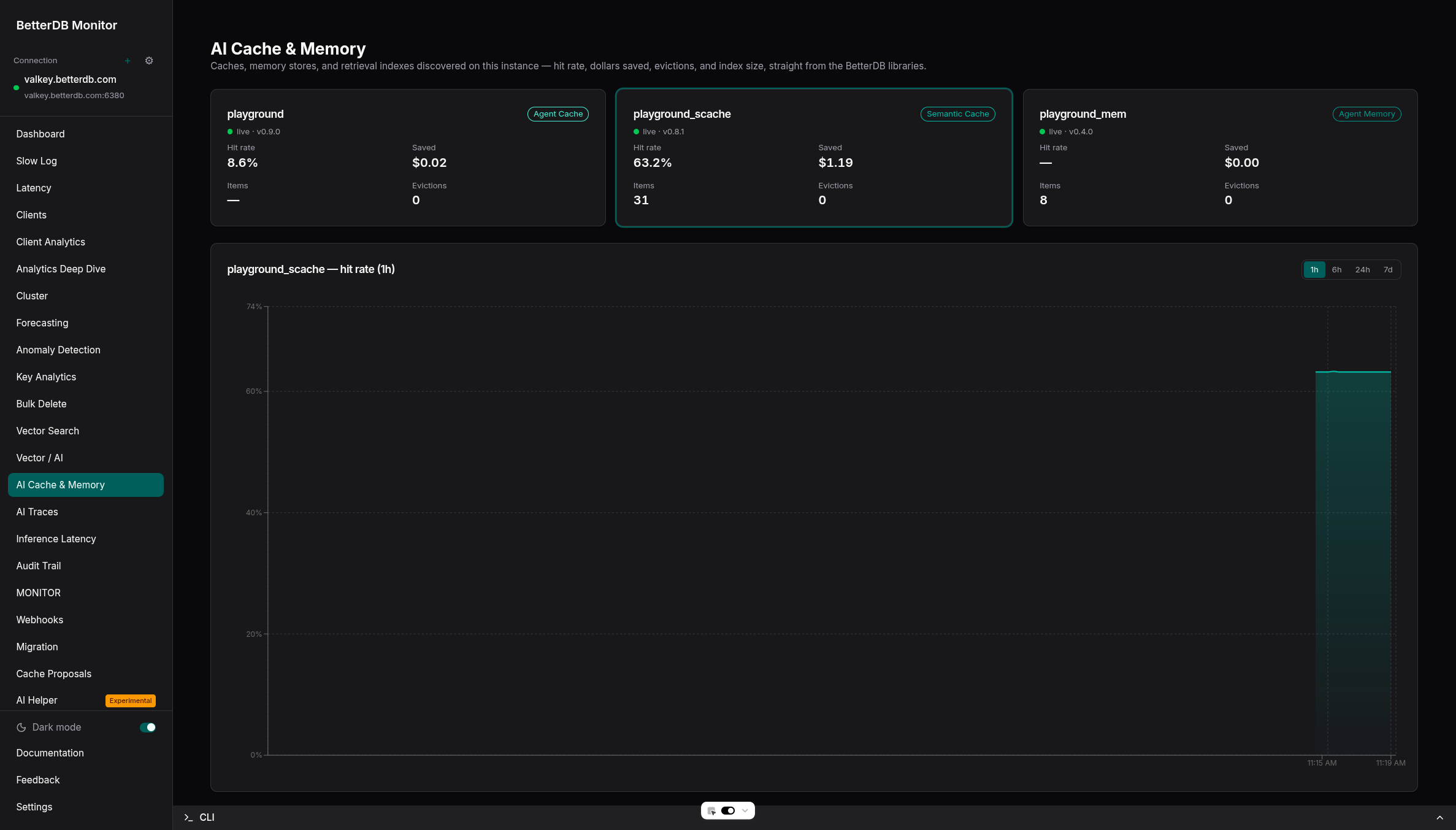
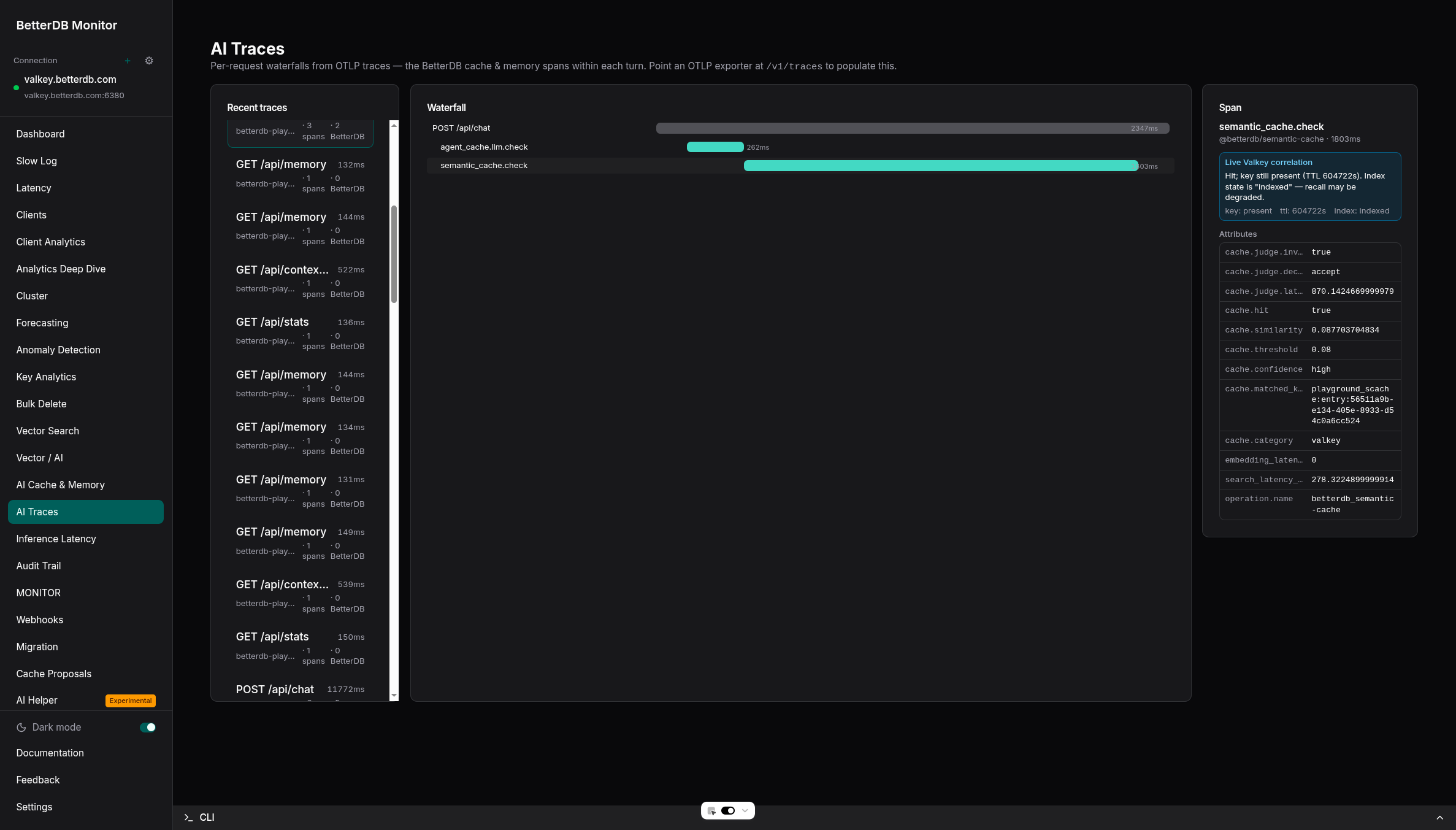
Run it self-hosted (docker run -p 3001:3001 betterdb/monitor), or use BetterDB Cloud - which can also provision a managed, TLS-enabled Valkey instance with the Search module in one click - exactly what this library needs.
Installation
pip install betterdb-semantic-cache
# With OpenAI embeddings:
pip install betterdb-semantic-cache[openai]
# All extras:
pip install betterdb-semantic-cache[all]
Quick start
import asyncio
import valkey.asyncio as valkey
from betterdb_semantic_cache import SemanticCache, SemanticCacheOptions
from betterdb_semantic_cache.embed.openai import create_openai_embed

async def main():
    client = valkey.Valkey(host="localhost", port=6399)
    cache = SemanticCache(SemanticCacheOptions(
        client=client,
        embed_fn=create_openai_embed(),
        default_threshold=0.12,
    ))
    await cache.initialize()

    result = await cache.check("What is the capital of France?")
    if not result.hit:
        await cache.store("What is the capital of France?", "Paris")

asyncio.run(main())
LLM-as-judge
When a hit lands in the uncertainty band (threshold - uncertainty_band < score <= threshold), you can supply a judge_fn to adjudicate automatically instead of handling confidence == 'uncertain' yourself.
from betterdb_semantic_cache import JudgeOptions
from betterdb_semantic_cache.types import CacheCheckOptions

result = await cache.check(user_prompt, CacheCheckOptions(
    judge=JudgeOptions(
        judge_fn=my_judge,
        on_error="accept",   # fail-open on judge errors (default)
        timeout_ms=2000,     # per-call timeout (default)
    )
))
A minimal OpenAI judge:
from openai import AsyncOpenAI

openai = AsyncOpenAI()

async def my_judge(inp: dict) -> bool:
    # Return True to accept (confidence → 'high')
    # Return False to reject (treated as miss with nearest_miss)
    verdict = await openai.chat.completions.create(
        model="gpt-4o-mini",
        messages=[
            {"role": "system", "content": "Reply YES or NO only."},
            {"role": "user", "content": (
                f"Does this cached response correctly answer the prompt?\n"
                f"Prompt: {inp['prompt']}\nResponse: {inp['response']}"
            )},
        ],
    )
    return (verdict.choices[0].message.content or "").startswith("YES")
When the judge is invoked: only for confidence == 'uncertain' hits. High-confidence hits, misses, and the zero-candidates case bypass the judge entirely.
Accept path: result.hit == True, result.confidence == 'high'.
Reject path: result.hit == False, result.nearest_miss populated with delta_to_threshold <= 0 (use this to distinguish judge rejections from regular misses where delta_to_threshold > 0).
Composing with rerank: when both rerank and judge are set, the judge receives the reranked pick's response and similarity score.
check_batch() does not support judge. Call check() individually for prompts that need adjudication.
CacheCheckOptions reference
| Option | Type | Default | Description |
|---|---|---|---|
threshold |
float |
default_threshold |
Per-request cosine distance threshold override |
category |
str |
"" |
Category tag for per-category thresholds and metric labels |
filter |
str |
None |
FT.SEARCH pre-filter expression (trusted input only) |
k |
int |
1 |
KNN neighbours to fetch (ignored when rerank is set) |
stale_after_model_change |
bool |
False |
Evict and miss when stored model differs from current_model |
current_model |
str |
None |
Model to compare against stored entries |
rerank |
RerankOptions |
None |
Rerank hook; see RerankOptions |
judge |
JudgeOptions |
None |
LLM-as-judge for borderline hits. Not supported by check_batch(); raises SemanticCacheUsageError |
Telemetry
The published wheel includes anonymous product analytics powered by PostHog. When a baked API key is present in the package (injected at publish time), aggregate usage statistics (hit rate, cost saved) are collected on a per-instance basis — no prompt text, responses, or personally-identifiable information is ever sent.
To opt out, set the environment variable before starting your process:
export BETTERDB_TELEMETRY=false # also accepts: 0, no, off
You can also disable it programmatically:
from betterdb_semantic_cache.types import AnalyticsOptions
cache = SemanticCache(SemanticCacheOptions(
    ...,
    analytics=AnalyticsOptions(disabled=True),
))
1 maintainer

Release files for betterdb-semantic-cache 0.11.0
For a detailed explanation of source distributions (sdists) and built distributions (wheels), please see the package formats documentation.
Source distribution (sdist)
| File | Size | Uploaded | |
|---|---|---|---|
| betterdb_semantic_cache-0.11.0.tar.gz | 108.9 kB | Details |
Built distribution (wheel)
| File | Interpreter | ABI | Platform | Reset |
|---|---|---|---|---|
| betterdb_semantic_cache-0.11.0-py3-none-any.whl | Python 3 | none | any | Details |
Total release size: 189.8 kB
Release files / betterdb_semantic_cache-0.11.0.tar.gz
| Download URL | betterdb_semantic_cache-0.11.0.tar.gz |
|---|---|
| Size | 108.9 kB |
| Tags | Source |
|
SHA-256 checksum How to use checksums |
9b70f82daa4d1939f298c0450141537df9a85964ab8cf7fb6fb5549b307b50e8
|
|
BLAKE2b-256 checksum How to use checksums |
91fab00a3bd999027c4cd05c98be3bcf019ab95b1f85cef9bac6e35e65b4d67d
|
| Upload date | |
|
Uploaded using Trusted Publishing? What is trusted publishing? |
Yes |
| Uploaded via |
twine/7.0.0 CPython/3.13.14
|
Provenance
Provenance describes where a file came from. On PyPI, provenance is shared via attestations, which provide a verifiable record of the build or publishing details. View details, limitations and caveats.


PyPI Publish Attestation
PyPI verified that this artifact, at this checksum, originated from the publisher listed below.
Signed by GitHub Actions, verified by PyPI on Aug 27, 2026.
Transparency logRelease files / betterdb_semantic_cache-0.11.0-py3-none-any.whl
| Download URL | betterdb_semantic_cache-0.11.0-py3-none-any.whl |
|---|---|
| Size | 80.9 kB |
| Tags | Python 3 |
|
SHA-256 checksum How to use checksums |
9344c59796dc6c2769a78c9ac4179ad891f7ec9544157120f3b116f4401494af
|
|
BLAKE2b-256 checksum How to use checksums |
177c0e345afbbaca2afdc9c60fc10afcb3a76a2c4855f96f5ada7551bf74c5f2
|
| Upload date | |
|
Uploaded using Trusted Publishing? What is trusted publishing? |
Yes |
| Uploaded via |
twine/7.0.0 CPython/3.13.14
|
Provenance
Provenance describes where a file came from. On PyPI, provenance is shared via attestations, which provide a verifiable record of the build or publishing details. View details, limitations and caveats.
PyPI Publish Attestation
PyPI verified that this artifact, at this checksum, originated from the publisher listed below.
Signed by GitHub Actions, verified by PyPI on Aug 27, 2026.
Transparency log













