
bezier_interpolation
bezier_interpolation is a Python library for generating smooth curves between given points using cubic Bezier or quadratic interpolation.
It solves a specific problem: Calculate the optimal control points between two data points to have smooth bezier curves.
It provides a simple and efficient way to calculate the control points and interpolate the data, making it ideal for applications in computer graphics, data visualization, and other fields where smooth curves are required.
Installation instructions
pip install bezier_interpolation
Usage
from bezier_interpolation import cubic_interpolation, quadratic_interpolation

c_data = {"x": [1, 2, 3], "y": [-1, -5, 3]}
c_data = list(zip(c_data["x"], c_data["y"]))
c_interpolated_data = cubic_interpolation(c_data)
print(c_interpolated_data)
# Returns: [[1, -1], [1.3, -3.3], [1.6 -5.6], [2, -5], [2.3, -4.3], [2.6, -0.6], [3, 3]]

q_data = [(1, 1), (2, 4), (3, 9)]
q_interpolated_data = quadratic_interpolation(q_data)
print(q_interpolated_data)
# Returns:  [[1, 1], [1.5, 2.5], [2, 4], [2.5, 5.5], [3, 9]]
Math explanation:
Cubic segments:
Let's say we have this 3 green points $P_{0,0}$, $P_{3,0} = P_{0,1}$ and $P_{3,1}$ and we want to have a smooth curve between them.
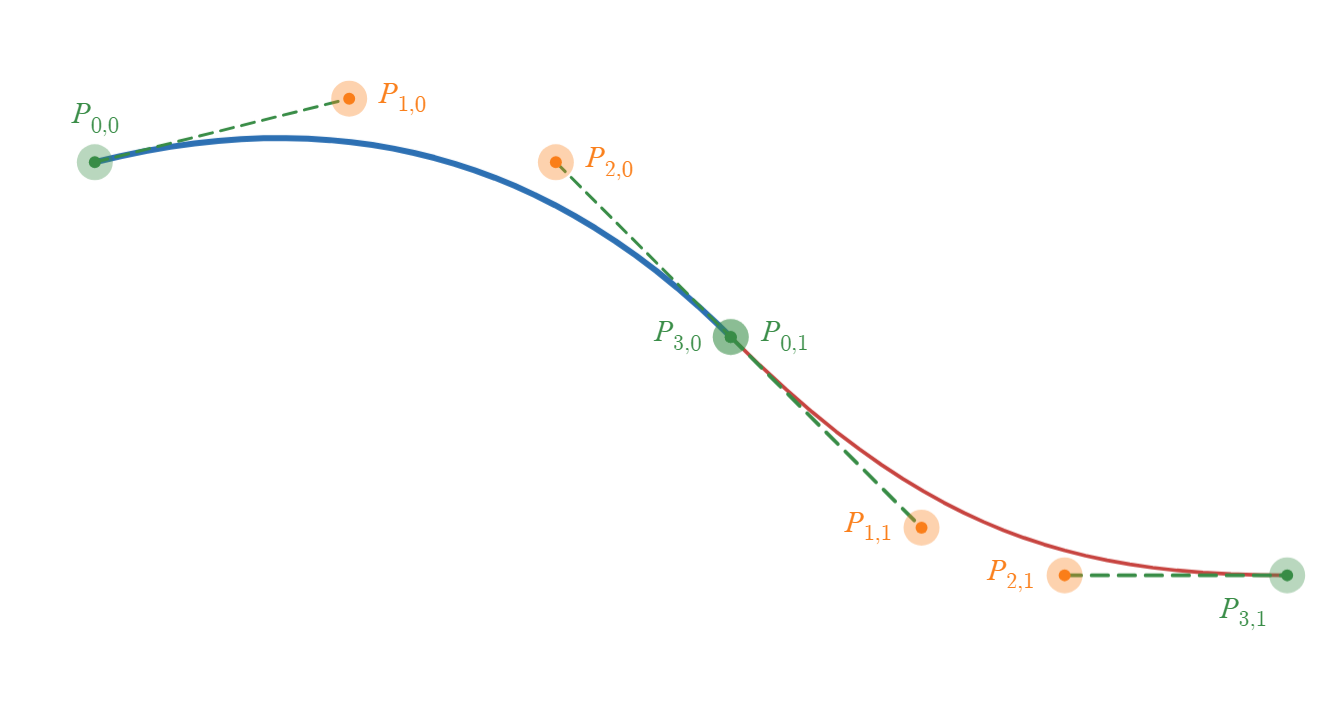
We need to find where to set the control points $P_{1,0}$, $P_{2,0}$, $P_{1,1}$ and $P_{2,1}$.
Here the first index represent the point and the second represent the segment.
In general we have n points, n - 1 segments, and we need to find $P_{1,i}$ and $P_{2,i}$ control points for i $\in [0, n - 1]$
For that we need to set two conditions:
- The last point in one segment $P_{3,i}$ is equal to the start point in the next segment $P_{0, i + 1}$.
- To get a smooth curve we need to make sure the slope of the line connecting $P_{2,0}$ and $P_{3,0}$ is the same as $P_{3,0}$ and $P_{0,1}$.
We can write the first condition as $$ \begin{align} P_{0,i} = P_{3,i - 1} = K_i \end{align} $$
For the second condition we are goint to use derivatives. The first derivative of any polynomial curve is the slope, so let's derivate the equation for a cubic Bezier curve:
$$ \begin{align} B(t) = (1 - t)^3 \cdot P_0 + 3(1 - t)^2t \cdot P_1 + 3(1 - t)t^2 \cdot P_2 + t^3 \cdot P_3 \end{align} $$
Ant its first derivative:
$$ \begin{align} B'(t) = 3(1 - t)^2 \cdot (P_1 - P_0) + 6(1 - t)t \cdot (P_2 - P_1) + 3t^2 \cdot (P_3 - P_2) \end{align} $$
By definition, if we replace $t = 0$ in $B(t)$ we get $B(0) = P_0$ and $B(1) = P_3$, so, to meet our condition we can write $$B'i(0) = B'{i-1}(1)$$
If we replace the values in the equation, we get:
$$-3P_{0,i} + 3P_{1, i} = -3 P_{2,i-1} + 3 P_{3, i-1}$$
And using the eq (1): $$ \begin{align} 2K_i = P_{1,i} + P_{2, i-1} \end{align} $$
We will now move to the second derivative. The second derivative tells us about the continuity of the curve. The second derivative of the bezier curve is:
$$ \begin{align} B''(t) = 6(1 - t) \cdot (P_2 - 2P_1 + P_0) + 6t \cdot (P_3 - 2P_2 + P_1) \end{align} $$
The second derivative talks about the continuity and concavity of the plot.
So, we can write:
$$B''i(0) = B''{i-1}(1)$$
If we substitute again we get: $$ -2P_{1,i} + P_{2,i} = P_{1, i - 1} - 2P_{2, i - 1} $$
Those equations only apply in the internal knots, when the segments come together. So, let's get the equations for the boundaries, this is, $i = 0$ and $i = n - 1$:
$$B''i(0) = 6P{0,0} - 12 P_{1,0} + 6P_{2,0} $$
$$ K_0 - 2P_{1,0} + P_{2,0} = 0 $$
and:
$$ P_{1,n-1} - P_{2,n-1} + K_n= 0 $$
now we have:
$$ 2P_{1,0} + P_{1,1} = K_0 + 2K_1 $$ $$ P_{1,i-1} + 4P_{1,i} + P_{1, i+1} = 4K_i + 2K_{i+1} $$ $$ 2P_{1,n-2} + P_{1,n-1} = 8K_{n-1} + K_n $$
With those equations we can set a matrix system with the form Ax -b = 0, when A is a tri-diagonal matrix with this form:
$$ \begin{bmatrix} 2 & 1 & 0 & 0 & \cdots & 0 \ 1 & 4 & 1 & 0 & \cdots & 0 \ 0 & 1 & 4 & 1 & \cdots & 0 \ \vdots & \vdots & \ddots & \ddots & \ddots & \vdots \ 0 & 0 & \cdots & 1 & 4 & 1 \ 0 & 0 & \cdots & 0 & 2 & 7 \end{bmatrix} $$
x is this vector: $$ \begin{bmatrix} P_{1,1} \ P_{1,2} \ P_{1,3} \ \vdots \ P_{1,n-2} \ P_{1, n-1} \end{bmatrix} $$
and b this one: $$ \begin{bmatrix} K_{0} + 2K_1 \ 4K_0 + 2K_1 \ 4K_1 + 2K_2 \ \vdots \ 4K_{n-2} + 2K_{n-1} \ 8K_{n-1} + K_{n} \end{bmatrix} $$
and if we solve this system, we can get $P_{2}$ with:
$$P_{2, i} = 2K_i + P_{1,i}$$ and $$P_{2, n-1} = (1/2)(K_n + P_{1,n-1})$$
Quadratic segments. Geometrical approach:
We could follow a process similar to the one we did above, but this one would be straightforward and it will have no dependency with t. We want to control the start angle, so let's try a geomterical approach.
Let's suppose we now want just one control point between two data points, so we have something like this
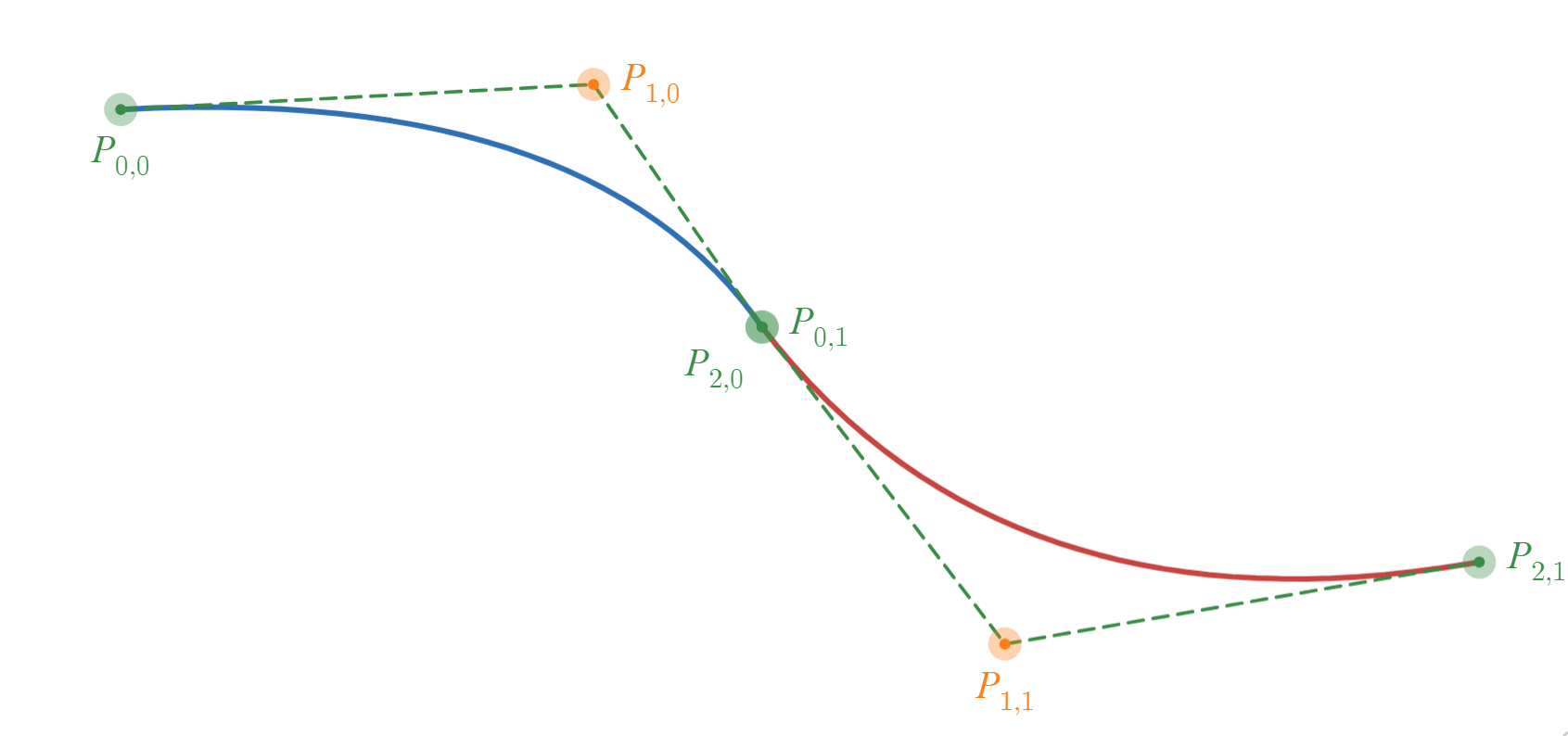
In general, we need $P_{1, i}$ align for $i \in 0,1,...,n-1$ when $n$ = number of data points, and $n-1$ is the number of segments.
We are going to set the first control point in the middle of $P_{0,0}$ and $P_{0,2}$, so, we can say for the midpoint formula:
$$ P_{0,1} = P_{0,0} + \frac{1}{2}(P_{0, 2} - P_{0,0}) $$
If we want to add the control parameter $t$, we can control the distance and relative altitude respect the last point, so we write
$$ P_{0,1} = P_{0,0} + t (P_{0, 2} - P_{0,0}) $$
Now that we have the first control point, we need to compute the line between $P_{0,1}$ and $P_{0,2}$ and set the next control point in that line.
We call the line between $P_{i,1}$ and $P_{i,2}$ $L_{i}$ which is defined by the equation $Y_i = m_i X_{i-1} + b_i$.
$Y_i$ is the $Y$ component of $P_{i,1}$ and $X_{i-1}$ is the $X$ component of $P_{i-1,1}$.
So, in general, for the next $n-2$ points we can write: $$m_i = \frac{Y_{i, 0} - Y_{i-1, 1}}{X_{i, 0} - X_{i-1, 1}}$$
$$b_i = Y_{i, 0} - m_i X_{i, 0} $$
and
$$X_{i,1} = X_{i,0} + \frac{1}{2}(x_{i,2} - X_{i,0})$$
$$Y_{i,1} = m_i X_{i,1} + b_i$$
wich are the X,Y components of the desired $P_{i,1}$ point respectively.
References:
1 maintainer

Metadata
1 maintainer
Release files for bezier-interpolation 0.0.2
For a detailed explanation of source distributions (sdists) and built distributions (wheels), please see the package formats documentation.
Source distribution (sdist)
| File | Size | Uploaded | Provenance | Actions |
|---|---|---|---|---|
| bezier-interpolation-0.0.2.tar.gz | 5.7 kB | Without provenance | Details for bezier-interpolation-0.0.2.tar.gz |
Built distribution (wheel)
| File | Interpreter | ABI | Platform | Actions Reset |
|---|---|---|---|---|
| bezier_interpolation-0.0.2-py3-none-any.whl | Python 3 | none | any | Details for bezier_interpolation-0.0.2-py3-none-any.whl |
Total release size: 12.2 kB
Release files / bezier-interpolation-0.0.2.tar.gz
| Download URL | bezier-interpolation-0.0.2.tar.gz |
|---|---|
| Size | 5.7 kB |
| Tags | Source |
|
SHA-256 checksum How to use checksums |
39f8a81bc7ed284eda729a1a938b307d9b8fdbba6fbb8cfc110f51c476e122c0
|
|
BLAKE2b-256 checksum How to use checksums |
2923ead45c909f8dd366d2a668e236a1081eaabd5421d72af5bd469deab904b5
|
| Upload date | |
|
Uploaded using Trusted Publishing? What is trusted publishing? |
No |
| Uploaded via |
twine/5.0.0 CPython/3.11.5
|
Release files / bezier_interpolation-0.0.2-py3-none-any.whl
| Download URL | bezier_interpolation-0.0.2-py3-none-any.whl |
|---|---|
| Size | 6.5 kB |
| Tags | Python 3 |
|
SHA-256 checksum How to use checksums |
1e28c9361750b59fc822a37043e05046be1c637df339e108c185a6bbc3171184
|
|
BLAKE2b-256 checksum How to use checksums |
a666c02e66998f0be9ff0ffcfe19ac2f21203789a74e410dcb187b34bc67b08e
|
| Upload date | |
|
Uploaded using Trusted Publishing? What is trusted publishing? |
No |
| Uploaded via |
twine/5.0.0 CPython/3.11.5
|
Security for bezier-interpolation 0.0.2
Provenance
Provenance describes where a file came from. On PyPI, provenance is shared via attestations, which provide a verifiable record of the build or publishing details. View details, limitations and caveats.
No provenance found
None of the files in this release were uploaded with provenance metadata.
A note on package security
PyPI is a repository for distributing packages, not a service for auditing them. While third-party security researchers and our staff do their best to detect and remove malicious packages, PyPI cannot guarantee the quality, security or suitability of any given package.
To learn more about protecting yourself from malicious actors, visit our package security documentation.














