

BiaPy: Accessible deep learning on bioimages











🔥NEWS🔥: BiaPy's paper is finally out in Nature Methods! Check it out at: https://www.nature.com/articles/s41592-025-02699-y
For those who have no access to Nature Methods, here is the preprint at bioRxiv: https://www.biorxiv.org/content/10.1101/2024.02.03.576026v3
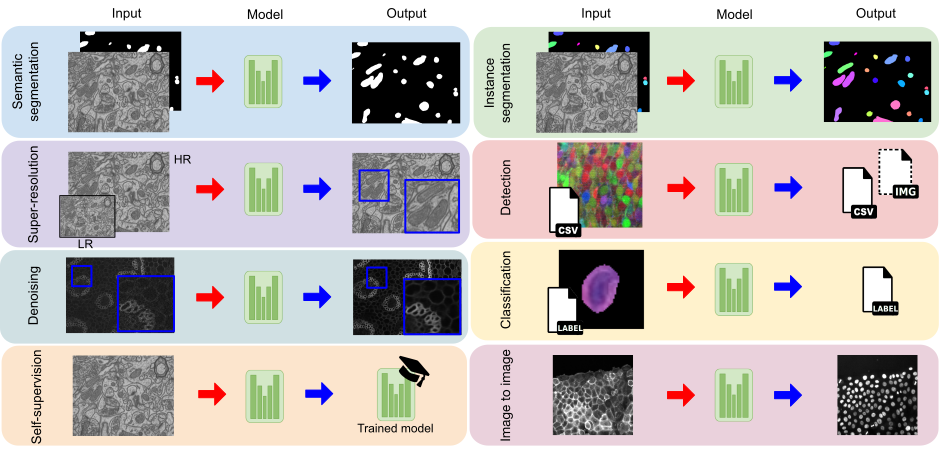
BiaPy is an open source library and application that streamlines the use of common deep-learning workflows for a large variety of bioimage analysis tasks, including 2D and 3D semantic segmentation, instance segmentation, object detection, image denoising, single image super-resolution, self-supervised learning, image classification and image to image translation.
BiaPy is a versatile platform designed to accommodate both proficient computer scientists and users less experienced in programming. It offers diverse and user-friendly access points to our workflows.
This repository is actively under development by the BiaPy Team, a group of contributors from different research institutions.
Description videos
Find a comprehensive overview of BiaPy and its functionality in the following videos:
 BiaPy history and GUI demo at RTmfm by Ignacio Arganda-Carreras and Daniel Franco-Barranco. |
|---|
 BiaPy presentation at Virtual Pub of Euro-BioImaging by Ignacio Arganda-Carreras. |
User interface
You can also use BiaPy through our graphical user interface (GUI).
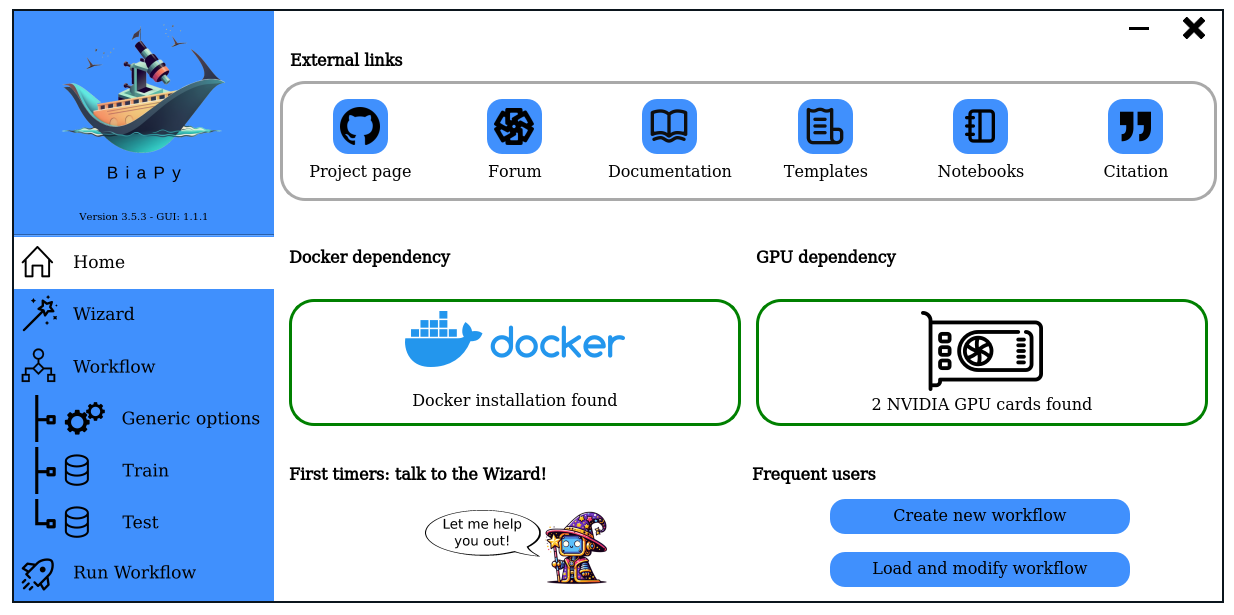
Download BiaPy GUI for you OS
Project's page: [BiaPy GUI]
Scientific publications using BiaPy
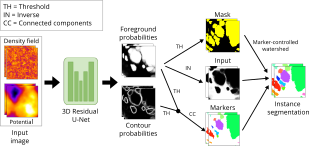
López-Cano, Daniel, et al. "Characterizing Structure Formation through Instance Segmentation" (2023). This study presents a machine-learning framework to predict the formation of dark matter haloes from early universe density perturbations. Utilizing two neural networks, it distinguishes particles comprising haloes and groups them by membership. The framework accurately predicts halo masses and shapes, and compares favorably with N-body simulations. The open-source model could enhance analytical methods of structure formation by analyzing initial condition variations. BiaPy is used in the creation of the watershed approach. [Documentation (not yet)] [Paper] |
 |
||
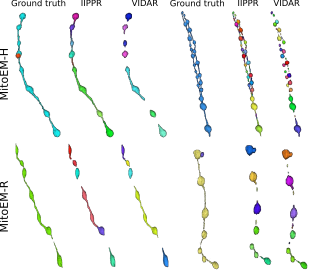
Franco-Barranco, Daniel, et al. "Current Progress and Challenges in Large-scale 3D Mitochondria Instance Segmentation." (2023). This paper reports the results of the MitoEM challenge on 3D instance segmentation of mitochondria in electron microscopy images, held in conjunction with IEEE-ISBI 2021. The paper discusses the top-performing methods, addresses ground truth errors, and proposes a new scoring system to improve segmentation evaluation. Despite progress, challenges remain in segmenting mitochondria with complex shapes, keeping the competition open for further submissions. BiaPy is used in the creation of the MitoEM challenge baseline (U2D-BC). [Documentation] [Paper] [Toolbox] |
 |
||
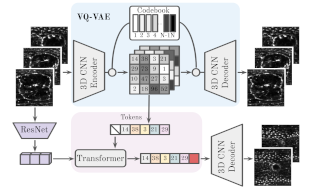
Backová, Lenka, et al. "Modeling Wound Healing Using Vector Quantized Variational Autoencoders and Transformers." 2023 IEEE 20th International Symposium on Biomedical Imaging (ISBI). IEEE, 2023. This study focuses on time-lapse sequences of Drosophila embryos healing from laser-incised wounds. The researchers employ a two-stage approach involving a vector quantized variational autoencoder and an autoregressive transformer to model wound healing as a video prediction task. BiaPy is used in the creation of the wound segmentation masks. [Documentation] [Paper] |
 |
||
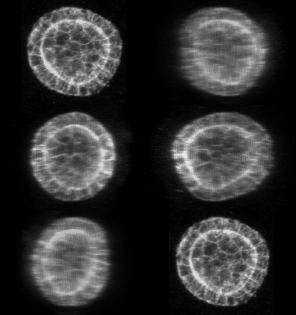
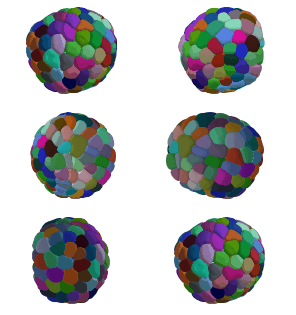
Andrés-San Román, Jesús A., et al. "CartoCell, a high-content pipeline for 3D image analysis, unveils cell morphology patterns in epithelia." Cell Reports Methods (2023) Combining deep learning and 3D imaging is crucial for high-content analysis. CartoCell is introduced, a method that accurately labels 3D epithelial cysts, enabling quantification of cellular features and mapping their distribution. It's adaptable to other epithelial tissues. CartoCell method is created using BiaPy. [Documentation] [Paper] |
|
||
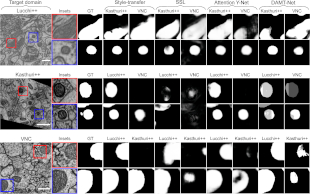
Franco-Barranco, Daniel, et al. "Deep learning based domain adaptation for mitochondria segmentation on EM volumes." Computer Methods and Programs in Biomedicine 222 (2022): 106949. This study addresses mitochondria segmentation across different datasets using three unsupervised domain adaptation approaches, including style transfer, self-supervised learning, and multi-task neural networks. To ensure robust generalization, a new training stopping criterion based on source domain morphological priors is proposed. BiaPy is used for the implementation of the Attention U-Net. [Documentation] [Paper] |
 |
||
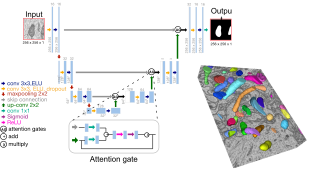
Franco-Barranco, Daniel, et al. "Stable deep neural network architectures for mitochondria segmentation on electron microscopy volumes." Neuroinformatics 20.2 (2022): 437-450. Recent deep learning models have shown impressive performance in mitochondria segmentation, but often lack code and training details, affecting reproducibility. This study follows best practices, comprehensively comparing state-of-the-art architectures and variations of U-Net models for mitochondria segmentation, revealing their impact and stability. The research consistently achieves state-of-the-art results on various datasets, including EPFL Hippocampus, Lucchi++, and Kasthuri++. BiaPy is used for the implementation of the methods compared in the study. [Documentation] [Paper] |
 |
||
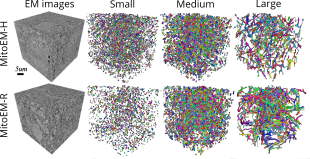
Wei, Donglai, et al. "Mitoem dataset: Large-scale 3d mitochondria instance segmentation from em images." International Conference on Medical Image Computing and Computer-Assisted Intervention. Cham: Springer International Publishing, 2020. Existing mitochondria segmentation datasets are small, raising questions about method robustness. The MitoEM dataset introduces larger 3D volumes with diverse mitochondria, challenging existing instance segmentation methods, highlighting the need for improved techniques. BiaPy is used in the creation of the MitoEM challenge baseline (U2D-BC). [Documentation] [Paper] [Challenge] |
 |
Authors
| Name | Role | Affiliations |
|---|---|---|
| Daniel Franco-Barranco | Creator, Implementation, Software design |
|
| Lenka Backová | Implementation |
|
| Aitor Gonzalez-Marfil | Implementation |
|
| Ignacio Arganda-Carreras | Supervision, Implementation |
|
| Arrate Muñoz-Barrutia | Supervision |
|
External collaborators
| Name | Role | Affiliations |
|---|---|---|
| Jesús Ángel Andrés-San Román | Implementation |
|
| Pedro Javier Gómez Gálvez | Supervision, Implementation |
|
| Luis M. Escudero | Supervision |
|
| Iván Hidalgo Cenalmor | Implementation |
|
| Donglai Wei | Supervision |
|
| Clément Caporal | Implementation |
|
| Anatole Chessel | Supervision |
|
Citation
Please note that BiaPy is based on a publication. If you use it successfully for your research please be so kind to cite our work:
Franco-Barranco, D., Andrés-San Román, J.A., Hidalgo-Cenalmor, I.,
Backová, L., González-Marfil, A., Caporal, C., Chessel, A., Gómez-Gálvez, P.,
Escudero, L.M., Wei, D., Muñoz-Barrutia, A. and Arganda-Carreras, I.
BiaPy: accessible deep learning on bioimages. Nat Methods 22, 1124–1126 (2025).
https://doi.org/10.1038/s41592-025-02699-y
1 maintainer

Metadata
1 maintainer
Release files for biapy 3.7.1
For a detailed explanation of source distributions (sdists) and built distributions (wheels), please see the package formats documentation.
Source distribution (sdist)
| File | Size | Uploaded | |
|---|---|---|---|
| biapy-3.7.1.tar.gz | 794.2 kB | Details |
Built distribution (wheel)
| File | Interpreter | ABI | Platform | Reset |
|---|---|---|---|---|
| biapy-3.7.1-py3-none-any.whl | Python 3 | none | any | Details |
Total release size: 1.7 MB
Release files / biapy-3.7.1.tar.gz
| Download URL | biapy-3.7.1.tar.gz |
|---|---|
| Size | 794.2 kB |
| Tags | Source |
|
SHA-256 checksum How to use checksums |
2ad31197469a5d638a99ac35fb341efc2b481f5c0e8221b20fcf810da910310a
|
|
BLAKE2b-256 checksum How to use checksums |
c5297d9c56ad412eb512be151368eed2bb7b749755ba31e5084e888976edd19c
|
| Upload date | |
|
Uploaded using Trusted Publishing? What is trusted publishing? |
Yes |
| Uploaded via |
twine/7.0.0 CPython/3.13.14
|
Provenance
Provenance describes where a file came from. On PyPI, provenance is shared via attestations, which provide a verifiable record of the build or publishing details. View details, limitations and caveats.


PyPI Publish Attestation
PyPI verified that this artifact, at this checksum, originated from the publisher listed below.
Signed by GitHub Actions, verified by PyPI on Sep 10, 2026.
Transparency logRelease files / biapy-3.7.1-py3-none-any.whl
| Download URL | biapy-3.7.1-py3-none-any.whl |
|---|---|
| Size | 878.2 kB |
| Tags | Python 3 |
|
SHA-256 checksum How to use checksums |
e727cec5adacb2ef58aa6d63ba6f9bd4935bda3ae9f8932a44f4bb8387cfebf0
|
|
BLAKE2b-256 checksum How to use checksums |
b277c40f1902d61c7be9dcd560701401c5ac7e0a6ec08bc3f2887c1134a3b1b2
|
| Upload date | |
|
Uploaded using Trusted Publishing? What is trusted publishing? |
Yes |
| Uploaded via |
twine/7.0.0 CPython/3.13.14
|
Provenance
Provenance describes where a file came from. On PyPI, provenance is shared via attestations, which provide a verifiable record of the build or publishing details. View details, limitations and caveats.
PyPI Publish Attestation
PyPI verified that this artifact, at this checksum, originated from the publisher listed below.
Signed by GitHub Actions, verified by PyPI on Sep 10, 2026.
Transparency log













