
A calculator to predict big-O of sorting functions

Project description
Table of Contents
Big-O Caculator
A big-O calculator to estimate time complexity of sorting functions.
inspired by : https://github.com/ismaelJimenez/cpp.leastsq
Installation
pip install big-O-calculator
What it does
You can test time complexity, calculate runtime, compare two sorting algorithms
Results may vary.
(n : [10, 100, 1_000, 10_000, 100_000])
Big-O calculator

Methods:
    def test(function, array="random", limit=True, prtResult=True):
        It will run only specified array test, returns Tuple[str, estimatedTime]

    def test_all(function):
        It will run all test cases, prints (best, average, worst cases), returns dict

    def runtime(function, array="random", size, epoch=1):
        It will simply returns execution time to sort length of size of test array, returns Tuple[float, List[Any]]

    def compare(function1, function2, array, size, epoch=3):
        It will compare two functions on {array} case, returns dict
Methods parameters
def test(**args):
    functionName [Callable]: a function to call.
    array [str]: "random", "big", "sorted", "reversed", "partial", "Ksorted", "string", "almost_equal", "equal", "hole".
    limit [bool] = True: To break before it takes "forever" to sort an array. (ex. selectionSort)
    prtResult [bool] = True: Whether to print result by itself

def test_all(**args):
    functionName [Callable]: a function to call.

def runtime(**args):
    functionName [Callable]: a function to call.
    array: "random", "big", "sorted", "partial", "reversed", "Ksorted" ,
        "hole", "equal", "almost_equal" or your custom array.
    size [int]: How big test array should be.
    epoch [int]: How many tests to run and calculte average.
    prtResult (bool): Whether to print the result by itself. (default = True)

def compare(**args):
    function1 [Callable]: a function to compare.
    function2 [Callable]: a function to compare.
    array [str]|[List]: "random", "big", "sorted", "partial", "reversed", "Ksorted",
        "hole", "equal", "almost_equal", "all" or your custom array.
    size [int]: How big test array should be.
Info: To see the result of function, return the array.
These methods will also check if the function sorts correctly.

"K" in Ksorted uses testSize.bit_length().
Usage
from bigO import bigO
from bigO import algorithm

lib = bigO()

lib.test(bubbleSort, "random")
lib.test_all(bubbleSort)
lib.runtime(bubbleSort, "random", 5000)
lib.runtime(algorithm.insertSort, "reversed", 32)
lib.compare(algorithm.insertSort, algorithm.bubbleSort, "all", 5000)
Quick Sort Example
from bigO import bigO
from random import randint

def quickSort(array):  # in-place | not-stable
    """
    Best : O(nlogn) Time | O(logn) Space
    Average : O(nlogn) Time | O(logn) Space
    Worst : O(n^2) Time | O(logn) Space
    """
    if len(array) <= 1:
        return array
    smaller, equal, larger = [], [], []
    pivot = array[randint(0, len(array) - 1)]
    for x in array:
        if x < pivot:
            smaller.append(x)
        elif x == pivot:
            equal.append(x)
        else:
            larger.append(x)
    return quickSort(smaller) + equal + quickSort(larger)


tester = bigO()
complexity, time = tester.test(quickSort, "random")
complexity, time = tester.test(quickSort, "sorted")
complexity, time = tester.test(quickSort, "reversed")
complexity, time = tester.test(quickSort, "partial")
complexity, time = tester.test(quickSort, "Ksorted")

''' Result
Running quickSort(random array)...
Completed quickSort(random array): O(nlog(n))
Time took: 0.35816s
Running quickSort(sorted array)...
Completed quickSort(sorted array): O(nlog(n))
Time took: 0.37821s
Running quickSort(reversed array)...
Completed quickSort(reversed array): O(nlog(n))
Time took: 0.38500s
Running quickSort(partial array)...
Completed quickSort(partial array): O(nlog(n))
Time took: 0.35820s
Running quickSort(Ksorted array)...
Completed quickSort(ksorted array): O(nlog(n))
Time took: 0.38140s
'''
Selection Sort Example
from bigO import bigO

def selectionSort(array):  # in-place, unstable
    '''
    Best : O(n^2) Time | O(1) Space
    Average : O(n^2) Time | O(1) Space
    Worst : O(n^2) Time | O(1) Space
    '''
    currentIdx = 0
    while currentIdx < len(array) - 1:
        smallestIdx = currentIdx
        for i in range(currentIdx + 1, len(array)):
            if array[smallestIdx] > array[i]:
                smallestIdx = i
        array[currentIdx], array[smallestIdx] = array[smallestIdx], array[currentIdx]
        currentIdx += 1
    return array


tester = bigO()
complexity, time = tester.test(selectionSort, "random")
complexity, time = tester.test(selectionSort, "sorted")
complexity, time = tester.test(selectionSort, "reversed")
complexity, time = tester.test(selectionSort, "partial")
complexity, time = tester.test(selectionSort, "Ksorted")

''' Result
Running selectionSort(random array)...
Completed selectionSort(random array): O(n^2)
Time took: 4.04027s
Running selectionSort(reversed array)...
Completed selectionSort(reversed array): O(n^2)
Time took: 4.04918s
Running selectionSort(sorted array)...
Completed selectionSort(sorted array): O(n^2)
Time took: 3.97238s
Running selectionSort(partial array)...
Completed selectionSort(partial array): O(n^2)
Time took: 4.02878s
Running selectionSort(Ksorted array)...
Completed selectionSort(ksorted array): O(n^2)
Time took: 4.05617s
'''
test_all(mySort) Example
We can test all "random", "sorted", "reversed", "partial", "Ksorted", "almost_equal" at once, and it shows, best, average and worst time complexity
from bigO import bigO

lib = bigO()

lib.test_all(bubbleSort)
lib.test_all(insertSort)

result = lib.test_all(selectionSort)

print(result)  # Dictionary


''' Result
Running bubbleSort(tests)
Best : O(n) Time
Average : O(n^2) Time
Worst : O(n^2) Time
Running insertSort(tests)
Best : O(n) Time
Average : O(n^2) Time
Worst : O(n^2) Time
Running selectionSort(tests)
Best : O(n^2) Time
Average : O(n^2) Time
Worst : O(n^2) Time

{'random': 'O(n^2)', 'sorted': 'O(n^2)', 'reversed': 'O(n^2)', 'partial': 'O(n^2)', 'Ksorted': 'O(n^2)'}
'''
runtime(mySort) Example
array: "random", "big", "sorted", "partial", "reversed", "Ksorted", "hole", "equal", "almost_equal" or your custom array.
from bigO import bigO
from bigO import algorithm

lib = bigO()

timeTook, result = lib.runtime(algorithm.bubbleSort, "random", 5000)

custom = ["abc", "bbc", "ccd", "ef", "az"]

timeTook, result = lib.runtime(algorithm.bubbleSort, custom)

''' Result
Running bubbleSort(len 5000 random array)
Took 2.61346s to sort bubbleSort(random)

Running bubbleSort(len 5 custom array)
Took 0.00001s to sort bubbleSort(custom)
'''
compare(mySort, thisSort) Example
array: "random", "big", "sorted", "partial", "reversed", "Ksorted", "hole", "equal", "almost_equal", "all" or your custom array.
lib = bigO()

result = lib.compare(algorithm.bubbleSort, algorithm.insertSort, "reversed", 5000)
result = lib.compare(algorithm.insertSort, algorithm.insertSortOptimized, "reversed", 5000)
result = lib.compare(algorithm.quickSort, algorithm.quickSortHoare, "reversed", 50000)
result = lib.compare(algorithm.timSort, algorithm.introSort, "reversed", 50000)
result = lib.compare(sorted, algorithm.introSort, "reversed", 50000)

result = lib.compare(algorithm.bubbleSort, algorithm.insertSort, "all", 5000)

print(result)

'''Result
bubbleSort is 3.6% faster than insertSort on reversed case
Time Difference: 0.04513s
insertSortOptimized is 5959.3% faster than insertSort on reversed case
Time Difference: 1.25974s
quickSortHoare is 153.6% faster than quickSort on reversed case
Time Difference: 0.09869s
introSort is 206.6% faster than timSort on reversed case
Time Difference: 0.12597s
sorted is 12436.9% faster than introSort on reversed case
Time Difference: 0.06862s

Running bubbleSort(tests) vs insertSort(tests)
insertSort is 32.6% faster than bubbleSort on 6 of 8 cases
Time Difference: 0.11975s

{'bubbleSort': 0.4875642249999998, 'insertSort': 0.3678110916666666}
'''
@isSorted
If it sorts correctly, it shows: "mySort sorts correctly."
Otherwise, it shows like, "mySort doesn't sort correctly." "At N index: [...100, -72, 121...]
from bigO import bigO
from bigO import utils

@utils.isSorted
def bubbleSort(array):  # in-place | stable
    isSorted = False
    counter = 1  # not correct
    while not isSorted:
        isSorted = True
        for i in range(len(array) - 1 - counter):
            if array[i] > array[i + 1]:
                array[i], array[i + 1] = array[i + 1], array[i]
                isSorted = False

        counter += 1

    return array


if __name__ == "__main__":
    bubbleSort(bigO.genRandomArray(100))

''' Result
bubbleSort doesn't sort correctly.
At 99 index: [...99, -76]
'''
Array generators
from bigO import bigO

lib = bigO()

arr = lib.genRandomArray(100)
arr = lib.genRandomBigArray(100)
arr = lib.genRandomString(100)
arr = lib.genSortedArray(100)
arr = lib.genReversedArray(100)
arr = lib.genPartialArray(100)
arr = lib.genKsortedArray(100)
arr = lib.genAlmostEqualArray(100)
arr = lib.genEqualArray(100)
arr = lib.genHoleArray(100)
Test arrays sample (size = 20)
Results vary.
random = [15, 15, -11, -16, -19, -16, -14, 14, 19, 2, 18, -10, 5, -17, -4, -2, 9, 12, 8, 12]
randomBig = [-996061023766482, 347955820115093, ...]
string = ['rwe55pi8hkwpjv5rhhoo', '5ecvybo5xi8p25wanh3t', ...]
sorted = [0, 1, 2, 3, 4, 5, 6, 7, 8, 9, 10, 11, 12, 13, 14, 15, 16, 17, 18, 19]
reversed = [19, 18, 17, 16, 15, 14, 13, 12, 11, 10, 9, 8, 7, 6, 5, 4, 3, 2, 1, 0]
partial = [-18, 14, 7, -11, 17, 5, 6, 7, 8, 9, 14, 9, -13, 0, 14, -17, -18, -9, -16, 14]
Ksorted = [-4, -5, -6, -7, -8, -9, -10, -3, -2, -1, 0, 1, 2, 3, 4, 5, 6, 7, 9, 8]
almost_equal = [19, 19, 19, 20, 20, 19, 20, 20, 21, 19, 20, 21, 21, 19, 19, 21, 20, 19, 21, 19]
equal = [16, 16, 16, 16, 16, 16, 16, 16, 16, 16, 16, 16, 16, 16, 16, 16, 16, 16, 16, 16]
hole = [-7, -7, -7, -7, -7, -7, -9999, -7, -7, -7, -7, -7, -7, -7, -7, -7, -7, -7, -7, -7]
Built-in algorithms list
Visit here to see codes
BinaryInsertSort, BubbleSort, CountSort, gnomeSort, heapSort, InsertSort, InsertSortOptimized, IntroSort, mergeSort, quickSort(random pivot), quickSortHoare(Hoare+Tail recur+InsertionSort), timSort(simplified)
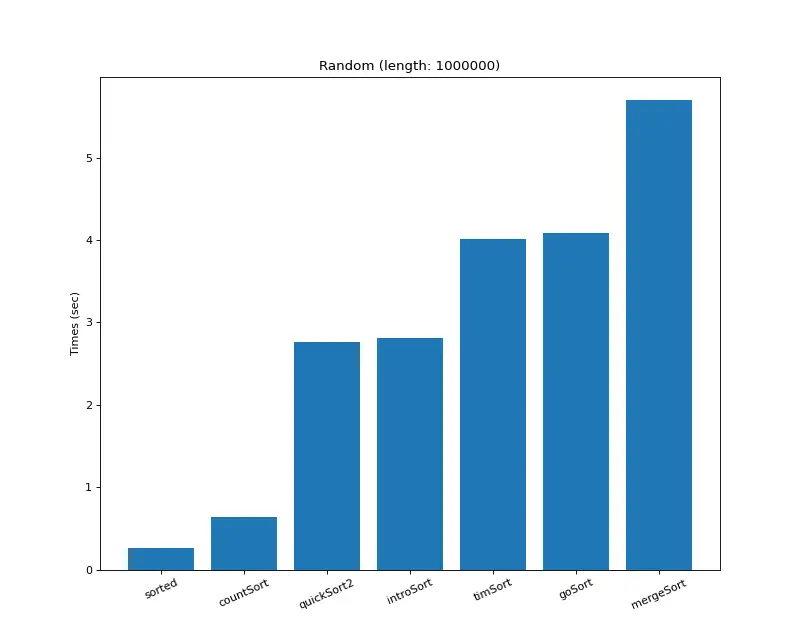
Benchmarks
Visit here for more results
Release history Release notifications | RSS feed


Download files
Download the file for your platform. If you're not sure which to choose, learn more about installing packages.
Source Distribution
Built Distributions
Filter files by name, interpreter, ABI, and platform.
If you're not sure about the file name format, learn more about wheel file names.
Copy a direct link to the current filters
File details
Details for the file big-O calculator-0.0.9.8.2.tar.gz.
File metadata
- Download URL: big-O calculator-0.0.9.8.2.tar.gz
- Upload date:
- Size: 21.5 kB
- Tags: Source
- Uploaded using Trusted Publishing? No
- Uploaded via: twine/3.2.0 pkginfo/1.5.0.1 requests/2.24.0 setuptools/49.6.0.post20200814 requests-toolbelt/0.9.1 tqdm/4.49.0 CPython/3.7.7
File hashes
| Algorithm | Hash digest | |
|---|---|---|
| SHA256 |
bd3f4a78651f52760c8313ad0eaa814d9bfd7430e6bcc8379b9e6a4ecaa6bc36
|
|
| MD5 |
789c6f24f272d206ee48d2eac1c773b1
|
|
| BLAKE2b-256 |
533ae122231d15865d0485894785f2e499b816ed2fa8c638b30036068f243262
|
File details
Details for the file big_O_calculator-0.0.9.8.2-py3.7.egg.
File metadata
- Download URL: big_O_calculator-0.0.9.8.2-py3.7.egg
- Upload date:
- Size: 175.0 kB
- Tags: Egg
- Uploaded using Trusted Publishing? No
- Uploaded via: twine/3.2.0 pkginfo/1.6.1 requests/2.24.0 setuptools/50.3.2.post20201201 requests-toolbelt/0.9.1 tqdm/4.54.0 CPython/3.7.7
File hashes
| Algorithm | Hash digest | |
|---|---|---|
| SHA256 |
8421322883614e5dbce8c7b9db04129a55e5cda16675d77e3567cf8959991385
|
|
| MD5 |
c8efce8ad286fe1492befc83daa1fa69
|
|
| BLAKE2b-256 |
3cf1b775c6bdac68383bd54b57e4130080c1f5c712b32fcecac4e45b11f1cfcb
|
File details
Details for the file big_O_calculator-0.0.9.8.2-py3.7-win-amd64.egg.
File metadata
- Download URL: big_O_calculator-0.0.9.8.2-py3.7-win-amd64.egg
- Upload date:
- Size: 93.9 kB
- Tags: Egg
- Uploaded using Trusted Publishing? No
- Uploaded via: twine/3.2.0 pkginfo/1.6.1 requests/2.24.0 setuptools/50.3.2.post20201201 requests-toolbelt/0.9.1 tqdm/4.54.0 CPython/3.7.7
File hashes
| Algorithm | Hash digest | |
|---|---|---|
| SHA256 |
3c09b42bc06ebee78dd448caab93149344482c2fecb79e31951274210c2d94c1
|
|
| MD5 |
e0b6509a95dc08315ee7a1c5bbee1cc3
|
|
| BLAKE2b-256 |
7afd18c626c4c006ae97cbdef54b2d634d979f3fc8b12fdab11239515951a177
|
File details
Details for the file big_O_calculator-0.0.9.8.2-py3-none-any.whl.
File metadata
- Download URL: big_O_calculator-0.0.9.8.2-py3-none-any.whl
- Upload date:
- Size: 21.0 kB
- Tags: Python 3
- Uploaded using Trusted Publishing? No
- Uploaded via: twine/3.2.0 pkginfo/1.5.0.1 requests/2.24.0 setuptools/49.6.0.post20200814 requests-toolbelt/0.9.1 tqdm/4.49.0 CPython/3.7.7
File hashes
| Algorithm | Hash digest | |
|---|---|---|
| SHA256 |
97682b7479cf7179e3fdd12b83181343cfe4b5bd48e1f34de65e8fb73b0f9b35
|
|
| MD5 |
32c85f6cd34f4d7efda5309bfe045478
|
|
| BLAKE2b-256 |
f3e18abcd5ba0b2c249d25c1f16cc8aa9838c993061ce322b0ac5ed42251a5d0
|






