

Gamut: an open file format for parametric simulation studies
By Bijective Systems, with libraries for Python, MATLAB, Julia, C++, C and Rust.
Documentation · Installing · Examples · Specification · PyPI: bijective-gamut · Releases

Gamut is a file format for parametric simulation studies: the hundreds or thousands of CFD or FEA runs behind a design sweep, an aerodynamic database or a surrogate model. One file holds the run table, each run's inputs, results and status, and, when the runs have a mesh, the mesh and every field on it, all with units. A model fitted to the runs is saved the same way, as plain numbers with no code. Every language reads and writes the file through one core, so each reads what another wrote, value for value.
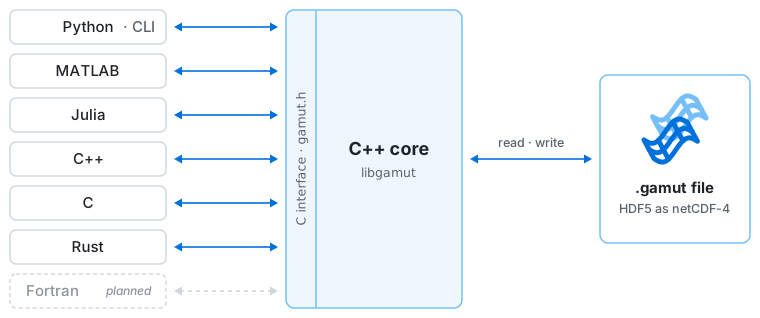
Example
A sweep of a wing's angle of attack: six runs written at once, a seventh
added later, and the lift of the runs that converged read back. cl
stands for your solver's results.
alpha = np.arange(0.0, 11.0, 2.0)  # six angles of attack, in degrees
cl = 0.11 * alpha                  # stands for the solver's lift coefficients

with gamut.create("sweep.gamut", writer="example sweep",
                   parameters={"alpha": {"units": "degree", "role": "condition"}},
                   labels={"status": {"role": "status",
                                      "categories": ["converged", "failed"]}},
                   scalars={"cl": "1"}) as study:
    study.add_runs({"alpha": alpha, "cl": cl,
                    "status": ["converged"] * len(alpha)})

with gamut.open("sweep.gamut", mode="a") as study:
    study.add_run({"alpha": 12, "status": "failed"})

with gamut.open("sweep.gamut") as study:
    lift = study.get_scalar("cl", rows=study.select("status == converged"))
MATLAB
alpha = (0:2:10)';   % six angles of attack, in degrees
cl = 0.11 * alpha;   % stands for the solver's lift coefficients

study = gamut.create('sweep.gamut', 'writer', 'example sweep', ...
    'parameters', struct('alpha', struct('units', 'degree', ...
                                         'role', 'condition')), ...
    'labels', struct('status', struct('role', 'status', ...
                                      'categories', {{'converged', 'failed'}})), ...
    'scalars', struct('cl', '1'));
status = repmat({'converged'}, numel(alpha), 1);
study.addRuns(struct('alpha', alpha, 'cl', cl, 'status', {status}));
study.close();

study = gamut.open('sweep.gamut', 'mode', 'a');
study.addRun(struct('alpha', 12, 'status', 'failed'));
study.close();

study = gamut.open('sweep.gamut');
lift = study.getScalar('cl', 'rows', study.select('status == converged'));
study.close();
Julia
alpha = collect(0.0:2.0:10.0)  # six angles of attack, in degrees
cl = 0.11 .* alpha             # stands for the solver's lift coefficients

Gamut.create("sweep.gamut"; writer="example sweep",
              parameters=Dict("alpha" => (units="degree", role="condition")),
              labels=Dict("status" => (role="status",
                                       categories=["converged", "failed"])),
              scalars=Dict("cl" => "1")) do study
    status = fill("converged", length(alpha))
    Gamut.add_runs!(study, Dict("alpha" => alpha, "cl" => cl, "status" => status))
end

Gamut.open("sweep.gamut"; mode="a") do study
    Gamut.add_run!(study, Dict("alpha" => 12.0, "status" => "failed"))
end

lift = Gamut.open("sweep.gamut") do study
    Gamut.get_scalar(study, "cl"; rows=Gamut.select(study, "status == converged"))
end
C++
const std::vector<double> alpha = {0, 2, 4, 6, 8, 10};  // angles of attack, degrees
std::vector<double> cl;  // stands for the solver's lift coefficients
for (const double a : alpha) cl.push_back(0.11 * a);

auto study = gamut::create("sweep.gamut", "example sweep");
study.declare_parameter("alpha", "condition", "degree");
study.declare_label("status", "status", {"converged", "failed"});
study.declare_scalar("cl", "1");
const std::vector<std::string> status(alpha.size(), "converged");
study.add_runs({{"alpha", alpha}, {"cl", cl}, {"status", status}});
study.close();

study = gamut::open("sweep.gamut", "a");
study.add_run({{"alpha", 12.0}, {"status", "failed"}});
study.close();

study = gamut::open("sweep.gamut");
const std::vector<double> lift =
    study.get_scalar("cl", study.select("status == converged"));
Rust
let alpha = vec![0.0, 2.0, 4.0, 6.0, 8.0, 10.0];   // angles of attack, degrees
let cl: Vec<f64> = alpha.iter().map(|a| 0.11 * a).collect();   // stands for the solver's lift coefficients

let mut study = gamut::create("sweep.gamut", "example sweep", "", "")?;
study.declare_parameter("alpha", "condition", "degree")?;
study.declare_label("status", "status", &["converged", "failed"])?;
study.declare_scalar("cl", "1")?;
let status = vec!["converged"; alpha.len()];
study.add_runs(&[("alpha", alpha.into()), ("cl", cl.into()), ("status", status.into())], &[])?;
study.close()?;

let mut study = gamut::open_append("sweep.gamut")?;
study.add_run(&[("alpha", 12.0.into()), ("status", "failed".into())], &[])?;
study.close()?;

let study = gamut::open("sweep.gamut")?;
let lift = study.get_scalar("cl", study.select("status == converged")?)?;
All five print the same line:
lift of the runs that converged: 0.00 0.22 0.44 0.66 0.88 1.10
The examples go on from here, a step at a time and in each language: a mesh shared by every run, families of shapes, meshes that change, time series, uncertainty, and models fitted to the runs.
Performance
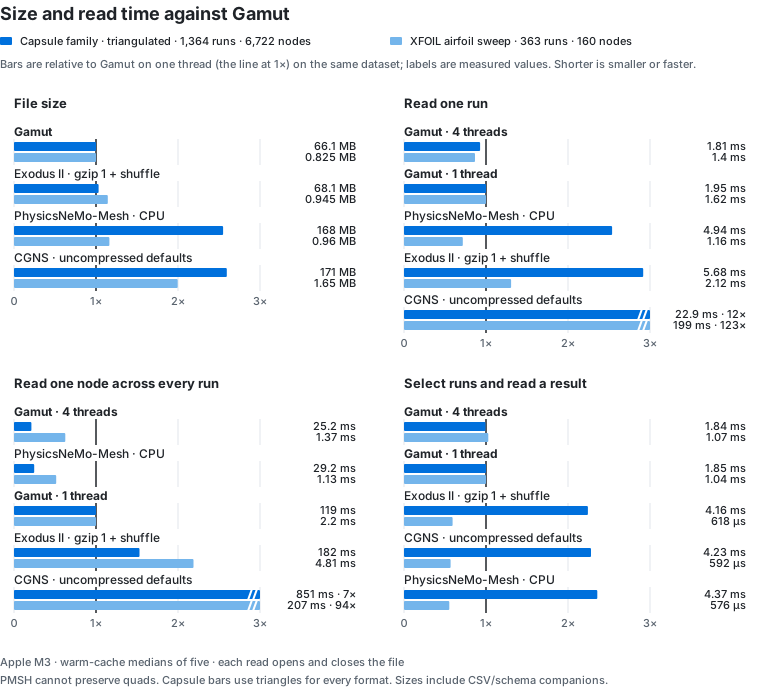
On the triangulated capsule family, Gamut and compressed Exodus occupy about the same space, and Gamut is smaller and reads one run faster than PhysicsNeMo-Mesh, which writes faster; on the smaller airfoil sweep, PhysicsNeMo-Mesh reads faster and Gamut is smaller. PhysicsNeMo-Mesh needs triangles, so every format here uses the capsule converted to triangles. The benchmarks give the full timings, settings and machine, the original quadrilateral results, and the workloads where another approach is faster.
Install
| Language | Install |
|---|---|
| Python 3.11 or later | pip install bijective-gamut |
| MATLAB R2023b or later | open Gamut.mltbx from the latest release |
| Julia 1.10 or later | Pkg.add(url="https://github.com/bijective-systems-org/gamut", subdir="julia", rev="v2.1.0") |
| C++ and C | CMake build and install, then find_package(gamut); include gamut/gamut.hpp (C++17) or gamut/gamut.h (C) |
| Rust 1.70 or later | bijective-gamut = { git = "https://github.com/bijective-systems-org/gamut", tag = "v2.1.0" }, with GAMUT_LIB_DIR at a release's core |
In Python, install bijective-gamut, then import gamut; the PyPI project
named gamut is a different package. Installing has
the details for each language, and llms.txt gives coding
agents a plain-text overview.
License
Apache 2.0. Made by Bijective Systems. If you use Gamut in published work, please cite it (CITATION.cff).
1 maintainer

Metadata
1 maintainer
Release files for bijective-gamut 2.1.0
For a detailed explanation of source distributions (sdists) and built distributions (wheels), please see the package formats documentation.
Source distribution (sdist)
| File | Size | Uploaded | Provenance | Actions |
|---|---|---|---|---|
| bijective_gamut-2.1.0.tar.gz | 344.0 kB | With provenance | Details for bijective_gamut-2.1.0.tar.gz |
Built distributions (wheels)
| File | Actions Reset | |||
|---|---|---|---|---|
| bijective_gamut-2.1.0-py3-none-win_amd64.whl | Python 3 | none | Windows x86-64 | Details for bijective_gamut-2.1.0-py3-none-win_amd64.whl |
| bijective_gamut-2.1.0-py3-none-manylinux_2_28_x86_64.whl | Python 3 | none | Linux glibc 2.28+ x86-64 | Details for bijective_gamut-2.1.0-py3-none-manylinux_2_28_x86_64.whl |
| bijective_gamut-2.1.0-py3-none-macosx_11_0_x86_64.whl | Python 3 | none | macOS 11.0+ x86-64 | Details for bijective_gamut-2.1.0-py3-none-macosx_11_0_x86_64.whl |
| bijective_gamut-2.1.0-py3-none-macosx_11_0_arm64.whl | Python 3 | none | macOS 11.0+ ARM64 | Details for bijective_gamut-2.1.0-py3-none-macosx_11_0_arm64.whl |
Total release size: 8.1 MB
Release files / bijective_gamut-2.1.0.tar.gz
| Download URL | bijective_gamut-2.1.0.tar.gz |
|---|---|
| Size | 344.0 kB |
| Tags | Source |
|
SHA-256 checksum How to use checksums |
e65b896f656731ea5dc06853924550c94b66cb857304567dfc34ac3e63d8ee43
|
|
BLAKE2b-256 checksum How to use checksums |
31ef2c8ff9abf1b519d565bf89f7ae19226eab4038be190dfa64dada7012b25e
|
| Upload date | |
|
Uploaded using Trusted Publishing? What is trusted publishing? |
Yes |
| Uploaded via |
twine/7.0.0 CPython/3.13.14
|
Provenance
Provenance describes where a file came from. On PyPI, provenance is shared via attestations, which provide a verifiable record of the build or publishing details. View details, limitations and caveats.


PyPI Publish Attestation
PyPI verified that this artifact, at this checksum, originated from the publisher listed below.
Signed by GitHub Actions, verified by PyPI on Oct 30, 2026.
Transparency logRelease files / bijective_gamut-2.1.0-py3-none-win_amd64.whl
| Download URL | bijective_gamut-2.1.0-py3-none-win_amd64.whl |
|---|---|
| Size | 1.7 MB |
| Tags | Python 3 Windows x86-64 |
|
SHA-256 checksum How to use checksums |
2f21f0bf16e558c9912fad6cfa8e50ec7396e7369d61880378ad4ebf3ea6dca3
|
|
BLAKE2b-256 checksum How to use checksums |
6da3381bc227d3a4b6c36e27ccbc73e12701c60038d2fed55c2b156f9c43d0e9
|
| Upload date | |
|
Uploaded using Trusted Publishing? What is trusted publishing? |
Yes |
| Uploaded via |
twine/7.0.0 CPython/3.13.14
|
Provenance
Provenance describes where a file came from. On PyPI, provenance is shared via attestations, which provide a verifiable record of the build or publishing details. View details, limitations and caveats.
PyPI Publish Attestation
PyPI verified that this artifact, at this checksum, originated from the publisher listed below.
Signed by GitHub Actions, verified by PyPI on Oct 30, 2026.
Transparency logRelease files / bijective_gamut-2.1.0-py3-none-manylinux_2_28_x86_64.whl
| Download URL | bijective_gamut-2.1.0-py3-none-manylinux_2_28_x86_64.whl |
|---|---|
| Size | 2.4 MB |
| Tags | Linux glibc 2.28+ x86-64 Python 3 |
|
SHA-256 checksum How to use checksums |
ae38b96a8afb53c3ea277354f01e9a6a8da07b516447c73c4e4bb8faa0df033d
|
|
BLAKE2b-256 checksum How to use checksums |
cd39efc1307a2b32295ad06717c1cb61b42fddc7406963948f16936c948261fb
|
| Upload date | |
|
Uploaded using Trusted Publishing? What is trusted publishing? |
Yes |
| Uploaded via |
twine/7.0.0 CPython/3.13.14
|
Provenance
Provenance describes where a file came from. On PyPI, provenance is shared via attestations, which provide a verifiable record of the build or publishing details. View details, limitations and caveats.
PyPI Publish Attestation
PyPI verified that this artifact, at this checksum, originated from the publisher listed below.
Signed by GitHub Actions, verified by PyPI on Oct 30, 2026.
Transparency logRelease files / bijective_gamut-2.1.0-py3-none-macosx_11_0_x86_64.whl
| Download URL | bijective_gamut-2.1.0-py3-none-macosx_11_0_x86_64.whl |
|---|---|
| Size | 2.0 MB |
| Tags | Python 3 macOS 11.0+ x86-64 |
|
SHA-256 checksum How to use checksums |
2315460f4f4e805ef23833b0f1bf1c372eb0bb8eb312d931b289ec4a6ad98cd3
|
|
BLAKE2b-256 checksum How to use checksums |
b1e81f606570f0ce099f86f619e11f44ce3d14440c6092a3dbb4972283edd699
|
| Upload date | |
|
Uploaded using Trusted Publishing? What is trusted publishing? |
Yes |
| Uploaded via |
twine/7.0.0 CPython/3.13.14
|
Provenance
Provenance describes where a file came from. On PyPI, provenance is shared via attestations, which provide a verifiable record of the build or publishing details. View details, limitations and caveats.
PyPI Publish Attestation
PyPI verified that this artifact, at this checksum, originated from the publisher listed below.
Signed by GitHub Actions, verified by PyPI on Oct 30, 2026.
Transparency logRelease files / bijective_gamut-2.1.0-py3-none-macosx_11_0_arm64.whl
| Download URL | bijective_gamut-2.1.0-py3-none-macosx_11_0_arm64.whl |
|---|---|
| Size | 1.7 MB |
| Tags | Python 3 macOS 11.0+ ARM64 |
|
SHA-256 checksum How to use checksums |
4140132776c7a7f735f44482483d183ffce38ef0be18e48e7a9b7fd2cca9f8e5
|
|
BLAKE2b-256 checksum How to use checksums |
17f1daf708be572cfe89bd0c6e3f8b6f04cfd9b8485bfc2f666ae5159679d7a4
|
| Upload date | |
|
Uploaded using Trusted Publishing? What is trusted publishing? |
Yes |
| Uploaded via |
twine/7.0.0 CPython/3.13.14
|
Provenance
Provenance describes where a file came from. On PyPI, provenance is shared via attestations, which provide a verifiable record of the build or publishing details. View details, limitations and caveats.
PyPI Publish Attestation
PyPI verified that this artifact, at this checksum, originated from the publisher listed below.
Signed by GitHub Actions, verified by PyPI on Oct 30, 2026.
Transparency logSecurity for bijective-gamut 2.1.0
Provenance
Provenance describes where a file came from. On PyPI, provenance is shared via attestations, which provide a verifiable record of the build or publishing details. View details, limitations and caveats.
Full provenance
All 5 files in this release have been uploaded with provenance metadata.
Attestation for bijective_gamut-2.1.0.tar.gz
PyPI Publish Attestation
PyPI verified that this artifact, at this checksum, originated from the publisher listed below.
Signed by GitHub Actions, verified by PyPI on Oct 30, 2026.
Transparency logA note on package security
PyPI is a repository for distributing packages, not a service for auditing them. While third-party security researchers and our staff do their best to detect and remove malicious packages, PyPI cannot guarantee the quality, security or suitability of any given package.
To learn more about protecting yourself from malicious actors, visit our package security documentation.













