
bioacoustic-synthesis
Builds synthetic soundscapes by mixing isolated vocalisations into field-recorded backgrounds at controlled signal-to-noise ratios. Because every source signal is known before it is mixed, each placement carries an analytically derived label — presence, time span, time-frequency box, and time-frequency mask — with no hand annotation.
Install
pip install bioacoustic-synthesis
Quick start
bioacoustic-synthesis -c config.yaml
Useful flags: -i reviews each generated soundscape interactively, -n caps the
number of source files used per class, and -s fixes the RNG seed. Omit -s and
a seed is drawn at random and written into the output's generation_config.yaml,
so any run can be reproduced after the fact.
Input
Three folders of audio, all pointed at from the config. Formats: .wav, .flac,
.mp3.
Positives — isolated vocalisations, one subfolder per class. The subfolder name becomes the class label. Each clip should contain the target call and as little else as possible, since everything in the clip is placed into the mix and counted as signal when the SNR is set.
vocalisations/
├── petroica_australis/
│   ├── clip_001.wav
│   └── clip_002.wav
└── prosthemadera_novaeseelandiae/
    └── clip_003.wav
Negatives — isolated contaminants: rain, wind gusts, machinery, handling noise, anything that a detector should learn to reject. These are placed like vocalisations, at a comparable SNR, and generate no labels.
Backgrounds — clean ambience carrying none of the positive classes, since any
call present here becomes an unlabelled positive in the output. Each file must be
longer than length_seconds so a window can be cropped from it; shorter files
are reassigned to the negatives pool. Background diversity is the single largest
influence on how well a detector trained on the result generalises, so favour many
distinct recordings over long ones.
Optionally, a tags.csv in a positives or negatives folder with a filename
column attaches arbitrary metadata to each record.
Configuration
Everything is driven by one YAML file. See config.example.yaml:
paths:
  vocalisations: [corpora/vocalisations]
  negative: [corpora/negatives]
  noise: [corpora/backgrounds]
  output: output

synthesis:
  n_soundscapes: 1000
  length_seconds: 10
  sample_rate: 32000

  # How many events land in each soundscape, drawn uniformly in range
  positive_overlay_range: [1, 4]
  negative_overlay_range: [0, 2]

  # Consecutive plays of the same source clip, and the gap between them
  repetitions: [1, 3]
  repetitions_spacing_s: [0.5, 3.0]

  # True dB power ratios, measured where the overlay actually has energy
  snr_db_range: [0, 25]
  negative_snr_db_range: [0, 10]

  # Label definition: a pixel joins the mask at this many dB above the local
  # noise floor, and a placement is rejected if too little of its mask survives
  mask_threshold_db: 1
  minimum_mask_area_px: 200

  edge_fade_ms: 50

  # Whether band-limited backgrounds are usable, and the tolerance for calling
  # a recording full-band
  allow_bandpass: true
  bandpass_tolerance_hz: 500

  synthetic_noise:
    white: true
    pink: true
    brown: true
    probability: 0.5
    db_range: [-46.0, -30.0]

spectrogram:
  n_fft: 2048
  win_length: 2048
  hop_length: 512
  log_base: 10.0

output:
  include_audio: true
  include_spectrogram: true
  include_boxes: true
  include_masks: true
  include_presence: true
  include_simple_labels: true
  overwrite: true
  color_mode: HSV        # HSV, RGB, or L (greyscale)
  target_db: -10.0
  generate_raw_dataset: false
  ignore_classes: []

proportions:
  species: {}
  noise: {}
Output
Written to <output>/artificial_dataset/:
| Path | Contents |
|---|---|
sound_files/ |
the mixed soundscape, 16-bit PCM WAV |
images/ |
the rendered spectrogram, 640×640 JPEG, PCEN-normalised, log-frequency |
labels/ |
class ids present in the soundscape, space separated |
presence/ |
1000-bin boolean array over the window, .npy |
box_labels/ |
time-frequency boxes in YOLO format |
unetplusplus_masks/ |
paired PNGs — image, per-instance mask, per-class mask |
provenance.csv |
every placement: source file, species, sample range, SNR |
species_value_map.csv |
class id to label |
dataset.yaml |
class map for YOLO training |
generation_config.yaml |
the config used, plus the seeds and limits the run applied |
example/ |
the first three soundscapes as audio and annotated figures |
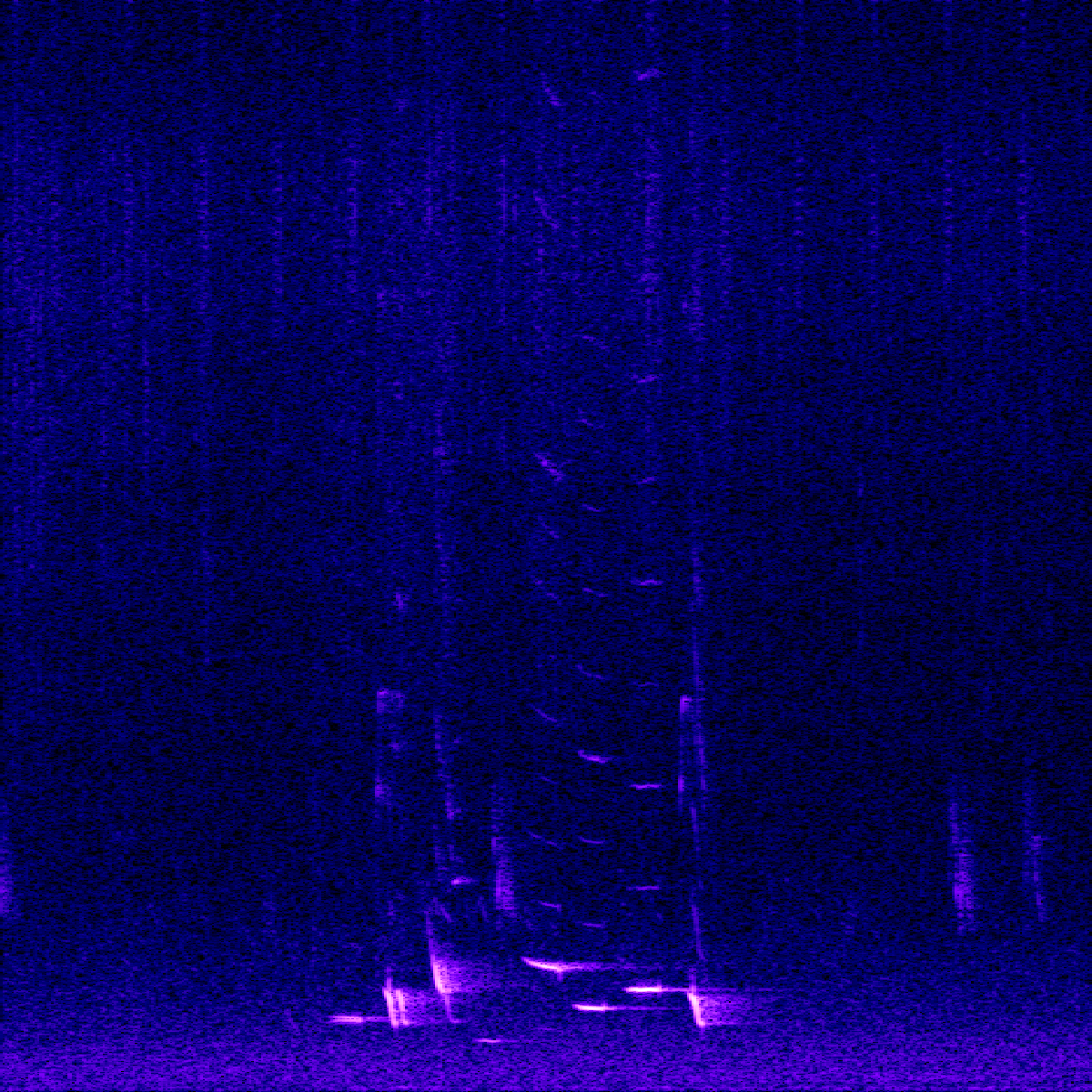
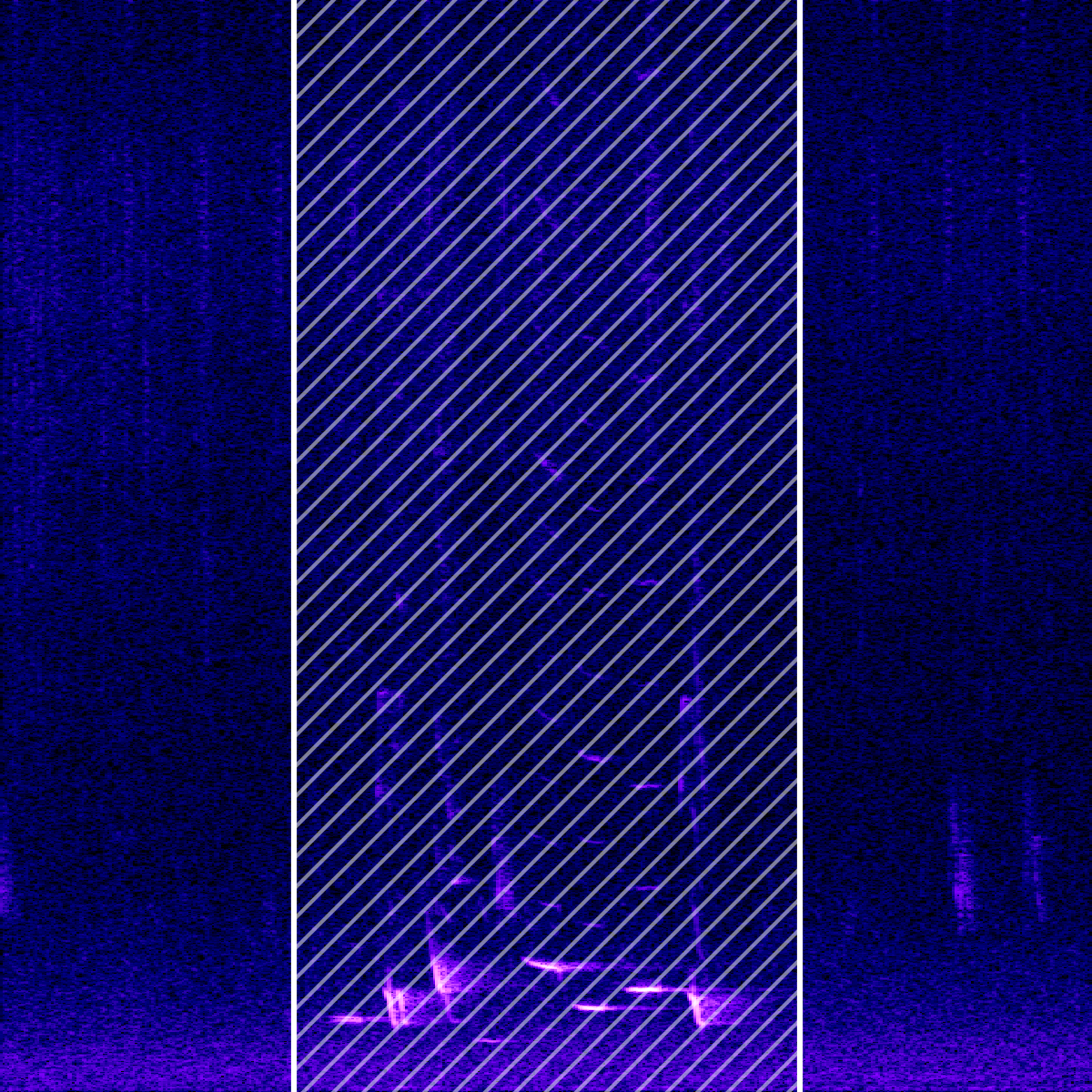
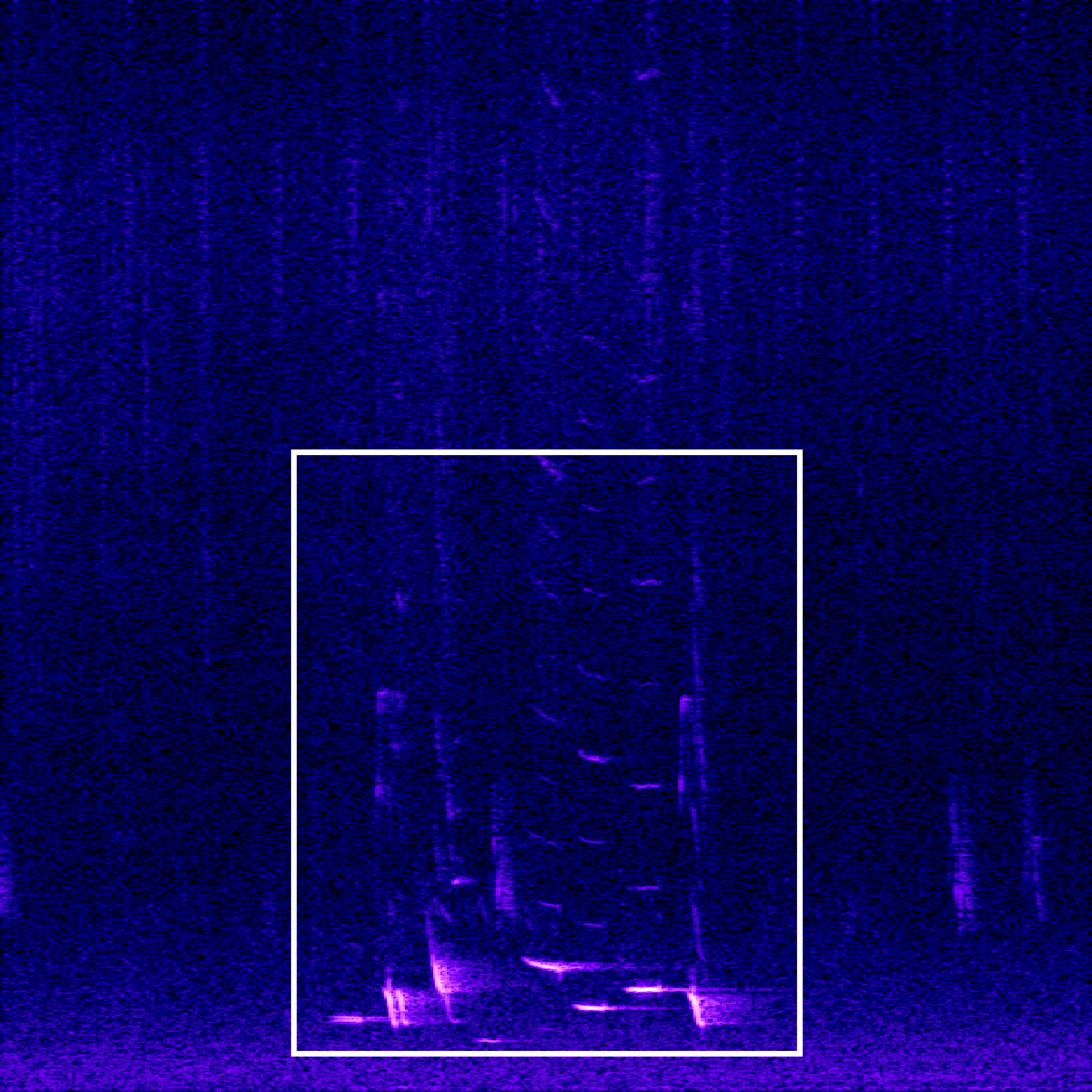
Each placement is labelled at four levels of detail, all derived from the same source signal:
 |
 |
 |
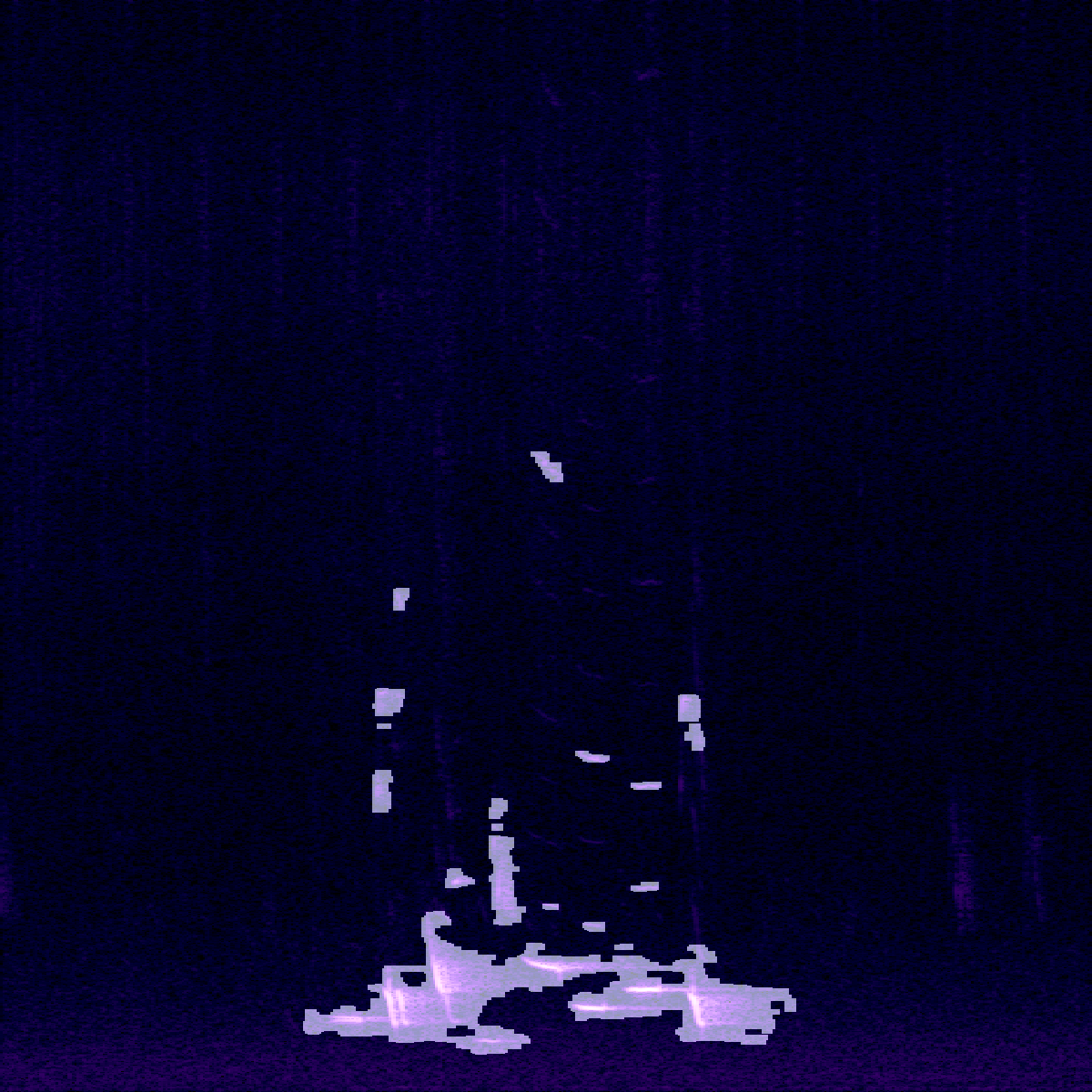 |
| Presence | Time span | Time-frequency box | Time-frequency mask |
The mask is the primary label. It marks every spectrogram pixel where the
isolated source sits at least mask_threshold_db above the noise floor measured
at that placement, so it follows the call's actual structure rather than a
rectangle around it. The box is the mask's extent, and the time span and presence
labels are progressive reductions of the same measurement. A placement whose mask
is smaller than minimum_mask_area_px is discarded and redrawn, which keeps the
faintest events out of the labels rather than labelling something invisible.
Setting generate_raw_dataset: true produces a second, parallel dataset from
unisolated source clips, for comparing what the isolation contributes.
Licence
GNU GPLv3
1 maintainer

Metadata
1 maintainer
Release files for bioacoustic-synthesis 0.1.0
For a detailed explanation of source distributions (sdists) and built distributions (wheels), please see the package formats documentation.
Source distribution (sdist)
| File | Size | Uploaded | Provenance | Actions |
|---|---|---|---|---|
| bioacoustic_synthesis-0.1.0.tar.gz | 49.0 kB | Without provenance | Details for bioacoustic_synthesis-0.1.0.tar.gz |
Built distribution (wheel)
| File | Interpreter | ABI | Platform | Actions Reset |
|---|---|---|---|---|
| bioacoustic_synthesis-0.1.0-py3-none-any.whl | Python 3 | none | any | Details for bioacoustic_synthesis-0.1.0-py3-none-any.whl |
Total release size: 100.8 kB
Release files / bioacoustic_synthesis-0.1.0.tar.gz
| Download URL | bioacoustic_synthesis-0.1.0.tar.gz |
|---|---|
| Size | 49.0 kB |
| Tags | Source |
|
SHA-256 checksum How to use checksums |
0a305a6f18a5b47089ec30011d00d35d16c7c85e78331737bc094dbc5dff5d81
|
|
BLAKE2b-256 checksum How to use checksums |
33f9fd5eb294f51d44dbbefc29cf8ae1e29bf29c6590a478d2c18d0cb83aa25a
|
| Upload date | |
|
Uploaded using Trusted Publishing? What is trusted publishing? |
No |
| Uploaded via |
uv/0.7.12
|
Release files / bioacoustic_synthesis-0.1.0-py3-none-any.whl
| Download URL | bioacoustic_synthesis-0.1.0-py3-none-any.whl |
|---|---|
| Size | 51.8 kB |
| Tags | Python 3 |
|
SHA-256 checksum How to use checksums |
86dd40c5aba120622d7b48a0f22a9f253cf0e2725d39ccd3b13d650e4a4ef73c
|
|
BLAKE2b-256 checksum How to use checksums |
f0e96be9e79639a4046a43a0ba2f2108d29cd80912efcfed27e676fb238bf405
|
| Upload date | |
|
Uploaded using Trusted Publishing? What is trusted publishing? |
No |
| Uploaded via |
uv/0.7.12
|
Security for bioacoustic-synthesis 0.1.0
Provenance
Provenance describes where a file came from. On PyPI, provenance is shared via attestations, which provide a verifiable record of the build or publishing details. View details, limitations and caveats.
No provenance found
None of the files in this release were uploaded with provenance metadata.
A note on package security
PyPI is a repository for distributing packages, not a service for auditing them. While third-party security researchers and our staff do their best to detect and remove malicious packages, PyPI cannot guarantee the quality, security or suitability of any given package.
To learn more about protecting yourself from malicious actors, visit our package security documentation.













