
DEM
Dual-extraction modeling: A multi-modal deep-learning architecture for phenotypic prediction and functional gene mining of complex traits




Latest news
v0.9.1 is released with a lot of improvements!
Please checkout the tutorials and documentations at cma2015.github.io/DEM.
- The DEM is implemented in the Python package
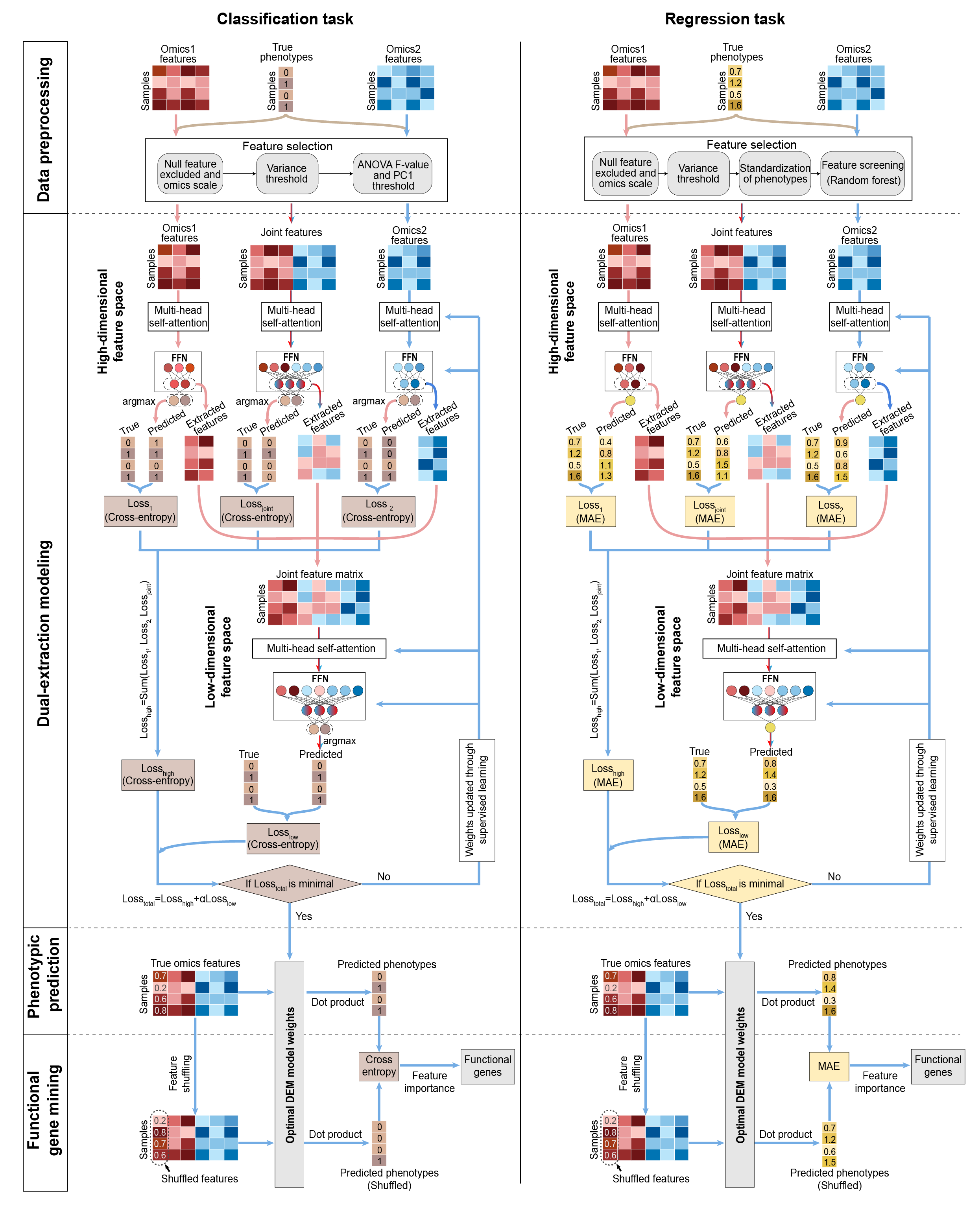
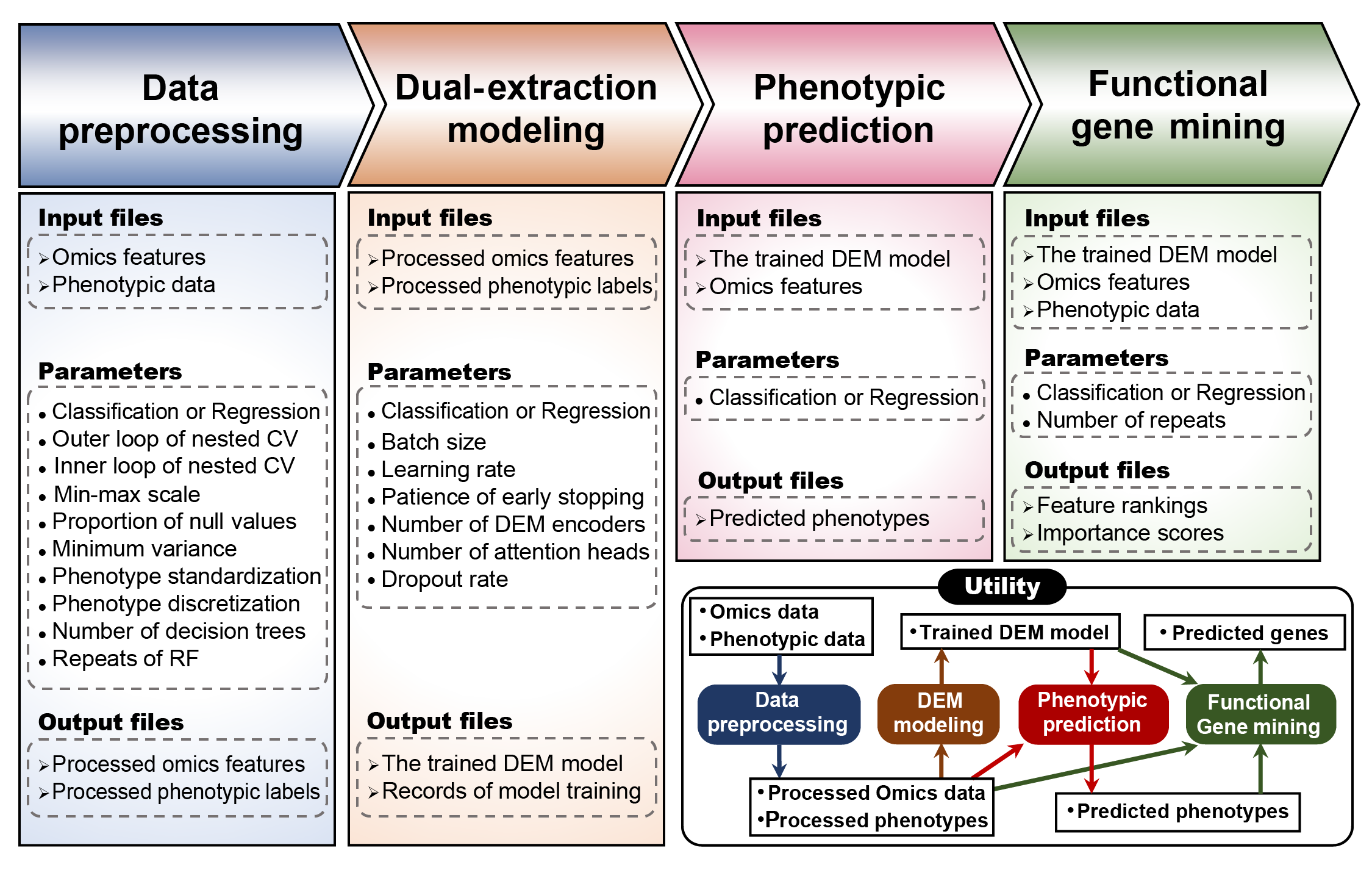
biodem, which comprises 4 modules: data preprocessing, dual-extraction modeling, phenotypic prediction, and functional gene mining. - For more details, please check out our publication. 🖱️Click to copy citation
 |
 |
Installation
System requirements
- Python 3.10 / 3.11 / 3.12.
- Optional: Hardware accelerator supporting PyTorch.
Recommended: NVIDIA graphics card with 12GB memory or larger.
Install biodem
-
Create a conda environment:
mamba create -n dem python=3.11
mamba activate dem

# Install PyTorch with CUDA support
mamba install pytorch torchvision torchaudio pytorch-cuda=12.4 -c pytorch -c nvidia
-
Install biodem package from PyPI
pip install biodem
Usage
Please checkout the documentations at cma2015.github.io/DEM.
biodem comprises 4 functional modules:
1. Data preprocessing
Nested cross-validation is recommended for data preprocessing.
- Steps:
- Split data into nested cross-validation sets.
- Imputation & standardization.
- Feature selection using the variance threshold filter and Random Forests.
- SNP2Gene transformation.
2. Dual-extraction modeling
- It takes preprocessed multi-omics data and phenotypic data as inputs. DEM is capable of performing both classification and regression tasks.
3. Phenotypic prediction
- It loads the trained DEM model checkpoint and performs phenotypic prediction.
4. Functional gene mining
- It performs functional gene mining based on the trained DEM model through feature ranking by permutation.
Citation
Please cite our paper if you use this package:
@article{renDualextractionModelingMultimodal2024a,
  title = {Dual-Extraction Modeling: {{A}} Multi-Modal Deep-Learning Architecture for Phenotypic Prediction and Functional Gene Mining of Complex Traits},
  shorttitle = {Dual-Extraction Modeling},
  author = {Ren, Yanlin and Wu, Chenhua and Zhou, He and Hu, Xiaona and Miao, Zhenyan},
  year = {2024},
  month = sep,
  journal = {Plant Communications},
  volume = {5},
  number = {9},
  pages = {101002},
  issn = {25903462},
  doi = {10.1016/j.xplc.2024.101002},
  langid = {english}
}
Asking for help
If you have any questions, please contact us via GitHub issues or email us.
1 maintainer

Metadata
1 maintainer
Release files for biodem 0.9.1
For a detailed explanation of source distributions (sdists) and built distributions (wheels), please see the package formats documentation.
Source distribution (sdist)
| File | Size | Uploaded | Provenance | Actions |
|---|---|---|---|---|
| biodem-0.9.1.tar.gz | 93.7 MB | Without provenance | Details for biodem-0.9.1.tar.gz |
Built distribution (wheel)
| File | Interpreter | ABI | Platform | Actions Reset |
|---|---|---|---|---|
| biodem-0.9.1-py3-none-any.whl | Python 3 | none | any | Details for biodem-0.9.1-py3-none-any.whl |
Total release size: 96.1 MB
Release files / biodem-0.9.1.tar.gz
| Download URL | biodem-0.9.1.tar.gz |
|---|---|
| Size | 93.7 MB |
| Tags | Source |
|
SHA-256 checksum How to use checksums |
8a9f32d28d45ee7afb57a5bc4a99ba313f22570881fb6bac6ed7412f266bd8c6
|
|
BLAKE2b-256 checksum How to use checksums |
7e0d341b0c9c75e7e128b18ebe0c4dbde8f3d8897be6f5d3fda799ef469f6fb1
|
| Upload date | |
|
Uploaded using Trusted Publishing? What is trusted publishing? |
No |
| Uploaded via |
twine/5.1.1 CPython/3.12.0
|
Release files / biodem-0.9.1-py3-none-any.whl
| Download URL | biodem-0.9.1-py3-none-any.whl |
|---|---|
| Size | 2.4 MB |
| Tags | Python 3 |
|
SHA-256 checksum How to use checksums |
1312362b3427d4e4e30fde2cf1abfcf5928c85e5d9d8837e86b9b37a65cb66d3
|
|
BLAKE2b-256 checksum How to use checksums |
b433f7482df107b02ecd3b01d2e046d3b7fc090fd70eb665dd3bcddc419db976
|
| Upload date | |
|
Uploaded using Trusted Publishing? What is trusted publishing? |
No |
| Uploaded via |
twine/5.1.1 CPython/3.12.0
|
Security for biodem 0.9.1
Provenance
Provenance describes where a file came from. On PyPI, provenance is shared via attestations, which provide a verifiable record of the build or publishing details. View details, limitations and caveats.
No provenance found
None of the files in this release were uploaded with provenance metadata.
A note on package security
PyPI is a repository for distributing packages, not a service for auditing them. While third-party security researchers and our staff do their best to detect and remove malicious packages, PyPI cannot guarantee the quality, security or suitability of any given package.
To learn more about protecting yourself from malicious actors, visit our package security documentation.














