






Biomni: A General-Purpose Biomedical AI Agent
Overview
Biomni is a general-purpose biomedical AI agent designed to autonomously execute a wide range of research tasks across diverse biomedical subfields. By integrating cutting-edge large language model (LLM) reasoning with retrieval-augmented planning and code-based execution, Biomni helps scientists dramatically enhance research productivity and generate testable hypotheses.
Quick Start
Installation
Our software environment is massive and we provide a single setup.sh script to setup. Follow this file to setup the env first.
Then activate the environment E1:
conda activate biomni_e1
then install the biomni official pip package:
pip install biomni --upgrade
For the latest update, install from the github source version, or do:
pip install git+https://github.com/snap-stanford/Biomni.git@main
Lastly, configure your API keys using one of the following methods:
Click to expand
Option 1: Using .env file (Recommended)
Create a .env file in your project directory:
# Copy the example file
cp .env.example .env

# Edit the .env file with your actual API keys
Your .env file should look like:
# Required: Anthropic API Key for Claude models
ANTHROPIC_API_KEY=your_anthropic_api_key_here

# Optional: OpenAI API Key (if using OpenAI models)
OPENAI_API_KEY=your_openai_api_key_here

# Optional: Azure OpenAI API Key (if using Azure OpenAI models)
OPENAI_API_KEY=your_azure_openai_api_key
OPENAI_ENDPOINT=https://your-resource-name.openai.azure.com/

# Optional: AI Studio Gemini API Key (if using Gemini models)
GEMINI_API_KEY=your_gemini_api_key_here

# Optional: groq API Key (if using groq as model provider)
GROQ_API_KEY=your_groq_api_key_here

# Optional: Set the source of your LLM for example:
#"OpenAI", "AzureOpenAI", "Anthropic", "Ollama", "Gemini", "Bedrock", "Groq", "Custom"
LLM_SOURCE=your_LLM_source_here

# Optional: AWS Bedrock Configuration (if using AWS Bedrock models)
AWS_BEARER_TOKEN_BEDROCK=your_bedrock_api_key_here
AWS_REGION=us-east-1

# Optional: Custom model serving configuration
# CUSTOM_MODEL_BASE_URL=http://localhost:8000/v1
# CUSTOM_MODEL_API_KEY=your_custom_api_key_here

# Optional: Biomni data path (defaults to ./data)
# BIOMNI_DATA_PATH=/path/to/your/data

# Optional: Timeout settings (defaults to 600 seconds)
# BIOMNI_TIMEOUT_SECONDS=600
Option 2: Using shell environment variables
Alternatively, configure your API keys in bash profile ~/.bashrc:
export ANTHROPIC_API_KEY="YOUR_API_KEY"
export OPENAI_API_KEY="YOUR_API_KEY" # optional if you just use Claude
export OPENAI_ENDPOINT="https://your-resource-name.openai.azure.com/" # optional unless you are using Azure
export AWS_BEARER_TOKEN_BEDROCK="YOUR_BEDROCK_API_KEY" # optional for AWS Bedrock models
export AWS_REGION="us-east-1" # optional, defaults to us-east-1 for Bedrock
export GEMINI_API_KEY="YOUR_GEMINI_API_KEY" #optional if you want to use a gemini model
export GROQ_API_KEY="YOUR_GROQ_API_KEY" # Optional: set this to use models served by Groq
export LLM_SOURCE="Groq" # Optional: set this to use models served by Groq
⚠️ Known Package Conflicts
Some Python packages are not installed by default in the Biomni environment due to dependency conflicts. If you need these features, you must install the packages manually and may need to uncomment relevant code in the codebase. See the up-to-date list and details in docs/known_conflicts.md.
Basic Usage
Once inside the environment, you can start using Biomni:
from biomni.agent import A1

# Initialize the agent with data path, Data lake will be automatically downloaded on first run (~11GB)
agent = A1(path='./data', llm='claude-sonnet-4-20250514')

# Execute biomedical tasks using natural language
agent.go("Plan a CRISPR screen to identify genes that regulate T cell exhaustion, generate 32 genes that maximize the perturbation effect.")
agent.go("Perform scRNA-seq annotation at [PATH] and generate meaningful hypothesis")
agent.go("Predict ADMET properties for this compound: CC(C)CC1=CC=C(C=C1)C(C)C(=O)O")
Controlling Datalake Loading
By default, Biomni automatically downloads the datalake files (~11GB) when you create an agent. You can control this behavior:
# Skip automatic datalake download (faster initialization)
agent = A1(path='./data', llm='claude-sonnet-4-20250514', expected_data_lake_files = [])
This is useful for:
- Faster testing and development
- Environments with limited storage or bandwidth
- Cases where you only need specific tools that don't require datalake files If you plan on using Azure for your model, always prefix the model name with azure- (e.g. llm='azure-gpt-4o').
Gradio Interface
Launch an interactive web UI for Biomni:
from biomni.agent import A1

agent = A1(path='./data', llm='claude-sonnet-4-20250514')
agent.launch_gradio_demo()
Installation:
pip install gradio
Options:
share=True- Create a public shareable linkserver_name="127.0.0.1"- Localhost only (default: "0.0.0.0")require_verification=True- Require access code (default code: "Biomni2025")
The interface will be available at http://localhost:7860
Configuration Management
Biomni includes a centralized configuration system that provides flexible ways to manage settings. You can configure Biomni through environment variables, runtime modifications, or direct parameters.
from biomni.config import default_config
from biomni.agent import A1

# RECOMMENDED: Modify global defaults for consistency
default_config.llm = "gpt-4"
default_config.timeout_seconds = 1200

# All agents AND database queries use these defaults
agent = A1()  # Everything uses gpt-4, 1200s timeout
Note: Direct parameters to A1() only affect that agent's reasoning, not database queries. For consistent configuration across all operations, use default_config or environment variables.
For detailed configuration options, see the Configuration Guide.
PDF Generation
Generate PDF reports of execution traces:
from biomni.agent import A1

# Initialize agent
agent = A1(path='./data', llm='claude-sonnet-4-20250514')

# Run your task
agent.go("Your biomedical task here")

# Save conversation history as PDF
agent.save_conversation_history("my_analysis_results.pdf")
PDF Generation Dependencies:
Click to expand
For optimal PDF generation, install one of these packages:# Option 1: WeasyPrint (recommended for best layout control)
# Conda environment (recommended)
conda install weasyprint
# System installation
brew install weasyprint # macOS
apt install weasyprint # Linux
# See [WeasyPrint Installation Guide](https://doc.courtbouillon.org/weasyprint/stable/first_steps.html) for detailed instructions.
# Option 2: markdown2pdf (Rust-based, fast and reliable)
# macOS:
brew install theiskaa/tap/markdown2pdf
# Windows/Linux (using Cargo):
cargo install markdown2pdf
# Or download prebuilt binaries from:
# https://github.com/theiskaa/markdown2pdf/releases/latest
# Option 3: Pandoc (pip installation)
pip install pandoc
MCP (Model Context Protocol) Support
Biomni supports MCP servers for external tool integration:
from biomni.agent import A1

agent = A1()
agent.add_mcp(config_path="./mcp_config.yaml")
agent.go("Find FDA active ingredient information for ibuprofen")
Built-in MCP Servers:
For usage and implementation details, see the MCP Integration Documentation and examples in tutorials/examples/add_mcp_server/ and tutorials/examples/expose_biomni_server/.
Biomni-R0
Biomni-R0 is our first reasoning model for biology, built on Qwen-32B with reinforcement learning from agent interaction data. It's designed to excel at tool use, multi-step reasoning, and complex biological problem-solving through iterative self-correction.
- 🤗 Model: biomni/Biomni-R0-32B-Preview
- 📝 Technical Report: biomni.stanford.edu/blog/biomni-r0-technical-report
To use Biomni-R0 for agent reasoning while keeping database queries on your usual provider (recommended), run a local SGLang server and pass the model to A1() directly.
- Launch SGLang with Biomni-R0:
python -m sglang.launch_server --model-path RyanLi0802/Biomni-R0-Preview --port 30000 --host 0.0.0.0 --mem-fraction-static 0.8 --tp 2 --trust-remote-code --json-model-override-args '{"rope_scaling":{"rope_type":"yarn","factor":1.0,"original_max_position_embeddings":32768}, "max_position_embeddings": 131072}'
- Point the agent to your SGLang endpoint for reasoning:
from biomni.config import default_config
from biomni.agent import A1

# Database queries (indexes, retrieval, etc.) use default_config
default_config.llm = "claude-3-5-sonnet-20241022"
default_config.source = "Anthropic"

# Agent reasoning uses Biomni-R0 served via SGLang (OpenAI-compatible API)
agent = A1(
    llm="biomni/Biomni-R0-32B-Preview",
    source="Custom",
    base_url="http://localhost:30000/v1",
    api_key="EMPTY",
)

agent.go("Plan a CRISPR screen to identify genes regulating T cell exhaustion")
Biomni-Eval1
Biomni-Eval1 is a comprehensive evaluation benchmark for assessing biological reasoning capabilities across diverse tasks. It contains 433 instances spanning 10 biological reasoning tasks, from gene identification to disease diagnosis.
Tasks Included:
- GWAS causal gene identification (3 variants)
- Lab bench Q&A (2 variants)
- Patient gene detection
- Screen gene retrieval
- GWAS variant prioritization
- Rare disease diagnosis
- CRISPR delivery method selection
Resources:
- 🤗 Dataset: biomni/Eval1
- 💻 Quick Start:
from biomni.eval import BiomniEval1

evaluator = BiomniEval1()
score = evaluator.evaluate('gwas_causal_gene_opentargets', 0, 'BRCA1')
🤝 Contributing to Biomni
Biomni is an open-science initiative that thrives on community contributions. We welcome:
- 🔧 New Tools: Specialized analysis functions and algorithms
- 📊 Datasets: Curated biomedical data and knowledge bases
- 💻 Software: Integration of existing biomedical software packages
- 📋 Benchmarks: Evaluation datasets and performance metrics
- 📚 Misc: Tutorials, examples, and use cases
- 🔧 Update existing tools: many current tools are not optimized - fix and replacements are welcome!
Check out this Contributing Guide on how to contribute to the Biomni ecosystem.
If you have particular tool/database/software in mind that you want to add, you can also submit to this form and the biomni team will implement them.
🔬 Call for Contributors: Help Build Biomni-E2
Biomni-E1 only scratches the surface of what’s possible in the biomedical action space.
Now, we’re building Biomni-E2 — a next-generation environment developed with and for the community.
We believe that by collaboratively defining and curating a shared library of standard biomedical actions, we can accelerate science for everyone.
Join us in shaping the future of biomedical AI agent.
- Contributors with significant impact (e.g., 10+ significant & integrated tool contributions or equivalent) will be invited as co-authors on our upcoming paper in a top-tier journal or conference.
- All contributors will be acknowledged in our publications.
- More contributor perks...
Let’s build it together.
Tutorials and Examples
Biomni 101 - Basic concepts and first steps
More to come!
🌐 Web Interface
Experience Biomni through our no-code web interface at biomni.stanford.edu.
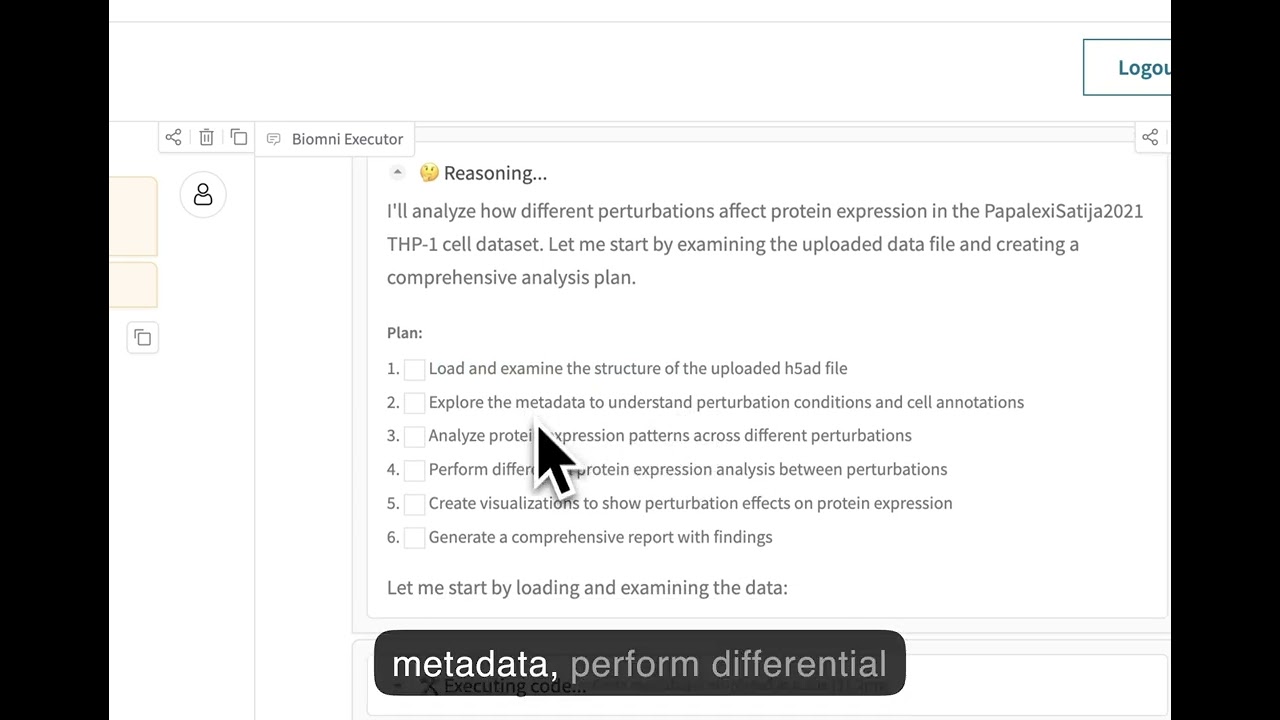
Important Note
- Security warning: Currently, Biomni executes LLM-generated code with full system privileges. If you want to use it in production, please use in isolated/sandboxed environments. The agent can access files, network, and system commands. Be careful with sensitive data or credentials.
- This release was frozen as of April 15 2025, so it differs from the current web platform.
- Biomni itself is Apache 2.0-licensed, but certain integrated tools, databases, or software may carry more restrictive commercial licenses. Review each component carefully before any commercial use.
Cite Us
@article{huang2025biomni,
  title={Biomni: A General-Purpose Biomedical AI Agent},
  author={Huang, Kexin and Zhang, Serena and Wang, Hanchen and Qu, Yuanhao and Lu, Yingzhou and Roohani, Yusuf and Li, Ryan and Qiu, Lin and Zhang, Junze and Di, Yin and others},
  journal={bioRxiv},
  pages={2025--05},
  year={2025},
  publisher={Cold Spring Harbor Laboratory}
}
2 maintainers


Metadata
2 maintainers
Release files for biomni 0.0.8
For a detailed explanation of source distributions (sdists) and built distributions (wheels), please see the package formats documentation.
Source distribution (sdist)
| File | Size | Uploaded | Provenance | |
|---|---|---|---|---|
| biomni-0.0.8.tar.gz | 506.7 kB | Without provenance | Details |
Built distribution (wheel)
| File | Interpreter | ABI | Platform | Reset |
|---|---|---|---|---|
| biomni-0.0.8-py3-none-any.whl | Python 3 | none | any | Details |
Total release size: 1.1 MB
Release files / biomni-0.0.8.tar.gz
| Download URL | biomni-0.0.8.tar.gz |
|---|---|
| Size | 506.7 kB |
| Tags | Source |
|
SHA-256 checksum How to use checksums |
909f0c9d56f0607d0190bed190a4957e4fb8b335c162d514ffd262744aef6c47
|
|
BLAKE2b-256 checksum How to use checksums |
b524d6ade4dd4ac0acb6922564f0902e5ad9bc7232dd7693b1a2b2b75995a9d2
|
| Upload date | |
|
Uploaded using Trusted Publishing? What is trusted publishing? |
No |
| Uploaded via |
twine/6.1.0 CPython/3.11.13
|
Release files / biomni-0.0.8-py3-none-any.whl
| Download URL | biomni-0.0.8-py3-none-any.whl |
|---|---|
| Size | 555.7 kB |
| Tags | Python 3 |
|
SHA-256 checksum How to use checksums |
723e271097d0ef0d4a0f0b4746a28884afd617dcdd9e4496d06c2b53815e9770
|
|
BLAKE2b-256 checksum How to use checksums |
b214519e5912fbdfe8c06e173b8e35454f3a4a69fc8a901e214f13f839922aeb
|
| Upload date | |
|
Uploaded using Trusted Publishing? What is trusted publishing? |
No |
| Uploaded via |
twine/6.1.0 CPython/3.11.13
|
Security for biomni 0.0.8
Provenance
Provenance describes where a file came from. On PyPI, provenance is shared via attestations, which provide a verifiable record of the build or publishing details. View details, limitations and caveats.
No provenance found
None of the files in this release were uploaded with provenance metadata.
A note on package security
PyPI is a repository for distributing packages, not a service for auditing them. While third-party security researchers and our staff do their best to detect and remove malicious packages, PyPI cannot guarantee the quality, security or suitability of any given package.
To learn more about protecting yourself from malicious actors, visit our package security documentation.














