
Business logic core for python (bisslog-core-py)


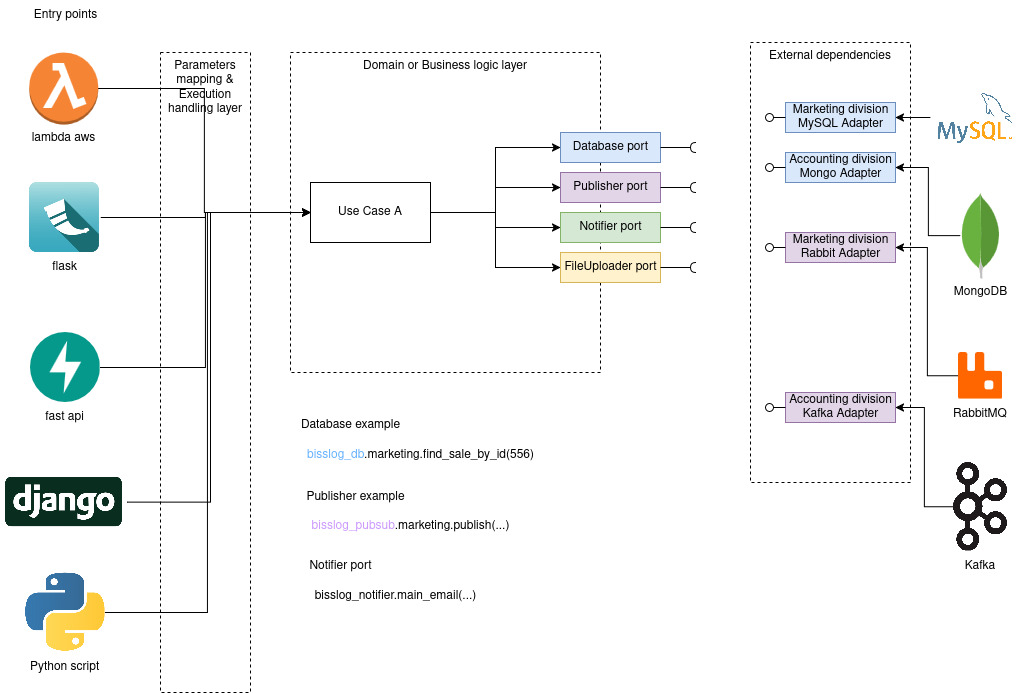
bisslog-core is a lightweight and dependency-free Python library that implements the Hexagonal Architecture (Ports and Adapters).
It enforces a strict separation between domain logic, application, and infrastructure, allowing easy integration with different frameworks and external services without modifying core business logic.
This library serves as an auxiliary layer for business logic or service domain, providing a common language for operations when interacting with external components.
In other words, the business rules remain unchanged even if the infrastructure changes (e.g., switching the messaging system).
The key principle is:
"The domain should not change because some adapter changed."
It is designed for backend functionality, framework-agnostic development, and to minimize migration costs.
🚀 Installation
You can install bisslog-core using pip:
pip install bisslog
Usage Example
Here is an example of what the implementation of a use case looks like without importing any additional dependencies.
Note: if the adapter is not implemented it will give execution attempt messages.
from random import random

from bisslog.database.bisslog_db import bisslog_db as db
from bisslog.use_cases.use_case_full import FullUseCase
from bisslog import use_case
from scripts.project_example_1.usecases.my_second_use_case import my_second_use_case


class SumarUseCase(FullUseCase):

    @use_case  # or simply def use()
    def something(self, a: int, b: int, user_id: int, transaction_id: str, *args, **kwargs) -> dict:
        component = self._transaction_manager.get_component()
        self.log.info("Receive a:%d b:%d %s", a, b, component, checkpoint_id="reception",
                      transaction_id=transaction_id)

        # Retrieve last session
        last_session = db.session.get_last_session_user(user_id)
        if last_session is not None:
            self.log.info(f"Last session of user {user_id} fue {last_session}",
                          checkpoint_id="last_session")

        db.session.save_new_session_user(user_id)

        db.event_type.loadWebhookEventType(5)
        rand = random()
        new_value = my_second_use_case(value=rand*10, product_type="string2", transaction_id=transaction_id)

        # Calculate result
        res = a + b
        if res > 10:
            self.log.warning("Es mayor que 10", checkpoint_id="check-response")

        # Publish event
        self.publish("queue_suma", {"suma": res + new_value, "operation": "a + b"})
        return {"suma": res}


sumar_use_case = SumarUseCase("sumar")
from bisslog import use_case, domain_context, transaction_manager, bisslog_upload_file


log = domain_context.tracer

@use_case
def my_second_use_case(value: float, product_type: str, *args, **kwargs) -> float:

        log.info(
            "Received %d %s", value, transaction_manager.get_component(),
            checkpoint_id="second-reception")

        if product_type == "string1":
            new_value = value * .2
        elif product_type == "string2":
            new_value = value * .3
        elif product_type == "string3":
            new_value = value * .5
        else:
            new_value = value * .05

        uploaded = bisslog_upload_file.main.upload_file_from_local("./test.txt", "/app/casa/20")

        if uploaded:

            log.info("Uploaded file component: %s", transaction_manager.get_component(),
                     checkpoint_id="uploaded-file")

        return new_value
For the configuration of the entry-points or primary libraries, they will only have to call the corresponding use case and map the fields. Here is an example with FastAPI. More examples
from typing import Annotated

from fastapi import FastAPI, Header, HTTPException

from scripts.project_example_1.usecases.my_first_use_case import sumar_use_case

app = FastAPI()

@app.get("/fast-api-example/first-use-case/{a}/{b}")
async def get_user(a: str, b: str,
                   user_id: Annotated[str | None, Header()]):
    print(a, b, user_id)
    if user_id is None:
        raise HTTPException(status_code=400, detail="user_id is required")
    res = sumar_use_case(int(a), int(b), int(user_id))
    res["identifier"] = "fast-api"
    return res
Definition of possible interfaces of divisions needed by the database, if not, it does not matter.
from abc import ABC, abstractmethod
from typing import Optional

from bisslog.adapters.division import Division


class SessionDivision(Division, ABC):

    @abstractmethod
    def save_new_session_user(self, user_identifier: int) -> None:
        raise NotImplementedError("save_new_session_user not implemented")

    @abstractmethod
    def get_last_session_user(self, user_identifier: int) -> Optional[dict]:
        raise NotImplementedError("get_last_session_user not implemented")
The following is a dummie implementation of the above division to give an example
import uuid
from datetime import datetime, timezone
from typing import Optional

from scripts.project_example_1.database.session_division import SessionDivision


cache_db = {"session": []}

class SessionDivisionCache(SessionDivision):

    def get_last_session_user(self, user_identifier: int) -> Optional[dict]:

        user_sessions = [session for session in cache_db["session"]
                         if session["user"] == user_identifier]
        if not user_sessions:
            return None
        return user_sessions[-1]


    def save_new_session_user(self, user_identifier: int) -> None:
        cache_db["session"].append({"user": user_identifier, "id": uuid.uuid4().hex,
                                    "created_at": datetime.now(timezone.utc)})

session_division_cache = SessionDivisionCache()
🧪 Running library tests
To Run test with coverage
coverage run --source=bisslog -m pytest tests/
To generate report
coverage html && open htmlcov/index.html
📜 License
This project is licensed under the MIT License. See the LICENSE file for details.
1 maintainer

Metadata
1 maintainer
Release files for bisslog 0.0.9
For a detailed explanation of source distributions (sdists) and built distributions (wheels), please see the package formats documentation.
Source distribution (sdist)
| File | Size | Uploaded | Provenance | |
|---|---|---|---|---|
| bisslog-0.0.9.tar.gz | 159.9 kB | Without provenance | Details |
Built distribution (wheel)
| File | Interpreter | ABI | Platform | Reset |
|---|---|---|---|---|
| bisslog-0.0.9-py3-none-any.whl | Python 3 | none | any | Details |
Total release size: 207.5 kB
Release files / bisslog-0.0.9.tar.gz
| Download URL | bisslog-0.0.9.tar.gz |
|---|---|
| Size | 159.9 kB |
| Tags | Source |
|
SHA-256 checksum How to use checksums |
59d39502d2b820af6de093a20f3ef2ac96d73396bd86759e93bd6f7d0e001c72
|
|
BLAKE2b-256 checksum How to use checksums |
89469843d722a20cfacdc2d5f58d01d11c20fd52f97109976ab28fbdf9bafa22
|
| Upload date | |
|
Uploaded using Trusted Publishing? What is trusted publishing? |
No |
| Uploaded via |
twine/6.2.0 CPython/3.13.7
|
Release files / bisslog-0.0.9-py3-none-any.whl
| Download URL | bisslog-0.0.9-py3-none-any.whl |
|---|---|
| Size | 47.6 kB |
| Tags | Python 3 |
|
SHA-256 checksum How to use checksums |
9f54cdb837d1de57b484724e9085eaa2a02fba2719c9eab0def91ed0dd2e0b63
|
|
BLAKE2b-256 checksum How to use checksums |
5f9a852eb3561b1f2827ce9d0bbb0d6fcf5fc80c43c735e65d864ae21f0f5d2b
|
| Upload date | |
|
Uploaded using Trusted Publishing? What is trusted publishing? |
No |
| Uploaded via |
twine/6.2.0 CPython/3.13.7
|
Security for bisslog 0.0.9
Provenance
Provenance describes where a file came from. On PyPI, provenance is shared via attestations, which provide a verifiable record of the build or publishing details. View details, limitations and caveats.
No provenance found
None of the files in this release were uploaded with provenance metadata.
A note on package security
PyPI is a repository for distributing packages, not a service for auditing them. While third-party security researchers and our staff do their best to detect and remove malicious packages, PyPI cannot guarantee the quality, security or suitability of any given package.
To learn more about protecting yourself from malicious actors, visit our package security documentation.














