
Generate lottery grids from cryptographic randomness and plan a month within a hard budget cap.
Verified details
These details have been verified by PyPIProject links
GitHub Statistics
Maintainers

Project description
blindgrid
Lottery grids from cryptographic randomness,
inside a budget you cannot exceed.



Install · What it refuses to do · Households · Tablets · Language · Add your own lottery · Responsible gambling
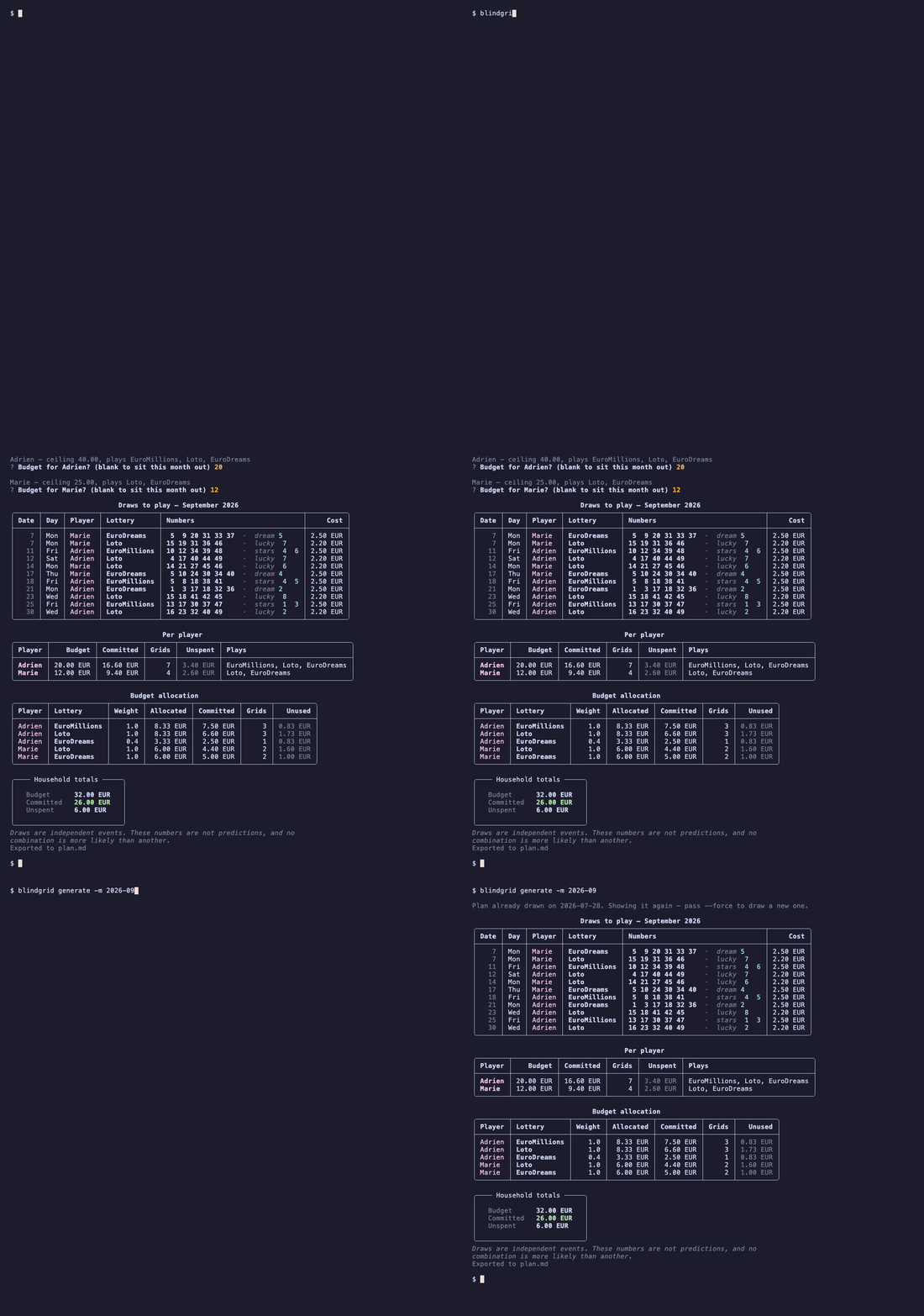
What this is
A small CLI that answers two questions once a month:
- Which draws should I play? Given a budget and a set of lotteries, it allocates the money by weight, picks real calendar dates at random, and stops. No pattern, no habit, no "I always play on Saturdays".
- Which numbers? Drawn from
secrets.SystemRandom, then filtered against a handful of anti-pattern rules so the grid does not look like something a human would have chosen.
The plan is printed as a table and exported to a Markdown file.
What this is not
It does not predict anything, and it never will. Lottery draws are independent events. The numbers drawn last week carry no information about next week's draw; a number that has not come up in two years is not "due". This is not an opinion about lotteries, it is what independence means.
So the following are permanently out of scope, and pull requests adding them will be declined:
| Not here | Why |
|---|---|
| Historical draw data, frequency statistics, hot/cold numbers | Past draws say nothing about future ones. Displaying them implies otherwise. |
A --seed flag or any deterministic mode |
Reproducible numbers reintroduce exactly the structure this tool removes. |
| A history of past months | Months of stored grids invite comparing them against results, and comparing invites pattern-hunting. The current month is kept so you can find it again — one file, replaced, never accumulated. |
| Any attempt to spend the budget exactly | Unspent money is a good outcome. A tool that consumed the envelope would encourage spending. |
What is left, then? Two honest things: randomness without human bias, and a budget ceiling that does not move.
Why filter the numbers at all, if every combination is equally likely?
Because the payout is not equally likely. Every combination has the same probability of being drawn, but combinations humans favour — birthdates below 32, sequences, neat patterns — are picked by thousands of other players at the same time. When such a combination wins, the jackpot is split. Filtering does not improve your odds of winning; it improves what you would receive if you did.
The rule set stays deliberately small for the same reason. Every additional rule shrinks the sample space, and a heavily filtered "random" pick is just a different kind of predictable.
Install
Runs on Linux, macOS, Windows, and iOS through a-Shell.
pip install blindgrid # or: uv tool install blindgrid
That is the whole of it if you already have Python 3.11 or newer. The scripts
below add a little more: they pick an install method for you, write a starter
configuration, and tell you what to put on your PATH.
macOS and Linux
curl -fsSL https://raw.githubusercontent.com/adrnbttr/blindgrid/main/install.sh | bash
Windows (PowerShell)
irm https://raw.githubusercontent.com/adrnbttr/blindgrid/main/install.ps1 | iex
Either one installs into your own user profile, writes a starter config, and
tells you what to add to your PATH if anything is missing. Neither asks for
sudo or administrator rights, and neither writes outside your home
directory. Prefer to read the script first? Download it and open it — both are
short, and both are linted in CI (shellcheck, PSScriptAnalyzer).
Python 3.11 or newer is required, except with uv, which brings its own.
3.11 is a floor, not a default: it is the newest Python a-Shell ships, and
raising it would drop iPad support — a test says so.
Uninstalling is install.sh --uninstall / install.ps1 -Uninstall, and your
config survives it.
iPad and iPhone, in a-Shell (free, App Store):
pip install blindgrid
Then python3 -m blindgrid generate. Every dependency is pure Python, which is
what makes this work on a device with no compiler. If pip is not on your path
there, curl -sL https://raw.githubusercontent.com/adrnbttr/blindgrid/main/install.py | python3
does the same and sets up a starter config — see
On a tablet or a phone.
Full installation guide — per-platform details, other install methods, file locations, troubleshooting, updating, uninstalling.
Use
blindgrid config show      # where your config lives and what is in it
blindgrid generate         # plan the current month
generate asks for two things — the budget for this month, and which lotteries
to include — then prints the plan and writes plan.md. It plans the current
month by default; --month is only there for planning ahead.
A month is drawn once
Run generate again and you get the same plan back, not a new one:
$ blindgrid generate
Plan already drawn on 2026-09-01. Showing it again — pass --force to draw a new one.
This is partly convenience — you can come back to it while you fill your grids — but mostly it is the point. A tool that redrew on every run would let you reroll until the numbers looked right, and picking the draw you like best is exactly the bias the filters exist to remove.
--force is there for the genuine mistake, a mistyped budget or the wrong
lotteries. It says what it is replacing before it does it.
The plan lives in one file in your state directory (see file locations), replaced when the month turns. It is a self-contained snapshot, so editing your config afterwards never changes a plan you already hold. Draws whose date has passed are struck through when the plan is shown again, so what is left to play is obvious.
On a tablet or a phone
The plan lays itself out to fit. Below roughly 80 columns — an iPad in portrait, a phone, a split view — the table is dropped for a list, and the numbers get a line to themselves:
September 2026

 8 Tue  EuroMillions  Adrien  2.50 EUR
    10 11 30 34 47  ·  stars  8 12

 9 Wed  Loto  Adrien  2.20 EUR
     7 20 22 34 35  ·  lucky  2
The numbers are the one thing you copy onto a paper slip, so they are never
wrapped and nothing is ever cut to Eur…. It stays readable down to about 40
columns. --compact and --table force either layout.
Playing as a household
Two people, one month, one command. Everyone keeps their own ceiling and their own games:
blindgrid player add     # name, ceiling, which lotteries, what weights
blindgrid generate       # asks each person for their budget, then plans
╭────────────┬───────────┬────────┬──────────────┬──────────────────────────┬──────────╮
│ Date       │ Day       │ Player │ Lottery      │ Numbers                  │     Cost │
├────────────┼───────────┼────────┼──────────────┼──────────────────────────┼──────────┤
│ 2026-09-11 │ Friday    │ Adrien │ EuroMillions │ 10 11 22 35 36 · stars…  │ 2.50 EUR │
│ 2026-09-19 │ Saturday  │ Marie  │ Loto         │  4  5 10 38 42 · lucky 3 │ 2.20 EUR │
│ 2026-09-21 │ Monday    │ Marie  │ EuroDreams   │  7  9 18 32 34 · dream 5 │ 2.50 EUR │
╰────────────┴───────────┴────────┴──────────────┴──────────────────────────┴──────────╯
Three things hold:
- Nobody spends against anyone else's ceiling. Each person has their own
max_monthly_budget, and one player's budget never changes another's share. There is no household cap, on purpose: if two people together want to spend more than they should, that is a conversation, not something software gets to arbitrate. - Everyone plays only their own games. Weights are per person; a weight of zero, or simply leaving a lottery out, means they never play it.
- Draws are spread out. The household covers as many different draws as it can before any date is played twice.
On spreading draws
Spreading does not improve anyone's odds, and the tool will never claim it does. Two grids are two independent chances whether they sit on the same draw or on two different ones, and the probability that at least one of them wins is identical either way.
What it does buy is exposure to more distinct jackpots — some of which have rolled over and are larger — and the certainty that two people in one house are not holding near-duplicate tickets for a single draw. That is diversification, not an edge.
When there are fewer draws left than grids to play, dates are shared rather than grids dropped, and the output says which. Losing a grid someone budgeted for, to satisfy a rule that does not change the odds, would be the wrong trade.
[[player]]
name = "Adrien"
max_monthly_budget = 40.00
  [player.weight]
  EuroMillions = 1.0
  Loto = 1.0
  EuroDreams = 0.4

[[player]]
name = "Marie"
max_monthly_budget = 25.00
  [player.weight]
  Loto = 1.0
  EuroDreams = 1.0
Declare nobody and blindgrid stays in single-player mode, exactly as before.
Usage: blindgrid [OPTIONS] COMMAND [ARGS]...

  generate    Build this month's plan: how much to spend, which draws, which numbers.
  config      Inspect and edit the configuration.
  lottery     Manage lottery definitions.
  player      Manage the people who play.
  version     Print the installed version.
Useful options on generate:
| Option | Effect |
|---|---|
-b, --budget 30 |
Skip the prompt and use this amount. With players: -b "Adrien=30", repeatable. |
-l, --lottery Loto |
Include a specific lottery. Repeatable. Single-player mode only. |
-p, --player Marie |
Limit the plan to these people. Repeatable. |
-m, --month 2026-09 |
Plan a month other than the current one. |
--force |
Draw a new plan even though this month already has one. |
--no-export |
Print the plan without writing plan.md. |
--lang fr |
Interface language for this run. See Language. |
--compact / --table |
Force the narrow layout, or the table. Default: whichever fits. |
-c, --config path |
Use a specific configuration file. |
Every prompt has an option that skips it, so the whole tool works without an interactive terminal — in a script, over SSH, or in a shell that cannot draw prompts.
Language
The interface speaks English, French, Spanish and German, and follows your system locale by default — so there is usually nothing to set at all.
blindgrid generate --lang fr |
Just this run. Works before the command too. |
blindgrid config edit |
Pick one and keep it. |
export BLINDGRID_LANG=es |
For a shell session. |
language = "de" in config.toml |
Written by config edit, or by hand. |
Order of precedence: --lang, then BLINDGRID_LANG, then language in the
config file, then your system locale, then English.
The whole interface moves, including month and weekday names:
$ blindgrid generate --lang fr

              Tirages à jouer — septembre 2026
╭────────────┬──────────┬──────────────┬───────────────────────┬──────────╮
│ Date       │ Jour     │ Loterie      │ Numéros               │     Coût │
├────────────┼──────────┼──────────────┼───────────────────────┼──────────┤
│ 2026-09-04 │ vendredi │ EuroMillions │ 5 19 28 32 50 · … 1 2 │ 2.50 EUR │
╰────────────┴──────────┴──────────────┴───────────────────────┴──────────╯

  Poids · Alloué · Engagé · Grilles · Non dépensé
Terms follow each country's own vocabulary rather than a literal translation: a played grid is an apuesta in Spanish and a Tipp in German, which is what the operators there call it.
Only the interface is translated. Lottery labels, pool names and player names
are printed exactly as you wrote them, and the weekday keys in the config file
stay English (monday, tuesday, …) — those are a file format, not text for
reading.
Adding a language is one file in src/blindgrid/i18n/ plus one line in its
__init__.py. Tests check that every catalogue carries exactly the same keys
and placeholders as the English one, so a half-finished translation fails the
build rather than leaking English sentences into someone's session.
Configuration
Two files:
config.example.toml— versioned, three French games as an illustration.config.toml— yours, gitignored, holding your own ceiling.
The ceiling is the point of the file:
max_monthly_budget = 40.00
generate refuses any budget above it. There is no override flag. A cap you
can raise in the moment while looking at a jackpot headline is not a cap.
Adding a lottery from any country
Nothing in the code knows about France, or about any specific game. A lottery is a price, a set of draw days, and one or more pools of numbers. That is the whole model, and it covers every draw-style lottery I am aware of.
Here is the US Powerball — five numbers from 69, plus one from 26, drawn on Mondays, Wednesdays and Saturdays at $2 a play:
[[lottery]]
label = "Powerball"
currency = "USD"
price_per_grid = 2.00
draw_days = ["monday", "wednesday", "saturday"]
weight = 1.0

  [[lottery.pool]]
  name = "numbers"
  count = 5
  max = 69

  [[lottery.pool]]
  name = "powerball"
  count = 1
  max = 26
Drop that into config.toml and it works. Or run blindgrid lottery add and
answer the prompts.
The filters adapt on their own: the 1-from-26 Powerball pool is too small for a parity or spread rule to mean anything, so those rules switch themselves off for it rather than searching forever for a combination that cannot exist.
Weights
Weights are relative shares of one envelope, not draw counts.
weight = 1.0   # EuroMillions
weight = 1.0   # Loto
weight = 0.4   # EuroDreams — played, but a smaller slice
weight = 0.0   # disabled, without deleting the definition
With a €40 budget and those weights, EuroMillions and Loto receive €16.66 each and EuroDreams €6.66. Each share then buys as many grids as it can afford, and the leftover in each share stays unspent. It is never pooled, never redistributed, never rounded up into one more grid.
If a share cannot cover a single grid, that lottery is skipped for the month and the output says so explicitly. It never borrows from another share to make itself viable.
The randomness
Every number comes from secrets.SystemRandom, which draws from the operating
system's entropy pool. The random module is not imported anywhere in the
package — its Mersenne Twister is seedable and reproducible, which is a
liability here — and a test enforces that.
The same source picks which dates to play, because a schedule chosen by habit is as predictable as numbers chosen by birthdate.
Development
uv pip install -e ".[dev]"
pytest
ruff check .
ruff format --check .
CI runs both on Python 3.11, 3.12 and 3.13.
Responsible gambling
This tool exists because a budget written down and capped is better than a budget decided in the moment. It does not make gambling profitable. Over any meaningful number of draws, the expected return of a lottery ticket is negative — that is how lotteries fund themselves — and no arrangement of numbers changes that.
Play with money you have already decided to lose. If gambling has stopped being a small monthly cost and started being something else, these services are free and confidential:
- France — Joueurs Info Service, 09 74 75 13 13, https://www.joueurs-info-service.fr
- United Kingdom — GamCare, 0808 8020 133, https://www.gamcare.org.uk
- United States — 1-800-GAMBLER, https://www.ncpgambling.org
- International — https://www.gamblingtherapy.org
License
MIT — see LICENSE.
Project details
Verified details
These details have been verified by PyPIProject links
GitHub Statistics
Maintainers
Release history Release notifications | RSS feed


Download files
Download the file for your platform. If you're not sure which to choose, learn more about installing packages.
Source Distribution
Built Distribution
Filter files by name, interpreter, ABI, and platform.
If you're not sure about the file name format, learn more about wheel file names.
Copy a direct link to the current filters
File details
Details for the file blindgrid-0.2.0.tar.gz.
File metadata
- Download URL: blindgrid-0.2.0.tar.gz
- Upload date:
- Size: 88.4 kB
- Tags: Source
- Uploaded using Trusted Publishing? Yes
- Uploaded via: twine/6.1.0 CPython/3.13.14
File hashes
| Algorithm | Hash digest | |
|---|---|---|
| SHA256 |
d0c67219fad4dfe008e7adbafd6359681861b700c9a40452e3bb64b7ef43864a
|
|
| MD5 |
41ed3bf518f8410b07b8c02804479a54
|
|
| BLAKE2b-256 |
cddb37cb0831f9e39f315d8c430c104a59a7fe195c887bfe798e4bd86e47a622
|
Provenance
The following attestation bundles were made for blindgrid-0.2.0.tar.gz:
Publisher:
release.yml on adrnbttr/blindgrid
-
Statement:
-
Statement type:
https://in-toto.io/Statement/v1 -
Predicate type:
https://docs.pypi.org/attestations/publish/v1 -
Subject name:
blindgrid-0.2.0.tar.gz -
Subject digest:
d0c67219fad4dfe008e7adbafd6359681861b700c9a40452e3bb64b7ef43864a - Sigstore transparency entry: 2260747342
- Sigstore integration time:
-
Permalink:
adrnbttr/blindgrid@ffaf2ac5faccba3fec1d08d991aefee3d89b35e8 -
Branch / Tag:
refs/tags/v0.2.0 - Owner: https://github.com/adrnbttr
-
Access:
public
-
Token Issuer:
https://token.actions.githubusercontent.com -
Runner Environment:
github-hosted -
Publication workflow:
release.yml@ffaf2ac5faccba3fec1d08d991aefee3d89b35e8 -
Trigger Event:
push
-
Statement type:
File details
Details for the file blindgrid-0.2.0-py3-none-any.whl.
File metadata
- Download URL: blindgrid-0.2.0-py3-none-any.whl
- Upload date:
- Size: 61.6 kB
- Tags: Python 3
- Uploaded using Trusted Publishing? Yes
- Uploaded via: twine/6.1.0 CPython/3.13.14
File hashes
| Algorithm | Hash digest | |
|---|---|---|
| SHA256 |
32860fbfa6260513b9c249562d9edc45c93c928c46af6aaa60a7486e4098af17
|
|
| MD5 |
14de54afdee48358e8d58e25893445be
|
|
| BLAKE2b-256 |
4a1a480a55fd6647671bcd1402a95e62892dc77cf3759dff0e0bf3c5a8e0df54
|
Provenance
The following attestation bundles were made for blindgrid-0.2.0-py3-none-any.whl:
Publisher:
release.yml on adrnbttr/blindgrid
-
Statement:
-
Statement type:
https://in-toto.io/Statement/v1 -
Predicate type:
https://docs.pypi.org/attestations/publish/v1 -
Subject name:
blindgrid-0.2.0-py3-none-any.whl -
Subject digest:
32860fbfa6260513b9c249562d9edc45c93c928c46af6aaa60a7486e4098af17 - Sigstore transparency entry: 2260747755
- Sigstore integration time:
-
Permalink:
adrnbttr/blindgrid@ffaf2ac5faccba3fec1d08d991aefee3d89b35e8 -
Branch / Tag:
refs/tags/v0.2.0 - Owner: https://github.com/adrnbttr
-
Access:
public
-
Token Issuer:
https://token.actions.githubusercontent.com -
Runner Environment:
github-hosted -
Publication workflow:
release.yml@ffaf2ac5faccba3fec1d08d991aefee3d89b35e8 -
Trigger Event:
push
-
Statement type:






