
A blog-oriented static site generation engine

Project description
BlogMore
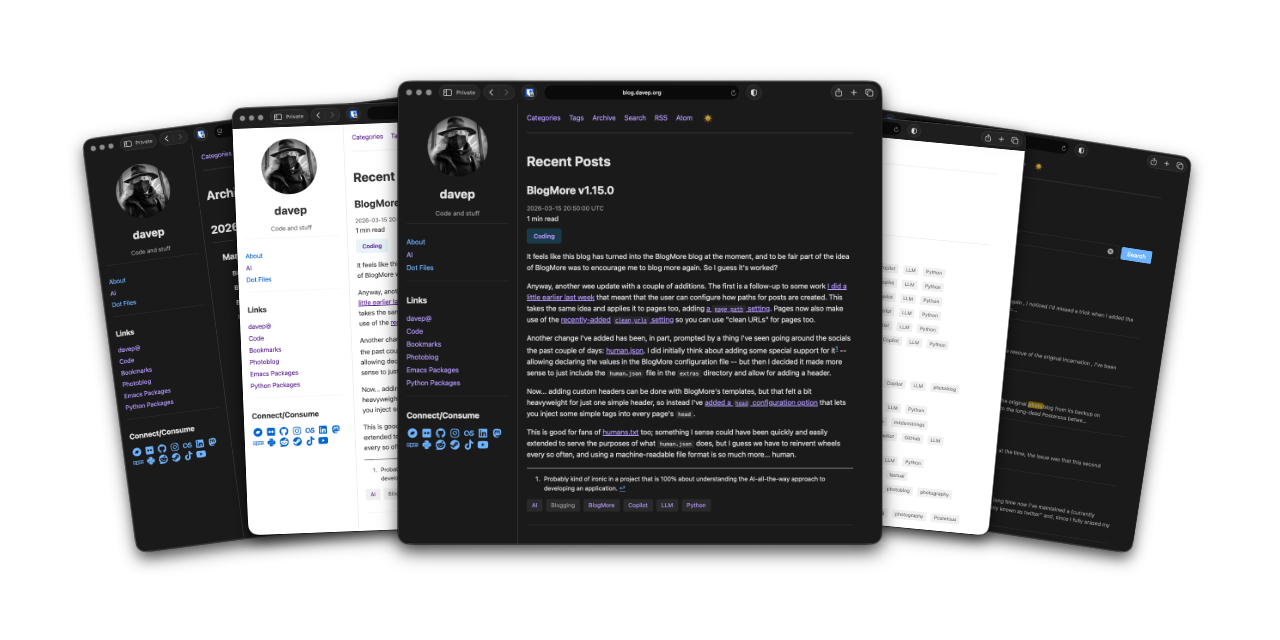
A blog-oriented static site generation engine built in Python.
[!IMPORTANT] This project is built almost 100% using GitHub Copilot. Every other Python project you will find in my repository is good old human-built code. This project is the complete opposite: as much as possible I'm trying to write no code at all as an experiment in getting to know how this process works, how to recognise such code, and to understand those who use this process every day to, in future, better guide them.
If "AI written" is a huge red flag for you I suggest you avoid this project; you'll find plenty of other pure-davep-built projects via my profile.
What is BlogMore?
BlogMore is a blog-oriented static site generation engine built in Python. It transforms your Markdown files into a complete, modern blog website with a clean, responsive design—no database, no server-side runtime required.
See my own blog for an example of a site created with BlogMore (the site is hosted on GitHub pages, with the repository over here).
Key Features
- Static site generator — produces plain HTML/CSS/JS that can be hosted anywhere
- Markdown-based content — write all your posts in Markdown with support for code highlighting, tables, and footnotes
- Frontmatter metadata — control post metadata (title, date, tags, category, author) through YAML frontmatter
- Jinja2 templating — fully customisable templates for complete control over your site's appearance
- Client-side search — optional full-text search across post titles and content, running entirely in the browser with no external services
- Automatic icon generation — generate favicons and platform-specific icons (iOS, Android/Chrome, Windows) from a single source image
- CSS minification — optional minification of the generated stylesheet
- JavaScript minification — optional minification of generated scripts
- HTML minification — optional minification of every generated HTML page
- Flexible post URL format — fully configurable post output paths and URLs
via the
post_pathoption; choose date-based paths, per-post directories, category-based layouts, and more - Optional reading time display — estimated reading time shown next to the post date, based on 200 words per minute
- GitHub-style admonitions — alert boxes (note, tip, important, warning,
caution) rendered from standard
> [!TYPE]blockquote syntax - RSS and Atom feeds — built-in feed generation for syndication
- XML sitemap — optional
sitemap.xmlfor search engine indexing - Blog statistics page — optional stats page with histograms, word counts, reading times, lifespan, top linked domains, and more
- Calendar view — optional full-history year calendar showing all posts, with links to day, month, and year archives; responsive design adapts from four months per row down to one
- SEO optimisation — meta tags, Open Graph tags, and Twitter Card support
- Automatic organisation — tag pages, category pages, and chronological archives generated automatically
- GitHub Pages integration — one-command publishing to GitHub Pages (or any git branch)
- Live preview server — local development server with automatic rebuilding on file changes
- YAML configuration file — keep all your settings in
blogmore.yamlinstead of repeating them on the command line
Installation
BlogMore requires Python 3.12 or later.
Using uv (recommended)
The fastest and most modern way to install BlogMore is with uv:
uv tool install blogmore
If you don't have uv installed you can use uvx.sh to
perform the installation. For GNU/Linux or macOS or similar:
curl -LsSf uvx.sh/blogmore/install.sh | sh
or on Windows:
powershell -ExecutionPolicy ByPass -c "irm https://uvx.sh/blogmore/install.ps1 | iex"
Using pipx
pipx install blogmore
From source
git clone https://github.com/davep/blogmore.git
cd blogmore
uv sync
Documentation
Full documentation -- including a getting-started guide, day-to-day usage, a complete configuration reference, and the command-line reference -- is available at blogmore.davep.dev.
Getting Help
- Feature requests, questions and discussion — GitHub Discussions
- Bug reports — GitHub Issues
Licence
BlogMore is released under the GPL-3.0-or-later licence.
Release history Release notifications | RSS feed


Download files
Download the file for your platform. If you're not sure which to choose, learn more about installing packages.
Source Distribution
Built Distribution
Filter files by name, interpreter, ABI, and platform.
If you're not sure about the file name format, learn more about wheel file names.
Copy a direct link to the current filters
File details
Details for the file blogmore-2.13.0.tar.gz.
File metadata
- Download URL: blogmore-2.13.0.tar.gz
- Upload date:
- Size: 102.3 kB
- Tags: Source
- Uploaded using Trusted Publishing? No
- Uploaded via: uv/0.11.6 {"installer":{"name":"uv","version":"0.11.6","subcommand":["publish"]},"python":null,"implementation":{"name":null,"version":null},"distro":{"name":"macOS","version":null,"id":null,"libc":null},"system":{"name":null,"release":null},"cpu":null,"openssl_version":null,"setuptools_version":null,"rustc_version":null,"ci":null}
File hashes
| Algorithm | Hash digest | |
|---|---|---|
| SHA256 |
f55f22f19410051d47b4b69d38d1cee76dab9d0bf131110228f4ca7f28704794
|
|
| MD5 |
06f32763b242d4c23f0ed7ffb1bea435
|
|
| BLAKE2b-256 |
00ee5f06630333bad5d69aec7045a78698cdfcf8e92f432372758ed31edb14a5
|
File details
Details for the file blogmore-2.13.0-py3-none-any.whl.
File metadata
- Download URL: blogmore-2.13.0-py3-none-any.whl
- Upload date:
- Size: 125.5 kB
- Tags: Python 3
- Uploaded using Trusted Publishing? No
- Uploaded via: uv/0.11.6 {"installer":{"name":"uv","version":"0.11.6","subcommand":["publish"]},"python":null,"implementation":{"name":null,"version":null},"distro":{"name":"macOS","version":null,"id":null,"libc":null},"system":{"name":null,"release":null},"cpu":null,"openssl_version":null,"setuptools_version":null,"rustc_version":null,"ci":null}
File hashes
| Algorithm | Hash digest | |
|---|---|---|
| SHA256 |
8e9afa3ea88436ed44c463b9fed6c36fd34d8dfb2ea12764b9ce70bcc0d05228
|
|
| MD5 |
baaed04bd504e558ab63cc4750271455
|
|
| BLAKE2b-256 |
1592243e47fd542779b4ba925059e49e888eaecb54f7aba7cba9ca2f039882ac
|






