




blue-sampler
Generate large stealthy point patterns (i.e. blue noise) on the unit torus $[0, 1)^D$. 📐
Stealthy point patterns exhibit vanishing density fluctuations at low frequencies, making them particularly suited for Monte Carlo integration, image stippling, and any application requiring well-distributed, low-discrepancy points.
📦 Installation
pip install blue-sampler
Quick Start
import blue_sampler as blue

# Generate 10,000 2D blue-noise points
x = blue.sample_points(N=10_000, D=2)
blue.plot(x)

# Structure factor
blue.plot_structure_factor(x)

# Image stippling
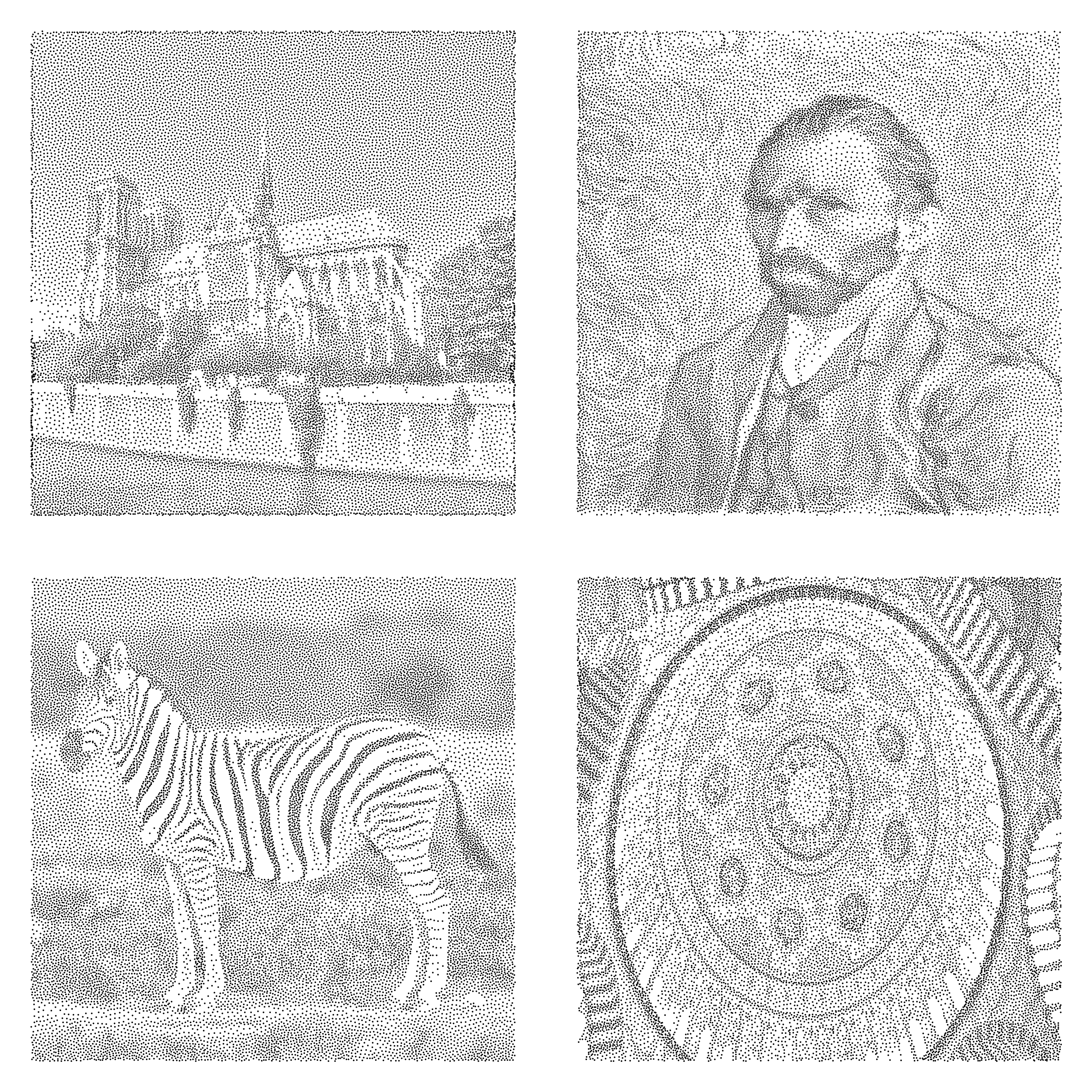
x = blue.im2points("plots/zebra.jpg")
🖼️ Examples
Uniform sampling, Gaussian Blue Noise (3k points)
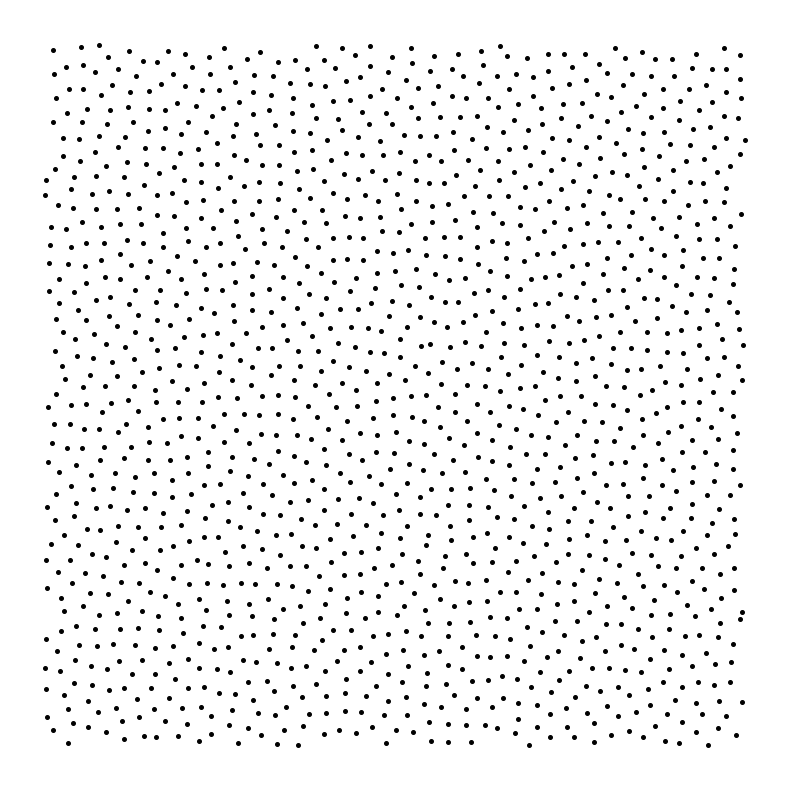
Image stippling with points (20k points)
📋 Available Samplers
Main sampling methods
x = blue.sample_points(N, D, method="rgbn") #(N, D)
| Method | Description |
|---|---|
gaussian |
original Gaussian-Blue-Noise sampler (high quality, slow), A. G. M. Ahmed, J. Ren, and P. Wonka. |
rgbn |
Recursive Gaussian-Blue-Noise (speed-up GBN with robust approximations) |
nufft/nufft+ |
Non-Uniform FFT (speed-up spectral methods with fast fourier transform) |
cstit |
STIT inspired clustering (clusters replace complex polygon geometry) |
latjit |
fast and simple lattice jittering |
All presented samplers, having linear complexity in the number of points, are thus intended to scale up to million points (at least in 2/3D) beyond the minute (GPU) or 20 minutes (CPU). Were their will be a difference will be in supported dimensions (or cardinality constrains on N), spectral quality, speed, gpu support, target support. Depending on one's specific task, it is recommanded to give them all a quick try, starting with rgbn and nufft. QUality can be checked with the structure factor and by ploting the points if D <= 3.
Alternative Samplers
Sobol sequence 📏
x = blue.sobol(N, D) #(N, D)
Low-discrepancy quasi-random sequence.
STIT Tessellations (2D only) 🧩
# Raw STIT tessellation (quadrilaterals)
ts = blue.sample_tessels(N) #(N, 4, D=2)
blue.plot_tessels(ts)

# Convert to point set
x = blue.tessel2points(ts) #(N, m, D=2)
Pinwheel Tilings (2D only) 𖣘
# Base pinwheel triangle
pw0 = blue.pinwheel_base()  #(3, D=2)

# Triangulation level 4
pw4 = blue.pinwheel_transform(pw0, depth=4) #(4*5**depth, 3, D=2)
blue.plot_polygons(pw4)

#===============================
# Convert Pinwheel to point set:
#===============================
#sample points from the BASE pinwheel
x0 = blue.tessel2points(pw0) #(m, D=2)
#then replicate the sample on the full triangulation,
#in a fractal way
x4 = blue.pinwheel_transform(x0, depth = 4) #(4*5**depth, m, D=2)
Note on GPU support: Most methods can run on CPU only, but they can benefit from GPU acceleration. To install the optional GPU dependencies for a CUDA 12 environment:
pip install blue-sampler[gpu]If the CUDA 12 installation fails, you may need to install
jax,cupy, andcufinufftmanually. Once installed, you can check that GPU support is correctly configured by running:import blue_sampler blue_sampler.check_gpu()
Note on adaptative sampling: The sampling methods implemented here support adaptive sampling from a target distribution. This feature is still experimental beyond 2d distributions
Note on structure factor: The estimation of sf assumes that the points domain is the unit hypercube and uses the standard
scattering intensity.
Note on tessel2points method: The conversion from geometric objects (polygons or clusters) to point sets is performed using a standard moment matching technique. cluster2points(x, p = 3) and tessel2points(x, p = 3) will sample m points per batch that mimic the statistical {0, 1, ... p-1} moments of the batch.
Supported Dimensions
| Dimension | Status |
|---|---|
| 2–3D | Fast ⚡ |
| 4–5D | Supported |
| ≥6D | Experimental 🧪 |
Documentation & Links 🔗
- 📖 Documentation: https://blue-sampler.readthedocs.io
- 📦 PyPI: https://pypi.org/project/blue-sampler
- 🌐 Project website: https://for-a-few-dpps-more.github.io/rgbn/
- 💻 GitHub: https://github.com/For-a-few-DPPs-more/rgbn
📚 References
The algorithms and mathematical tools implemented in blue-sampler are based or inspired from the following works.
-
Gaussian Blue Noise (repulsive interaction kernel)
A. G. M. Ahmed, J. Ren, and P. Wonka.
Gaussian Blue Noise.
ACM Transactions on Graphics (SIGGRAPH Asia), 41(6), 2022.
DOI: 10.1145/3550454.3555519 -
FReSCo
A. Shih, M. Casiulis, and S. Martiniani.
Fast Generation of Spectrally-Shaped Disorder.
Physical Review E, 110(3):034122, 2024.
DOI: 10.1103/PhysRevE.110.034122 -
STIT tessellations and moment matching
L. Lotz and M. A. Klatt.
Persistence of asymptotic variance under transport: from hyperfluctuation to stealthy hyperuniformity.
arXiv:2605.22803, 2026. -
Aperiodic tiling for hyuperuniformity (here pinwheel)
A. Gabrielli, B. Jancovici, M. Joyce, J. L. Lebowitz, L. Pietronero, and F. Sylos Labini.
Generation of Primordial Cosmological Perturbations from Statistical Mechanical Models.
Physical Review D, 67(4):043506, 2003. -
SquareNet (v1.3.11). 2026.
Grid data structure for point clouds, codeveloped with RGBN
for efficient neighbor query and fourier trnasform in Python. -
Sobol sequences
Wrapped fromscipy.stats.qmc.Sobol(SciPy). -
Nufft: The non uniform fast fourier transform (nufft) is performed using the finufft library [FIN] A parallel non-uniform fast Fourier transform library based on an “exponential of semicircle”
kernel. A. H. Barnett, J. F. Magland, and L. af Klinteberg. SIAM J. Sci. Comput. 41(5), C479-C504 (2019).
Positioning and scope
One can find extensive Blue-noise and hyperuniform sampling methods in the literature, all involving different trade-offs between spectral quality, computational cost, dimensionality, hardware requirements, implementation complexity, and support for adaptive sampling. To briefly cite some of them: Perturbed lattices are simple and fast; Poisson-disk is a mature and popular tool; Void-and-Cluster masks offer instant execution but are restricted to regular grids; Relaxation methods (such as Lloyd or CCVT) are classic but slow to converge and prone to structural artifacts; Optimal Transport (BNOT) provides natural adaptive sampling but is computationally heavy; Gaussian blue noise (GBN) achieves ultra-high spatial quality but has quadratic complexity; and Fast reciprocal space Correlator (FReSCo) combines ultra-high quality with near-linear complexity, though it requires installing heavy external dependencies or familiarity with docker containers.
blue-sampler is not intended as a universal replacement for these methods. It is a lightweight Python framework for experiments on blue noise and hyperuniformity, targeting simple installation (native Python code) and device flexibility (CPU/GPU), high spectral quality (achieving the commonly accepted "stealthy" criterions $S(k) \lesssim 10^{-3} - 10^{-4}$), adaptive sampling, and support for 3D and higher dimensions.
License
MIT
1 maintainer

Metadata
1 maintainer
Release files for blue-sampler 2.1.3
For a detailed explanation of source distributions (sdists) and built distributions (wheels), please see the package formats documentation.
Source distribution (sdist)
| File | Size | Uploaded | |
|---|---|---|---|
| blue_sampler-2.1.3.tar.gz | 47.2 kB | Details |
Built distribution (wheel)
| File | Interpreter | ABI | Platform | Reset |
|---|---|---|---|---|
| blue_sampler-2.1.3-py3-none-any.whl | Python 3 | none | any | Details |
Total release size: 103.0 kB
Release files / blue_sampler-2.1.3.tar.gz
| Download URL | blue_sampler-2.1.3.tar.gz |
|---|---|
| Size | 47.2 kB |
| Tags | Source |
|
SHA-256 checksum How to use checksums |
c7c72aed78753ddea1a579ebb761773b6aa69565b5ac2df2dafc6e39f4374615
|
|
BLAKE2b-256 checksum How to use checksums |
fec03db1a5fd3f17f0e0f0640d4ea87072c5b7b92fddadb05eda29f4a0a1b167
|
| Upload date | |
|
Uploaded using Trusted Publishing? What is trusted publishing? |
No |
| Uploaded via |
twine/7.0.0 CPython/3.14.4
|
Release files / blue_sampler-2.1.3-py3-none-any.whl
| Download URL | blue_sampler-2.1.3-py3-none-any.whl |
|---|---|
| Size | 55.9 kB |
| Tags | Python 3 |
|
SHA-256 checksum How to use checksums |
58b23b14a86c3432896ab8a53e585c2af6828e2e459eb4959078a0b3af510008
|
|
BLAKE2b-256 checksum How to use checksums |
0c4dee7c72d757af67902a24bb8b47a477a341d79065ecf98e7c2c3b0c598801
|
| Upload date | |
|
Uploaded using Trusted Publishing? What is trusted publishing? |
No |
| Uploaded via |
twine/7.0.0 CPython/3.14.4
|














