
Python framework for TradingView's Lightweight Charts JavaScript library.

Project description
bn-lightweight-charts-python





lightweight-charts-python aims to provide a simple and pythonic way to access and implement TradingView's Lightweight Charts.
Installation
pip install bn-lightweight-charts
History
Package is based on lightweight-charts-python Changes:
- used lightweight-charts js v:5.x
- added milti-pane support from lightweight-charts js v:5.x
- added support for charts resize and panel resize
- fixed issue with sync charts
- added support view in browser
Features
- Streamlined for live data, with methods for updating directly from tick data.
- Multi-pane charts using Subcharts.
- The Toolbox, allowing for trendlines, rectangles, rays and horizontal lines to be drawn directly onto charts.
- Events allowing for timeframe selectors (1min, 5min, 30min etc.), searching, hotkeys, and more.
- Tables for watchlists, order entry, and trade management.
- Direct integration of market data through Polygon.io's market data API.
Supports: Jupyter Notebooks, PyQt6, PyQt5, PySide6, wxPython, Streamlit, and asyncio.
PartTimeLarry: Interactive Brokers API and TradingView Charts in Python
Samples
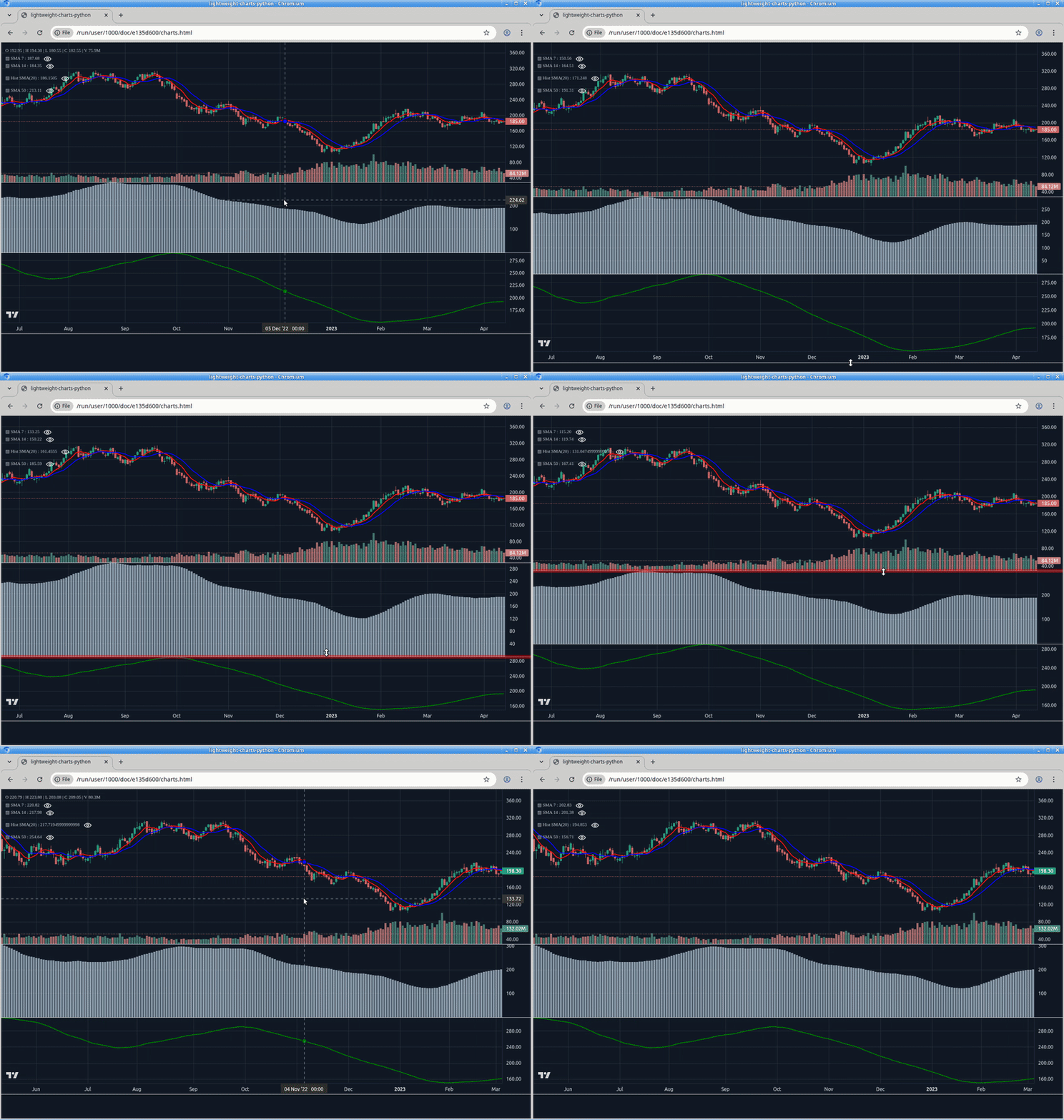
0. Multi-pane support
import pandas as pd
import webbrowser
from bn_lightweight_charts import HTMLChart

def calculate_sma(df, period: int = 50, name = None):
    name = name or f'SMA {period}'
    return pd.DataFrame({
        'time': df['date'],
        name: df['close'].rolling(window=period).mean()
    }) #.dropna()

def demo():
    chart = HTMLChart(width=1200, height=800, inner_height=-500, filename='charts.html')
    chart.legend(visible=True)
    df = pd.read_csv('./PDATA/4ohlcv.csv')
    chart.set(df)

    # Pane 0
    line7 = chart.create_line('SMA 7', color='red', price_line=False, price_label=False)
    sma7_data = calculate_sma(df, period=7)
    line7.set(sma7_data)
    line14 = chart.create_line('SMA 14', color='blue', price_line=False, price_label=False)
    sma14_data = calculate_sma(df, period=14)
    line14.set(sma14_data)

    # Pane 1
    sma20_data = calculate_sma(df, period=20, name='Hist SMA(20)')
    line20 = chart.create_histogram('Hist SMA(20)', price_line=False, price_label=False, pane_index=1)
    line20.set(sma20_data)

    # Pane 2
    sma50_data = calculate_sma(df, period=50)
    line50 = chart.create_line('SMA 50', color='green', price_line=False, price_label=False, pane_index=2)
    line50.set(sma50_data)

    chart.load()
    webbrowser.open(chart.filename)

if __name__ == '__main__':
    demo()
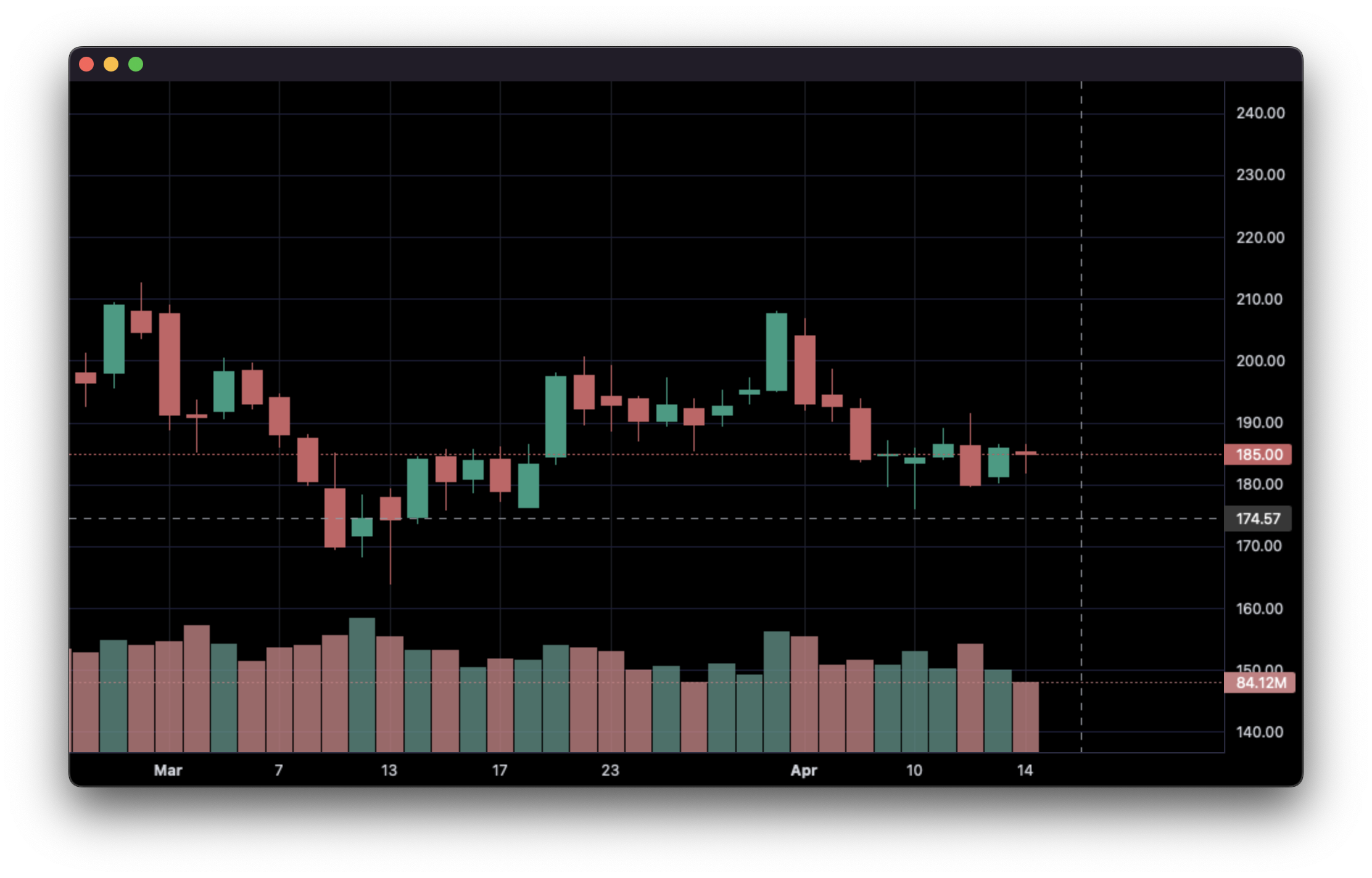
1. Display data from a csv:
import pandas as pd
from bn_lightweight_charts import Chart


if __name__ == '__main__':

    chart = Chart()

    # Columns: time | open | high | low | close | volume
    df = pd.read_csv('ohlcv.csv')
    chart.set(df)

    chart.show(block=True)
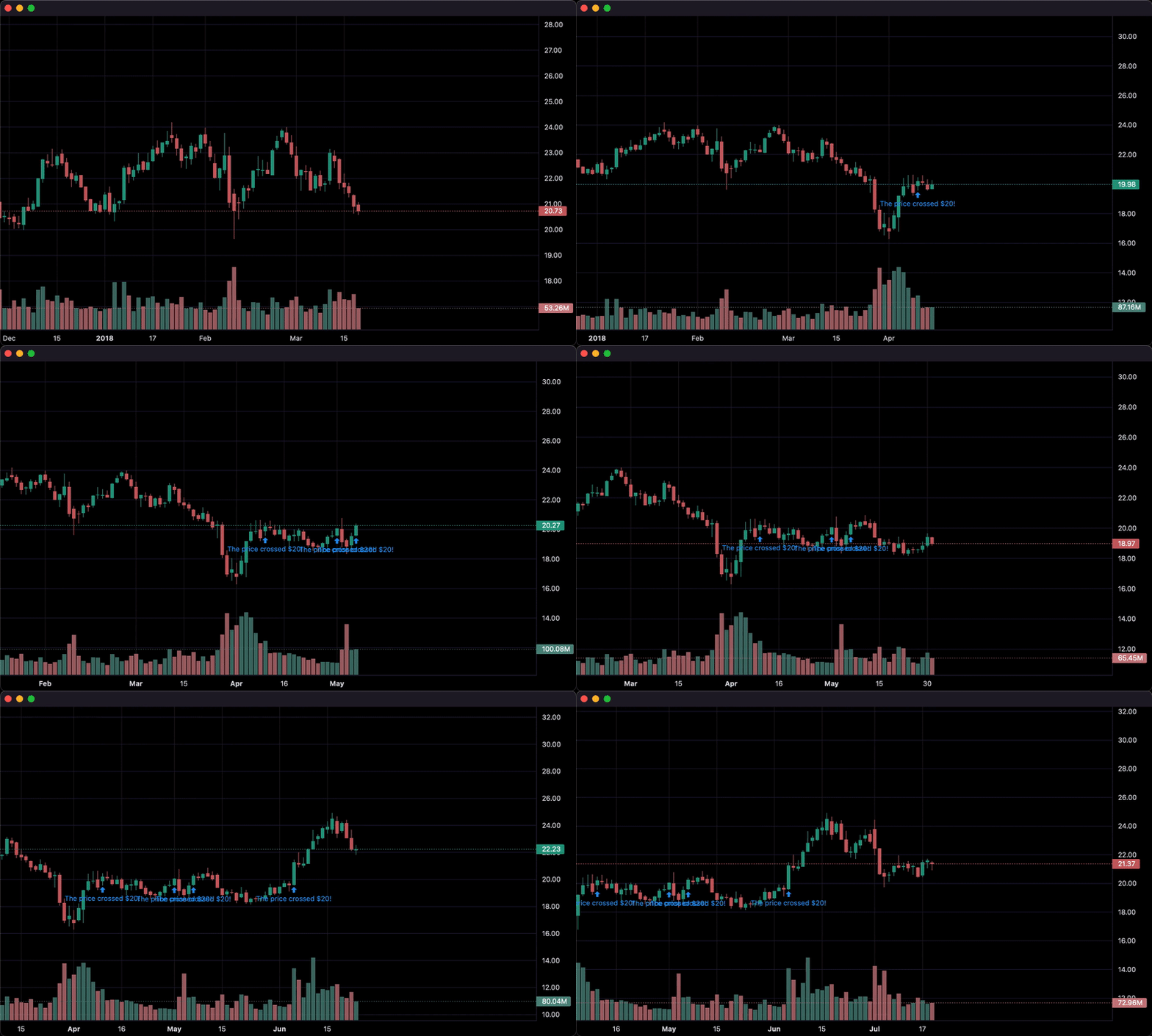
2. Updating bars in real-time:
import pandas as pd
from time import sleep
from bn_lightweight_charts import Chart

if __name__ == '__main__':

    chart = Chart()

    df1 = pd.read_csv('ohlcv.csv')
    df2 = pd.read_csv('next_ohlcv.csv')

    chart.set(df1)

    chart.show()

    last_close = df1.iloc[-1]['close']

    for i, series in df2.iterrows():
        chart.update(series)

        if series['close'] > 20 and last_close < 20:
            chart.marker(text='The price crossed $20!')

        last_close = series['close']
        sleep(0.1)
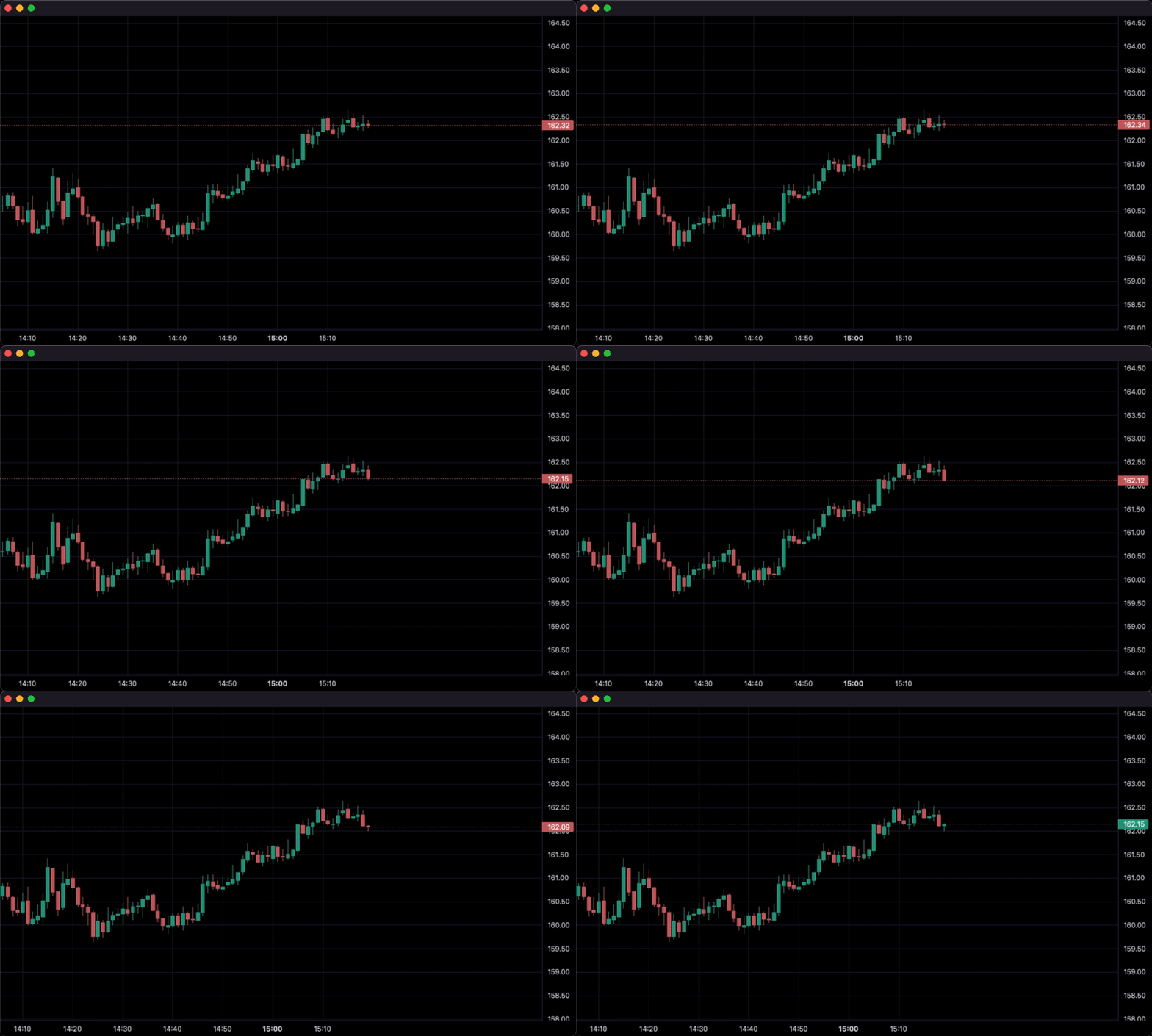
3. Updating bars from tick data in real-time:
import pandas as pd
from time import sleep
from bn_lightweight_charts import Chart


if __name__ == '__main__':

    df1 = pd.read_csv('ohlc.csv')

    # Columns: time | price
    df2 = pd.read_csv('ticks.csv')

    chart = Chart()

    chart.set(df1)

    chart.show()

    for i, tick in df2.iterrows():
        chart.update_from_tick(tick)

        sleep(0.03)
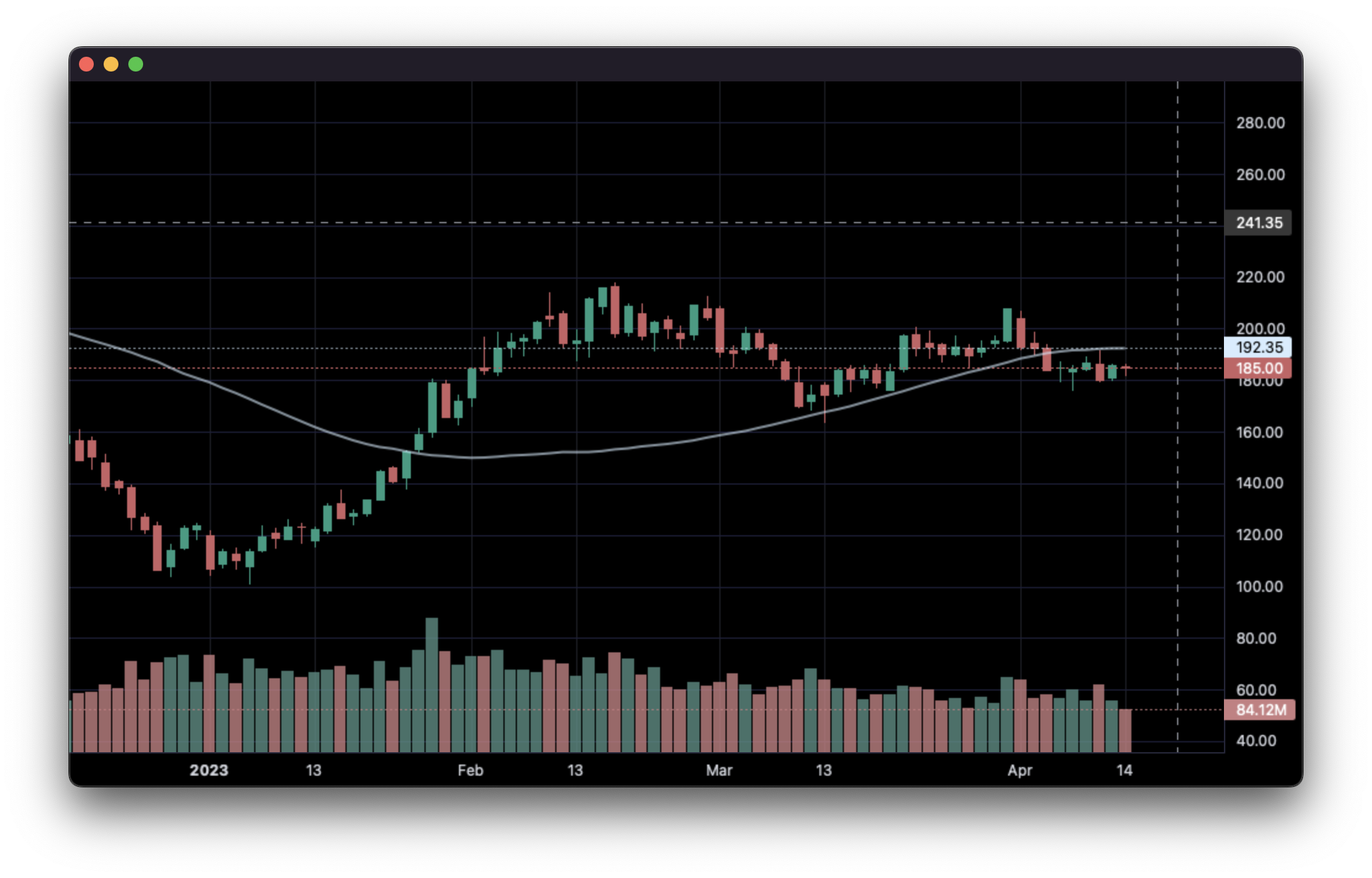
4. Line Indicators:
import pandas as pd
from bn_lightweight_charts import Chart


def calculate_sma(df, period: int = 50):
    return pd.DataFrame({
        'time': df['date'],
        f'SMA {period}': df['close'].rolling(window=period).mean()
    }).dropna()


if __name__ == '__main__':
    chart = Chart()
    chart.legend(visible=True)

    df = pd.read_csv('ohlcv.csv')
    chart.set(df)

    line = chart.create_line('SMA 50')
    sma_data = calculate_sma(df, period=50)
    line.set(sma_data)

    chart.show(block=True)
5. Styling:
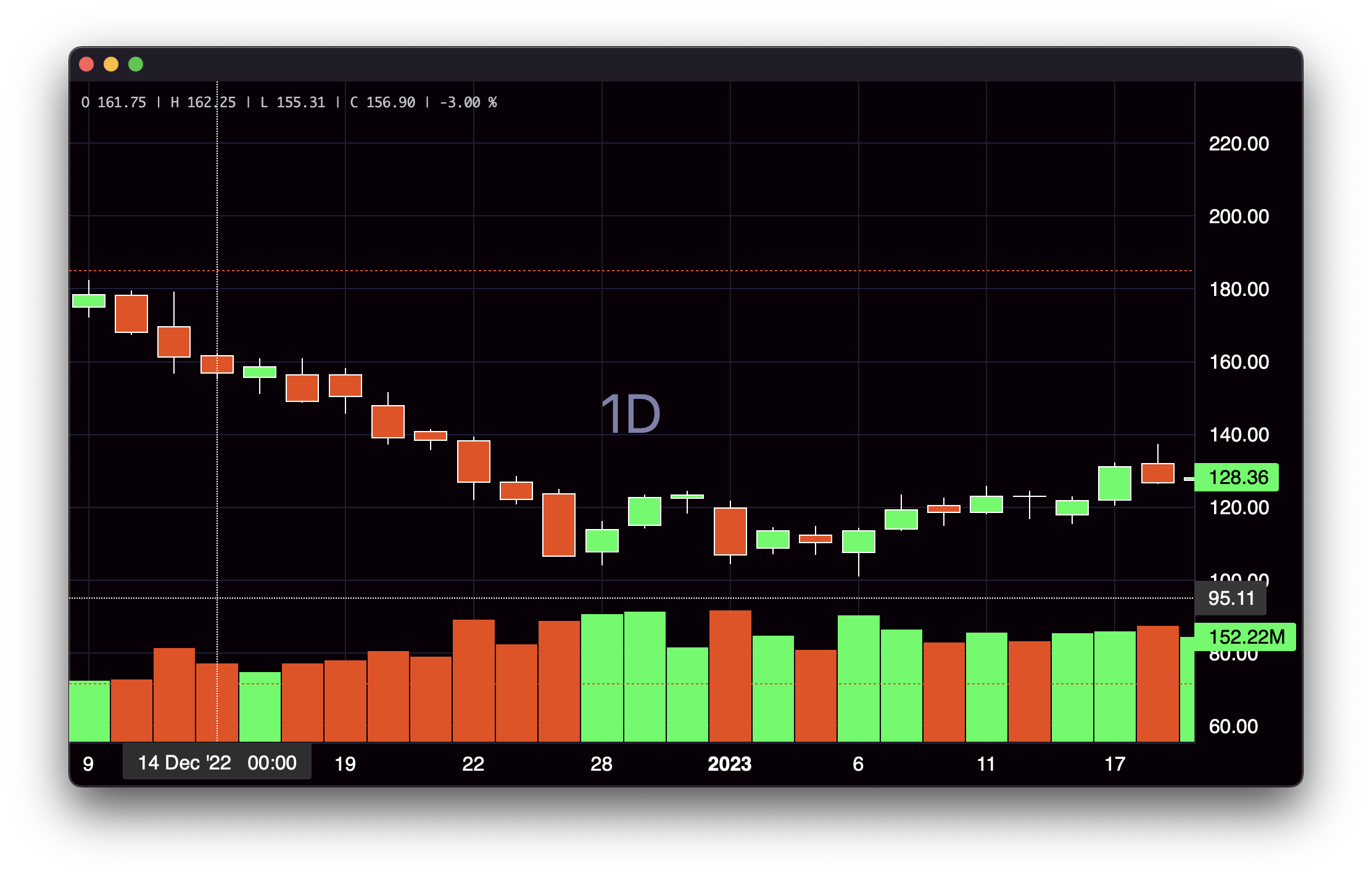
import pandas as pd
from bn_lightweight_charts import Chart


if __name__ == '__main__':

    chart = Chart()

    df = pd.read_csv('ohlcv.csv')

    chart.layout(background_color='#090008', text_color='#FFFFFF', font_size=16,
                 font_family='Helvetica')

    chart.candle_style(up_color='#00ff55', down_color='#ed4807',
                       border_up_color='#FFFFFF', border_down_color='#FFFFFF',
                       wick_up_color='#FFFFFF', wick_down_color='#FFFFFF')

    chart.volume_config(up_color='#00ff55', down_color='#ed4807')

    chart.watermark('1D', color='rgba(180, 180, 240, 0.7)')

    chart.crosshair(mode='normal', vert_color='#FFFFFF', vert_style='dotted',
                    horz_color='#FFFFFF', horz_style='dotted')

    chart.legend(visible=True, font_size=14)

    chart.set(df)

    chart.show(block=True)
6. Callbacks:
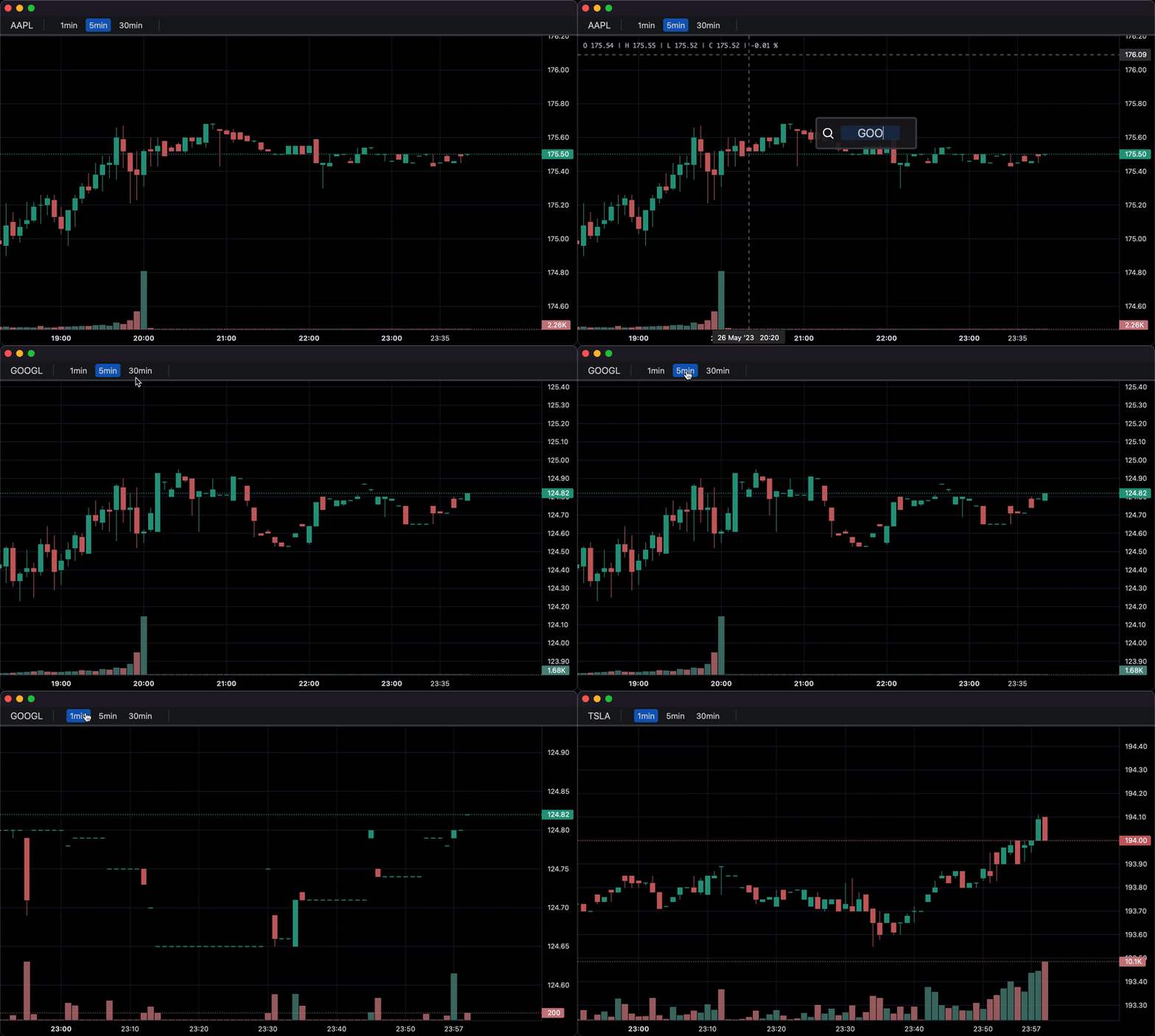
import pandas as pd
from bn_lightweight_charts import Chart


def get_bar_data(symbol, timeframe):
    if symbol not in ('AAPL', 'GOOGL', 'TSLA'):
        print(f'No data for "{symbol}"')
        return pd.DataFrame()
    return pd.read_csv(f'bar_data/{symbol}_{timeframe}.csv')


def on_search(chart, searched_string):  # Called when the user searches.
    new_data = get_bar_data(searched_string, chart.topbar['timeframe'].value)
    if new_data.empty:
        return
    chart.topbar['symbol'].set(searched_string)
    chart.set(new_data)


def on_timeframe_selection(chart):  # Called when the user changes the timeframe.
    new_data = get_bar_data(chart.topbar['symbol'].value, chart.topbar['timeframe'].value)
    if new_data.empty:
        return
    chart.set(new_data, True)


def on_horizontal_line_move(chart, line):
    print(f'Horizontal line moved to: {line.price}')


if __name__ == '__main__':
    chart = Chart(toolbox=True)
    chart.legend(True)

    chart.events.search += on_search

    chart.topbar.textbox('symbol', 'TSLA')
    chart.topbar.switcher('timeframe', ('1min', '5min', '30min'), default='5min',
                          func=on_timeframe_selection)

    df = get_bar_data('TSLA', '5min')
    chart.set(df)

    chart.horizontal_line(200, func=on_horizontal_line_move)

    chart.show(block=True)


Download files
Download the file for your platform. If you're not sure which to choose, learn more about installing packages.
Source Distribution
Built Distribution
Filter files by name, interpreter, ABI, and platform.
If you're not sure about the file name format, learn more about wheel file names.
Copy a direct link to the current filters
File details
Details for the file bn_lightweight_charts-1.0.0.tar.gz.
File metadata
- Download URL: bn_lightweight_charts-1.0.0.tar.gz
- Upload date:
- Size: 101.5 kB
- Tags: Source
- Uploaded using Trusted Publishing? No
- Uploaded via: twine/6.2.0 CPython/3.10.12
File hashes
| Algorithm | Hash digest | |
|---|---|---|
| SHA256 |
e0e055dfcf87e2b6eee802ad681725722e632b87f7cb5b734e49811c784a8d0f
|
|
| MD5 |
bee48122e8396ef941a39b9b55e1a069
|
|
| BLAKE2b-256 |
768da35ba97571602cf86b69b30b417ebb1b71e41752afa0b46cfab0ee9550a8
|
File details
Details for the file bn_lightweight_charts-1.0.0-py3-none-any.whl.
File metadata
- Download URL: bn_lightweight_charts-1.0.0-py3-none-any.whl
- Upload date:
- Size: 108.4 kB
- Tags: Python 3
- Uploaded using Trusted Publishing? No
- Uploaded via: twine/6.2.0 CPython/3.10.12
File hashes
| Algorithm | Hash digest | |
|---|---|---|
| SHA256 |
684107cc4429fd5a46dbf247a108fec00a04cbfaeea964cc08a27af2f7848a7e
|
|
| MD5 |
6c78da644c7976271b4921ee7335e1ff
|
|
| BLAKE2b-256 |
92a3610e0254d60dff19bde0d8c6f473994e1c919ba90766526762460e261373
|






