
BNC Lookup






Featured Article: Every Word Has a Price Tag — How word frequency data from the British National Corpus can transform your NLP pipelines.
Is this token a word? O(1) answer. No setup. No dependencies.
A simple question deserves a simple answer. This library gives you instant yes/no validation against 669,000 word forms from the British National Corpus, plus frequency ranking.
Quick Start
pip install bnc-lookup
import bnc_lookup as bnc

# Check if a word exists
bnc.exists('the')          # True
bnc.exists('however')      # True
bnc.exists('xyzabc123')    # False

# Get frequency bucket (1=most common, 100=least common)
bnc.bucket('the')          # 1
bnc.bucket('python')       # 4
bnc.bucket('qwerty')       # 12
bnc.bucket('xyzabc123')    # None (not found)

# Relative frequency (per-word precision)
bnc.relative_frequency('the')              # 0.0618
bnc.relative_frequency('shimmered')        # 9.79e-07

# Expected occurrences in a text of given length
bnc.expected_count('the', 50000)           # 3090.7
bnc.expected_count('the', 50000, rounded=True)  # 3091

# Handles plurals and case automatically
bnc.exists('computers')    # True
bnc.exists('THE')          # True
Morphological Analysis
Beyond existence and frequency, the library provides morphological suffix analysis: derivational suffixes (pre-computed, O(1)) and inflectional suffixes (runtime detection).
import bnc_lookup as bnc

# Derivational suffixes (pre-computed from morphroot)
bnc.get_suffixes('happiness')      # ['ness']
bnc.get_suffixes('beautifully')    # ['ful', 'ly']
bnc.get_suffixes('cat')            # []  (monomorphemic)
bnc.get_suffixes('xyz123')         # None (not in BNC)

# Inflectional suffixes (runtime detection)
bnc.get_inflections('cats')        # ['s']
bnc.get_inflections('running')     # ['ing']
bnc.get_inflections('walked')      # ['ed']
bnc.get_inflections('fastest')     # ['est']
bnc.get_inflections('cat')         # []  (base form)
bnc.get_inflections('xyz123')      # None

# Combined morphological analysis
bnc.get_morphology('happiness')
# Morphology(derivational=['ness'], inflectional=[])

bnc.get_morphology('cats')
# Morphology(derivational=[], inflectional=['s'])

bnc.get_morphology('cat')
# Morphology(derivational=[], inflectional=[])

bnc.get_morphology('xyz123')
# None
See Morphological Analysis Documentation for the full API reference.
Features
- Zero Dependencies - Pure Python, no external packages
- Zero I/O - No filesystem access, no database queries
- Zero Setup - No corpus downloads or configuration
- Microsecond Lookups - O(1) dictionary access
- Smart Plurals - Automatically checks singular forms
- Frequency Ranking - 100 buckets from most to least common
- Relative Frequency - Per-word precision for quantitative analysis
- Expected Counts - Predict word occurrences in any text length
- Derivational Suffixes - Pre-computed O(1) morphological suffix lookup
- Inflectional Suffixes - Runtime detection of -s, -es, -ing, -ed, -est
- Combined Morphology - Unified derivational + inflectional analysis via
Morphologydataclass - CLI Tools -
bnc-exists,bnc-bucket,bnc-freq,bnc-expected
The Problem This Solves
In NLP, you frequently need to answer the question: "Is this token a real word?"
Not "what does it mean?" Not "give me synonyms." Just: is this a word?
bnc.exists('computer') |
bnc.exists('asdfgh') |
 |
 |
True |
False |
That's it. O(1) response. No ambiguity.
Frequency Buckets
Words are ranked into 100 buckets based on their frequency in the BNC corpus:
| Bucket | Description | Examples |
|---|---|---|
| 1 | Most frequent (~6,700 words) | the, of, and, is, computer |
| 2-10 | Very common | algorithm, python, beautiful |
| 11-50 | Common | qwerty, specialized terms |
| 51-99 | Less common | Rare but valid words |
| 100 | Least frequent | Obscure terms |
import bnc_lookup as bnc

# Filter by frequency
def is_common_word(word):
    bucket = bnc.bucket(word)
    return bucket is not None and bucket <= 10
Why BNC?
The British National Corpus isn't an academic wordlist (too narrow). It's not a web scrape (too noisy). It's not slang (too ephemeral).
It's a 100-million-word corpus of real British English collected from written and spoken sources between 1991-1994. Books, newspapers, academic papers, conversations. The BNC frequency list captures ~669,000 unique word forms actually used by native speakers.
If a token passes the BNC test, you can be confident it's a word that real people actually use.
Real Words vs Dictionary Words
How much of real-world English is in the dictionary? We compared BNC against WordNet:
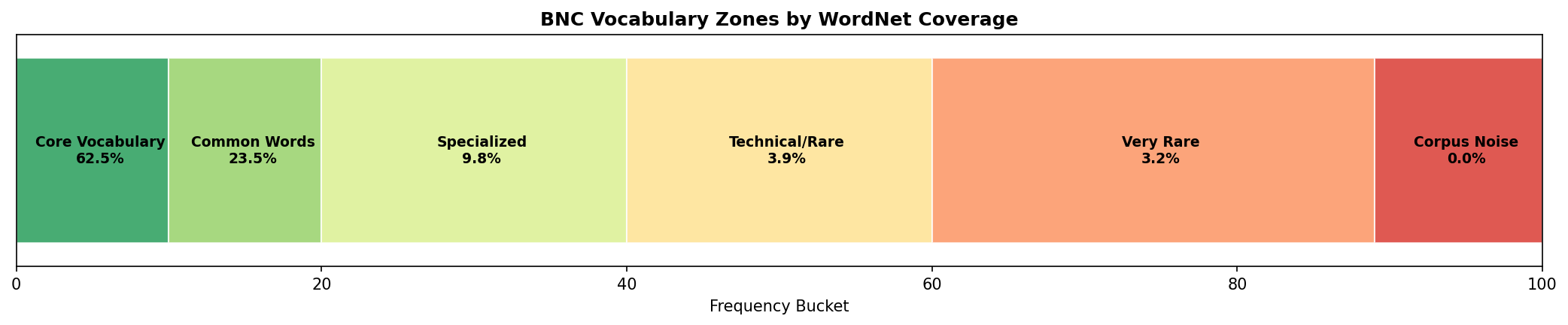
93% of common words (bucket 1-10) are in WordNet. But dictionaries miss proper nouns, technical terms, compounds, and domain jargon that appear constantly in real text.
That's the gap BNC fills. Full analysis
When to Use This
- Tokenization filtering: Keep real words, discard garbage
- Input validation: Reject nonsense in user input
- NLP preprocessing: Filter candidates before expensive operations
- Spell-check pre-filtering: Quick reject obvious non-words before fuzzy matching
- Data cleaning: Identify malformed or corrupted text
- Frequency-based filtering: Prefer common words over obscure ones
What This Doesn't Do
- No definitions, synonyms, or semantic relationships (use spaCy for that)
- No spell-checking or suggestions (just existence check)
- No irregular plural handling ("mice" → "mouse")
CLI
bnc-exists the            # True (exit code 0)
bnc-bucket python         # 4
bnc-freq the              # 6.181373e-02
bnc-expected the 50000    # 3090.6865
bnc-expected the 50000 --rounded  # 3091
Documentation
For detailed usage, performance benchmarks, and advanced features, see the API Documentation.
Development
git clone https://github.com/craigtrim/bnc-lookup.git
cd bnc-lookup
make install  # Install dependencies
make test     # Run tests
make all      # Full build pipeline
See API Documentation for detailed development information.
License
This package is dual-licensed:
- Software: MIT License
- BNC Data: BNC User Licence
See LICENSE for complete terms.
Attribution
This package contains data derived from the British National Corpus frequency lists:
BNC frequency lists compiled by Adam Kilgarriff. Source: https://www.kilgarriff.co.uk/BNClists/all.num.gz
The British National Corpus, version 3 (BNC XML Edition). 2007. Distributed by Bodleian Libraries, University of Oxford, on behalf of the BNC Consortium.
Note: This is a static snapshot of BNC frequency data. The data is not automatically updated.
See Also
- wordnet-lookup - Similar O(1) lookup using the WordNet lexicon
- morphroot - Morpheme segmentation engine (source of derivational suffix data)
- BNC vs WordNet Analysis - Deep dive on what each captures
Links
- Article: Every Word Has a Price Tag
- Repository: github.com/craigtrim/bnc-lookup
- PyPI: pypi.org/project/bnc-lookup
- BNC: natcorp.ox.ac.uk
- Author: Craig Trim (craigtrim@gmail.com)
1 maintainer

Metadata
1 maintainer
Release files for bnc-lookup 1.5.0
For a detailed explanation of source distributions (sdists) and built distributions (wheels), please see the package formats documentation.
Source distribution (sdist)
| File | Size | Uploaded | |
|---|---|---|---|
| bnc_lookup-1.5.0.tar.gz | 45.1 MB | Details |
Built distribution (wheel)
| File | Interpreter | ABI | Platform | Reset |
|---|---|---|---|---|
| bnc_lookup-1.5.0-py3-none-any.whl | Python 3 | none | any | Details |
Total release size: 90.8 MB
Release files / bnc_lookup-1.5.0.tar.gz
| Download URL | bnc_lookup-1.5.0.tar.gz |
|---|---|
| Size | 45.1 MB |
| Tags | Source |
|
SHA-256 checksum How to use checksums |
6135111bd3422722e3f6eb440237570207efa82ddf8d53b5928d4473a5e98b00
|
|
BLAKE2b-256 checksum How to use checksums |
2b37ab7d7f9df313af2b478d2c710ce6c89d723c15521394e218e7bcc90232ee
|
| Upload date | |
|
Uploaded using Trusted Publishing? What is trusted publishing? |
No |
| Uploaded via |
poetry/2.3.2 CPython/3.11.9 Darwin/25.3.0
|
Release files / bnc_lookup-1.5.0-py3-none-any.whl
| Download URL | bnc_lookup-1.5.0-py3-none-any.whl |
|---|---|
| Size | 45.6 MB |
| Tags | Python 3 |
|
SHA-256 checksum How to use checksums |
fdd8770383bc6903c11336bc716e39003971042451b32ade1157f83cc20ec940
|
|
BLAKE2b-256 checksum How to use checksums |
0d91ad0fe37b8573dae1c7c4f573ffaea03a819eea4d2ab18bf5679b68ce4d0f
|
| Upload date | |
|
Uploaded using Trusted Publishing? What is trusted publishing? |
No |
| Uploaded via |
poetry/2.3.2 CPython/3.11.9 Darwin/25.3.0
|














