

A Compositional Operation Toolbox for Gradient-based Bi-Level Optimization
Home |
Installation |
Docs |
Tutorials |
Examples








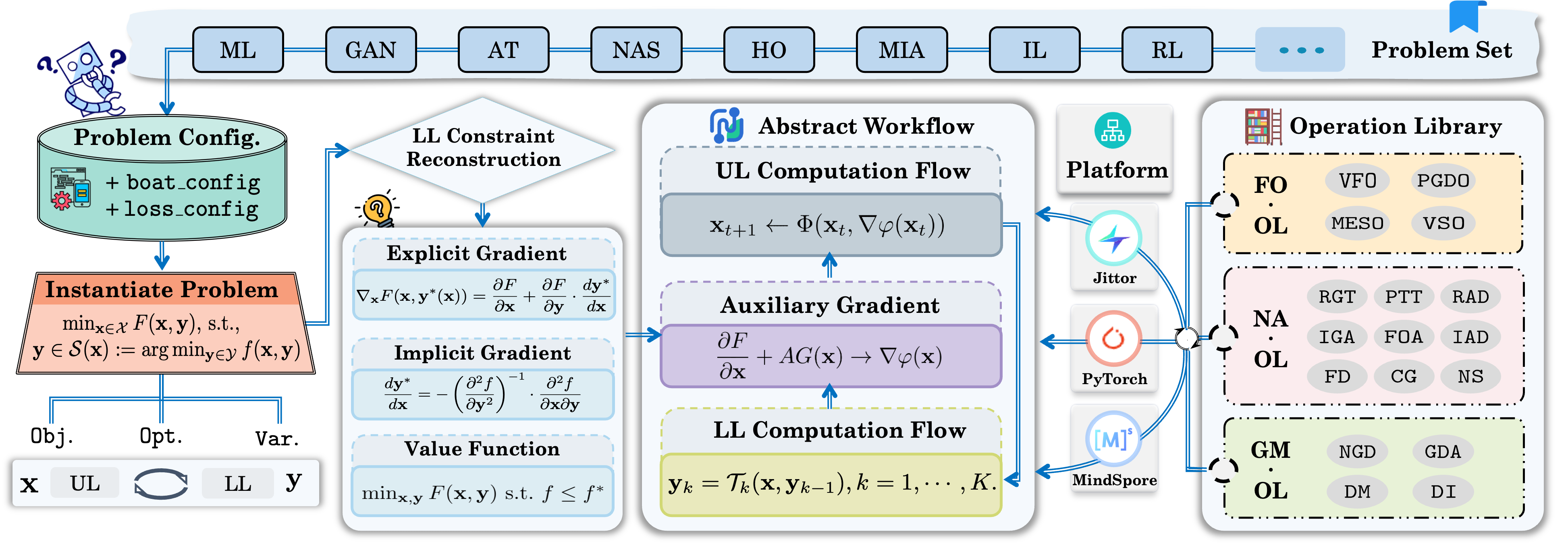
BOAT is a compositional OperAtion-level Toolbox for gradient-based BLO. Unlike existing libraries that typically encapsulate fixed solver routines, BOAT factorizes the BLO workflow into atomic, reusable primitives. Through a unified constraint reconstruction perspective, it empowers researchers to automatically compose solvers via simple configuration.
This is the MindSpore-based version of BOAT (boat-ms). It is seamlessly integrated into MindSpore’s computation graph and heterogeneous hardware ecosystem (Ascend/GPU/CPU), incorporating the latest First-Order (FO) optimization strategies to support emerging large-scale application scenarios.
BOAT supports unified execution across backends via separate branches:
- PyTorch-based: The widely-used standard version.
- Jittor-based: Accelerated version with meta-operators.
🔑 Key Features
- 🧩 First-Order Operation Specialization: Specifically optimized for First-Order (FO) BLO methods, enabling fast prototyping on Ascend hardware.
- 🚀 Heterogeneous Hardware Support: Native compatibility with Huawei Ascend (NPU), GPU, and CPU backends.
- 🏭 Generative Solver Construction: Supports dynamic serialization of operations. Users can switch between different FO strategies (e.g., VFO, MESO) simply by changing configurations.
- 🛠 Configuration-Driven: Define complex optimization strategies via simple
JSONconfigurations (boat_config&loss_config), decoupling algorithmic logic from model definitions. - ✅ Comprehensive Testing: Achieves 99% code coverage through rigorous testing, ensuring software robustness.
🚀 Why BOAT?
Existing automatic differentiation (AD) tools primarily focus on specific optimization strategies, such as explicit or implicit methods, and are often targeted at meta-learning or specific application scenarios, lacking support for algorithm customization.
In contrast, BOAT expands the landscape of Bi-Level Optimization (BLO) applications by supporting a broader range of problem-adaptive operations. It bridges the gap between theoretical research and practical deployment, offering unparalleled flexibility to design, customize, and accelerate BLO techniques.
📚 Supported Operation Libraries
The MindSpore version of BOAT currently focuses on First-Order (FO) operations, providing efficient single-level reformulations that avoid expensive Hessian computations.
| Library | Functional Role | Supported Atomic Operations |
|---|---|---|
| FO-OL (First-Order) |
Constructs single-level surrogates. Reformulates the nested problem into first-order objectives using value-functions or penalties. |
• VFO (Value-Function First-Order / BOME) • VSO (Value-Function Sequential) • MESO (Moreau Envelope) • PGDO (Penalty Gradient Descent) |
🔨 Installation
BOAT-ms is built on top of MindSpore. Please install a suitable version for your hardware (Ascend / GPU / CPU) first.
1. Install MindSpore
Follow the Official Installation Guide or use the reference commands below:
CPU (Linux-x86_64) Example
# 1. Create environment
conda create -n mindspore_py39 python=3.9.11 -y
conda activate mindspore_py39

# 2. Install GCC dependencies (Linux only)
sudo apt-get install software-properties-common -y
sudo add-apt-repository ppa:ubuntu-toolchain-r/test
sudo apt-get update
sudo apt-get install gcc-9 -y

# 3. Install MindSpore (Adjust MS_VERSION as needed)
export MS_VERSION=2.4.1
pip install mindspore==${MS_VERSION} -i [https://repo.mindspore.cn/pypi/simple](https://repo.mindspore.cn/pypi/simple) --trusted-host repo.mindspore.cn
2. Install BOAT-ms
Once MindSpore is ready, install BOAT-ms via PyPI or Source:
# Install from PyPI
pip install boat-ms

# Or install from Source (Specific Branch)
git clone -b boat_ms --single-branch https://github.com/callous-youth/BOAT.git
cd BOAT
pip install -e .
✅ Quick Verification
Run the following command from the root directory of the BOAT repository:
python examples/L2_Reg_ms/l2_regularization.py
⚡ How to Use BOAT
BOAT separates the problem definition from the solver configuration. Below is a MindSpore-based example.
1. Load Configurations
import json
import boat_ms as boat

# Load algorithmic configurations
with open("configs/boat_config.json", "r") as f:
    boat_config = json.load(f)

# Load objective configurations
with open("configs/loss_config.json", "r") as f:
    loss_config = json.load(f)
2. Define Models and Optimizers
Use standard MindSpore models and optimizers.
import mindspore as ms

# Define models
upper_model = MyUpperModel()
lower_model = MyLowerModel()

# Define optimizers (MindSpore syntax)
upper_opt = ms.nn.Adam(upper_model.trainable_params(), learning_rate=1e-3)
lower_opt = ms.nn.SGD(lower_model.trainable_params(), learning_rate=1e-2)
3. Customize & Initialize Problem
Specify the First-Order operation (e.g., VFO) and inject runtime objects.
# Configure BOAT with MindSpore models/optimizers
boat_config["fo_ol"] = ["VFO"]  # Select First-Order Operation
boat_config["lower_level_model"] = lower_model
boat_config["upper_level_model"] = upper_model
boat_config["lower_level_opt"] = lower_opt
boat_config["upper_level_opt"] = upper_opt

# Initialize the BOAT core
b_optimizer = boat.Problem(boat_config, loss_config)
4. Build Solvers
Automatically construct the computation graph for the bilevel strategy.
# Pass optimizers explicitly if needed by the solver backend
b_optimizer.build_ll_solver(lower_opt)
b_optimizer.build_ul_solver(upper_opt)
5. Run Optimization Loop
# Training loop
for x_itr in range(1000):
    # Prepare data (MindSpore Tensors or dicts)
    ul_feed_dict = {"data": ul_data, "target": ul_target}
    ll_feed_dict = {"data": ll_data, "target": ll_target}

    # Run one iteration
    loss, run_time = b_optimizer.run_iter(ll_feed_dict, ul_feed_dict, current_iter=x_itr)

    if x_itr % 100 == 0:
        print(f"Iter {x_itr}: UL Loss {loss:.4f}")
🌍 Applications
BOAT covers a wide spectrum of BLO applications, categorized by the optimization target:
- Data-Centric: Data Hyper-Cleaning, Synthetic Data Reweighting, Diffusion Model Guidance.
- Model-Centric: Neural Architecture Search (NAS), LLM Prompt Optimization, Parameter Efficient Fine-Tuning (PEFT).
- Strategy-Centric: Meta-Learning, Hyperparameter Optimization (HO), Reinforcement Learning from Human Feedback (RLHF).
📝 Citation
If you find BOAT useful in your research, please consider citing our paper:
@article{liu2025boat,
  title={BOAT: A Compositional Operation Toolbox for Gradient-based Bi-Level Optimization},
  author={Liu, Yaohua and Pan, Jibao and Jiao, Xianghao and Gao, Jiaxin and Liu, Zhu and Liu, Risheng},
  journal={Submitted to Journal of Machine Learning Research (JMLR)},
  year={2025}
}
License
MIT License
Copyright (c) 2024 Yaohua Liu
Permission is hereby granted, free of charge, to any person obtaining a copy of this software and associated documentation files (the "Software"), to deal in the Software without restriction, including without limitation the rights to use, copy, modify, merge, publish, distribute, sublicense, and/or sell copies of the Software, and to permit persons to whom the Software is furnished to do so, subject to the following conditions:
The above copyright notice and this permission notice shall be included in all copies or substantial portions of the Software.
THE SOFTWARE IS PROVIDED "AS IS", WITHOUT WARRANTY OF ANY KIND, EXPRESS OR IMPLIED, INCLUDING BUT NOT LIMITED TO THE WARRANTIES OF MERCHANTABILITY, FITNESS FOR A PARTICULAR PURPOSE AND NONINFRINGEMENT. IN NO EVENT SHALL THE AUTHORS OR COPYRIGHT HOLDERS BE LIABLE FOR ANY CLAIM, DAMAGES OR OTHER LIABILITY, WHETHER IN AN ACTION OF CONTRACT, TORT OR OTHERWISE, ARISING FROM, OUT OF OR IN CONNECTION WITH THE SOFTWARE OR THE USE OR OTHER DEALINGS IN THE SOFTWARE.
1 maintainer

Metadata
1 maintainer
Release files for boat-ms 1.1.0
For a detailed explanation of source distributions (sdists) and built distributions (wheels), please see the package formats documentation.
Source distribution (sdist)
| File | Size | Uploaded | |
|---|---|---|---|
| boat_ms-1.1.0.tar.gz | 20.1 kB | Details |
Built distribution (wheel)
| File | Interpreter | ABI | Platform | Reset |
|---|---|---|---|---|
| boat_ms-1.1.0-py3-none-any.whl | Python 3 | none | any | Details |
Total release size: 40.5 kB
Release files / boat_ms-1.1.0.tar.gz
| Download URL | boat_ms-1.1.0.tar.gz |
|---|---|
| Size | 20.1 kB |
| Tags | Source |
|
SHA-256 checksum How to use checksums |
6ff2d077e0960cad869be351a267b0e59a77d3b52389369fd28cd8a24d2fbf5d
|
|
BLAKE2b-256 checksum How to use checksums |
17651f635c6dfb48d1678fbe9d15afa89aee7c65be18a16469a20da27a47ed5b
|
| Upload date | |
|
Uploaded using Trusted Publishing? What is trusted publishing? |
No |
| Uploaded via |
twine/6.2.0 CPython/3.13.5
|
Release files / boat_ms-1.1.0-py3-none-any.whl
| Download URL | boat_ms-1.1.0-py3-none-any.whl |
|---|---|
| Size | 20.4 kB |
| Tags | Python 3 |
|
SHA-256 checksum How to use checksums |
71b888de4c6f6d06357b0385aa9ac8e048c032d516ac8d408b21d28229151cb2
|
|
BLAKE2b-256 checksum How to use checksums |
f9f9c1c7e0437dcd8785fe6bd8cee1ebd6a57d4cc66f4d60680815ef457f6b93
|
| Upload date | |
|
Uploaded using Trusted Publishing? What is trusted publishing? |
No |
| Uploaded via |
twine/6.2.0 CPython/3.13.5
|














