





BoFire — Bayesian Optimization Framework Intended for Real Experiments
BoFire is a powerful Python package that serves as a comprehensive framework for experimental design. BoFire is designed to empower researchers, data scientists, engineers, and enthusiasts who are venturing into the world of Design of Experiments (DoE) and Bayesian optimization (BO) techniques. BoFire is developed by BO practitioners from the chemical and pharmaceutical industry and academic partners, with a focus on solving real-world experimental design and optimization challenges like reaction, formulation, digital twin and closed-loop optimization. It is actively used by hundreds of users across leading organizations such as Agilent, BASF, Bayer, Boehringer Ingelheim and Evonik.
Why BoFire? BoFire ...
- supports mixed continuous, discrete and categorical parameter spaces for system inputs and outputs,
- separates objectives (minimize, maximize, close-to-target) from the outputs on which they operate,
- supports different specific and generic constraints as well as black-box output constraints,
- supports single and multi-objective Bayesian optimization,
- supports built-in chemical encodings and kernels to boost surrogate performance for optimization problems including molecules,
- can provide flexible DoEs that fulfill constraints,
- provides sampling methods for constrained mixed variable spaces,
- provides seamless integration into RESTful APIs, by builtin serialization capabilities for problems, optimization strategies and surrogates,
- includes an agentic
LLMStrategythat proposes candidates by prompting a large language model with the problem description and prior experiments — useful for cold starts and domains where written context informs proposals.
Getting started
In our docs, you can find all different options for the BoFire installation. For basic BoFire Bayesian optimization features using BoTorch which depends on PyTorch, you need to run
pip install bofire[optimization]
For a more complete introduction to BoFire, please look in our docs.
Optimization problem
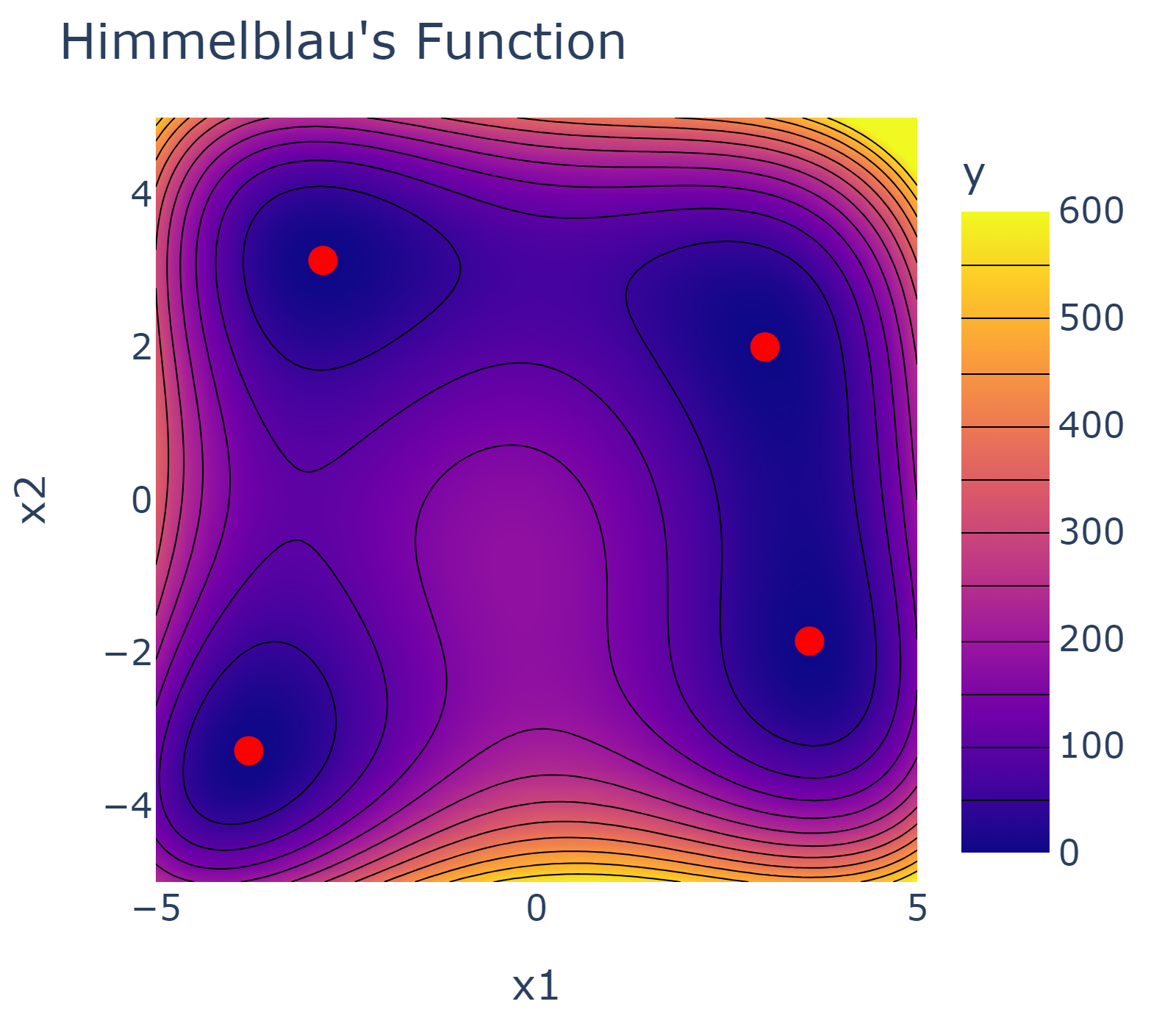
Let us consider a test function for single-objective optimization - the Himmelblau's function. The Himmelblau's function has four identical local minima used to test the performance of optimization algorithms. The optimization domain of the Himmelblau's function is illustrated below together with the four minima marked red.
Defining the optimization output
Let's consider the single continuous output variable y of the Himmelblau's function with the objective to minimize it. In BoFire's terminology, we create a MinimizeObjective object to define the optimization objective of a Continuous Output feature.
from bofire.data_models.features.api import ContinuousOutput
from bofire.data_models.objectives.api import MinimizeObjective


objective = MinimizeObjective()
output_feature = ContinuousOutput(key="y", objective=objective)
For more details on Output features and Objective objects, see the respective sections in our docs.
Defining the optimization inputs
For the two continuous input variables of the Himmelblau's function x1 and x2, we create two ContinuousInput features including boundaries following BoFire's terminology.
from bofire.data_models.features.api import ContinuousInput


input_feature_1 = ContinuousInput(key="x1", bounds=[-5, 5])
input_feature_2 = ContinuousInput(key="x2", bounds=[-5, 5])
For more details on Input features, see the respective sections in our docs.
Defining the optimization domain
In BoFire's terminology, Domain objects fully describe the search space of the optimization problem. Input and Output features are optionally bound with Constraint objects to specify allowed relationships between the parameters. Here, we will run an unconstrained optimization. For more details, see the respective sections in our docs.
from bofire.data_models.domain.api import Domain, Inputs, Outputs


domain = Domain(
    inputs=Inputs(features=[input_feature_1, input_feature_2]),
    outputs=Outputs(features=[output_feature]),
)
Draw candidates and execute experiments
Let's define the Himmelblau's function to evaluate points in the domain space.
def himmelblau(x1, x2):
    return (x1**2 + x2 - 11) ** 2 + (x1 + x2**2 - 7) ** 2
To initialize an iterative Bayesian optimization loop, let's first randomly draw 10 samples from the domain. In BoFire's terminology, those suggested samples are called Candidates.
candidates = domain.inputs.sample(10, seed=13)

print(candidates)
>           x1        x2
>  0  1.271053  1.649396
>  1 -5.012360 -1.907210
>  2 -4.541719  5.609014
>  3  ...       ...
Let's evaluate the function output for the randomly drawn candidates using the himmelblau function to obtain Experiments in BoFire's terminology.
experimental_output = candidates.apply(
    lambda row: himmelblau(row["x1"], row["x2"]), axis=1
)

experiments = candidates.copy()
experiments["y"] = experimental_output

print(experiments)
>           x1        x2           y
>  0  1.271053  1.649396   68.881387
>  1 -5.012360 -1.907210  219.383137
>  2 -4.541719  5.609014  628.921615
>  3 ...        ...       ...
For more details on candidates and experiments, see the respective sections in our docs.
Defining an optimization strategy
Let's specify the strategy how the Bayesian optimization campaign should be conducted. Here, we define a single-objective Bayesian optimization strategy and pass the optimization domain together with a acquisition function. Here, we use logarithmic expected improvement qLogEI as the acquisition function.
from bofire.strategies.api import SoboStrategy
from bofire.data_models.acquisition_functions.api import qLogEI

sobo_strategy = SoboStrategy.make(
    domain=domain, acquisition_function=qLogEI(), seed=19
)
It is possible to separate BoFire into serializable parameters and a functional part. We call the serializable parameters usually data models. This is especially helpful when working with REST APIs. See the respective sections in our docs.
Run the optimization loop
To run the optimization loop using BoFire's terminology, we first tell the strategy object about the experiments we have already executed.
sobo_strategy.tell(experiments=experiments)
We run the optimization loop for 30 iterations. In each iteration, we ask the strategy object to suggest one new candidate, which is returned as a list containing a single item. We then perform a new experiment by evaluating the Himmelblau function output of this candidate. After completing the experiment, we add the new data to our existing experiments and tell the strategy object about the updated dataset. This process is repeated for each of the 30 iterations.
for _ in range(30):
    new_candidates = sobo_strategy.ask(candidate_count=1)

    new_experiments = new_candidates.copy()
    new_experiments["y"] = new_candidates.apply(
        lambda row: himmelblau(row["x1"], row["x2"]), axis=1
    )

    sobo_strategy.tell(experiments=new_experiments)
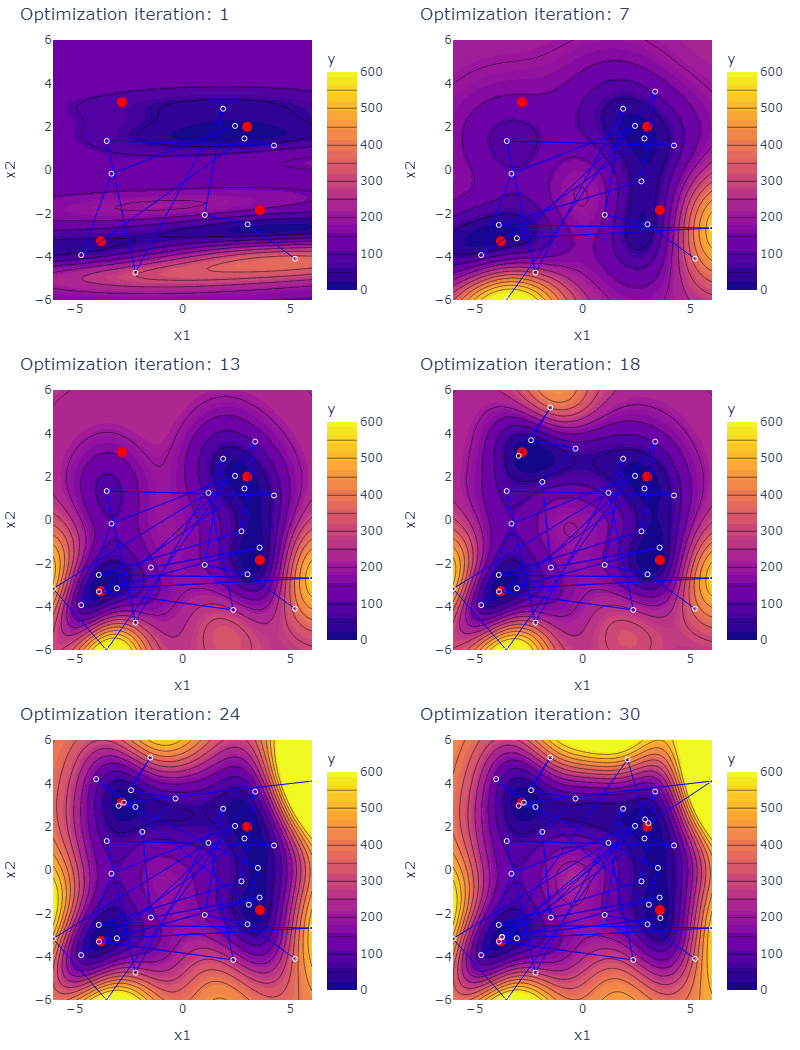
The optimization behavior of the strategy is shown in the animated figure below. The four minima are marked red, the experiments carried out are marked blue with blue lines connecting them. The contours are indicating the predicted mean of the current model of each iteration.
Documentation
Documentation including a section on how to get started can be found under https://experimental-design.github.io/bofire/.
Reference
We would love for you to use BoFire in your work! If you do, please cite our paper:
@article{durholt2024bofire,
  author  = {Johannes P. D{\"{u}}rholt and Thomas S. Asche and Johanna Kleinekorte and Gabriel Mancino-Ball and Benjamin Schiller and Simon Sung and Julian Keupp and Aaron Osburg and Toby Boyne and Ruth Misener and Rosona Eldred and Chrysoula Kappatou and Robert M. Lee and Dominik Linzner and Wagner Steuer Costa and David Walz and Niklas Wulkow and Behrang Shafei},
  title   = {BoFire: Bayesian Optimization Framework Intended for Real Experiments},
  journal = {Journal of Machine Learning Research},
  year    = {2025},
  volume  = {26},
  number  = {204},
  pages   = {1--7},
  url     = {http://jmlr.org/papers/v26/24-1540.html}
}
Bayesian optimization in BoFire is based on META's BoTorch library. For BoTorch, please cite also the botorch paper:
@inproceedings{NEURIPS2020_f5b1b89d,
    author = {Balandat, Maximilian and Karrer, Brian and Jiang, Daniel and Daulton, Samuel and Letham, Ben and Wilson, Andrew G and Bakshy, Eytan},
    booktitle = {Advances in Neural Information Processing Systems},
    editor = {H. Larochelle and M. Ranzato and R. Hadsell and M.F. Balcan and H. Lin},
    pages = {21524--21538},
    publisher = {Curran Associates, Inc.},
    title = {BoTorch: A Framework for Efficient Monte-Carlo Bayesian Optimization},
    url = {https://proceedings.neurips.cc/paper_files/paper/2020/file/f5b1b89d98b7286673128a5fb112cb9a-Paper.pdf},
    volume = {33},
    year = {2020}
}
For optimization over molecular species, the molecular kernels introduced in the GAUCHE library are implemented in BoFire. If you use the molecular kernels in BoFire please cite also the GAUCHE paper:
@inproceedings{NEURIPS2023_f2b1b2e9,
    author = {Griffiths, Ryan-Rhys and Klarner, Leo and Moss, Henry and Ravuri, Aditya and Truong, Sang and Du, Yuanqi and Stanton, Samuel and Tom, Gary and Rankovic, Bojana and Jamasb, Arian and Deshwal, Aryan and Schwartz, Julius and Tripp, Austin and Kell, Gregory and Frieder, Simon and Bourached, Anthony and Chan, Alex and Moss, Jacob and Guo, Chengzhi and D\"{u}rholt, Johannes Peter and Chaurasia, Saudamini and Park, Ji Won and Strieth-Kalthoff, Felix and Lee, Alpha and Cheng, Bingqing and Aspuru-Guzik, Alan and Schwaller, Philippe and Tang, Jian},
    booktitle = {Advances in Neural Information Processing Systems},
    editor = {A. Oh and T. Naumann and A. Globerson and K. Saenko and M. Hardt and S. Levine},
    pages = {76923--76946},
    publisher = {Curran Associates, Inc.},
    title = {GAUCHE: A Library for Gaussian Processes in Chemistry},
    url = {https://proceedings.neurips.cc/paper_files/paper/2023/file/f2b1b2e974fa5ea622dd87f22815f423-Paper-Conference.pdf},
    volume = {36},
    year = {2023}
}
Contributing
See our Contributing guidelines. If you are not sure about something or find bugs, feel free to create an issue.
By contributing you agree that your contributions will be licensed under the same license as BoFire: BSD 3-Clause License.
Versioning
Starting with release 0.1.0, we follow a pragmatic versioning scheme.
BIGRELEASE.MAJOR.MINOR
Thereby, BIGRELEASE and MAJOR releases can contain breaking changes to our public API. Vice versa, every breaking change of our API
is at least a MAJOR release.
4 maintainers


Metadata
4 maintainers
Release files for bofire 0.5.0
For a detailed explanation of source distributions (sdists) and built distributions (wheels), please see the package formats documentation.
Source distribution (sdist)
| File | Size | Uploaded | |
|---|---|---|---|
| bofire-0.5.0.tar.gz | 4.1 MB | Details |
Built distribution (wheel)
| File | Interpreter | ABI | Platform | Reset |
|---|---|---|---|---|
| bofire-0.5.0-py3-none-any.whl | Python 3 | none | any | Details |
Total release size: 8.3 MB
Release files / bofire-0.5.0.tar.gz
| Download URL | bofire-0.5.0.tar.gz |
|---|---|
| Size | 4.1 MB |
| Tags | Source |
|
SHA-256 checksum How to use checksums |
7c7300c43cc038127c01d1900817a39a4904c178b0f6a4cae8a2c97bd2c8863e
|
|
BLAKE2b-256 checksum How to use checksums |
da9b9e4ad0c534fa3550b90dab2ed31b62b2ad0747534bbe475b890bafacc0dc
|
| Upload date | |
|
Uploaded using Trusted Publishing? What is trusted publishing? |
No |
| Uploaded via |
twine/6.2.0 CPython/3.9.25
|
Release files / bofire-0.5.0-py3-none-any.whl
| Download URL | bofire-0.5.0-py3-none-any.whl |
|---|---|
| Size | 4.3 MB |
| Tags | Python 3 |
|
SHA-256 checksum How to use checksums |
08ff798e3a0094a5ec4318dac594eda559dee87880dfda37a87dc8f85262812f
|
|
BLAKE2b-256 checksum How to use checksums |
b289c1f5ef73b03795f821fb30043f168d69b17d03a19d098090dcc180450b46
|
| Upload date | |
|
Uploaded using Trusted Publishing? What is trusted publishing? |
No |
| Uploaded via |
twine/6.2.0 CPython/3.9.25
|














