
BoltzYML
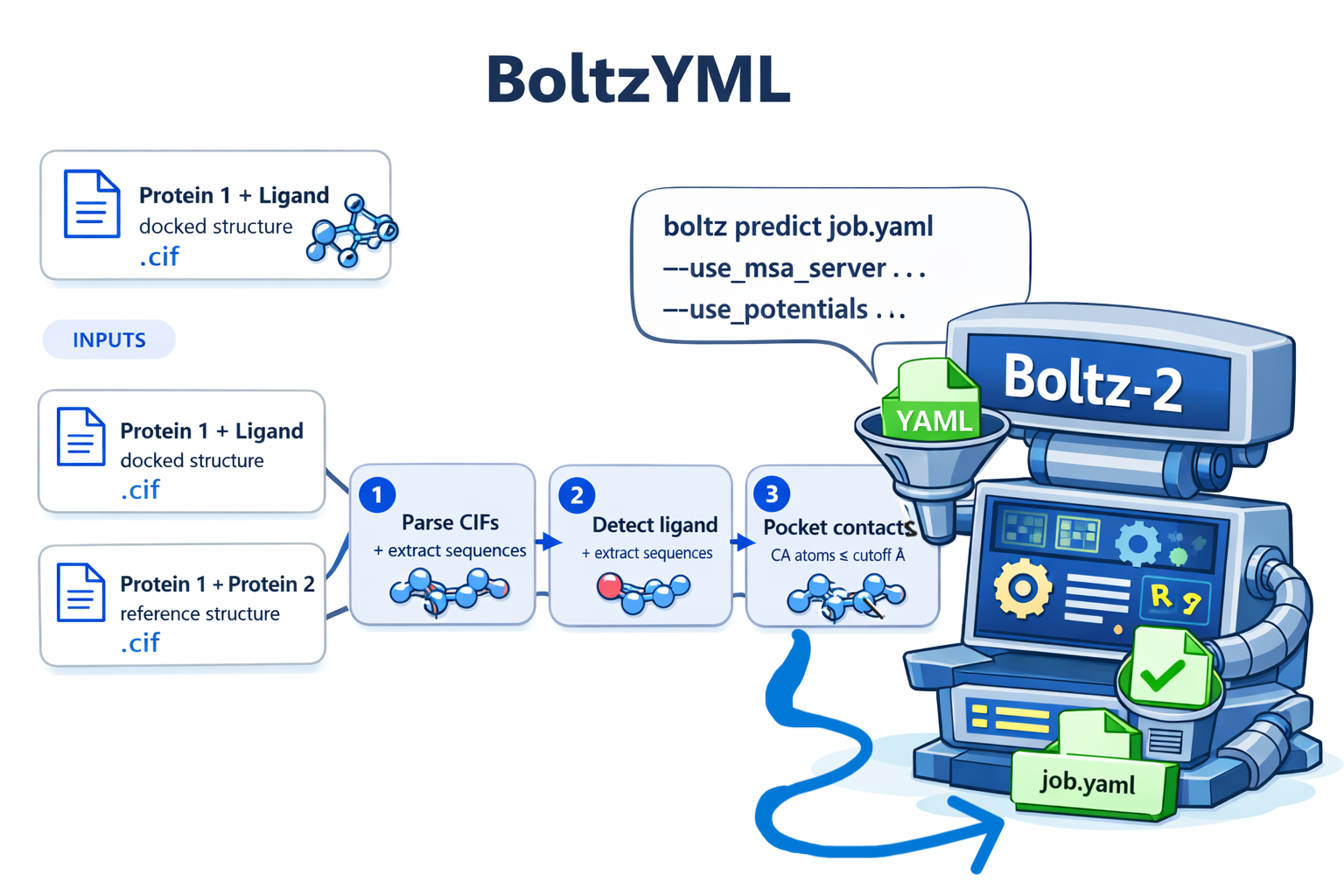
Preprocessing-file generator for ternary (Protein 1 + Ligand + Protein 2) binding prediction with Boltz-2.






Live web app → · CLI · How it works
When to use BoltzYML
Use this tool only if you want to study how the interaction between two proteins changes in the presence of a ligand.
That is the one scenario it is built for: a small molecule sits in a pocket of Protein 1, and you want Boltz-2 to predict how Protein 1 and Protein 2 dock together while that ligand is bound (or absent, as a control). Typical use cases:
- ABA signaling: PYR/PYL/RCAR receptor + ABA + PP2C phosphatase
- Allosteric drug screens where a ligand is expected to enable or block partner binding
- Any ternary system where the ligand sits on Protein 1 and you care about the Protein 1 ↔ Protein 2 interface
If your problem is just protein–protein docking, just protein–ligand docking, or anything that is not a ternary Protein 1 + Ligand + Protein 2 complex, BoltzYML will not help — write the YAML directly or use the Boltz-2 examples.
What it does
You hand BoltzYML two CIF files:
| Input | Contents | Role |
|---|---|---|
protein1_ligand.cif |
Protein 1 bound to the ligand (docked structure, e.g. AlphaFill, Glide, AutoDock) | Source of Protein 1 sequence + ligand identity + pocket residues |
protein1_protein2.cif |
Protein 1 together with Protein 2 (e.g. AlphaFold3 prediction) | Source of Protein 2 sequence |
BoltzYML then runs entirely in your browser (or via the CLI) and produces a single Boltz-2 v1 YAML with:
- Protein 1 sequence on chain
A - The ligand on chain
B(with its PDB CCD code) - Protein 2 sequence on chain
C - A
pocketconstraint listing the Protein 1 CA atoms within a cutoff of the ligand - An
affinityproperty block targeting the ligand
That YAML is then fed straight into the Boltz-2 CLI.
Two ways to run it
1. Web app (recommended)
Open https://ayushmania2002.github.io/boltzyml/, drop in the two CIFs, click Generate YAML, download the file.
Everything happens in your browser — no uploads, no server, no telemetry. Works on any modern browser, no installation required.
2. Command-line interface
Install from PyPI:
pip install boltzyml
Then run:
boltzyml \
    --ligand   PYL2_ABA.cif \
    --complex  PYL2_PP2C30.cif \
    --output   PYL2_ABA_PP2C30.yaml
Pure Python 3.10+, zero runtime dependencies (no gemmi, no numpy, no pyyaml required).
You can also clone the repo and run it as a module without installing:
git clone https://github.com/Ayushmania2002/boltzyml.git
cd boltzyml
pip install -e .
boltzyml --ligand A.cif --complex B.cif -o out.yaml
CLI options
| Flag | Description | Default |
|---|---|---|
--ligand |
CIF with Protein 1 + Ligand | required |
--complex |
CIF with Protein 1 + Protein 2 | required |
-o, --output |
Output YAML path | {ligand-stem}__{complex-stem}.yaml |
--job-name |
Job name used for the default output filename | derived |
--cutoff |
CA-to-ligand distance cutoff in Å | 6.0 |
--ccd |
Override the ligand CCD code (used verbatim in the YAML's ccd: field) |
auto-detect |
--no-affinity |
Skip the affinity prediction block | off |
--no-pocket |
Skip the pocket constraints block | off |
--no-force |
Emit force: false on the pocket block |
off |
-v, --verbose |
Print detected chains, ligand, and contacts | off |
How it works
- Parse both CIFs. The parser handles two layouts seen in the wild: single-line atom records (AlphaFold3 style, 18 fields per line) and two-line records (some AlphaFill outputs, 21 fields split 17 + 4).
- Identify the ligand. The first non-water HETATM whose comp ID is not a standard amino acid is taken as the ligand. If the CIF labels it generically (
LIG,UNL,UNK), the tool warns and asks for a CCD override. - Assign chains. Protein 1 = the longest protein chain in the ligand CIF. The corresponding chain in the complex CIF is matched by 5-mer overlap similarity; the remaining chain is Protein 2.
- Compute pocket contacts. CA atoms of Protein 1 within
--cutoffÅ of any ligand atom are emitted as[A, residue_number]entries, using the CIF'sauth_seq_idso the numbers match Boltz-2's own residue numbering. - Emit YAML. A deterministic Boltz-2 v1 YAML is written out, in the field order Boltz-2 expects.
Why CA-only at 6 Å? CA-to-ligand at 6 Å approximates all-atom contacts at ~4 Å, which is the right scale for the soft pocket constraint Boltz-2 applies as an inference-time potential.
Example output
version: 1
sequences:
  - protein:
      id: A
      sequence: MEAHVERALREGLTEEERAALEPAVMAHHTFPPSTTTATTAAATCTSLVTQRVAAPVRAVWPIVRSFGNPQRYKHFVRTCALAAGDGASVGSVREVTVVSGLPASTSTERLEMLDDDRHIISFRVVGGQHRLRNYRSVTSVTEFQPPAAGPAPAPPYCVVVESYVVDVPDGNTAEDTRMFTDTVVKLNLQKLAAVAEDSSSASRRRD
  - ligand:
      id: B
      ccd: A8S
  - protein:
      id: C
      sequence: MAEICCEVVAGSSSEGKGPECDTGSRAARRRR...
constraints:
  - pocket:
      binder: B
      contacts:
        - [A, 76]    # PHE76
        - [A, 98]    # VAL98
        - [A, 103]   # PRO103
        - [A, 104]   # ALA104
        - [A, 107]   # SER107
        - [A, 130]   # HIS130
        - [A, 131]   # ARG131
        - [A, 132]   # LEU132
        - [A, 181]   # THR181
        - [A, 184]   # VAL184
        - [A, 185]   # VAL185
      max_distance: 6.0
      force: true
properties:
  - affinity:
      binder: B
Running Boltz-2 on the output
pip install boltz

boltz predict job.yaml \
    --use_msa_server \
    --use_potentials \
    --diffusion_samples 3 \
    --recycling_steps  3 \
    --step_scale       1.638
Key result files:
| File | Contents |
|---|---|
*_model_0.pdb |
Predicted ternary structure |
confidence_*.json |
iptm, ptm, ligand_iptm |
affinity_*.json |
affinity_pred_value in kcal/mol |
pae_*.npz |
Predicted aligned error matrix |
Sanity checks:
iptm > 0.6— confident protein–protein interfaceligand_iptm > 0.5— confident ligand placement- A low off-diagonal block between chain
Aand chainCin the PAE map = confident interaction
Project layout
boltzyml/
├── index.html              # Web app (deploy to GitHub Pages as-is)
├── logo.png                # Wordmark — favicon + header logo
├── banner.png              # Pipeline schematic — used in this README
│
├── pyproject.toml          # PyPI packaging metadata (hatchling)
├── LICENSE                 # MIT
│
├── src/boltzyml/
│   ├── __init__.py         # Public API re-exports
│   ├── cli.py              # CLI entry point (boltzyml command)
│   ├── parser.py           # CIF parser (1-line and 2-line layouts)
│   ├── contacts.py         # CA-to-ligand pocket contact computation
│   ├── utils.py            # Chain assignment via k-mer similarity
│   └── yaml_writer.py      # Boltz-2 v1 YAML emitter
│
└── tests/
    ├── test_parser.py      # Synthetic CIFs for both layouts
    ├── test_contacts.py    # Cutoff filtering, missing ligand, chain remap
    └── test_cli.py         # End-to-end CLI smoke test
Tests
pip install -e ".[dev]"
pytest
Or run each file directly without pytest:
python tests/test_parser.py
python tests/test_contacts.py
python tests/test_cli.py
Each script exits non-zero on failure and prints all tests passed otherwise.
Gotchas
LIG/UNL/UNKligands. Docking tools often name the ligand generically. The real PDB CCD code (e.g.A8Sfor abscisic acid,ATP,HEM) belongs in theccd:field — use the CCD override in the web app or--ccdon the CLI. Verify codes at https://www.rcsb.org/ligand/.- Residue numbering. Boltz-2 uses
auth_seq_idfrom your CIF. If your CIF starts at residue 14 (truncated structure), the pocket numbers will start at 14 too — that is correct. - Apo vs holo Protein 1. For the ligand CIF, use the holo (ligand-bound) structure, not the apo AlphaFold prediction, so the pocket is in the right conformation.
- Tamarind Bio users. The same YAML works on https://app.tamarind.bio/boltz. Do not include a
templates:block when submitting there — use Tamarind's UI fields for template CIFs instead.
Citation
If you use BoltzYML in published or shared work, please cite both of the following.
1. BoltzYML (this tool):
Mallick, A. BoltzYML: a preprocessing-file generator for Boltz-2 ternary (Protein 1 + Ligand + Protein 2) binding prediction. Zenodo (2026). https://doi.org/10.5281/zenodo.20397272
BibTeX:
@software{boltzyml_2026,
  author    = {Mallick, Ayushman},
  title     = {{BoltzYML}: a preprocessing-file generator for Boltz-2 ternary
               (Protein 1 + Ligand + Protein 2) binding prediction},
  year      = {2026},
  publisher = {Zenodo},
  version   = {1.0.0},
  doi       = {10.5281/zenodo.20397272},
  url       = {https://doi.org/10.5281/zenodo.20397272}
}
2. Boltz-2 (the upstream model BoltzYML produces input for):
Wohlwend, J. et al. Boltz-2: Towards Accurate and Efficient Binding Affinity Prediction. 2024. https://github.com/jwohlwend/boltz
License
MIT. Copyright © 2026 Ayushman Mallick.
1 maintainer

Metadata
1 maintainer
Release files for boltzyml 1.0.1
For a detailed explanation of source distributions (sdists) and built distributions (wheels), please see the package formats documentation.
Source distribution (sdist)
| File | Size | Uploaded | |
|---|---|---|---|
| boltzyml-1.0.1.tar.gz | 17.0 kB | Details |
Built distribution (wheel)
| File | Interpreter | ABI | Platform | Reset |
|---|---|---|---|---|
| boltzyml-1.0.1-py3-none-any.whl | Python 3 | none | any | Details |
Total release size: 33.5 kB
Release files / boltzyml-1.0.1.tar.gz
| Download URL | boltzyml-1.0.1.tar.gz |
|---|---|
| Size | 17.0 kB |
| Tags | Source |
|
SHA-256 checksum How to use checksums |
ad23ed6b18788423c5ad7644db70f6786d073d9920421abdadf31f01fd87741f
|
|
BLAKE2b-256 checksum How to use checksums |
29cba2de450a6cef15f4ee3f2cf4bd3d2071badef648da15e12709364e509aeb
|
| Upload date | |
|
Uploaded using Trusted Publishing? What is trusted publishing? |
No |
| Uploaded via |
twine/6.2.0 CPython/3.14.2
|
Release files / boltzyml-1.0.1-py3-none-any.whl
| Download URL | boltzyml-1.0.1-py3-none-any.whl |
|---|---|
| Size | 16.5 kB |
| Tags | Python 3 |
|
SHA-256 checksum How to use checksums |
7d7b4a7114318265ee03b99193cc8f5c44c3a3d4b30585d6e752c8756f2965fd
|
|
BLAKE2b-256 checksum How to use checksums |
5d42f52e4d45d393677bc7f39bc9555b372a8c7e48b99d451e2e608bb1eb2cc9
|
| Upload date | |
|
Uploaded using Trusted Publishing? What is trusted publishing? |
No |
| Uploaded via |
twine/6.2.0 CPython/3.14.2
|














