
Bonito
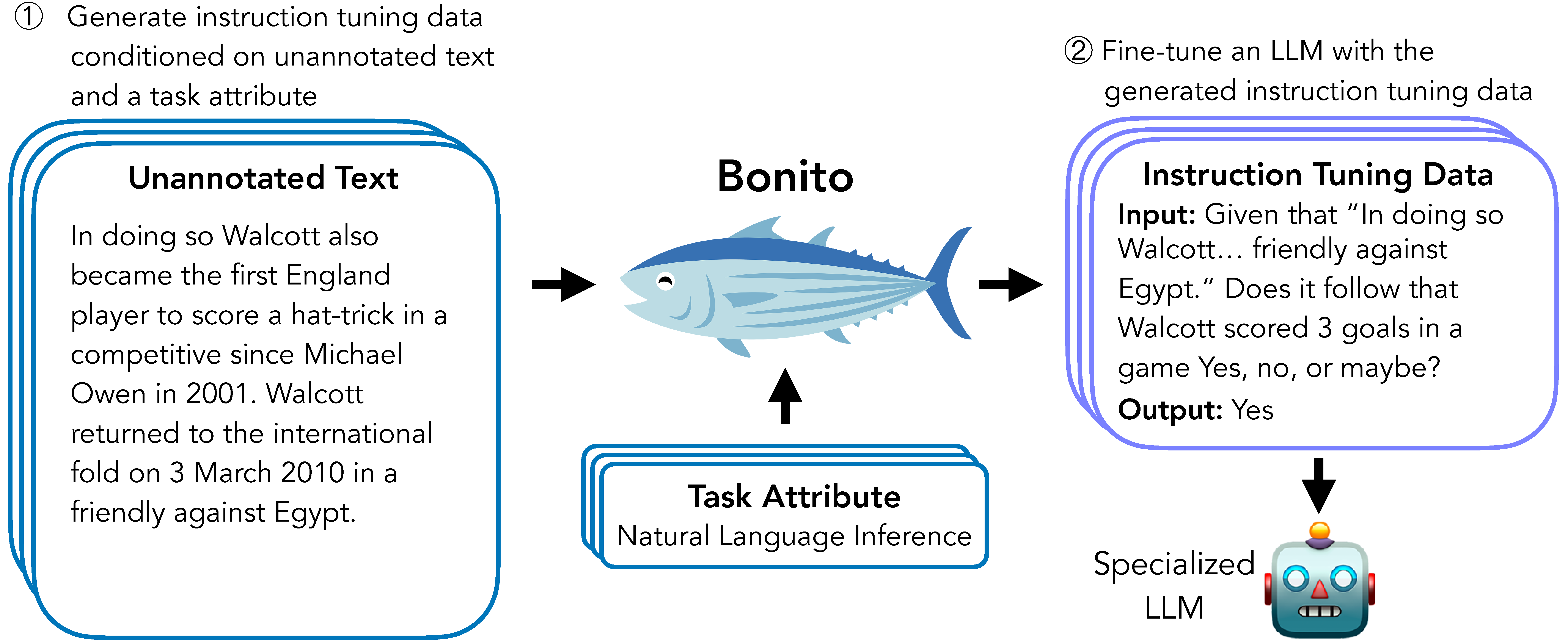
Bonito is an open-source model for conditional task generation: the task of converting unannotated text into task-specific training datasets for instruction tuning. This repo is a lightweight library for Bonito to easily create synthetic datasets built on top of the Hugging Face transformers and vllm libraries.
- Paper: Learning to Generate Instruction Tuning Datasets for Zero-Shot Task Adaptation
- Model: bonito-v1
- Demo: Bonito on Spaces
- Dataset: ctga-v1
- Code: To reproduce experiments in our paper, see nayak-aclfindings24-code.
News
- 🐠 February 2025: Uploaded
bonito-llmto PyPI. - 🐡 August 2024: Released new Bonito model with Meta Llama 3.1 as the base model.
- 🐟 June 2024: Bonito is accepted to ACL Findings 2024.
Installation
Create an environment and install the package using the following command:
pip3 install bonito-llm
Basic Usage
To generate synthetic instruction tuning dataset using Bonito, you can use the following code:
from bonito import Bonito
from vllm import SamplingParams
from datasets import load_dataset

# Initialize the Bonito model
bonito = Bonito("BatsResearch/bonito-v1")

# load dataset with unannotated text
unannotated_text = load_dataset(
    "BatsResearch/bonito-experiment",
    "unannotated_contract_nli"
)["train"].select(range(10))

# Generate synthetic instruction tuning dataset
sampling_params = SamplingParams(max_tokens=256, top_p=0.95, temperature=0.5, n=1)
synthetic_dataset = bonito.generate_tasks(
    unannotated_text,
    context_col="input",
    task_type="nli",
    sampling_params=sampling_params
)
Supported Task Types
Here we include the supported task types [full name (short form)]: extractive question answering (exqa), multiple-choice question answering (mcqa), question generation (qg), question answering without choices (qa), yes-no question answering (ynqa), coreference resolution (coref), paraphrase generation (paraphrase), paraphrase identification (paraphrase_id), sentence completion (sent_comp), sentiment (sentiment), summarization (summarization), text generation (text_gen), topic classification (topic_class), word sense disambiguation (wsd), textual entailment (te), natural language inference (nli)
You can use either the full name or the short form to specify the task_type in generate_tasks.
Tutorial
We have created a tutorial here for how to use a quantized version of the model in a Google Colab T4 instance. The quantized version was graciously contributed by user alexandreteles. We have an additional tutorial to try out the Bonito model on A100 GPU on Google Colab here.
Citation
If you use Bonito in your research, please cite the following paper:
@inproceedings{bonito:aclfindings24,
  title = {Learning to Generate Instruction Tuning Datasets for Zero-Shot Task Adaptation},
  author = {Nayak, Nihal V. and Nan, Yiyang and Trost, Avi and Bach, Stephen H.},
  booktitle = {Findings of the Association for Computational Linguistics: ACL 2024},
  year = {2024}}
1 maintainer

Metadata
1 maintainer
Release files for bonito-llm 0.1.0
For a detailed explanation of source distributions (sdists) and built distributions (wheels), please see the package formats documentation.
Source distribution (sdist)
| File | Size | Uploaded | Provenance | Actions |
|---|---|---|---|---|
| bonito_llm-0.1.0.tar.gz | 6.0 kB | Without provenance | Details for bonito_llm-0.1.0.tar.gz |
Built distribution (wheel)
| File | Interpreter | ABI | Platform | Actions Reset |
|---|---|---|---|---|
| bonito_llm-0.1.0-py3-none-any.whl | Python 3 | none | any | Details for bonito_llm-0.1.0-py3-none-any.whl |
Total release size: 12.4 kB
Release files / bonito_llm-0.1.0.tar.gz
| Download URL | bonito_llm-0.1.0.tar.gz |
|---|---|
| Size | 6.0 kB |
| Tags | Source |
|
SHA-256 checksum How to use checksums |
71570544c9514f92688afecd8a366fdc673d86cb16c29b16f8d5546ff852b53c
|
|
BLAKE2b-256 checksum How to use checksums |
ebeff62e660f8ab45a383998e93f8b9a6a916821df03d2e3b3cfbdce638de1f6
|
| Upload date | |
|
Uploaded using Trusted Publishing? What is trusted publishing? |
No |
| Uploaded via |
twine/6.1.0 CPython/3.10.4
|
Release files / bonito_llm-0.1.0-py3-none-any.whl
| Download URL | bonito_llm-0.1.0-py3-none-any.whl |
|---|---|
| Size | 6.4 kB |
| Tags | Python 3 |
|
SHA-256 checksum How to use checksums |
20c61ed56fdf169348b4b7fed8f01eb9ba55363ac3593459d42d9868db8b27bb
|
|
BLAKE2b-256 checksum How to use checksums |
32682a65cf3dfd017afbc6cbb93127f92cbfe97d9a4af290b707156cdcd2c4d9
|
| Upload date | |
|
Uploaded using Trusted Publishing? What is trusted publishing? |
No |
| Uploaded via |
twine/6.1.0 CPython/3.10.4
|
Security for bonito-llm 0.1.0
Provenance
Provenance describes where a file came from. On PyPI, provenance is shared via attestations, which provide a verifiable record of the build or publishing details. View details, limitations and caveats.
No provenance found
None of the files in this release were uploaded with provenance metadata.
A note on package security
PyPI is a repository for distributing packages, not a service for auditing them. While third-party security researchers and our staff do their best to detect and remove malicious packages, PyPI cannot guarantee the quality, security or suitability of any given package.
To learn more about protecting yourself from malicious actors, visit our package security documentation.













