
bonsai-lint
Find the code that's hard to read, in seconds, in one project or a whole monorepo.
Bonsai: the art of keeping a tree small enough to take in at a glance. Same idea, applied to your syntax trees.
A multi-language cognitive complexity linter written in Rust. One static binary that currently reads JavaScript, TypeScript, Vue single-file components, Python, Java, PHP and Go. Use it for any one of them, or all at once. No runtime or toolchain for any of them, nothing added to your project. Scans 1.26 million lines in 0.8 seconds.
The official site is bonsai.kauneckas.dev: install and editor guides, and a playground that scores code in your browser.





Why this one
- One language or all of them. Point it at any project with nothing to configure. A mixed codebase scores in one pass on one metric, and the same logic gets the same number in every language. That is tested.
- No runtime, no plugins, no conflicts. Nothing to wire into each language's own linter and no plugin versions to keep in step.
- Never executes your code. Syntax only: no autoloader, reflection or module resolution, so untrusted source is safe to scan.
- Callbacks compound. A closure in a loop in a condition scores at its real depth, so a callback pyramid is one hard function, not several easy ones.
- Sees the code other tools miss. Scripts, templates, route files and module-level setup are scored too. On a legacy codebase that is often where the worst of it hides.
- Adoptable on day one. Baseline existing findings and fail only on regressions.
Cognitive complexity measures how hard code is to read, where cyclomatic complexity measures
how hard it is to test. A switch with twenty arms is cyclomatically awful and cognitively
fine; three nested ifs are the reverse.
Install
npx bonsai-lint --over 15 src/            # run it without installing anything
npm install -D bonsai-lint                # or pin it in the project
uvx bonsai-lint --over 15 src/            # the same, for a Python project
pip install bonsai-lint                   # or: uv tool install / pipx install bonsai-lint
brew install ryckakas/tap/bonsai-lint     # macOS and Linux
go install bonsai.kauneckas.dev/bonsai-lint@latest
cargo install bonsai-lint                 # from source
curl -LsSf https://github.com/ryckakas/bonsai-lint/releases/latest/download/bonsai-lint-installer.sh | sh
The npm package fetches the prebuilt binary for your platform on install. Nothing is compiled, and Node only launches it. The analysis itself is pure Rust.
Linux has two builds. One links glibc 2.35 or newer. The other is static and runs on any Linux, which covers Alpine and other musl systems as well as older glibc. The installer script, the npm package and the Go module each pick the right one for you, and the PyPI wheels always carry the static one.
In a Go module, go get -tool bonsai.kauneckas.dev/bonsai-lint@latest pins it in go.mod, and
go tool bonsai-lint runs it (Go 1.24+). The Go module is a launcher with no dependencies, at the
same version as the CLI. The first run of each version downloads that release's binary, checks it
against a checksum recorded in the module, and caches it. The platforms and settings are in
bonsai-lint-go.
From PyPI, pip install bonsai-lint, uv tool install bonsai-lint or pipx install bonsai-lint
puts the binary on your PATH, and uvx bonsai-lint runs it without installing anything. Each wheel
holds the release's own binary, with no Python code around it: macOS on Apple silicon and Intel,
Linux on x86_64 and arm64 (glibc 2.17 or newer, or musl), and Windows on x64. There is no source
distribution, so any other platform gets pip's "no matching distribution". That includes an ARM64
Python on Windows, where an x64 Python works under emulation, and so does
cargo install bonsai-lint.
As a pre-commit hook, from v0.4.2:
repos:
  - repo: https://github.com/ryckakas/bonsai-lint
    rev: v0.4.2
    hooks:
      - id: bonsai-lint
        # args: [--over, "10"]
pre-commit installs the matching wheel itself and runs the hook on the staged files it can score.
The hook judges each file exactly as bonsai-lint run from the repository root does, so a
bonsai-lint.toml below the root counts only when the root config declares it as a domain. A
commit touching only files it skips, such as generated code, passes. pre-commit autoupdate
moves rev to the latest release.
There is no Maven or Gradle plugin yet. On a Java project, use Homebrew, the installer script or
npx bonsai-lint.
Use it
bonsai-lint src/                     # fail on anything above 15
bonsai-lint --over 10 src/           # stricter; `--over php=10,typescript=20` per language
bonsai-lint --all src/               # every unit, ranked
bonsai-lint --format json src/       # for editors and CI
bonsai-lint --write-baseline src/    # record today's findings, exit 0
bonsai-lint --lang php src/          # one language only; `--help` lists the ids
The rest of the flags: monorepos, CI and editors
bonsai-lint --domain web                       # one declared domain only
bonsai-lint --baseline PATH .                  # one baseline file for the whole repo, wherever you choose
bonsai-lint --config packages/web src/         # discover config from here, not from the first path
bonsai-lint --no-toplevel src/                 # skip code outside any function
bonsai-lint --stdin --stdin-path src/a.php < buffer   # score an unsaved buffer as that file
bonsai-lint --jobs 4 .                         # cap the workers; 0 or absent uses every core
bonsai-lint --allow-no-files a.d.ts gen.go     # pass when none of the paths can be scored
  69  packages/billing/src/invoice-mapper.service.ts:47  InvoiceMapperService::mapLineItems
  25  services/api/src/Controller/CheckoutController.php:207  CheckoutController::applyDiscounts
  22  packages/web/src/parser/lexer.js:19  Lexer
The same run as JSON
bonsai-lint --format json .
{
  "thresholds": {
    "go": 15,
    "java": 15,
    "php": 15,
    "python": 15,
    "typescript": 15,
    "vue": 15
  },
  "breaches": 3,
  "findings": [
    {
      "path": "packages/billing/src/invoice-mapper.service.ts",
      "line": 47,
      "name": "InvoiceMapperService::mapLineItems",
      "score": 69,
      "language": "typescript",
      "domain": "root"
    },
    {
      "path": "services/api/src/Controller/CheckoutController.php",
      "line": 207,
      "name": "CheckoutController::applyDiscounts",
      "score": 25,
      "language": "php",
      "domain": "root"
    },
    {
      "path": "packages/web/src/parser/lexer.js",
      "line": 19,
      "name": "Lexer",
      "score": 22,
      "language": "typescript",
      "domain": "root"
    }
  ]
}
findings is already ranked, worst first, so a consumer does not have to sort it. thresholds
is keyed by language id and reports what the scan actually applied, which is the domain's
threshold rather than the root's when the scan was scoped to one. breaches counts the findings
over that threshold, and is what the exit code follows; with --all the array also carries
everything under it, and breaches still counts only the ones that failed.
domain names the domain a file resolved to — root when there is no bonsai-lint.toml
declaring any — and path is always forward-slashed, so a report generated on Windows compares
against one generated in CI.
A clean run prints nothing and exits 0. Exit 1 means a breach, or that the scan was untrustworthy, because a path could not be read or matched no supported file. A gate that cannot read what it was pointed at must not report success.
Supported languages and extensions
| Extensions | Parsed as | Language id |
|---|---|---|
.js, .mjs, .cjs, .jsx, .tsx |
TypeScript with JSX | typescript |
.ts, .mts, .cts |
TypeScript | typescript |
.vue |
the <script> blocks only |
vue |
.py, .pyw |
Python | python |
.java |
Java | java |
.php, .phtml |
PHP | php |
.go |
Go | go |
*.min.js, *.min.mjs, *.min.cjs |
skipped, generated output | |
*.d.ts, *.d.mts, *.d.cts |
skipped, signatures only | |
.pyi |
not scanned, typing stubs | |
.py whose header says "generated" and "do not edit" |
skipped, generated output | |
.java whose header says "generated" and "do not edit" |
skipped, generated output | |
.go headed // Code generated … DO NOT EDIT. |
skipped, generated output |
The language id is what --lang, --over LANG=N and a [section] in the config take, so
typescript covers every JavaScript and TypeScript file however it is parsed. An id that is not
one of these is an error, not a silent no-op.
.js is parsed with the TypeScript grammar, which accepts a superset of JavaScript. Flow
annotations are the one thing this misparses.
A declaration file and a minified one are both skipped outright, for opposite reasons: the first
holds only signatures so every unit scores zero, and the second is generated output whose whole
body rolls up into one unit nobody will refactor. The skipped names are whole suffixes, listed by
the TypeScript and TSX descriptors' unscored_suffixes, so app.mini.js, jasmine.js and a
file simply called min.js are all still scanned.
A .vue file scores its <script> and <script setup> blocks, with lang="ts" choosing the
TypeScript grammar and anything else (including no lang) choosing the JSX-capable one, which
is the grammar .js already uses. Each block is parsed on its own, and their file-level code is
added together into the one <toplevel> a component reports. Reported lines are lines in the
.vue file, so editing a template moves a finding without changing its baseline key.
| Construct | Scored |
|---|---|
<script> and <script setup>, any lang |
yes, as vue |
a render() function written in a script block |
yes, as vue |
JSX inside <script lang="tsx"> |
yes, as vue |
<template>: v-if, v-for, {{ }}, @click="a && b()" |
no |
<style>, and custom blocks such as <docs> or <i18n> |
no |
<script src="./logic.ts"> |
no, but logic.ts is scanned on its own, as typescript |
Two consequences are worth knowing:
- The template is deliberately not scored. A
v-ifchain is real branching, but the the metric is defined over script code, and counting a template would make a component incomparable with the same logic written in TypeScript. Arender()function is scored, because it is ordinary script code, so moving logic out of a template and intorender()makes it visible, and a component that never had a template was never hidden. - A
src=block belongs to the file it points at. That file is scored astypescript, so a[vue]threshold does not reach it.
A Python method is keyed by its class, OrderService::process. A property's getter, setter and
deleter redefine one name on purpose, so the accessor a decorator declares joins the key:
Cart::total, Cart::total.setter and Cart::total.deleter are baselined apart. A def whose
body is only ..., such as an @overload stub or a protocol method, declares a signature and is
not a unit. A .py file is skipped as generated by the same header rule as Java below, which
covers protobuf, gRPC and Thrift output. A Django migration says only "Generated by Django",
because it is meant to be edited, so it stays scored.
Java overloads freely, so a Java method or constructor is keyed by its parameter types as well as
its name: OrderService::process(Order, User). Each type is its simple name, without type
arguments or annotations, so two overloads are baselined apart and switching between an import
and a qualified name never re-keys one. Java has no single generated-code convention, so a .java
file is skipped when the comments before its first line of code say both "generated" and "do not
edit". That covers protobuf, Thrift, Avro and JavaCC output. Most generated sources sit in a
gitignored target/ or build/ directory and are never scanned in the first place.
Go marks generated code in the file rather than its name, so a .go file is read first and then
turned away if a // Code generated … DO NOT EDIT. line comes before its package clause, which
is the convention the Go toolchain itself follows. Such a file is neither scored nor counted, on
disk and through --stdin alike. vendor/ and testdata/ get no special treatment: if a
repository commits them, exclude = ["vendor/**", "**/testdata/**"] keeps them out.
A Go method is keyed by its receiver type, so func (s *Stack[T]) Push() reports as
Stack::Push and keeps its baseline entry when the receiver switches between pointer and value.
The same code scores the same in every language
foreach ($orders as $order) {          //  +1
    if ($order->isActive()) {          //  +2
        array_map(function ($item) {   //  +0, nesting is now 3
            if ($item->qty > 0) {      //  +4
                return $item->qty > 10 ? 'bulk' : 'single';   // +5
  12  backend/Orders.php:3   OrderRepository::syncLineItems
  12  frontend/orders.ts:1   syncLineItems
Identical logic, identical number. That is what makes one threshold meaningful across a monorepo.
Configure it, or don't
Nothing on disk is required. Defaults are a threshold of 15 for every language, .gitignore
respected, top-level code scored. One bonsai-lint.toml at the repository root covers a normal
project:
threshold = 15
exclude   = ["vendor/**", "**/*.generated.ts"]

[typescript]
threshold = 20
Every configuration key
| Key | Default | Meaning |
|---|---|---|
threshold |
15 |
Fail above this score. A section named after a language id, such as [typescript], overrides it per language. |
exclude |
[] |
Globs, relative to the config's own directory. * stops at / and ** crosses it, as in .gitignore. |
toplevel |
true |
Score code outside any function as <toplevel>. |
baseline |
.bonsai-lint-baseline.json |
Where this directory's baseline lives, relative to it. |
domains |
none | Root config only: globs naming directories that own their own config and baseline. |
name |
its path from the root, such as packages/web |
A domain's name in output and for --domain. Two domains cannot share one. |
A misspelt key is an error rather than a silent default, named with a suggestion when one is
close, and so is a negated glob: !pattern is not supported.
Monorepos: per-team thresholds and baselines
Add domains and each team owns its own thresholds and its own baseline, without editing a
shared file. The root declares where domains may live, so a stray config cannot quietly
create one.
# bonsai-lint.toml at the repository root
domains   = ["packages/*", "services/*"]
threshold = 15
# packages/web/bonsai-lint.toml
name      = "web"
threshold = 20
packages/web/.bonsai-lint-baseline.json       # each domain keeps its own
services/billing/.bonsai-lint-baseline.json
--write-baseline then writes one file per domain and prints what it wrote, or says that there
was nothing to record. Baseline keys are relative to the domain root, so they survive being
checked out anywhere, on any platform. A domain's own exclude is relative to its root too; the
root's applies everywhere.
--baseline PATH keeps every domain in one file of your choosing instead. Its keys are relative
to the repository root, so two domains with a src/index.ts cannot collide. Which to use is
your call: one file is simpler for a small repository, while per-domain files stay short and
put each team's accepted debt in the directory that team owns.
Wherever you point the CLI, the workspace is the same one. Discovery walks up from the first
scanned path and takes the outermost bonsai-lint.toml that declares domains as the root, so
bonsai-lint packages/web applies the same root excludes, inherited thresholds and domain list
as bonsai-lint ., and so does an editor buffer. Without a domains declaration anywhere, the
nearest config is the root. --config PATH starts the walk somewhere else.
Baselines: adopt it without fixing everything first
bonsai-lint --write-baseline src/
Records everything currently above the threshold as accepted. Later runs fail only on scores
that got worse, or on units the baseline has never seen. An unknown key is treated as a
regression, never as an acceptance. A renamed function is reported rather than silently
inheriting someone else's amnesty. Two units in one file that share a key, such as a def
redefined under if/else, share one entry holding the higher score. Entries that match
nothing are reported too, so a baseline cannot quietly rot into a permanent exemption, but only
by a scan that covered the whole domain, so a single file from a pre-commit hook or an editor
buffer never cries stale.
Without a bonsai-lint.toml, the directory holding the baseline is the project root, so
bonsai-lint --write-baseline . followed by bonsai-lint src/Foo.php finds the same entries.
Suppressing a finding: with a reason, or not at all
// bonsai-lint-ignore: hand-tuned state machine, splitting it hurts more than it helps
function parse(string $input): Ast { /* ... */ }
Works above the declaration, inside the docblock, or trailing the signature line, in every
supported language. In Python it goes in a # comment above the def or its decorators: a
docstring is a string inside the body, not a comment, so it cannot carry a marker. It works for a
bound function too, such as const handler = () => {}, Python's handler = lambda e: …, a
Java field Runnable handler = () -> {}, $handler = function () {} or Go's
var handler = func() {}, even when a call wraps it, as in
const useCart = defineStore('cart', () => {}). A marker after a closing brace on its own line
belongs to nobody. A marker without a reason is refused, reported on stderr, and the finding
stands. Suppression hides a finding but never changes a score, and --all always shows the real
number.
A <toplevel> finding is reported on line 1, so its marker goes in the comment block at the top of
the file: on the first line of a script, behind a shebang if there is one; in Python, behind a
shebang or coding line and above the module docstring; just above or trailing the package line
in Java or Go; or trailing <?php, or in the file's docblock, in PHP. One
comment silences one unit, so a marker directly above the first function is that function's; write
it on the package or <?php line to address the file instead.
Scoring
Three rules: shorthand that doesn't break reading flow is free; +1 for each break in linear flow; +nesting when a flow-breaker sits inside other flow-breakers. Full table in docs/scoring-rules.md.
Code outside a function is still code
Most complexity tools only score functions and methods, so a 200-line procedural template, a
route table or a module-level bootstrap is invisible to them. bonsai-lint scores whatever is left
over as a <toplevel> unit, one per file:
  84  services/api/templates/report/summary.php:1  <toplevel>
  37  services/api/scripts/migrate-tenants.php:1  <toplevel>
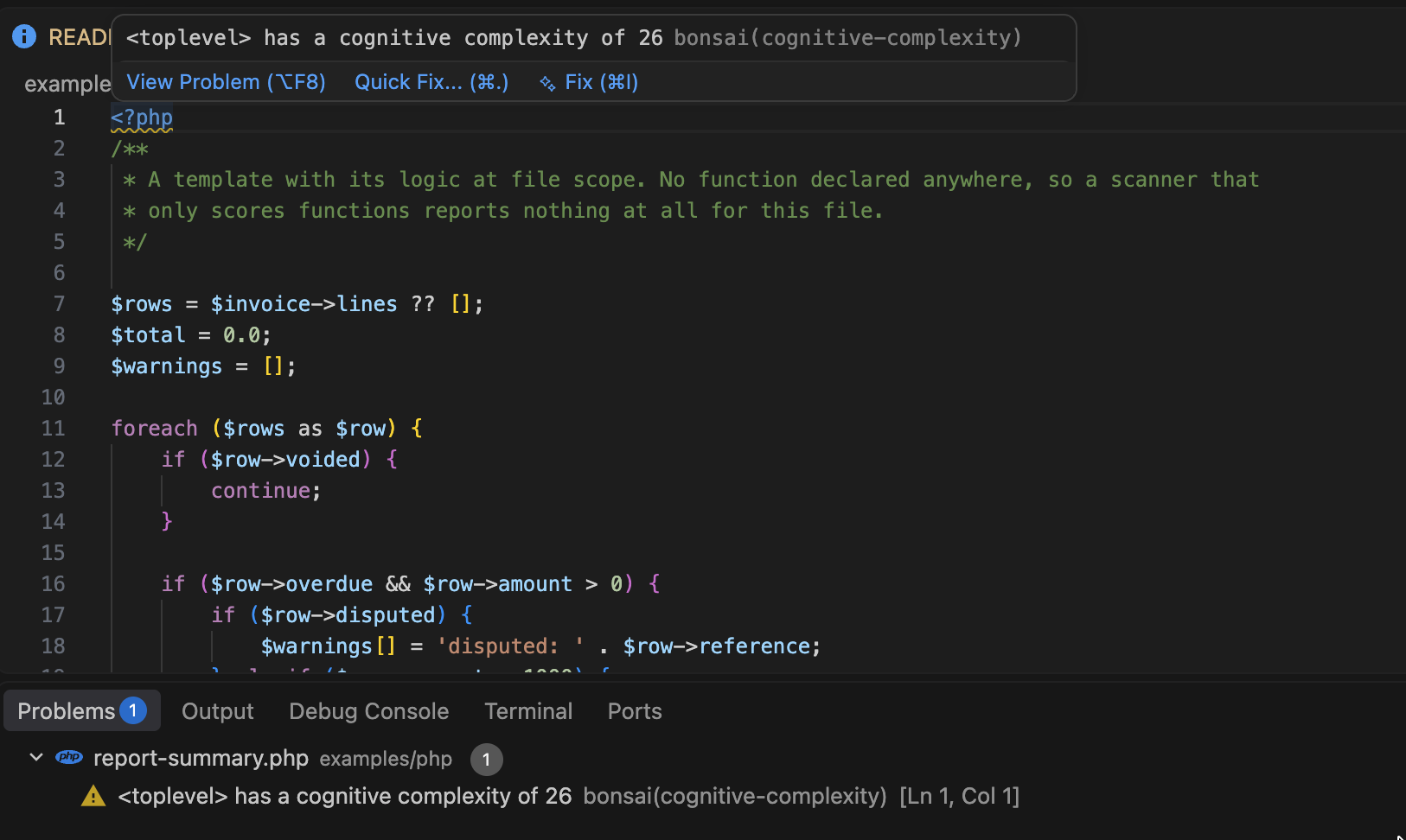
Files with no top-level logic report nothing, so this costs you no noise. Turn it off with
--no-toplevel or toplevel = false.
Choices that move the numbers
Numbers from bonsai-lint will not always match another implementation. Every difference is a deliberate choice, and this is all of them, so you can judge which suits you:
| Elsewhere | bonsai-lint | |
|---|---|---|
| Closure inside a function | scored separately, from zero | carries the nesting it sits at |
??, a?.b |
+1 | free |
JSX {cond && <X/>} |
exempt | +1, the same as the equivalent ternary |
const x = a || [] |
exempt | +1 |
| Code outside any function | not scored | scored as <toplevel> |
An if inside a plain else block |
no deeper than the else |
one level deeper, like any branch body |
a && (b || c) && d |
2, the group counted as its own run | 3, grouping is transparent |
a && b || c && d |
2, each operator counted once | 3, each switch of operator starts a run |
A later link of an else if chain |
one level deeper per link | one level below its if, like the first |
A loop or switch header |
one level deeper | at the construct's own depth |
| A method calling itself through its receiver | not recursion | +1 |
A builtin sharing a method's name, append() inside append |
+1, as recursion | free |
A Python comprehension, [x for x in xs if x] |
each for and if clause +1, or ignored |
free, but nests like the callback chain it replaces |
A Python loop's or try's else: |
free | +1, like any else |
A Python match |
free | +1, like a switch |
f(key=a or b), (x or "") + y, f"{a and b}" |
not counted | +1, wherever the operator sits |
A function holding only a nested function and its return |
the inner one keeps its level | one level deeper, like any closure |
A nested function under an if or with, or a method of a local class |
no deeper than the code around it | one level deeper, like any closure |
A bare m() inside Python method m |
+1, as recursion | free: the name is a global |
| A Python function recursing twice | +1 once, and not through self |
+1 per call, through self, cls or its class |
| A local closure sharing its function's name | resolved to the local | +1 per call, matched by name |
| A Java overload taking as many arguments | resolved by type, not recursion | +1, matched by name and argument count |
A call through another instance of the same type, left.count() |
+1, as recursion | free |
The last three rows are limits rather than preferences: recursion is recognised by syntax alone, with no scope or type analysis.
The first row moves numbers the most. Scoring every function from zero means a pyramid of callbacks costs almost nothing:
if (a) { for (const x of xs) { xs.forEach(item => { if (b) { … } }); } }
bonsai-lint reports that as a single unit scoring 7. Scored per function it is two units, at 3 and 1. Neither is wrong. They answer different questions. Per-function tells you how hard each piece is on its own; bonsai-lint tells you how hard the whole thing is to read where it stands. If you care about callback depth, the second is the more useful number.
Migrating? Expect your numbers to move, mostly upward, for these reasons and no others.
Editor
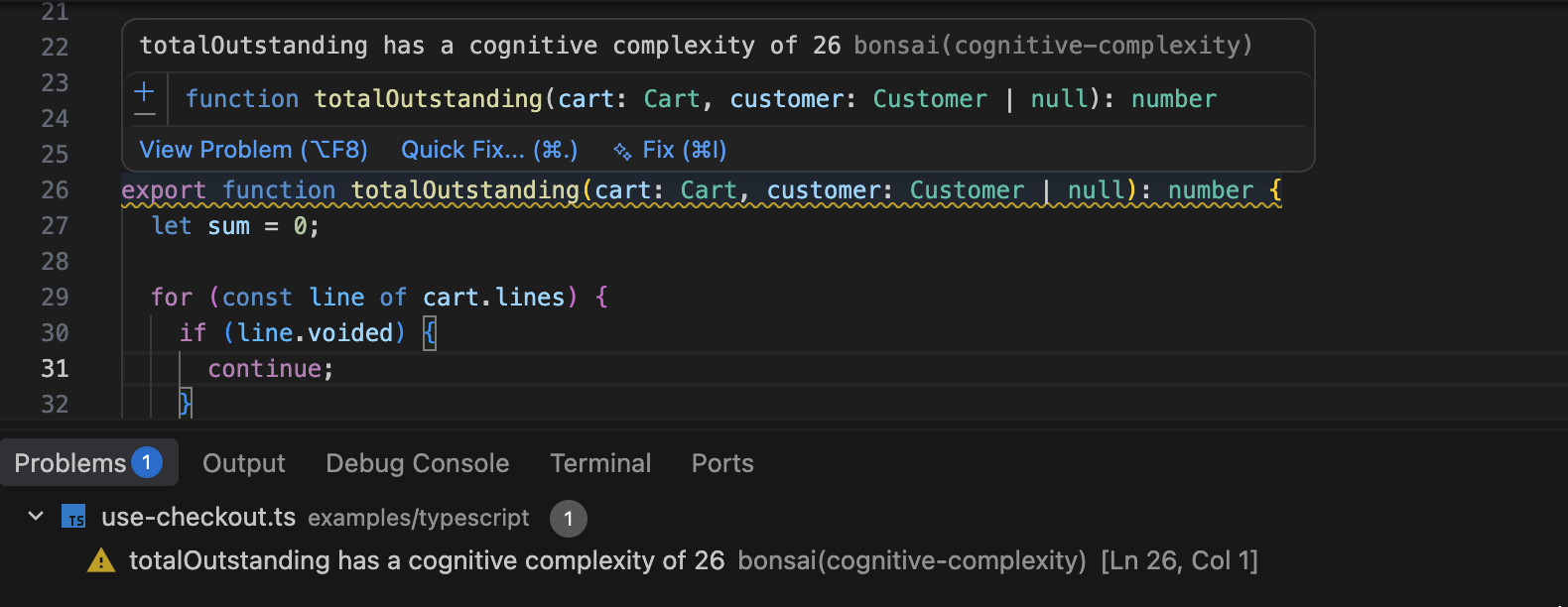
The VS Code extension reports diagnostics for every editor language it is
configured for. It
analyses the buffer as you type, not the file on disk, and it deliberately does not pass a
threshold unless you set one, so the editor shows exactly what CI would fail on, your
bonsai-lint.toml and baselines included.
Performance
| Corpus | Time |
|---|---|
| 1.26 million lines of JavaScript, TypeScript and PHP | 0.77s |
| 1.51 million lines of Python, CPython's standard library and Django | 0.92s |
| 2.29 million lines of Java, Spring Framework and Guava | 1.08s |
| 2.85 million lines of Go, its own standard library | 0.79s |
That is roughly 1.6 million lines per second on the monorepo, three languages in one pass, 1.6 million on Python, 2.1 million on Java and 3.6 million on the Go standard library, all on a ten-core M5. No warm-up, no daemon, no language server. One process, start to finish.
Files are read, parsed and scored in parallel; --jobs bounds that, and --jobs 1 is the same
scan on one core, at 3.15s. The report is byte for byte identical either way — findings are
collected and ranked after the scan, never printed as they arrive — so a diff of two runs is
always a real change, not a scheduling artefact.
One binary, about 2 MB to download and about 8 MB on disk, with every language built in. There is no variant to choose and nothing to enable.
Documentation
- bonsai.kauneckas.dev: the official site, with guides and a playground
- Scoring rules: the full increment table and per-language notes
- Architecture: the language seam, and how to add a language
- Roadmap: what is likely to come next, and why
- Changelog: what changed in each release
License
MIT
1 maintainer

Release files for bonsai-lint 0.4.2
For a detailed explanation of source distributions (sdists) and built distributions (wheels), please see the package formats documentation.
Built distributions (wheels)
| File | Reset | |||
|---|---|---|---|---|
| bonsai_lint-0.4.2-py3-none-win_amd64.whl | Python 3 | none | Windows x86-64 | Details |
| bonsai_lint-0.4.2-py3-none-manylinux2014_x86_64.manylinux_2_17_x86_64.musllinux_1_1_x86_64.whl | Python 3 | none | Linux glibc 2.17+ x86-64, Linux musl 1.1+ x86-64 | Details |
| bonsai_lint-0.4.2-py3-none-manylinux2014_aarch64.manylinux_2_17_aarch64.musllinux_1_1_aarch64.whl | Python 3 | none | Linux glibc 2.17+ ARM64, Linux musl 1.1+ ARM64 | Details |
| bonsai_lint-0.4.2-py3-none-macosx_11_0_arm64.whl | Python 3 | none | macOS 11.0+ ARM64 | Details |
| bonsai_lint-0.4.2-py3-none-macosx_10_12_x86_64.whl | Python 3 | none | macOS 10.12+ x86-64 | Details |
Total release size: 9.8 MB
Release files / bonsai_lint-0.4.2-py3-none-win_amd64.whl
| Download URL | bonsai_lint-0.4.2-py3-none-win_amd64.whl |
|---|---|
| Size | 2.0 MB |
| Tags | Python 3 Windows x86-64 |
|
SHA-256 checksum How to use checksums |
c3e8e33d625504fca723880e092e67fa1b3a5392f28b9674e58b6ff7682a70bb
|
|
BLAKE2b-256 checksum How to use checksums |
bb80ba4e0a85d8dafa2fabd74d76acdb5cc9e56f9000e8f773665c3e4fe4db6b
|
| Upload date | |
|
Uploaded using Trusted Publishing? What is trusted publishing? |
Yes |
| Uploaded via |
twine/7.0.0 CPython/3.13.14
|
Provenance
Provenance describes where a file came from. On PyPI, provenance is shared via attestations, which provide a verifiable record of the build or publishing details. View details, limitations and caveats.


PyPI Publish Attestation
PyPI verified that this artifact, at this checksum, originated from the publisher listed below.
Signed by GitHub Actions, verified by PyPI on Sep 27, 2026.
Transparency logRelease files / bonsai_lint-0.4.2-py3-none-manylinux2014_x86_64.manylinux_2_17_x86_64.musllinux_1_1_x86_64.whl
| Download URL | bonsai_lint-0.4.2-py3-none-manylinux2014_x86_64.manylinux_2_17_x86_64.musllinux_1_1_x86_64.whl |
|---|---|
| Size | 2.1 MB |
| Tags | Linux glibc 2.17+ x86-64 Linux musl 1.1+ x86-64 Python 3 |
|
SHA-256 checksum How to use checksums |
6aa6bd8c05d5c146ac00653abf7daed4f3c7c7defcfa905f2b25cbc1beffadde
|
|
BLAKE2b-256 checksum How to use checksums |
a4b135b1ff0122260455266422ff9420e8a6c17030c14739ff1e247947802aa9
|
| Upload date | |
|
Uploaded using Trusted Publishing? What is trusted publishing? |
Yes |
| Uploaded via |
twine/7.0.0 CPython/3.13.14
|
Provenance
Provenance describes where a file came from. On PyPI, provenance is shared via attestations, which provide a verifiable record of the build or publishing details. View details, limitations and caveats.
PyPI Publish Attestation
PyPI verified that this artifact, at this checksum, originated from the publisher listed below.
Signed by GitHub Actions, verified by PyPI on Sep 27, 2026.
Transparency logRelease files / bonsai_lint-0.4.2-py3-none-manylinux2014_aarch64.manylinux_2_17_aarch64.musllinux_1_1_aarch64.whl
| Download URL | bonsai_lint-0.4.2-py3-none-manylinux2014_aarch64.manylinux_2_17_aarch64.musllinux_1_1_aarch64.whl |
|---|---|
| Size | 1.9 MB |
| Tags | Linux glibc 2.17+ ARM64 Linux musl 1.1+ ARM64 Python 3 |
|
SHA-256 checksum How to use checksums |
5846e502d6363665fe7438fc41138ea6484266d8fd3ead98cc526713f64f3e6e
|
|
BLAKE2b-256 checksum How to use checksums |
125ff04427cbbb1665fe202e6112ae9f040a4b72c2acba30890c48b6de348151
|
| Upload date | |
|
Uploaded using Trusted Publishing? What is trusted publishing? |
Yes |
| Uploaded via |
twine/7.0.0 CPython/3.13.14
|
Provenance
Provenance describes where a file came from. On PyPI, provenance is shared via attestations, which provide a verifiable record of the build or publishing details. View details, limitations and caveats.
PyPI Publish Attestation
PyPI verified that this artifact, at this checksum, originated from the publisher listed below.
Signed by GitHub Actions, verified by PyPI on Sep 27, 2026.
Transparency logRelease files / bonsai_lint-0.4.2-py3-none-macosx_11_0_arm64.whl
| Download URL | bonsai_lint-0.4.2-py3-none-macosx_11_0_arm64.whl |
|---|---|
| Size | 1.8 MB |
| Tags | Python 3 macOS 11.0+ ARM64 |
|
SHA-256 checksum How to use checksums |
067aa040f62e68d6661e2bc7271f5fe0b98aae2a6d69fe8afcc48edb0e0036da
|
|
BLAKE2b-256 checksum How to use checksums |
8c1e1b064e121d001d58a7f2d1469b00e34b618fbf6ad1d8c781c442cdcb98f7
|
| Upload date | |
|
Uploaded using Trusted Publishing? What is trusted publishing? |
Yes |
| Uploaded via |
twine/7.0.0 CPython/3.13.14
|
Provenance
Provenance describes where a file came from. On PyPI, provenance is shared via attestations, which provide a verifiable record of the build or publishing details. View details, limitations and caveats.
PyPI Publish Attestation
PyPI verified that this artifact, at this checksum, originated from the publisher listed below.
Signed by GitHub Actions, verified by PyPI on Sep 27, 2026.
Transparency logRelease files / bonsai_lint-0.4.2-py3-none-macosx_10_12_x86_64.whl
| Download URL | bonsai_lint-0.4.2-py3-none-macosx_10_12_x86_64.whl |
|---|---|
| Size | 1.9 MB |
| Tags | Python 3 macOS 10.12+ x86-64 |
|
SHA-256 checksum How to use checksums |
5ce7c5e1a5e21268e7975e1bcea7403de5a90aa27015e13ca811b7ac34ee0b4e
|
|
BLAKE2b-256 checksum How to use checksums |
9d9ef4a846aff3fb8b8fb798e070ad2df8d3de9f576172b54fd1553531e384aa
|
| Upload date | |
|
Uploaded using Trusted Publishing? What is trusted publishing? |
Yes |
| Uploaded via |
twine/7.0.0 CPython/3.13.14
|
Provenance
Provenance describes where a file came from. On PyPI, provenance is shared via attestations, which provide a verifiable record of the build or publishing details. View details, limitations and caveats.
PyPI Publish Attestation
PyPI verified that this artifact, at this checksum, originated from the publisher listed below.
Signed by GitHub Actions, verified by PyPI on Sep 27, 2026.
Transparency log













