
boundver
Know which contracts changed — and which consumers to verify.






boundver classifies declared contract drift and downstream impact across polyglot repositories. It records four identities per component—exact, behavior, boundary, and compatibility family—then tells CI what changed and which declared consumers may need re-verification.
Use it when APIs, schemas, generated contracts, configuration, or package surfaces cross language and build-system boundaries. Internal refactors stay visible without being confused with public-contract changes.
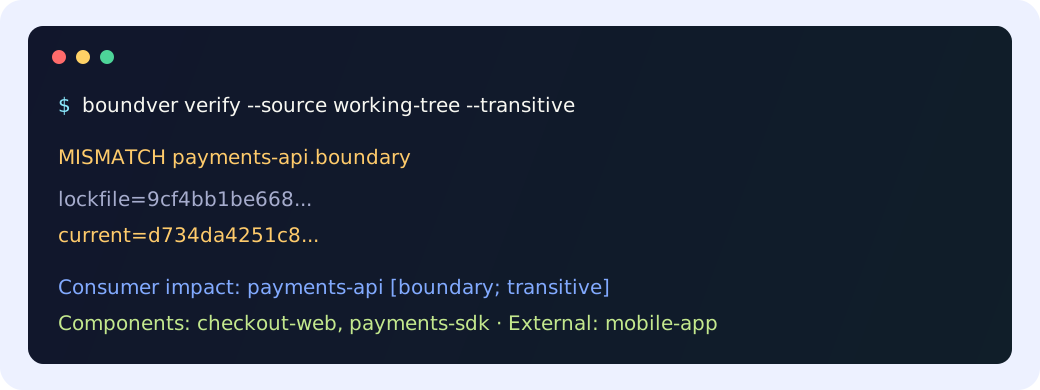
The install and Action examples below target the exact v0.13.0 release so local writers and CI verifiers use the same contract implementation.
Try it in one minute
For a Git repository with tracked code below src/, run from the repository
root:
python -m pip install "boundver[schema,yaml]"
boundver init
boundver validate-config
boundver generate --source working-tree
boundver verify --source working-tree --facets exact
Review and commit boundary.config.json and boundary.lock.json together. If
you prefer a best-effort scaffold for a manifest-based repository, use
boundver init --discover; it exits without writing when no safe component
root can be inferred. Either way, review the component path and boundary
declaration before generation.
The initial scaffold uses an implicit boundary and no version source, so only
exact is available. Declare a real boundary and version source before gating
boundary or compat.
What the four facets mean
| Facet | Question | Input |
|---|---|---|
exact |
Did any tracked component content or file identity change? | Every tracked file below the component path |
behavior |
Did declared observable behavior change? | Declared behavior paths, cryptographically bound to the boundary digest |
boundary |
Did a declared public artifact change? | Output of the configured boundary provider |
compat |
Did the configured compatibility family change? | Component version and compatibility mode |
A useful policy for a component that provides both signals is
boundary,compat: internal and behavior-only drift stays visible as
observations, while public-contract and compatibility drift fails the gate.
Use exact for an implicit, leaf, or unversioned component, or as the portable
CLI-wide gate over all tracked component bytes and file identities.
boundver detects drift in declared artifacts. It does not prove semantic or backward compatibility, execute consumer tests, or infer every runtime behavior. A clean result means the declared inputs and their recorded identities agree.
Where boundver fits
| Need | Use | Relationship to boundver |
|---|---|---|
| Determine affected projects and tasks from a build graph | Nx, Pants, Bazel | These tools discover build impact; boundver classifies declared contract drift across build systems. |
| Prove schema-specific compatibility | oasdiff, Buf, GraphQL Inspector | Run these semantic checkers alongside boundver for the formats they understand. |
| Plan package versions and release notes | Changesets, semantic-release | These automate releases; boundver supplies review and CI signals before promotion. |
| Detect contract-family drift and route downstream verification | boundver | Language-neutral, Git-aware fingerprints plus an explicit consumer graph. |
See the full comparison and integration guide.
A practical configuration
{
  "$schema": "https://raw.githubusercontent.com/yzm1/boundver/v0.13.0/boundary.config.schema.json",
  "project": "payments-platform",
  "defaults": {
    "compat_mode": "major",
    "verify_facets": ["boundary", "compat"]
  },
  "components": {
    "payment-api": {
      "path": "services/payment",
      "version_source": {"file": "package.json", "field": "version"},
      "boundary": {
        "provider": "openapi-canonical",
        "paths": ["openapi/**/*.yaml"]
      },
      "behavior": {
        "paths": [
          "openapi/**/*.yaml",
          "config/**/*.json"
        ]
      },
      "consumers": ["checkout-web"],
      "external_consumers": ["external-risk-service"]
    },
    "checkout-web": {
      "path": "apps/checkout",
      "version_source": {"file": "package.json", "field": "version"},
      "boundary": {"provider": "leaf", "paths": []},
      "verify_facets": ["exact"]
    }
  },
  "slices": {
    "checkout-contracts": {
      "description": "Contracts required by checkout",
      "mode": "boundary",
      "components": ["payment-api"]
    }
  }
}
Component paths are repository-relative. Boundary, behavior, and version-source
files are component-relative. Use POSIX / separators.
In v0.13, component ecosystem, component note, and boundary note are
presentation-only: use them for classification and review rationale, not hidden
contract selection, and editing them does not rotate config_digest.
Glob rules
All raw and canonical path-based providers, behavior selection, validation, and explain output use the same case-sensitive grammar:
| Pattern | Matches |
|---|---|
*.yaml |
YAML files at the component root only |
api/*.yaml |
Direct children of api only |
**/*.yaml |
YAML files at the root or any depth |
api/**/*.yaml |
YAML files directly below api or deeper |
Within one segment, *, ?, and character classes such as [ab] use
case-sensitive character matching; wildcards may match a leading .. A complete
** segment matches zero or more directories. Every
declared literal or pattern must select at least one file; otherwise strict
generation fails instead of hashing an empty contract.
Consumers and behavior
consumers contains unique names of direct downstream configured
components. They are validated as graph edges, so a typo cannot silently
shrink impact. external_consumers contains unique opaque terminal labels for
systems outside this config. Boundary and compatibility drift reports direct
impact by default; add --transitive to verify or why to walk internal
edges and include external terminals found along that downstream closure.
A slice may use an explicit components array or
"closure_of": "payment-api". The latter resolves to the seed plus all configured components
reachable through consumers, and stores the resolved membership in the lock.
The traversal is deterministic and cycle-safe. Exactly one membership form is
allowed. Choose a slice mode supplied by every resolved member (often exact
for a heterogeneous closure), or use --allow-partial only when null member
inputs are intentional.
behavior.paths should list the runtime-relevant contract files reviewers want
to see, normally including the boundary selectors plus configuration, defaults,
migrations, or contract tests. In v3 the behavior digest also includes the
boundary digest, so a configured behavior fingerprint cannot stay unchanged
when its boundary changes.
Review and accept intentional drift
# Inspect the matching local snapshot.
boundver verify --source working-tree
boundver why payment-api --source working-tree

# After consumer-impact review, update and inspect the lock diff.
boundver verify --source working-tree --update
git diff -- boundary.lock.json
--facets decides which fingerprint mismatches fail and which are reported as
observations. It does not limit which fields are regenerated. --update
writes a coherent component entry containing all four facets and its metadata.
Without --components, it regenerates the complete lock. With
--components payment-api, it updates that component and recomputes all slices
after proving every unselected entry is already current; otherwise it refuses
the partial update.
When --facets is omitted, policy precedence is component
verify_facets, then defaults.verify_facets, then an implicit gate over all
facets that are available for that component. A CLI --facets value overrides
every component. Explicitly selecting an unavailable facet—for example
compat on a component with no version_source, or boundary on a leaf
component—is a usage error (exit 2), not a successful null comparison.
Add the missing facet input or select only facets the component supplies;
--update cannot manufacture an unavailable facet and leaves the lock
unchanged.
generate --allow-partial is narrower: it permits an intentional null facet
to appear as a slice input. Missing declared files, provider failures, version
read errors, and vendored-copy failures remain fatal, so the option cannot
write a lock that fails verification merely because extraction failed.
Generated boundary artifacts
boundver currently fingerprints a generated artifact but does not know which source or generator produced it. Make freshness an explicit prerequisite:
python ci/generate_platform_openapi.py --check
boundver verify --source head
Run the generator itself before accepting intentional changes. For an index baseline, stage the generator source and derived output together with any config change, generate from that staged snapshot, then stage the lock:
python ci/generate_platform_openapi.py
git add ci/generate_platform_openapi.py platform/main.yaml \
  platform/infrastructure/openapi.yaml
# If changed, stage boundary.config.json in the same step.
boundver generate --source index
git add boundary.lock.json
boundver verify --source index
There is no executable derived_from config hook: repository config is not a
trusted command-execution boundary. A future declarative derivation contract is
roadmap work.
Source modes
The default source is head: committed state, not unstaged local edits. Use
head for committed CI state, index for staged pre-commit state, and
working-tree while reviewing local edits. Generate and verify from the same
source. The normative snapshot and tracked-file rules live in the
specification; practical staging examples live in
the CI cookbook.
GitHub Actions
Pin the Action to the same lock-contract release used by local writers (for
the latest stable release, yzm1/boundver@v0.13.0). The
CI cookbook is
the canonical workflow recipe and covers outputs, changed-path reporting,
GitLab, pre-commit, and caching.
Providers
| Provider | Selection and meaning |
|---|---|
path-hash |
Format-neutral raw bytes from any declared artifact, such as SQL or protobuf files |
openapi / openapi-raw |
Raw OpenAPI or Swagger bytes |
openapi-canonical |
Parsed OpenAPI contract with selected documentation noise removed |
json-file / json-file-raw |
Raw JSON contract bytes |
json-canonical |
Strictly parsed, deterministic JSON value |
python-exports |
Raw Python export files such as __init__.py |
typescript-exports |
Raw declarations or export barrels |
implicit |
Exact tracking before a boundary is declared |
leaf |
An intentional component with no published boundary |
Canonical means less formatting/documentation noise, not compatibility analysis. Custom Python providers require explicit trusted-code opt-in; a checked-out config cannot authorize imports. See public and custom providers.
Exit codes
The stable 0 through 5 contract distinguishes clean verification, exact or
metadata drift, usage errors, and behavior/boundary/compatibility drift. See
CI exit-code handling for the
authoritative table and shell examples.
Upgrade to 0.12
Version 0.11's boundary-lock/v3 uses semantic-config/v1, whose digest meaning
differs from 0.12's semantic-config/v2. Version 0.10's boundary-lock/v2 also
omits identities required by v3. Neither lock can be relabelled safely: upgrade
writers and verifiers together and regenerate from the snapshot CI will
verify. Follow the canonical
0.12 upgrade procedure.
Regeneration is still mandatory even when its content fingerprints are
digest-neutral. With the same source bytes and effective selectors, a v3/v1 to
v3/v2 regeneration and v0.12's built-in provider-metadata updates are expected
to retain component facet and slice digest values; the semantic-config and
provider metadata still change. Investigate any facet/slice value change rather
than treating it as metadata churn. The equivalent raw-provider case for
json-file-raw and path-hash is documented in the
provider guide.
The v0.13 diff command can compare canonical boundary-lock/v3
semantic-config/v1 and v2 locks read-only so this regeneration remains
reviewable. Full generation recomputes and emits v2 without trusting the old
lock; verification and generation paths that reuse an existing lock reject v1.
Useful commands
v0.13 adds discover --diff-config, migrate-lock --explain, and the
verification baseline flags shown below.
boundver discover
boundver discover --diff-config
boundver status --format json
boundver verify --changed-from origin/main --transitive
boundver verify --components payment-api --update
boundver diff old.lock.json boundary.lock.json
boundver migrate-lock --explain --source head --format json
boundver verify --write-baseline .boundver-verify-baseline.json
boundver why payment-api --transitive --format json
boundver slice checkout-contracts --format json
boundver completions --shell bash
Installation and documentation
boundver requires Git and Python 3.9 or newer.
python -m pip install boundver
python -m pip install "boundver[schema,yaml]"  # recommended for strict JSON Schema and YAML
For a reused developer environment, system pre-commit hook, or prebuilt
container, install the repository's exact pin with --upgrade and assert the
imported version before generating or verifying a lock:
python -m pip install --upgrade "boundver[schema,yaml]==0.13.0"
python -c "import boundver; assert boundver.__version__ == '0.13.0', boundver.__version__"
In persistent automation, invoke commands as python -m boundver ... with that
same interpreter so an older executable elsewhere on PATH cannot take over.
You can also use the release container, Homebrew tap, or GitLab CI/CD component:
docker run --rm -v "$PWD:/repo:ro" -w /repo \
  ghcr.io/yzm1/boundver:<version> verify --source head
brew install yzm1/boundver/boundver
Exact-version and digest-pinned examples are in the distribution guide.
- Documentation
- Getting started
- Runnable demo
- Examples
- CI cookbook
- Gradual adoption
- Migration inspection and verification ratchets
- Why boundver?
- Lockfile merge strategy
- Maintainer release runbook
- Changelog
- Support, contributing, and security
MIT licensed.
1 maintainer

Download files
Download the file for your platform. If you're not sure which to choose, learn more about installing packages.
Source Distribution
Built Distribution
Filter files by name, interpreter, ABI, and platform.
If you're not sure about the file name format, learn more about wheel file names.
Copy a direct link to the current filters
File details
Details for the file boundver-0.13.0.tar.gz.
File metadata
- Download URL: boundver-0.13.0.tar.gz
- Upload date:
- Size: 972.9 kB
- Tags: Source
- Uploaded using Trusted Publishing? Yes
- Uploaded via:
twine/7.0.0 CPython/3.13.14
File hashes
| Algorithm | Hash digest | |
|---|---|---|
| SHA256 |
a3b239df38150a7e9955ebf1bc40c0555547c39826b6b7ee261d1cfc893f077d
|
|
| MD5 |
aa492cb6668a713161498c390611cc93
|
|
| BLAKE2b-256 |
06027936830bdb398b570de36a703335de2900c4b7a96c192bc385e4357d0e81
|
Provenance
The following attestation bundles were made for boundver-0.13.0.tar.gz:
Publisher:
publish.yml on yzm1/boundver
-
Statement:
-
Statement type:
https://in-toto.io/Statement/v1 -
Predicate type:
https://docs.pypi.org/attestations/publish/v1 -
Subject name:
boundver-0.13.0.tar.gz -
Subject digest:
a3b239df38150a7e9955ebf1bc40c0555547c39826b6b7ee261d1cfc893f077d - Sigstore transparency entry: 2580008513
- Sigstore integration time:
-
Permalink:
yzm1/boundver@b5c489ea81cf5ecce87a56855d04431f0dcdcb11 -
Branch / Tag:
refs/heads/main - Owner: https://github.com/yzm1
-
Access:
public
-
Token Issuer:
https://token.actions.githubusercontent.com -
Runner Environment:
github-hosted -
Publication workflow:
publish.yml@b5c489ea81cf5ecce87a56855d04431f0dcdcb11 -
Trigger Event:
workflow_dispatch
-
Statement type:
File details
Details for the file boundver-0.13.0-py3-none-any.whl.
File metadata
- Download URL: boundver-0.13.0-py3-none-any.whl
- Upload date:
- Size: 625.0 kB
- Tags: Python 3
- Uploaded using Trusted Publishing? Yes
- Uploaded via:
twine/7.0.0 CPython/3.13.14
File hashes
| Algorithm | Hash digest | |
|---|---|---|
| SHA256 |
48581bf99f244325f8345f423d50c40b8b09dfecf07addb03df4e35a250434e3
|
|
| MD5 |
877ca4d932d08fcfa2e56cff2d35c1c2
|
|
| BLAKE2b-256 |
7286f7b34e19e594be9d0b46e5b92e3931369a8b736a807f245aad54fd13193b
|
Provenance
The following attestation bundles were made for boundver-0.13.0-py3-none-any.whl:
Publisher:
publish.yml on yzm1/boundver
-
Statement:
-
Statement type:
https://in-toto.io/Statement/v1 -
Predicate type:
https://docs.pypi.org/attestations/publish/v1 -
Subject name:
boundver-0.13.0-py3-none-any.whl -
Subject digest:
48581bf99f244325f8345f423d50c40b8b09dfecf07addb03df4e35a250434e3 - Sigstore transparency entry: 2580008519
- Sigstore integration time:
-
Permalink:
yzm1/boundver@b5c489ea81cf5ecce87a56855d04431f0dcdcb11 -
Branch / Tag:
refs/heads/main - Owner: https://github.com/yzm1
-
Access:
public
-
Token Issuer:
https://token.actions.githubusercontent.com -
Runner Environment:
github-hosted -
Publication workflow:
publish.yml@b5c489ea81cf5ecce87a56855d04431f0dcdcb11 -
Trigger Event:
workflow_dispatch
-
Statement type:














