
BRICK Model Summarizer


BRICK Model Summarizer is a Python tool designed to validate and benchmark AI-generated BRICK models against reference models. It transforms complex BRICK schema TTL files into concise, human-readable summaries of HVAC systems, zones, meters, and central plants. By leveraging reference BRICK models, this tool enables users to validate AI-created models for consistency, accuracy, and adherence to expected standards.
Purpose
The primary purpose of this repository is to provide a framework for summarizing BRICK models into HVAC-centric insights. This is especially useful for:
- Benchmarking AI-generated BRICK models against reference models.
- Validating BRICK schemas for completeness and alignment with building system expectations.
- Empowering building engineers, analysts, and AI developers with clear summaries of mechanical systems and operational data.
Key Features
- HVAC-Focused Summarization: Extracts key details about AHUs, VAVs, meters, and central plant equipment.
- Model Validation: Provides a framework for benchmarking AI-created BRICK models.
- Scalable Processing: Processes individual or multiple BRICK schema TTL files.
Installation
Tested in Linux and Windows Subsystem for Linux
pip install brick-model-summarizer
Local Installation for development purposes
-
Clone the repository:
git clone https://github.com/bbartling/brick-model-summarizer.git
cd brick-model-summarizer
-
Set up a virtual environment (optional but recommended):
python -m venv env
source env/bin/activate
-
Install the package locally:
pip install .
Usage
The package includes functions for summarizing BRICK models and generating detailed outputs. Below is an example of how to use the tool in Python to generate JSON-style data.
Example: Processing a BRICK Model
import os
from brick_model_summarizer import (
    load_graph_once,
    get_class_tag_summary,
    get_ahu_information,
    get_zone_information,
    get_building_information,
    get_meter_information,
    get_central_plant_information,
    get_vav_boxes_per_ahu,
)

# Get the absolute path of the project root
script_dir = os.path.dirname(os.path.abspath(__file__))
project_root = os.path.dirname(script_dir)

# Construct the relative path to the BRICK model
brick_model_path = os.path.join(project_root, "sample_brick_models", "diggs.ttl")

print("Resolved Brick Model Path:", brick_model_path)

# Load the RDF graph once
graph = load_graph_once(brick_model_path)

# Get the individual data components
ahu_data = get_ahu_information(graph)
print("ahu_data \n", ahu_data)

zone_info = get_zone_information(graph)
print("zone_info \n", zone_info)

class_tag_sum = get_class_tag_summary(graph)
print("class_tag_sum \n", class_tag_sum)

building_data = get_building_information(graph)
print("building_data \n", building_data)

meter_data = get_meter_information(graph)
print("meter_data \n", meter_data)

central_plant_data = get_central_plant_information(graph)
print("central_plant_data \n", central_plant_data)

vav_boxes_per_ahu = get_vav_boxes_per_ahu(graph)
print("vav_boxes_per_ahu \n", vav_boxes_per_ahu)
Example Output
=== AHU DEBUG Summary ===
Processed AHU's: 0

ahu_data
 {'total_ahus': 0, 'constant_volume_ahus': 0, 'variable_air_volume_ahus': 0, 'ahus_with_cooling_coil': 0, 'ahus_with_heating_coil': 0, 'ahus_with_return_fans': 0, 'ahus_with_supply_fans': 0, 'ahus_with_return_air_temp_sensors': 0, 'ahus_with_mixing_air_temp_sensors': 0, 'ahus_with_supply_air_temp_sensors': 0, 'ahus_with_supply_air_temp_setpoints': 0, 'ahus_with_static_pressure_sensors': 0, 'ahus_with_static_pressure_setpoints': 0, 'ahus_with_air_flow_sensors': 0, 'ahus_with_air_flow_setpoints': 0, 'ahus_with_active_chilled_beams': 0, 'ahus_with_chilled_beams': 0, 'ahus_with_passive_chilled_beams': 0, 'ahus_with_heat_wheels': 0, 'ahus_with_heat_wheel_vfds': 0}
zone_info
 {'zone_air_temperature_setpoints_found': False, 'total_variable_air_volume_boxes': 59, 'total_variable_air_volume_boxes_with_reheat': 0, 'number_of_vav_boxes_per_ahu': {}, 'vav_boxes_with_reheat_valve_command': 0, 'vav_boxes_with_air_flow_sensors': 0, 'vav_boxes_with_supply_air_temp_sensors': 0, 'vav_boxes_with_air_flow_setpoints': 0, 'co2_sensor_count': 0, 'co2_setpoint_count': 0, 'zone_air_conditioning_mode_status_count': 0, 'cooling_temp_setpoint_count': 0, 'dewpoint_sensor_count': 0, 'heating_temp_setpoint_count': 0, 'humidity_sensor_count': 0, 'humidity_setpoint_count': 0, 'temperature_sensor_count': 0, 'temperature_setpoint_count': 0, 'zone_count': 0, 'reheat_command_count': 0, 'reheat_hot_water_system_count': 0, 'reheat_valve_count': 0}

Class Similarities:
class_tag_sum
 {'class_mismatches': [], 'tag_mismatches': []}
building_data
 {'building_area': 'not_available', 'number_of_floors': 'not_available', 'hvac_equipment_count': 9, 'hvac_zone_count': 0}
meter_data
 {'chilled_water_meter_present': False, 'hot_water_meter_present': False, 'building_electrical_meter_present': False, 'building_gas_meter_present': False, 'building_water_meter_present': False, 'electric_energy_sensor_count': 0, 'electric_power_sensor_count': 0, 'active_power_sensor_count': 0, 'ev_charging_hub_count': 0, 'ev_charging_port_count': 0, 'ev_charging_station_count': 0, 'electrical_energy_usage_sensor_count': 0, 'pv_generation_system_count': 0, 'pv_panel_count': 0, 'photovoltaic_array_count': 0, 'photovoltaic_current_output_sensor_count': 0, 'photovoltaic_inverter_count': 0, 'peak_demand_sensor_count': 0, 'people_count_sensor_count': 0}
central_plant_data
 {'chiller_count': 0, 'water_cooled_chiller_count': 0, 'air_cooled_chiller_count': 0, 'centrifugal_chiller_count': 0, 'absorption_chiller_count': 0, 'boiler_count': 0, 'natural_gas_boiler_count': 0, 'noncondensing_natural_gas_boiler_count': 0, 'condensing_natural_gas_boiler_count': 0, 'electric_boiler_count': 0, 'cooling_tower_count': 0, 'cooling_tower_fan_count': 0, 'heat_exchanger_count': 0, 'heat_exchanger_discharge_temp_sensor_count': 0, 'heat_exchanger_leaving_temp_sensor_count': 0, 'heat_exchanger_supply_temp_sensor_count': 0, 'heat_exchanger_system_enable_status_count': 0, 'heat_pump_air_source_condensing_unit_count': 0, 'heat_pump_condensing_unit_count': 0, 'heat_pump_ground_source_condensing_unit_count': 0, 'heat_pump_water_source_condensing_unit_count': 0, 'heat_recovery_air_source_condensing_unit_count': 0, 'heat_recovery_condensing_unit_count': 0, 'heat_recovery_hot_water_system_count': 0, 'heat_recovery_water_source_condensing_unit_count': 0, 'hot_water_system_count': 0, 'water_pump_count': 0, 'chilled_water_system_count': 0, 'condenser_water_loop_count': 0, 'condenser_water_pump_count': 0, 'condenser_water_system_count': 0, 'domestic_hot_water_system_count': 0, 'preheat_hot_water_system_count': 0, 'radiation_hot_water_system_count': 0, 'reheat_hot_water_system_count': 0, 'water_system_count': 0, 'water_system': 1, 'water_pump': 4, 'hot_water_system': 1, 'chiller_water_flow_count': 0, 'boiler_water_flow_count': 0, 'cooling_tower_temp_count': 0}
vav_boxes_per_ahu
 {}
One note on the output of the Class Similarities is it finds mismatched BRICK classes and tags by comparing them to the most current standard. If a mismatch is found, it returns a dictionary like data in the format of ('custom_tag', 'standard_tag', 0.90):
{
    'class_mismatches': [('Air_Handler_Unit', 'Air_Handling_Unit', 0.85)],
    'tag_mismatches': [('custom_tag', 'standard_tag', 0.90)]
}
Here, 0.85 and 0.90 are similarity scores from SequenceMatcher, which measure how close the custom class or tag is to the standard one. These values provide a statistical similarity percentage from the Python difflib package, helping you assess how much a custom class deviates from the standard.
Validating AI-Generated Models
Use the outputs to compare AI-created models against reference BRICK models, checking for consistency in:
- Equipment classification (e.g., AHUs, VAVs).
- Sensor and control points.
- Central plant configurations.
Sample Data
Reference BRICK models from BRICK resources are included in the sample_brick_models directory. These files can be used for testing and validation.
Web App Demo
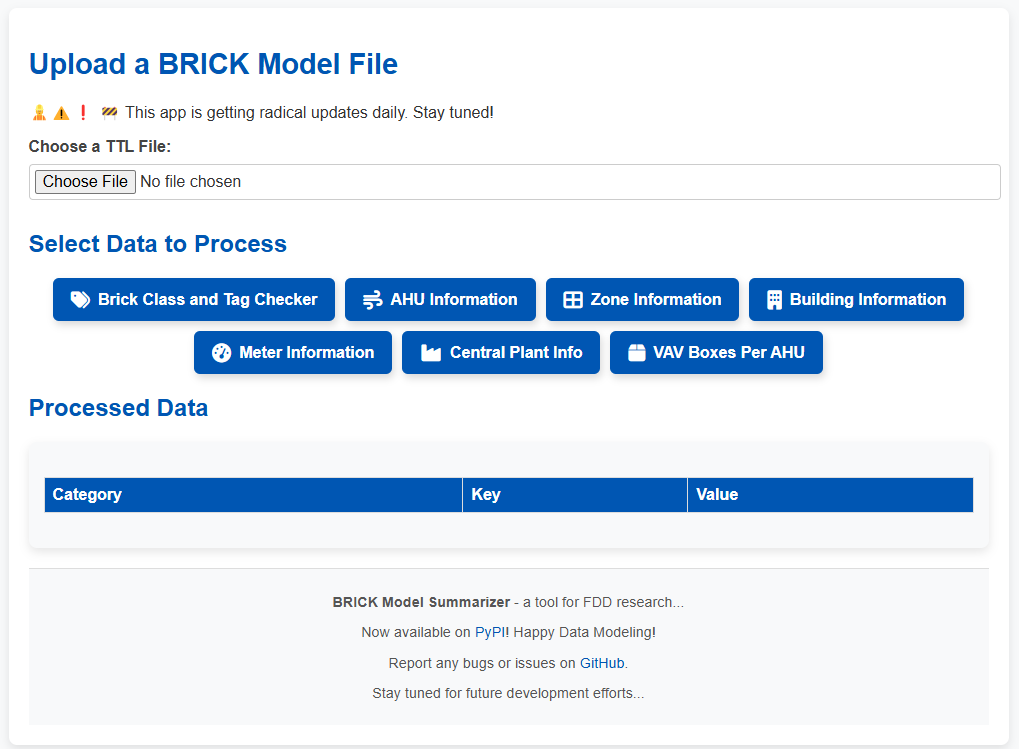
View a web app interface on Bens Pythonanywhere account for free!
- https://bensapi.pythonanywhere.com/
- Upload and process
.ttlfiles to generate detailed BRICK model summaries. - Compare your AI-generated models with official BRICK Reference Models.
- Easy-to-use web interface with support for
.ttlfile validation.
Contributing
We welcome contributions to improve the repository. Please submit issues or pull requests to discuss new features, bug fixes, or enhancements.
Roadmap
Planned Enhancements
- ECM and KPI Suggestions: Develop functionality to recommend energy conservation measures (ECMs) based on model summaries.
- Advanced Validation: Add checks for missing or inconsistent relationships in AI-generated models.
- PyPI Distribution: Prepare the package for publication on PyPI.
License
This project is licensed under the MIT License. See the LICENSE file for details.
1 maintainer

Metadata
1 maintainer
Release files for brick-model-summarizer 0.4.1
For a detailed explanation of source distributions (sdists) and built distributions (wheels), please see the package formats documentation.
Source distribution (sdist)
| File | Size | Uploaded | Provenance | Actions |
|---|---|---|---|---|
| brick_model_summarizer-0.4.1.tar.gz | 21.2 kB | Without provenance | Details for brick_model_summarizer-0.4.1.tar.gz |
Built distribution (wheel)
| File | Interpreter | ABI | Platform | Actions Reset |
|---|---|---|---|---|
| brick_model_summarizer-0.4.1-py3-none-any.whl | Python 3 | none | any | Details for brick_model_summarizer-0.4.1-py3-none-any.whl |
Total release size: 41.9 kB
Release files / brick_model_summarizer-0.4.1.tar.gz
| Download URL | brick_model_summarizer-0.4.1.tar.gz |
|---|---|
| Size | 21.2 kB |
| Tags | Source |
|
SHA-256 checksum How to use checksums |
baa39b305f8e7125f9aead26390966b1ba3fb5d4da40c2f7ce0692de8bec9da3
|
|
BLAKE2b-256 checksum How to use checksums |
caddcafdc1f143d890e35cf059ff80eea79519b1a1a729a79c834cb0b8290a34
|
| Upload date | |
|
Uploaded using Trusted Publishing? What is trusted publishing? |
No |
| Uploaded via |
twine/6.1.0 CPython/3.12.3
|
Release files / brick_model_summarizer-0.4.1-py3-none-any.whl
| Download URL | brick_model_summarizer-0.4.1-py3-none-any.whl |
|---|---|
| Size | 20.7 kB |
| Tags | Python 3 |
|
SHA-256 checksum How to use checksums |
c4feaca863b758fe85e96fc749e8c66531f00f0b9ed2569e4d4b24f70d9e0135
|
|
BLAKE2b-256 checksum How to use checksums |
c32936103ae18b82a90ea333cf897990ed07c1bdd657398b62bad2046fcab364
|
| Upload date | |
|
Uploaded using Trusted Publishing? What is trusted publishing? |
No |
| Uploaded via |
twine/6.1.0 CPython/3.12.3
|
Security for brick-model-summarizer 0.4.1
Provenance
Provenance describes where a file came from. On PyPI, provenance is shared via attestations, which provide a verifiable record of the build or publishing details. View details, limitations and caveats.
No provenance found
None of the files in this release were uploaded with provenance metadata.
A note on package security
PyPI is a repository for distributing packages, not a service for auditing them. While third-party security researchers and our staff do their best to detect and remove malicious packages, PyPI cannot guarantee the quality, security or suitability of any given package.
To learn more about protecting yourself from malicious actors, visit our package security documentation.














