
BrickNet: Graph-Backed Generative Brick Assembly
Peter Kulits and Cordelia Schmid
CVPR 2026
[Project Page] | [Models] | [Dataset]
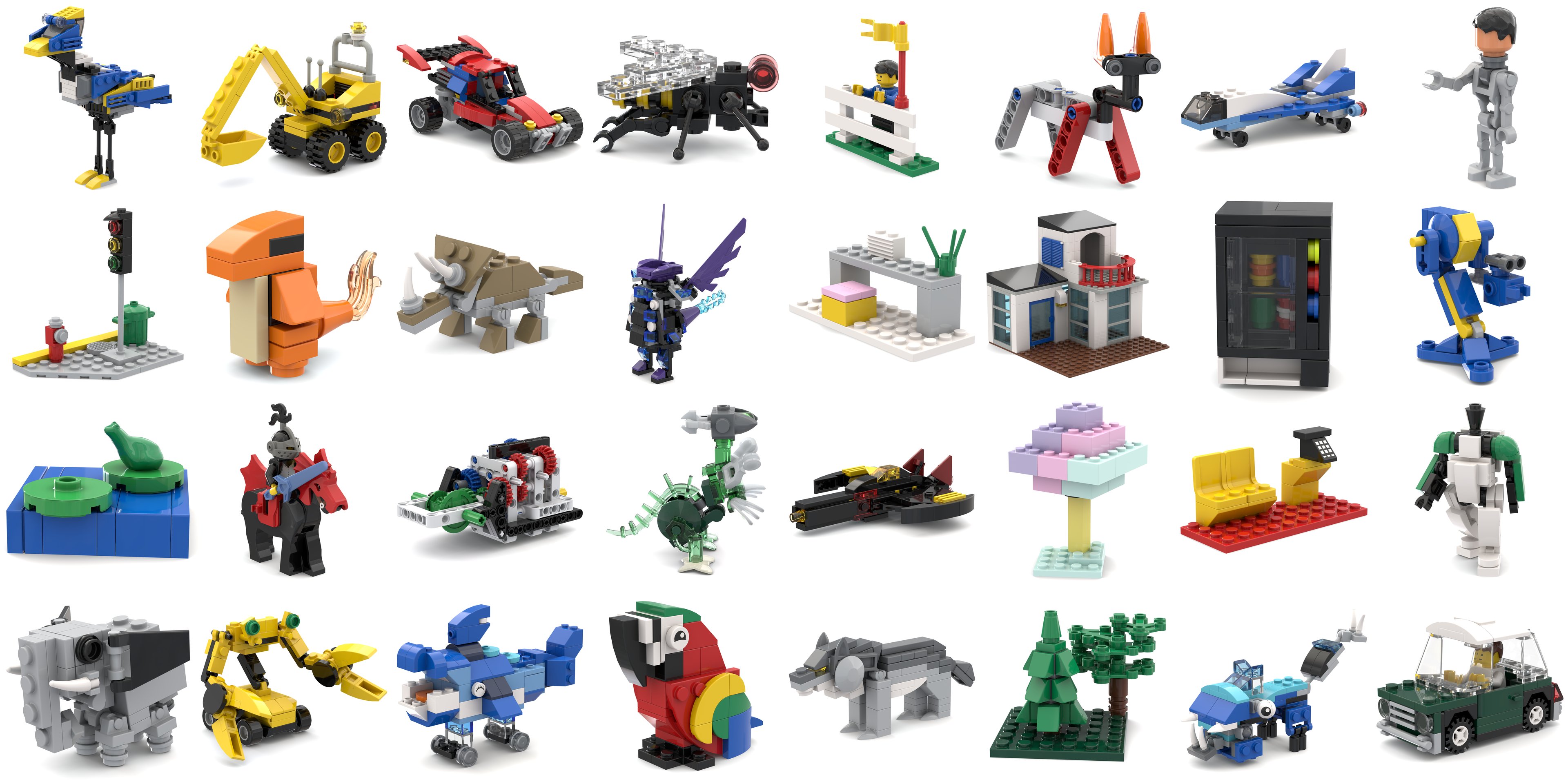
Updates
26-10-01 -- Convex Colliders
Collision checking now uses convex decompositions and Bullet penetration depths with a 1-LDU overlap allowance, replacing triangle-intersection checks on pre-inset meshes. The new checker is strongly recommended for new work. To reproduce the original BrickNet numbers, use v0.1.0.
The new colliders cover 14,442 of the 14,583 catalog parts (99.0%). The API is unchanged. Follow the install commands.
The non-decomposed watertight meshes can be separately downloaded at watertight.tar.xz (80.8 MiB).

Install
pip install bricknet
Collision checking requires the preprocessed per-part convex colliders (191 MiB download, 989 MiB extracted):
python -m bricknet fetch-meshes
Meshes are stored in the platform user-data directory; set BRICKNET_DATA to use another location.
Data Structures
There are three representations:
- LDR: standard LDraw model text; absolute part poses.
- Graph: part vocabulary ids, colors, optional absolute transforms, structured connector
edges, connected components; persisted as batched
.npz. - Tree: a quantized spanning tree of one Graph component; a build order. Serialized as path text, the format we train on.
import bricknet

g = bricknet.parse_ldr(open("model.ldr").read())   # LDR -> Graph
t = bricknet.sample_tree(g, 0, method="bfs")       # Graph -> Tree (component 0)
print(bricknet.serialize_tree(t))                  # Tree -> path text
Modules:
core: shared typesdata: catalog and connector loaderstree: the path-text codeccollision: the mesh collision kernelgraph: parsing, sampling, realization,.npzI/Oscore: parse/collision evaluation of generated samples
Generation
scripts/generate.py requires torch transformers accelerate peft.
Unconditional generation with a PT model:
python scripts/generate.py --model Qwen/Qwen3-0.6B --lora kulits/BrickNet-0.6B-PT \
    --output out.jsonl --num_samples 2048 --batch_size 128 --stop_after_newlines 199
Caption-conditioned generation with an SFT model (the SFT adapter stacks on the PT adapter;
the prompts file is a jsonl with a caption field):
python scripts/generate.py --model Qwen/Qwen3-0.6B \
    --lora kulits/BrickNet-0.6B-PT --lora kulits/BrickNet-0.6B-SFT \
    --output out.jsonl --prompts_file prompts.jsonl --batch_size 128
Output rows are {"id", "sample", "text"} with the path text under text.
Score the samples and turn them into viewable models:
python -m bricknet score out.jsonl scored.jsonl
python -m bricknet path2ldr out.jsonl -o models/   # one .ldr per sample
The .ldr files can be opened with an LDraw viewer such as LDView.
Command Line
python -m bricknet sample models/ -o paths.jsonl      # build sequences from .ldr models, --n per component
python -m bricknet sample graphs.npz -o paths.jsonl   # same, from a graph batch
python -m bricknet score samples.jsonl scored.jsonl   # parsability + collision metrics (--no-collision: parse only)
python -m bricknet path2ldr sample.txt -o model.ldr   # generated path text -> viewable LDR
python -m bricknet path2ldr out.jsonl -o models/      # generator output: one .ldr per sample
sample and score read and write the same jsonl row format as the distributed path datasets.
Evaluation
The paper's image--text metrics (PE / SigLIP 2 / VQAScore) are in eval/; see eval/README.md.
Data
The part vocabulary, connector labels, and alias table ship inside the package; the collision meshes are downloaded separately (see Install). The datasets (graphs, captions, and pre-sampled paths) are distributed via a request form; see DATA.md for schemas.
Rendering
Rendering code is distributed separately in BrickNet-Render.
pip install bricknet-render "bpy>=5.1"
python -m bricknet_render fetch-glbs
bricknet-render model.ldr out/views --views 8
Conversions
flowchart LR
  LDR[".ldr text<br/>absolute poses"]
  GRAPH["Graph<br/>parts + connector edges"]
  TREE["Tree<br/>build order, quantized joints"]
  PATH["path text<br/>a Tree as text"]
  NPZ[".npz<br/>Graphs on disk"]

  LDR   -->|parse_ldr| GRAPH
  GRAPH -->|graph_to_ldr| LDR
  GRAPH -->|"sample_tree / sample_collision_free_tree"| TREE
  TREE  -->|tree_to_graph| GRAPH
  TREE  -->|serialize_tree| PATH
  PATH  -->|parse_sample| TREE
  GRAPH -->|save_graphs| NPZ
  NPZ   -->|load_graphs| GRAPH
Citation
@InProceedings{Kulits_2026_CVPR,
    author    = {Kulits, Peter and Schmid, Cordelia},
    title     = {BrickNet: Graph-Backed Generative Brick Assembly},
    booktitle = {Proceedings of the IEEE/CVF Conference on Computer Vision and Pattern Recognition (CVPR)},
    month     = {June},
    year      = {2026},
    pages     = {39252-39261}
}
1 maintainer

Metadata
1 maintainer
Release files for bricknet 0.1.1
For a detailed explanation of source distributions (sdists) and built distributions (wheels), please see the package formats documentation.
Source distribution (sdist)
| File | Size | Uploaded | Provenance | Actions |
|---|---|---|---|---|
| bricknet-0.1.1.tar.gz | 478.6 kB | Without provenance | Details for bricknet-0.1.1.tar.gz |
Built distribution (wheel)
| File | Interpreter | ABI | Platform | Actions Reset |
|---|---|---|---|---|
| bricknet-0.1.1-py3-none-any.whl | Python 3 | none | any | Details for bricknet-0.1.1-py3-none-any.whl |
Total release size: 966.4 kB
Release files / bricknet-0.1.1.tar.gz
| Download URL | bricknet-0.1.1.tar.gz |
|---|---|
| Size | 478.6 kB |
| Tags | Source |
|
SHA-256 checksum How to use checksums |
8f0692b620b4b4578513047ec89d151c53385da478d9fc2c3d5091864d5d5529
|
|
BLAKE2b-256 checksum How to use checksums |
cc9454cf320d1db483ca92d0a3d387ea633eb61820825f145acc04a754aa6ac6
|
| Upload date | |
|
Uploaded using Trusted Publishing? What is trusted publishing? |
No |
| Uploaded via |
twine/7.0.0 CPython/3.13.7
|
Release files / bricknet-0.1.1-py3-none-any.whl
| Download URL | bricknet-0.1.1-py3-none-any.whl |
|---|---|
| Size | 487.7 kB |
| Tags | Python 3 |
|
SHA-256 checksum How to use checksums |
cc011bf3fc57e2aae56fe4fadf1b819bc3afce9ef8295c2320026f613f502fcb
|
|
BLAKE2b-256 checksum How to use checksums |
86de7abaf953d0cd3e65b1241dd740d22ef7969329856db1c3b64ab435506721
|
| Upload date | |
|
Uploaded using Trusted Publishing? What is trusted publishing? |
No |
| Uploaded via |
twine/7.0.0 CPython/3.13.7
|
Security for bricknet 0.1.1
Provenance
Provenance describes where a file came from. On PyPI, provenance is shared via attestations, which provide a verifiable record of the build or publishing details. View details, limitations and caveats.
No provenance found
None of the files in this release were uploaded with provenance metadata.
A note on package security
PyPI is a repository for distributing packages, not a service for auditing them. While third-party security researchers and our staff do their best to detect and remove malicious packages, PyPI cannot guarantee the quality, security or suitability of any given package.
To learn more about protecting yourself from malicious actors, visit our package security documentation.














