
bricksentry




Change-safety for Databricks pipelines and the AI agents that edit them.
Website and docs: bricksentry.org
Try it in 30 seconds (no Databricks needed)
pip install "bricksentry[duckdb]"
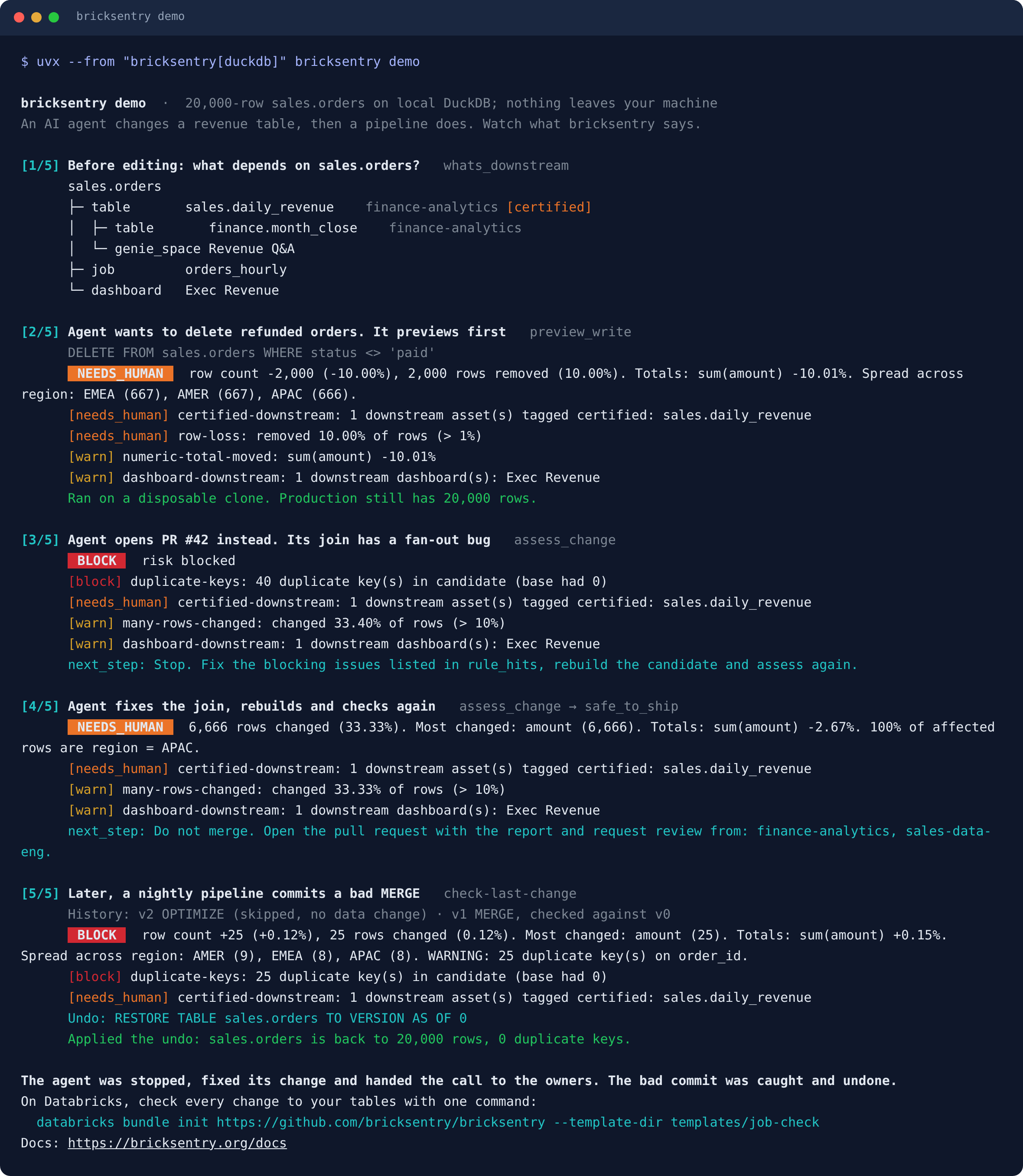
bricksentry demo
An AI agent changes a 20,000-row revenue table. bricksentry previews its DELETE on a clone (production untouched), blocks its pull request for a join that duplicates 40 orders, and routes the fixed version to the owners of a certified table downstream. Everything runs locally on DuckDB.
What it does
Before a change reaches production, bricksentry answers three questions, in a pull-request comment for humans and in structured JSON for agents:
- What does it do to the data? A key-based data diff: added, removed and changed rows, schema changes, per-column changes, numeric totals, duplicate keys, and where the change is concentrated ("100% of affected rows are region = APAC").
- Who gets hurt? The downstream blast radius from Unity Catalog lineage: tables, jobs, notebooks, Lakeflow pipelines, dashboards and queries, with owners and tags.
- Is it safe, and how do I undo it? A deterministic policy verdict (
pass·warn·needs_human·block) and the exactRESTORE TABLE … VERSION AS OF nrollback.
For your Databricks workspace:
pip install "bricksentry[databricks,mcp]"
bricksentry init        # writes bricksentry.yml and policy.yml
Why it exists
AI now writes much of our pipeline code, and checking what that code does to the data hasn't kept up. Code review can't see a silent 3% revenue shift or a join that fans out. The tools that do catch this mostly cover dbt, or need a paid platform. Most Databricks work is PySpark notebooks, Jobs and Lakeflow pipelines, and bricksentry is built for that work:
- Unity Catalog runtime lineage, not SQL parsing, so PySpark notebooks and jobs are included.
- SQL pushdown: all diffing runs on your SQL warehouse, so no Spark session is needed and calls stay cheap enough for an agent loop.
- One engine, three faces: CLI and GitHub Action · Python API · MCP server.
For AI agents: the MCP server
bricksentry mcp --config bricksentry.yml                 # stdio
claude mcp add bricksentry -- bricksentry mcp --config /abs/path/bricksentry.yml
| Tool | What the agent gets |
|---|---|
whats_downstream(table, depth) |
Downstream assets with owners and tags. Call it before editing. |
rollback_plan(table) |
The restore SQL. Capture it before changing anything. |
preview_write(sql, target, keys?) |
Runs one write against a disposable shallow clone, never production, and returns the diff plus verdict. |
assess_change(tables, candidates?, pr?) |
Diffs prod vs. the candidate built by your change, plus lineage and policy. Returns a verdict and an id. |
explain_diff(assessment_id or table) |
Plain-English summary. |
safe_to_ship(assessment_id) |
safe_to_ship, the reasons, and an explicit next_step to follow. |
Designed for agents:
- The verdict never comes from an LLM. Rules in
policy.ymldecide, so the same change always gets the same answer. - Read-only by default. Only
preview_writewrites, and only to a sandbox clone. It accepts a single INSERT / MERGE / UPDATE / DELETE / CREATE OR REPLACE whose target must be the clone, and it refuses DROP, TRUNCATE, ALTER, GRANT and multiple statements. - Errors come back as
{"error": ...}, so agents can recover instead of crashing. - Bounded cost: deterministic hash sampling (
sample_pct), capped samples, and lineage limited by depth and lookback window.
The same tools are plain Python functions in bricksentry.agent_tools, so you can use them from LangGraph, the OpenAI Agents SDK or the Databricks Agent Framework without MCP.
To watch the whole loop, run bricksentry demo (see the top of this page). bricksentry demo --report report.md also writes the pull-request comment a reviewer would see.
For data engineers: CLI and CI
bricksentry init                                        # starter bricksentry.yml + policy.yml
bricksentry impact main.sales.orders                    # blast radius
bricksentry diff main.sales.orders main.sales_pr_42.orders
bricksentry preview main.sales.orders --sql "MERGE INTO {{target}} t USING updates u ON t.order_id = u.order_id WHEN MATCHED THEN UPDATE SET *"
bricksentry assess --from-git origin/main --pr 42 --format markdown --fail-on needs_human
bricksentry rollback main.sales.orders
Exit codes: 0 below --fail-on, 1 at or above it, 2 for configuration errors.
In GitHub Actions. Build your PR's version of the pipeline into a per-PR schema (for example with a Databricks Asset Bundle ci target), then add:
- run: pip install "bricksentry[databricks]"
- run: >
    bricksentry assess
    --from-git origin/${{ github.base_ref }}
    --pr ${{ github.event.pull_request.number }}
    --comment --output bricksentry-report.md
    --fail-on needs_human
  env:
    GITHUB_TOKEN: ${{ github.token }}
    DATABRICKS_HOST: ${{ secrets.DATABRICKS_HOST }}
    DATABRICKS_CLIENT_ID: ${{ secrets.DATABRICKS_CLIENT_ID }}
    DATABRICKS_CLIENT_SECRET: ${{ secrets.DATABRICKS_CLIENT_SECRET }}
    DATABRICKS_WAREHOUSE_ID: ${{ secrets.DATABRICKS_WAREHOUSE_ID }}
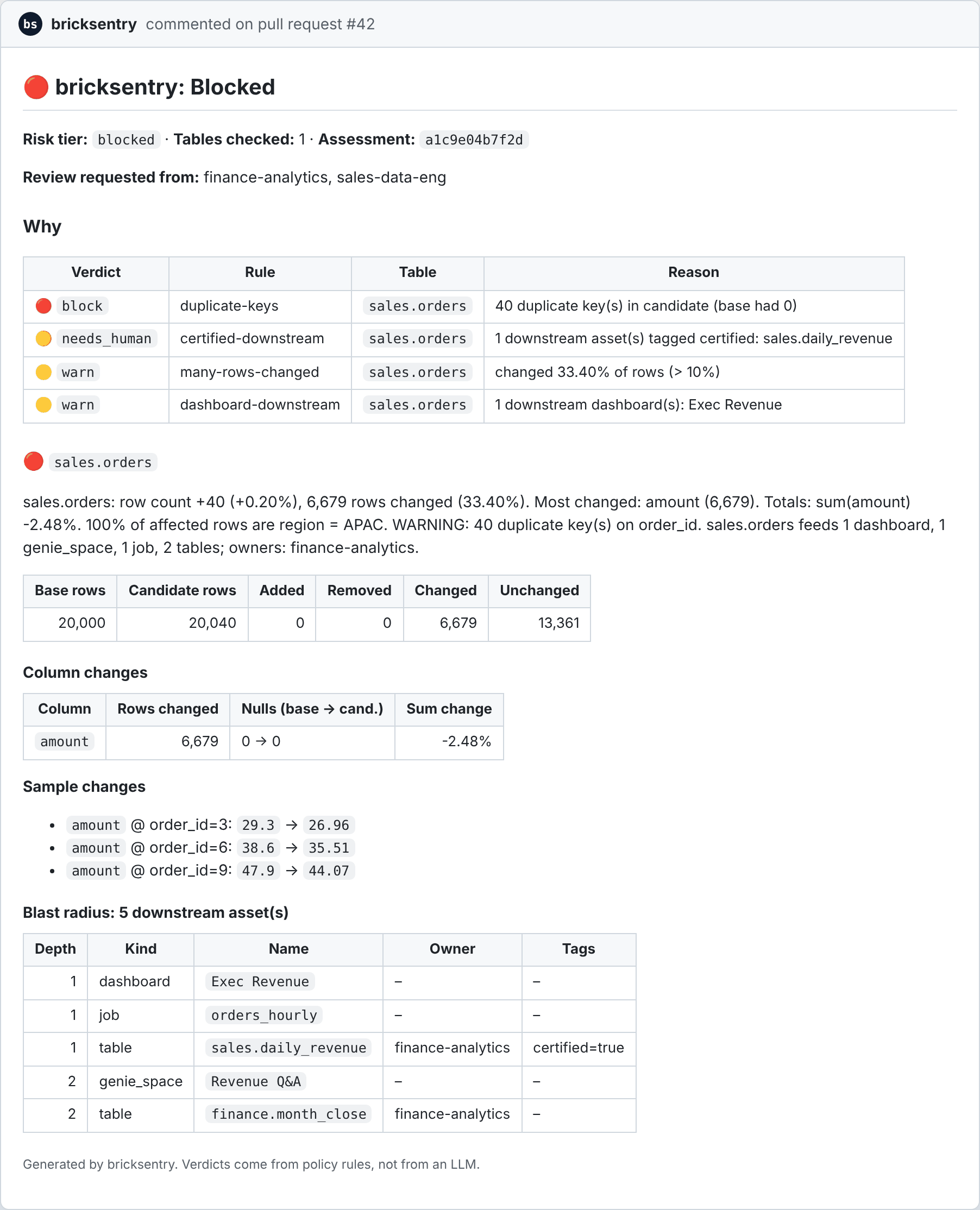
It detects changed tables from the files in the PR and posts or updates one PR comment, like this one for the demo's fan-out bug:
Check out with fetch-depth: 0 and give the job pull-requests: write permission.
Or use the bundled GitHub Action, which also writes the report to the job summary:
- uses: bricksentry/bricksentry@v0.1.0
  with:
    config: bricksentry.yml
    fail-on: needs_human
Python API
from bricksentry import Sentry

s = Sentry()                                   # reads ./bricksentry.yml
a = s.assess(["main.sales.orders"], pr="42")
print(a.verdict, a.notify)
print(a.tables[0].summary)

s.preview_write("DELETE FROM main.sales.orders WHERE status = 'test'", "main.sales.orders")
Configuration
backend: {type: databricks, warehouse_id: abc123}      # auth: standard Databricks SDK chain
sandbox_schema: main.bricksentry_sandbox
candidate_pattern: "{catalog}.{schema}_pr_{pr}.{table}"
sample_pct: 10
lineage: {type: databricks, depth: 3, lookback_days: 90}
tables:
  main.sales.orders:
    keys: [order_id]
    segment_by: [region]
    paths: ["src/pipelines/orders/**", "resources/orders_job.yml"]
policy: policy.yml
Policy conditions
table (glob) · tag · downstream_tag · downstream_kind · downstream_count_gt · removed_pct_gt · added_pct_gt · changed_pct_gt · row_count_change_pct_gt · row_count_drop_pct_gt · column_removed · column_added · column_type_changed · duplicate_keys · sum_change_pct_gt / null_increase_gt (optionally with column) · any_change · diff_error
All conditions in a when must hold. The most severe matching rule sets the verdict. Unknown conditions are rejected at load time, so a typo can't silently disable a rule.
Permissions needed on Databricks
CAN USEon a SQL warehouse.SELECTon the tables you assess and their candidates.SELECTonsystem.access.table_lineage, plussystem.information_schemafor owners and tags. Without these, bricksentry still diffs; lineage is just empty.CREATE TABLEonsandbox_schema, forpreview_write.
Known limits (v0.1.x)
- Lineage is recorded at runtime. Brand-new tables have no downstream history yet. Unity Catalog doesn't capture RDD operations, and UDFs hide column-level mapping.
- Keys are required. Tables without a stable key can't be diffed row by row yet (an aggregate-profile mode is planned).
- Changed-table detection uses path globs from config. It doesn't parse Asset Bundles yet.
- The Databricks backend is tested against a mocked SDK. Run it against a dev workspace before relying on it in CI.
Roadmap
Asset Bundle parsing for automatic table detection · column-level blast radius from system.access.column_lineage · an aggregate diff for keyless tables · Lakeflow expectations in the verdict · bricksentry watch for scheduled drift checks · a Databricks App UI.
Contributing
Bug reports from real pipelines help the most. See CONTRIBUTING.md, and SECURITY.md for reporting vulnerabilities privately.
License
Apache-2.0. Created and maintained by Brahma.
1 maintainer

Metadata
1 maintainer
Release files for bricksentry 0.1.1
For a detailed explanation of source distributions (sdists) and built distributions (wheels), please see the package formats documentation.
Source distribution (sdist)
| File | Size | Uploaded | Provenance | Actions |
|---|---|---|---|---|
| bricksentry-0.1.1.tar.gz | 44.1 kB | Without provenance | Details for bricksentry-0.1.1.tar.gz |
Built distribution (wheel)
| File | Interpreter | ABI | Platform | Actions Reset |
|---|---|---|---|---|
| bricksentry-0.1.1-py3-none-any.whl | Python 3 | none | any | Details for bricksentry-0.1.1-py3-none-any.whl |
Total release size: 90.0 kB
Release files / bricksentry-0.1.1.tar.gz
| Download URL | bricksentry-0.1.1.tar.gz |
|---|---|
| Size | 44.1 kB |
| Tags | Source |
|
SHA-256 checksum How to use checksums |
99afb8969e7cf66c9cd9ae82e2bc72cc86d219a66d61d161166986d5660edf87
|
|
BLAKE2b-256 checksum How to use checksums |
74bc8520fb34827e8b6a76a75913ae1a09039467ef78fe8a7ab2ca020516a1b1
|
| Upload date | |
|
Uploaded using Trusted Publishing? What is trusted publishing? |
No |
| Uploaded via |
twine/7.0.0 CPython/3.12.2
|
Release files / bricksentry-0.1.1-py3-none-any.whl
| Download URL | bricksentry-0.1.1-py3-none-any.whl |
|---|---|
| Size | 45.9 kB |
| Tags | Python 3 |
|
SHA-256 checksum How to use checksums |
e03844e569196d7b0bdf6897d9de5e74152f07600fdd5f275d0953a1605e3ec6
|
|
BLAKE2b-256 checksum How to use checksums |
a1d2d8cb74bef76fbaf2c76930dde290af9ca3df85a3190c11071ebdde63b7d2
|
| Upload date | |
|
Uploaded using Trusted Publishing? What is trusted publishing? |
No |
| Uploaded via |
twine/7.0.0 CPython/3.12.2
|
Security for bricksentry 0.1.1
Provenance
Provenance describes where a file came from. On PyPI, provenance is shared via attestations, which provide a verifiable record of the build or publishing details. View details, limitations and caveats.
No provenance found
None of the files in this release were uploaded with provenance metadata.
A note on package security
PyPI is a repository for distributing packages, not a service for auditing them. While third-party security researchers and our staff do their best to detect and remove malicious packages, PyPI cannot guarantee the quality, security or suitability of any given package.
To learn more about protecting yourself from malicious actors, visit our package security documentation.














