
Browser Automation CLI
If you are an LLM using this tool, read SKILL.md: or run
browser install skillto add it to Claude Code / Codex / OpenCode. (AGENTS.md is for agents developing this repo.)
A lightweight, self-hosted browser automation tool with a background daemon and CLI client. Enables authenticated web automation, screenshots, compact page snapshots, and page interactions via simple CLI commands. Share the SKILL.md file with your coding agent harness for seamless integration.
Why This Exists
Coding agents need to interact with authenticated web apps. Existing solutions all have tradeoffs:
- Chrome DevTools MCP: requires Node.js, per-agent MCP server configuration, Google telemetry by default, and complex setup for each coding agent
- BrowserMCP and similar tools: require installing Chrome extensions, tie into specific ecosystems, and use MCP which bloats the agent's context window with tool definitions and protocol overhead
- Playwright/Puppeteer scripts: require writing code for every interaction, no persistent auth state
- AI browser frameworks: heavy, opinionated, and framework-locked
Browser CLI solves this with a persistent daemon that any agent can call via subprocess. No extensions, no MCP config, no SDKs, no ecosystem lock-in. Sessions persist across agent calls (and daemon restarts) so you only log in once.
Benchmarks
On BU Bench V1 (browser-use's 100-task benchmark, opus-4-7,
scored by their gemini-2.5-flash judge), Claude Code + browser-automation-cli tops every published
harness × browser-tool configuration:
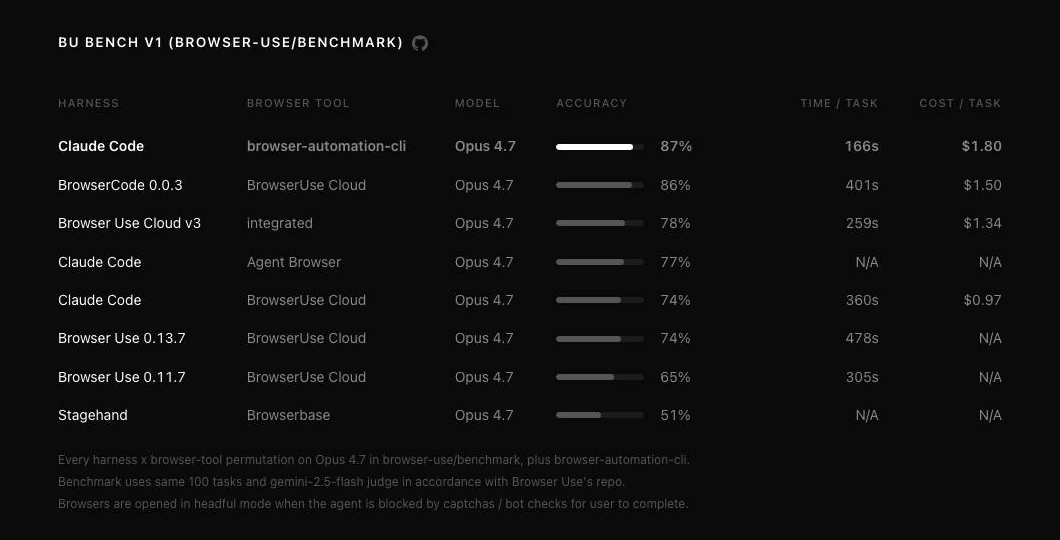
Methodology and per-task scores: benchmarks/busbench/.
Install
uv tool install browser-automation-cli
browser install
If commands are not found after install, add ~/.local/bin to your PATH:
export PATH="$HOME/.local/bin:$PATH"
Quick Start
1. Create a session (the daemon auto-starts)
browser create # first command starts the daemon in the background (0.5.0+)
Nothing visible opens: the daemon runs Chromium headless. Manage it yourself with browser daemon (or the legacy browser-daemon alias) if you prefer; BROWSER_NO_AUTOSTART=1 disables auto-start.
2. Log in when a site needs it
browser create --show # opens a window so you can log in; `browser <id> hide` afterwards
A session is an isolated browser profile (cookies, storage). Log into any sites you need while the window is shown; the agent drives it hidden afterwards. Sessions survive daemon restarts.
3. Run browser actions
browser <id> navigate https://github.com
browser <id> snapshot                      # interactive elements, one line each, with @refs
browser <id> click @e7                     # click by ref from the snapshot
browser <id> click --text "Sign in"        # or by visible text / role / label
browser <id> type --label "Username" octocat
browser <id> screenshot                    # JPEG saved under ~/.browser-daemon/shots/
A snapshot looks like this (Cloudflare login, 245 tokens):
url: https://dash.cloudflare.com/login
title: Cloudflare Dashboard | Manage Your Account
@e2 link "Sign up" href="/sign-up"
h1 "Sign in to Cloudflare"
@e3 button "Continue with Google"
@e7 textbox "Email"
@e8 textbox "Password" type="password"
@e10 checkbox "Save email and login method on this device"
@e11 button "Sign in" [disabled]
4. Manage sessions
browser list                  # JSON (--table for humans)
browser <id> show | hide      # move between a visible window and headless
browser <id> delete
browser shutdown              # stop the daemon; sessions are saved and restored next start
Commands Reference
Standalone (no daemon)
browser capture <url> [-f] [-o <path>]     # headless viewport screenshot (-f = full page)
browser install [--all]                    # download headless Chromium (Chrome for Testing, ~196 MB);
                                           # the headed build (~356 MB) downloads on first `show`, or now with --all
browser engine [auto|managed|system|<path>]  # use your installed Chrome/Edge/Brave instead (zero download);
                                           # auto = managed build if downloaded, else the system browser
browser profile [status]                   # by DEFAULT sessions use a persistent "default" profile:
                                           # the first session opens a window to sign in, every later
                                           # session reuses that login. Manage it with:
browser profile <name> | new <name>        #   switch to / create a named persistent profile
browser profile delete <name>              #   delete a profile + its logins (each is a full Chrome
                                           #   profile, ~100 MB+; delete ones you no longer need)
browser profile ephemeral                  #   make throwaway the default for new sessions
browser create --profile <name>            #   per-session: this session uses its own persistent login
browser create --ephemeral                 #   per-session: throwaway, isolated
browser <id> show | hide                   #   flip a profile visible<->headless seamlessly (sessions kept)
                                           #   (different --profile = concurrent & isolated; same = shared tabs)
browser cleanup                            # kill Chromium processes launched from Playwright's cache
browser install skill                      # install the agent skill into Claude Code / Codex / OpenCode
Sessions
| Command | Description |
|---|---|
browser create [--show] |
New session; --show opens a window (for manual login) |
browser list [--table] |
Sessions with state (active / frozen / hibernated) and visible |
browser <id> show / hide |
Move the session to a visible window / back to headless (auth kept) |
browser <id> delete |
Close session and forget its cookies |
browser shutdown |
Stop the daemon gracefully |
browser --version / browser update |
Show version; upgrade to the latest PyPI release. The daemon checks PyPI once a day and the CLI prints a one-line hint on stderr when a newer version exists (BROWSER_NO_UPDATE_CHECK=1 disables) |
Page commands
All print JSON (snapshot prints text). Add -s / --snapshot to any action to get a fresh snapshot in the same call.
| Command | Description |
|---|---|
navigate <url> [--wait load|domcontentloaded|networkidle] |
Returns as soon as the page is usable; never fails on a slow networkidle |
snapshot [scope] [--all] [--max N] [--json] |
Visible interactive elements + headings. --all adds text blocks, --json gives boxes and unique selectors |
click <target> [--double] |
Also click --at X,Y to click raw viewport pixels (canvas / vision, no DOM target; screenshot first, pixels map 1:1) |
type <target> <text> [--sequential] [--submit] |
fill() by default; --sequential sends key events (autocomplete); --submit presses Enter |
press <key> [target] |
Enter, Tab, Control+a, … |
hover <target> |
|
select <target> <value-or-label> |
|
scroll [up|down] [px] / scroll <target> |
|
text [selector] |
Readable text of the page or an element (cheap extraction) |
wait [--text T | --selector S] [--gone] [--timeout ms] |
|
screenshot [target] [-o path] [-f] [-q 70] |
JPEG; element screenshots via any target |
eval <js> |
Evaluate an expression in the page |
console [--clear] |
Buffered console messages |
back / forward |
|
batch |
JSON lines on stdin, run in one round-trip, stop at first failure |
Targets: @e12 (ref from snapshot, preferred) · CSS selector · text=Create · role=button[name=Create] · label=Email · placeholder=Search · or flags --text / --role [--name] / --label / --placeholder. Ambiguous CSS selectors are refused (strict mode) instead of clicking the first match. For canvas / vision cases with no DOM target, click --at X,Y clicks raw viewport pixels (take a screenshot first; its pixels map 1:1 to click coordinates).
Architecture
- Daemon (
browser-daemon): Unix socket server (~/.browser-daemon/socket, mode 600) owning a headless Chromium, plus a headed one that exists only while some session isshown. - CLI (
browser): a native Rust binary driving Chrome over raw CDP, ~2 ms per call, no Python/Node at runtime. - Sessions: one isolated browser context each. Hidden sessions are frozen after 10 s idle (script execution paused, ~3% CPU on animated dashboards; callbacks that fire while frozen are dropped, so
BROWSER_FREEZE_AFTER=0disables it) and hibernated to~/.browser-daemon/sessions/<id>.json(cookies + storage + URL) after 10 min idle or on shutdown; they are rehydrated transparently on the next command. Tune withBROWSER_FREEZE_AFTER/BROWSER_HIBERNATE_AFTER(seconds). - Resource profile (M4, Cloudflare dashboard parked in a session): 2% CPU / 1.1 GB vs 264% CPU / 2.1 GB for v0.2. See
benchmarks/for methodology and measurements.
Anti-Detection
navigator.webdriverhidden viaadd_init_script- Desktop Chrome user agent derived from the actual Chromium version
- 1280x800 viewport (desktop layouts; same size Anthropic/OpenAI computer-use tooling targets)
Output Format
Action responses:
{"success": true, "url": "https://github.com", "title": "GitHub"}
Errors (exit code 1):
{"success": false, "error": "ref @e9 is unknown or stale (page changed); run snapshot again"}
snapshot --json:
{"success": true, "url": "...", "title": "...", "scrollY": 0, "viewportHeight": 800, "viewportWidth": 1280, "documentHeight": 2400,
 "elements": [{"ref": "e3", "role": "button", "name": "Create", "pos": "", "box": [912, 640, 88, 36]}]}
Using with Coding Agents
Run browser install skill to install SKILL.md into Claude Code / Codex / OpenCode, or share the file with any other harness.
Implementation
Written entirely in Rust, one binary (browser, with a daemon subcommand) plus a browser-daemon
compat shim, driving Chrome over raw CDP via a websocket. No Python, Playwright, or Node at runtime:
browser install downloads the Chrome-for-Testing build directly, and capture is native too. ~2 ms
per call, daemon RSS −90 MB vs the old Python build, frame- and shadow-DOM-aware snapshots. See the
benchmarks/ directory for measurements. Since 0.4.0 the PyPI package ships these binaries under the same name
(wheels for Linux x86_64/aarch64, macOS arm64/x86_64).
cargo build --release
./target/release/browser list          # the daemon auto-starts (`browser daemon` runs it in the foreground)
Development
cargo build --release
BROWSER_CLI=$PWD/target/release/browser BROWSER_DAEMON=$PWD/target/release/browser-daemon \
  python3 -m unittest -v tests/test_cli.py                        # end-to-end tests (needs python3 + a Chromium)
python3 benchmarks/performance-test/run.py <label>               # benchmark (latency, tokens, idle CPU/RSS)
python3 benchmarks/performance-test/compare.py baseline <label>
Troubleshooting
| Symptom | Fix |
|---|---|
Command not found: browser |
export PATH="$HOME/.local/bin:$PATH" |
Daemon not running |
Auto-start was disabled or failed, browser daemon &, check ~/.browser-daemon/daemon.log |
| Browser doesn't launch | browser install |
Session not found |
browser list |
ref @eN is unknown or stale |
Page changed; run snapshot again |
strict mode violation |
Selector matched several elements; use an @ref, --text, or a tighter selector |
| Stale Chromium processes | browser cleanup |
Installing the binaries
curl -fsSL https://raw.githubusercontent.com/jshan9078/browser-automation-cli/main/install.sh | sh
or simply uv tool install browser-automation-cli (the PyPI wheels are the Rust binaries). The script installs
browser and browser-daemon into ~/.local/bin (set BROWSER_CLI_BIN to change); to build from source: cargo build --release.
Wheel: uvx maturin build --release → uv tool install target/wheels/browser_automation_cli-*.whl.
CI (.github/workflows/rust-wheels.yml) builds wheels for Linux x86_64/aarch64 and macOS arm64/x86_64 on every
push touching the Rust sources, runs the end-to-end suite against the Rust daemon on Linux, attaches wheels to the release
on v* tags, and publishes to PyPI when a PYPI_API_TOKEN repository secret exists. Windows is not a target: the
daemon speaks over a Unix socket.
1 maintainer

Metadata
1 maintainer
Release files for browser-automation-cli 0.8.3
For a detailed explanation of source distributions (sdists) and built distributions (wheels), please see the package formats documentation.
Source distribution (sdist)
| File | Size | Uploaded | |
|---|---|---|---|
| browser_automation_cli-0.8.3.tar.gz | 414.0 kB | Details |
Built distributions (wheels)
| File | Reset | |||
|---|---|---|---|---|
| browser_automation_cli-0.8.3-py3-none-manylinux_2_17_x86_64.manylinux2014_x86_64.whl | Python 3 | none | Linux glibc 2.17+ x86-64 | Details |
| browser_automation_cli-0.8.3-py3-none-manylinux_2_17_aarch64.manylinux2014_aarch64.whl | Python 3 | none | Linux glibc 2.17+ ARM64 | Details |
| browser_automation_cli-0.8.3-py3-none-macosx_11_0_arm64.whl | Python 3 | none | macOS 11.0+ ARM64 | Details |
| browser_automation_cli-0.8.3-py3-none-macosx_10_12_x86_64.whl | Python 3 | none | macOS 10.12+ x86-64 | Details |
Total release size: 7.1 MB
Release files / browser_automation_cli-0.8.3.tar.gz
| Download URL | browser_automation_cli-0.8.3.tar.gz |
|---|---|
| Size | 414.0 kB |
| Tags | Source |
|
SHA-256 checksum How to use checksums |
91bceb9c9f619d8861ad1f1d170ad13cc040be41dd99ec83dd0ddd6699e15d0e
|
|
BLAKE2b-256 checksum How to use checksums |
51cb5d0a082f21e778240675f6a56f1c6e4f491b452377b27e79f807d7c2ce69
|
| Upload date | |
|
Uploaded using Trusted Publishing? What is trusted publishing? |
No |
| Uploaded via |
uv/0.12.7 {"installer":{"name":"uv","version":"0.12.7","subcommand":["publish"]},"python":null,"implementation":{"name":null,"version":null},"distro":{"name":"Ubuntu","version":"24.04","id":"noble","libc":null},"system":{"name":null,"release":null},"cpu":null,"openssl_version":null,"setuptools_version":null,"rustc_version":null,"ci":true}
|
Release files / browser_automation_cli-0.8.3-py3-none-manylinux_2_17_x86_64.manylinux2014_x86_64.whl
| Download URL | browser_automation_cli-0.8.3-py3-none-manylinux_2_17_x86_64.manylinux2014_x86_64.whl |
|---|---|
| Size | 1.8 MB |
| Tags | Linux glibc 2.17+ x86-64 Python 3 |
|
SHA-256 checksum How to use checksums |
fa06d5bf324f087822ca4b08849b7d85a820cd51942bb77a11505dd72793d98c
|
|
BLAKE2b-256 checksum How to use checksums |
967847e136a8be156b305ba20e9699709327e2531d9e200a1a16667a4f5b2f7f
|
| Upload date | |
|
Uploaded using Trusted Publishing? What is trusted publishing? |
No |
| Uploaded via |
uv/0.12.7 {"installer":{"name":"uv","version":"0.12.7","subcommand":["publish"]},"python":null,"implementation":{"name":null,"version":null},"distro":{"name":"Ubuntu","version":"24.04","id":"noble","libc":null},"system":{"name":null,"release":null},"cpu":null,"openssl_version":null,"setuptools_version":null,"rustc_version":null,"ci":true}
|
Release files / browser_automation_cli-0.8.3-py3-none-manylinux_2_17_aarch64.manylinux2014_aarch64.whl
| Download URL | browser_automation_cli-0.8.3-py3-none-manylinux_2_17_aarch64.manylinux2014_aarch64.whl |
|---|---|
| Size | 1.7 MB |
| Tags | Linux glibc 2.17+ ARM64 Python 3 |
|
SHA-256 checksum How to use checksums |
b87972b029dcb748644344083cb5682f8ac13eb9160cf5651a2bf5383144a14e
|
|
BLAKE2b-256 checksum How to use checksums |
98e4b1813a384952fcab4b9751b379ab32d0ef4d21ea5750bd00737bd9b4d522
|
| Upload date | |
|
Uploaded using Trusted Publishing? What is trusted publishing? |
No |
| Uploaded via |
uv/0.12.7 {"installer":{"name":"uv","version":"0.12.7","subcommand":["publish"]},"python":null,"implementation":{"name":null,"version":null},"distro":{"name":"Ubuntu","version":"24.04","id":"noble","libc":null},"system":{"name":null,"release":null},"cpu":null,"openssl_version":null,"setuptools_version":null,"rustc_version":null,"ci":true}
|
Release files / browser_automation_cli-0.8.3-py3-none-macosx_11_0_arm64.whl
| Download URL | browser_automation_cli-0.8.3-py3-none-macosx_11_0_arm64.whl |
|---|---|
| Size | 1.6 MB |
| Tags | Python 3 macOS 11.0+ ARM64 |
|
SHA-256 checksum How to use checksums |
3b23d3e894175112afc3dd092489edc66b78981a8532467dadeda881b4cbe308
|
|
BLAKE2b-256 checksum How to use checksums |
62674a4ec94a1bfdf5bbec48e648ac08ab0a1f40de99728b8a1c47e998560de8
|
| Upload date | |
|
Uploaded using Trusted Publishing? What is trusted publishing? |
No |
| Uploaded via |
uv/0.12.7 {"installer":{"name":"uv","version":"0.12.7","subcommand":["publish"]},"python":null,"implementation":{"name":null,"version":null},"distro":{"name":"Ubuntu","version":"24.04","id":"noble","libc":null},"system":{"name":null,"release":null},"cpu":null,"openssl_version":null,"setuptools_version":null,"rustc_version":null,"ci":true}
|
Release files / browser_automation_cli-0.8.3-py3-none-macosx_10_12_x86_64.whl
| Download URL | browser_automation_cli-0.8.3-py3-none-macosx_10_12_x86_64.whl |
|---|---|
| Size | 1.7 MB |
| Tags | Python 3 macOS 10.12+ x86-64 |
|
SHA-256 checksum How to use checksums |
c8e8e6156ec801cdb2bf0504e1e887b357fcd7b7368a67c820151bbecda84d3c
|
|
BLAKE2b-256 checksum How to use checksums |
2677cc25e2ee37eeb5d8cab16d3473bac337304577e607ccab1e835b6c5a9d8f
|
| Upload date | |
|
Uploaded using Trusted Publishing? What is trusted publishing? |
No |
| Uploaded via |
uv/0.12.7 {"installer":{"name":"uv","version":"0.12.7","subcommand":["publish"]},"python":null,"implementation":{"name":null,"version":null},"distro":{"name":"Ubuntu","version":"24.04","id":"noble","libc":null},"system":{"name":null,"release":null},"cpu":null,"openssl_version":null,"setuptools_version":null,"rustc_version":null,"ci":true}
|














