
bsod2






BSoD2 (BalloonScope on Deck 2) is a command line interface and Python package for reading, processing, and plotting radiosonde data.
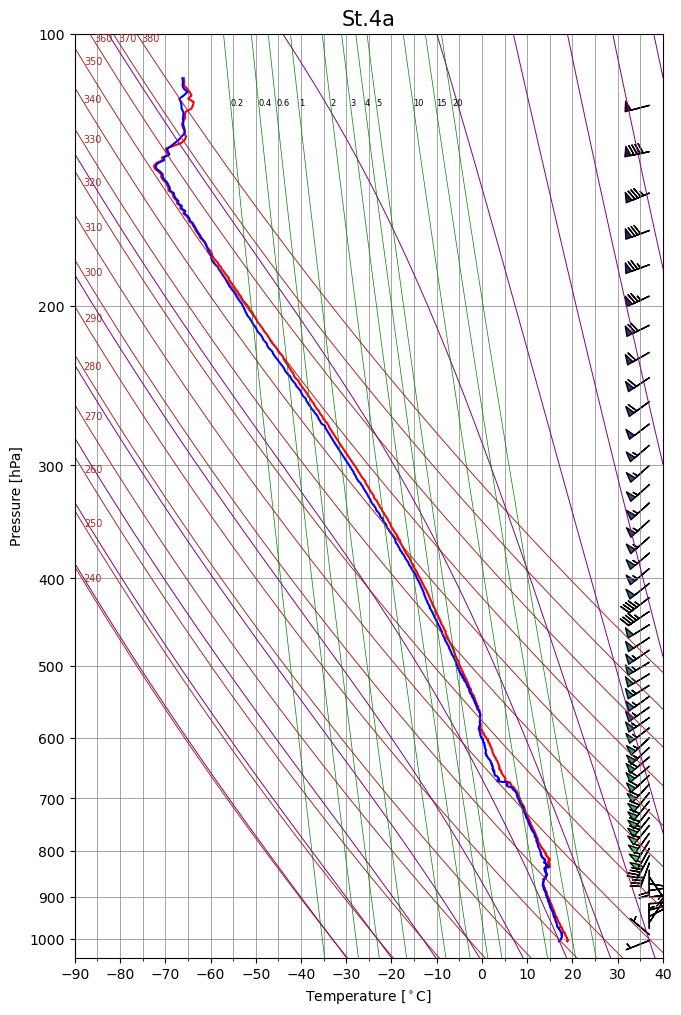
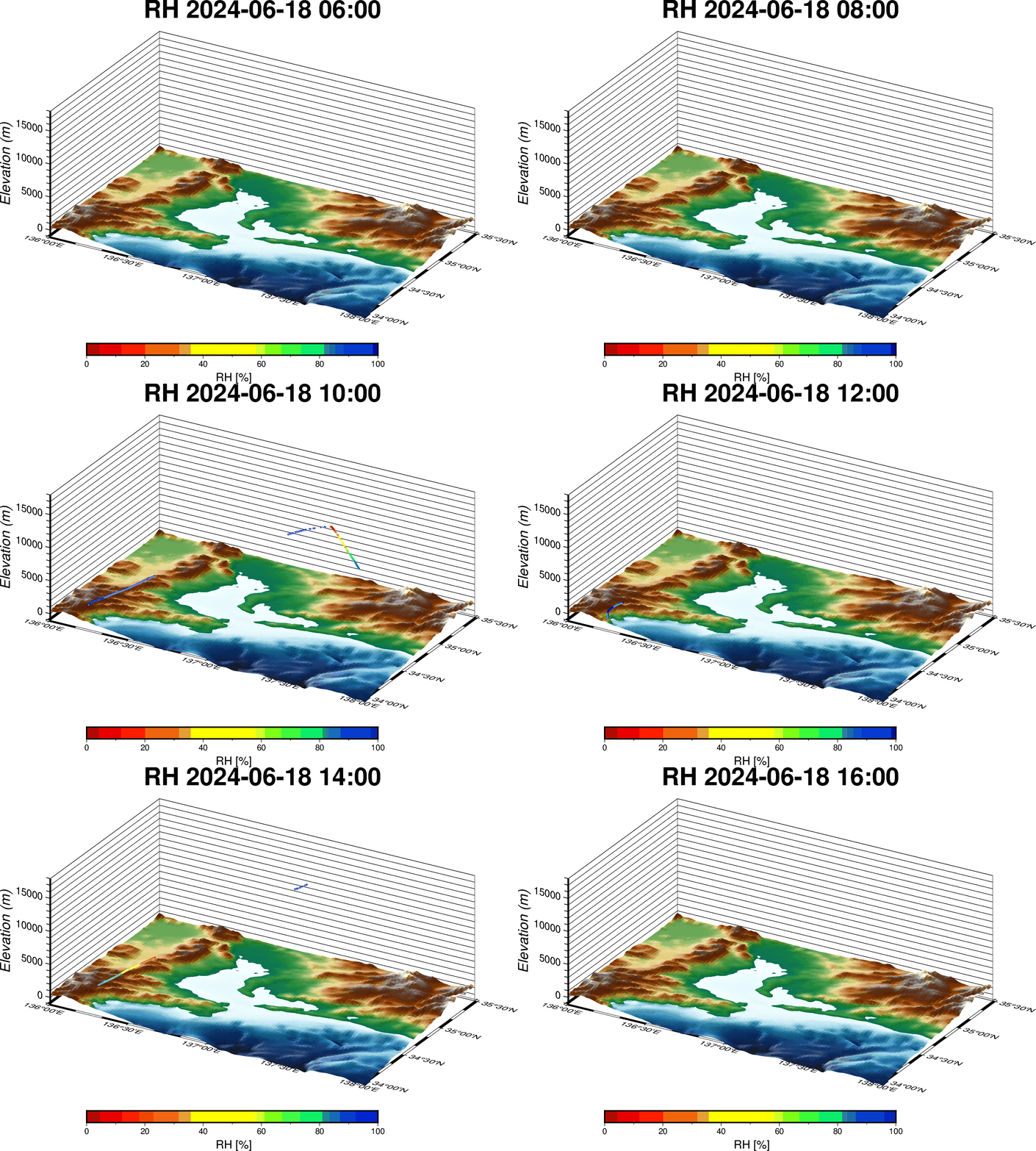
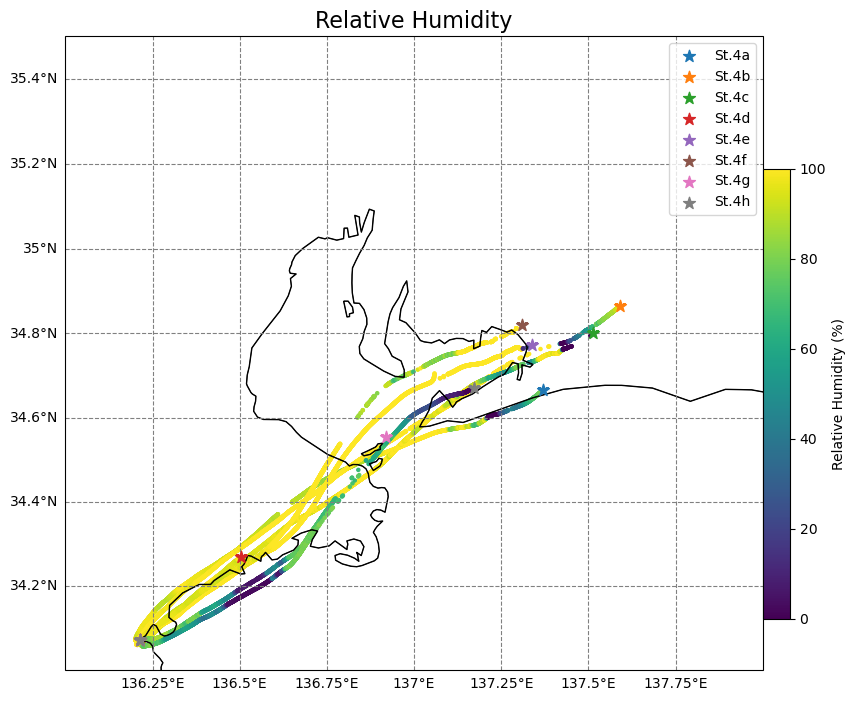
Table of Contents
Installation
This package can be installed from PyPI.
pip install bsod2
Usage
The only functionality provided by this package is the bsod2.Sondeset class, which retrieves radiosonde data ,performs quality control and plot a emagram.
A simple usage guide in Japanese is available on Qiita: (bsod2 ラジオゾンデ観測データ品質管理ツール).
Command Line Interface
bsod2 commannd performs on quality control.
$ bsod2 ./sample/Seisuimaru2407/raw_data ./output
 25%|███████              2/8 [00:01<00:03,  1.78it/s]
The first positional argument specifies the path to the input data file or directory.
The second one specifies the path to the output directory.
For more information, run:
bsod2 --help
Python module
Basic Sondeset construction and methods
Initialize the class with the file path to the raw data.
from pathlib import Path
from bsod2 import Sondeset

ss = Sondeset(Path("Seisuimaru2407/raw_data/F2024061806S1101771.CSV"))
print(ss)
>>> N=1, sonde_no=["1101771"]
If a directory path is given, all sonde data files (F*S*.CSV) in that directory are loaded.
ss = Sondeset(Path("Seisuimaru2407/raw_data"))
print(ss)
>>> N=8, sonde_no=["1101771", "1101323", "1101386", "1101322", "1101327", "1101772", "1101388", "1101326"]
Individual data items can be accessed by indexing.
print(ss[0])
>>> Sonde(sonde_no=1101771, launch_time=2024-06-18 06:01:42, product_name=iMS-100 , num_records=4174)
Accessors for individual data items
The following accessors can be used to access individual data items.
Most accessors return values with metpy.units.units attached.
| Accessor | units | Description | Example |
|---|---|---|---|
df |
None |
quality-controlled pandas.DataFrame |
ss[0].df |
time |
None |
Time | ss[0].time |
lat |
units("deg") |
Latitude | ss[0].lat |
lon |
units("deg") |
Longitude | ss[0].lon |
x |
units("m") |
X-displacement from the launch point | ss[0].x |
y |
units("m") |
Y-displacement from the launch point | ss[0].y |
z |
units("m") |
Altitude | ss[0].z |
p |
units("hPa") |
Pressure | ss[0].p |
t |
units("degC") |
Temperature | ss[0].tss |
rh |
units("percents") |
Relative humidity | ss[0].rh |
td |
units("degC") |
dewpoint | ss[0].td |
wd |
units("deg") |
Wind direction | ss[0].wd |
ws |
units("m/s") |
Wind speed | ss[0].ws |
u |
units("m/s") |
U-component wind | ss[0].u |
v |
units("m/s") |
V-component wind | ss[0].v |
Get Number of profiles
len function can be used to get number of profiles contained in Sondeset.
len(ss)
>>> 8
Save as CSV
Save the quality-controlled DataFrame as a CSV file to the specified file path using the save_df method.
ss[0].save_df(Path("output.csv"))
Altitude or pressure interpolation
Interpolate linearly onto an evenly spaced grid in pressure("p") or altitude("z") using the interp argument.
ss = Sondeset(DIR_PATH,interp="p")
By default, the interpolated pressure axis ranges from 50 to 1,100 hPa at 1 hPa intervals, or the height axis ranges from 0 m to 20,000 m at 10 m intervals.
Values outside the original data range are filled with NaN. The range and resolution of the interpolation axes can be specified using the following arguments.
| Argument | Description | Default |
|---|---|---|
interp |
Name of the interpolation axis. If None, interpolation is not performed. |
None |
interp_pmin |
Minimum value of the interpolated pressure axis (hPa) | 50 |
interp_pmax |
Maximum value of the interpolated pressure axis (hPa) | 1100 |
interp_dp |
Step size of the interpolated pressure axis (hPa) | 1 |
interp_zmin |
Minimum value of the interpolated height axis (m) | 0 |
interp_zmax |
Maximum value of the interpolated height axis (m) | 20000 |
interp_dz |
Step size of the interpolated height axis (m) | 10 |
Interpolated and combined xarray.Dataset
Sondeset.ds provides access to an xarray.Dataset containing interpolated and combined radiosonde data.
ss = Sondeset(Path("Seisuimaru2407/raw_data", interp="z"))
print(ss.ds)
>>>
xarray.Dataset> Size: 785kB
Dimensions:      (n: 8, z: 2001)
Coordinates:
  * n            (n) <U7 224B '1101771' '1101323' ... '1101388' '1101326'
  * z            (z) float64 16kB 0.0 10.0 20.0 ... 1.998e+04 1.999e+04 2e+04
Data variables:
    p            (n, z) float64 128kB nan 1.007e+03 1.005e+03 ... nan nan nan
    tmp          (n, z) float64 128kB nan 18.76 18.93 19.0 ... nan nan nan nan
    wd           (n, z) float64 128kB nan 270.4 252.9 250.7 ... nan nan nan nan
    ws           (n, z) float64 128kB nan 2.426 2.09 2.16 ... nan nan nan nan
    rh           (n, z) float64 128kB nan 89.21 89.78 90.21 ... nan nan nan nan
    launch_time  (n) datetime64[us] 64B 2024-06-18T06:01:42 ... 2024-06-18T14...
    time         (n, z) datetime64[ns] 128kB 2024-06-18T06:01:42 ... 2024-06-...
plot emagram
plot_emagram is a method for plotting a temperature emagram.
ss[0].plot_emagram(save_dir=Path("./"))
Sample data and scripts
Sample data was observed in Seisui-maru 2407 cruise (2024年度 三重大学 陸海空・環境科学実習).
See sample/sample.md for sample scripts.
License
This project is distributed under the terms of the GNU General Public License, Version 3 (GPLv3).
See the LICENSE file for details.
1 maintainer

Metadata
1 maintainer
Release files for bsod2 1.0.0
For a detailed explanation of source distributions (sdists) and built distributions (wheels), please see the package formats documentation.
Source distribution (sdist)
| File | Size | Uploaded | Provenance | |
|---|---|---|---|---|
| bsod2-1.0.0.tar.gz | 26.4 kB | With provenance | Details |
Built distribution (wheel)
| File | Interpreter | ABI | Platform | Reset |
|---|---|---|---|---|
| bsod2-1.0.0-py3-none-any.whl | Python 3 | none | any | Details |
Total release size: 51.5 kB
Release files / bsod2-1.0.0.tar.gz
| Download URL | bsod2-1.0.0.tar.gz |
|---|---|
| Size | 26.4 kB |
| Tags | Source |
|
SHA-256 checksum How to use checksums |
b0d4202bbcf804b9b26c148b44f68fde821dd47af7d8855f630fe2979d01bd8c
|
|
BLAKE2b-256 checksum How to use checksums |
cdba4b7748d452fdcffa34ffe9af961cc504c154d262fcb310f70e02ebac2cb1
|
| Upload date | |
|
Uploaded using Trusted Publishing? What is trusted publishing? |
Yes |
| Uploaded via |
twine/6.1.0 CPython/3.13.12
|
Provenance
Provenance describes where a file came from. On PyPI, provenance is shared via attestations, which provide a verifiable record of the build or publishing details. View details, limitations and caveats.


PyPI Publish Attestation
PyPI verified that this artifact, at this checksum, originated from the publisher listed below.
Signed by GitHub Actions, verified by PyPI on Jun 3, 2026.
Transparency logRelease files / bsod2-1.0.0-py3-none-any.whl
| Download URL | bsod2-1.0.0-py3-none-any.whl |
|---|---|
| Size | 25.1 kB |
| Tags | Python 3 |
|
SHA-256 checksum How to use checksums |
89336752e5d60513cbd7a1284195580d4437807b49941ad63c676c8d04bf7713
|
|
BLAKE2b-256 checksum How to use checksums |
acc0fabd05dd764d80a9558f42d68f03b69ac9cd0092a92652cd8ff36ce29807
|
| Upload date | |
|
Uploaded using Trusted Publishing? What is trusted publishing? |
Yes |
| Uploaded via |
twine/6.1.0 CPython/3.13.12
|
Provenance
Provenance describes where a file came from. On PyPI, provenance is shared via attestations, which provide a verifiable record of the build or publishing details. View details, limitations and caveats.
PyPI Publish Attestation
PyPI verified that this artifact, at this checksum, originated from the publisher listed below.
Signed by GitHub Actions, verified by PyPI on Jun 3, 2026.
Transparency logSecurity for bsod2 1.0.0
Provenance
Provenance describes where a file came from. On PyPI, provenance is shared via attestations, which provide a verifiable record of the build or publishing details. View details, limitations and caveats.
Full provenance
All 2 files in this release have been uploaded with provenance metadata.
Attestation for bsod2-1.0.0.tar.gz
PyPI Publish Attestation
PyPI verified that this artifact, at this checksum, originated from the publisher listed below.
Signed by GitHub Actions, verified by PyPI on Jun 3, 2026.
Transparency logA note on package security
PyPI is a repository for distributing packages, not a service for auditing them. While third-party security researchers and our staff do their best to detect and remove malicious packages, PyPI cannot guarantee the quality, security or suitability of any given package.














