
BTC Template Tables
Some classes for for describing tables with an auto-generated template.
Detailed documentation is in the “docs” directory.
Quick start
Add “template_tables” to your INSTALLED_APPS setting like this:
INSTALLED_APPS = (
      ...
      'template_tables',
  )
Create table class:
class MyTable(BaseTemplateTable):

    css_classes = ['template-tables', 'mdl-data-table', 'mdl-js-data-table']
    empty_table_text = 'Нет данных'

    def get_header_rows(self) -> List[TableRowType]:
        [TR([
            TH(''),
            MDLNonNumericTH('Уч.', ordering='section'),
            MDLNonNumericTH('Документ', ordering='invoices__unique_num'),
            MDLNonNumericTH('КПТП', ordering='process_map__unique_number'),
            MDLNonNumericTH('Артикул ДСЕ', ordering='invoices__product__vendor_code'),
            MDLNonNumericTH('Наименование', ordering='invoices__product__name'),
            TH('Кол-во (шт.)', ordering='invoices__product__count'),
            TH('Вес (кг)', ordering='invoices__product__weight'),
            MDLNonNumericTH('Место', ordering='invoices__product__storage__name'),
        ])]

    def get_body_row(self, index: int, data_item: Any) -> TableRowType:
        invoice = data_item.get_invoice()
        product = safety_get_attribute(invoice, 'product')
        invoice_unique_number = f'{invoice.get_document_type_display()}-{invoice.unique_num}' if invoice else None

        transition_btn = ARSimpleLink(
            icon=ARMaterialIcon('chevron_right'),
            css_classes=['table-transition-btn'],
            html_params=dict(href=reverse('dispatcher:task_details:selected-products', kwargs=dict(pk=data_item.pk)))
        )

        return TR([
            MDLNonNumericTD(transition_btn),
            MDLNonNumericTD(data_item.section),
            MDLNonNumericTD(invoice_unique_number),
            MDLNonNumericTD(safety_get_attribute(data_item, 'process_map')),
            MDLNonNumericTD(safety_get_attribute(product, 'vendor_code')),
            MDLNonNumericTD(safety_get_attribute(product, 'name')),
            TD(safety_get_attribute(product, 'count')),
            TD(safety_get_attribute(product, 'weight')),
            MDLNonNumericTD(safety_get_attribute(product, 'storage__name')),
        ])
Define view - ListView or FilterView:
class MyTableView(TemplateTableViewMixin, FilterView):

    model = MyModel
    filterset_class = MyTableFilter
    table_class = MyTable
    template_name = 'tables/template_table_base.html'

    def get_queryset(self):
        return super().get_queryset().get_pretty_qs()

# For ordering and searching, the django-filter package is used.
# Order filter:

_base_task_table_searching_fields = [
    'section',
    'invoices__unique_num',
    'process_map__unique_number',
    'invoices__product__vendor_code',
    'invoices__product__name',
    'invoices__product__count',
    'invoices__product__weight',
    'invoices__product__storage__name'
]

class MyTableFilter(FilterSet):

    ordering = OrderingFilter(
        fields=tuple(
            (field_name, field_name) for field_name in _base_task_table_searching_fields
        )
    )
In template:
<!--
tables/template_table_base.html

That example uses btc-flex-forms for filters rendering
-->

<div>
    <div>{{ filter.form.as_flex }}</div>
    <div>{{ table.render }}</div>
    <div>{{ pagination.render }}</div>
</div>

<!-- Note: To transform table to ajax-table just you simple js-handler for link click events -->
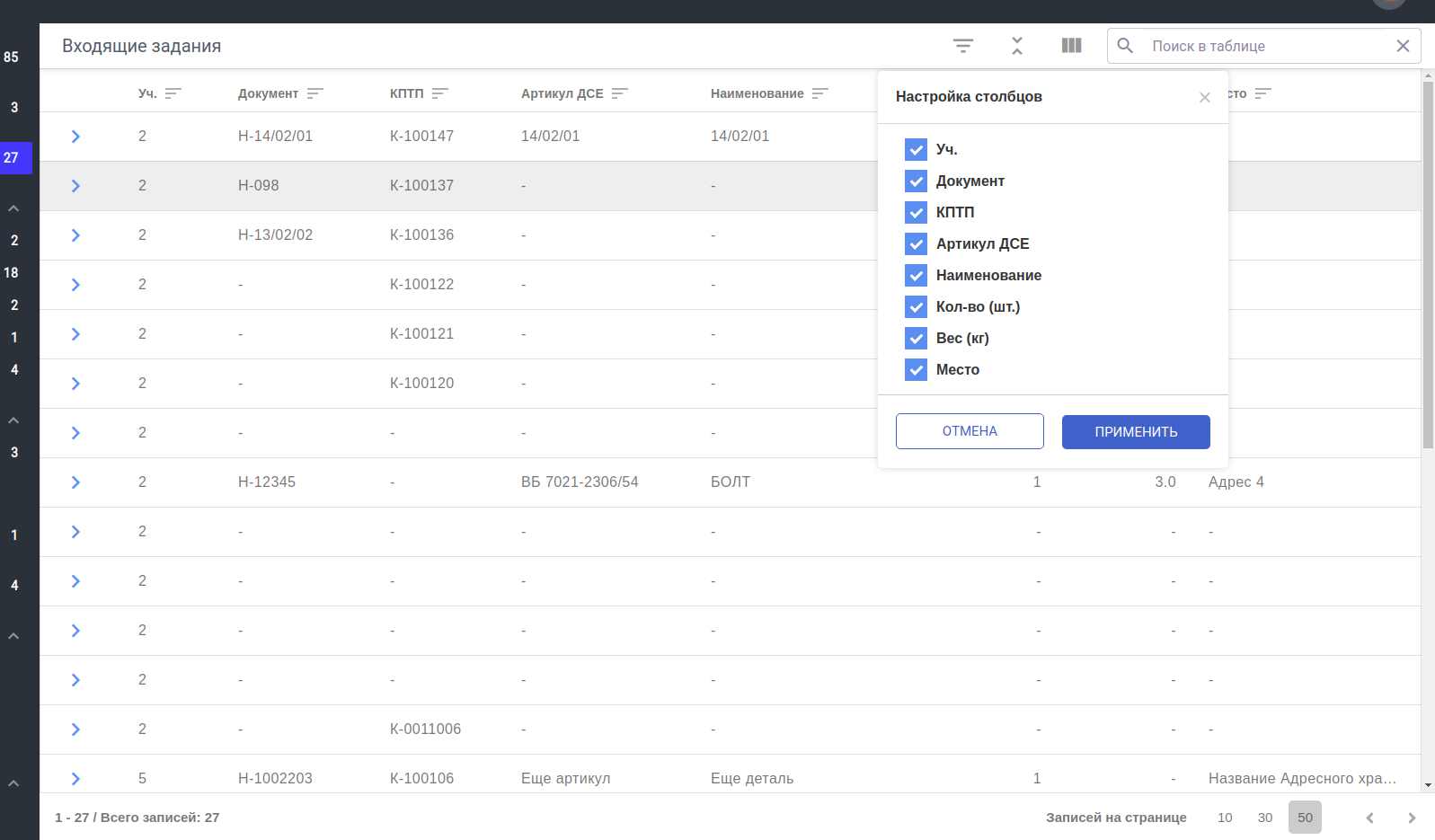
Example:
1 maintainer

Metadata
1 maintainer
Release files for btc-template-tables 0.4.2
For a detailed explanation of source distributions (sdists) and built distributions (wheels), please see the package formats documentation.
Source distribution (sdist)
| File | Size | Uploaded | Provenance | Actions |
|---|---|---|---|---|
| btc-template-tables-0.4.2.tar.gz | 8.7 kB | Without provenance | Details for btc-template-tables-0.4.2.tar.gz |
Release files / btc-template-tables-0.4.2.tar.gz
| Download URL | btc-template-tables-0.4.2.tar.gz |
|---|---|
| Size | 8.7 kB |
| Tags | Source |
|
SHA-256 checksum How to use checksums |
c995030ca704438ddfd47199b8428e6056f8972a06e2a2456e4ba991da28cbce
|
|
BLAKE2b-256 checksum How to use checksums |
f91323f47b24ad5fe8e5e62c9379d7b90eca1f24409faba854fbfcb2ae4db0e8
|
| Upload date | |
|
Uploaded using Trusted Publishing? What is trusted publishing? |
No |
| Uploaded via |
twine/3.1.1 pkginfo/1.5.0.1 requests/2.22.0 setuptools/41.6.0 requests-toolbelt/0.9.1 tqdm/4.40.0 CPython/3.7.5
|
Security for btc-template-tables 0.4.2
Provenance
Provenance describes where a file came from. On PyPI, provenance is shared via attestations, which provide a verifiable record of the build or publishing details. View details, limitations and caveats.
No provenance found
None of the files in this release were uploaded with provenance metadata.
A note on package security
PyPI is a repository for distributing packages, not a service for auditing them. While third-party security researchers and our staff do their best to detect and remove malicious packages, PyPI cannot guarantee the quality, security or suitability of any given package.
To learn more about protecting yourself from malicious actors, visit our package security documentation.














