
Bucket Helper



Bucket Helper belongs to a collection of libraries called AI Helpers developed for building Artificial Intelligence, each published on PyPI behind its own green CI gate (pytest plus ruff, both blocking) and semantic-versioned releases.
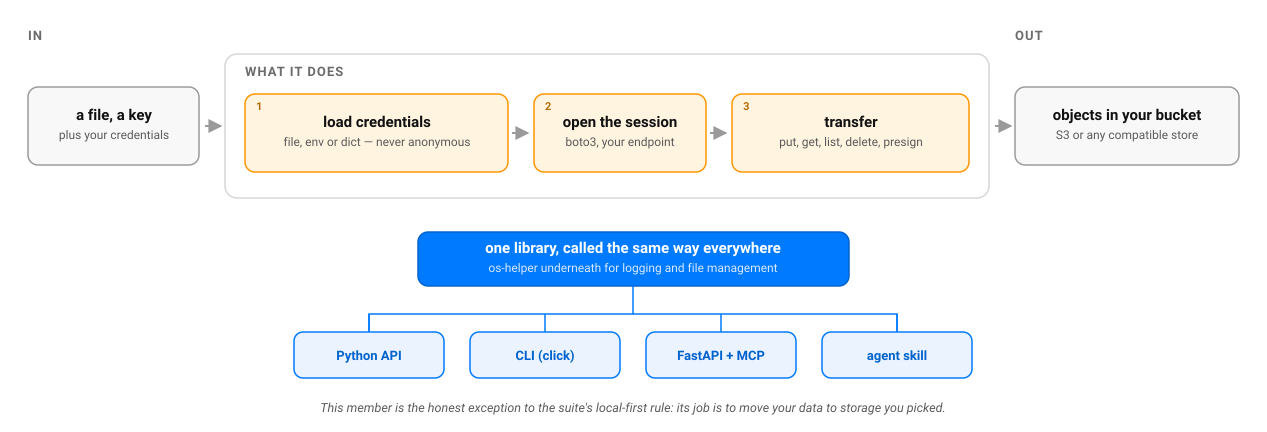
Utility functions for AWS S3 and any S3-compatible object storage: MinIO, Backblaze B2 S3 API, DigitalOcean Spaces, Cloudflare R2, Wasabi, and friends. Built on boto3. Same shape as sftp-helper: a credentials() loader, the usual CRUD (upload / download / delete / exists / list_prefix), and a remote_tempfile context manager for stage-and-share flows.
Object storage keeps files as flat, addressable blobs — a bucket plus a key, such as my-bucket/folder/file.txt — instead of a nested folder tree on a hard drive. Nothing to create in advance, no limit on how many files pile up in one place, and every object reachable straight from a URL.
Amazon Web Services built the first popular version of this, S3 (Simple Storage Service), and its wire protocol became the de facto standard. MinIO, Backblaze B2, DigitalOcean Spaces, Cloudflare R2 and Wasabi all speak the same S3 API, so bucket-helper runs unchanged against any of them. Only the endpoint URL changes.

The Promise
Remote by design. bucket-helper exists to move data to and from object
storage you choose: AWS, or any S3-compatible endpoint you point it at
(including a MinIO instance on your own network). It is deliberately not
local-first and ships no GUI. For a remote reached over SFTP instead of
S3, use sftp-helper; for downloading media from a URL, use youtube-helper.
That remote reach is also where "battle-tested" has to mean something checkable rather than a slogan.
Every push runs a blocking CI gate: the test suite exercises the S3 client against a moto-mocked backend, then ruff checks style. Nothing merges to main on a red run.
The package has shipped through thirteen semantic-versioned releases on PyPI, from v0.2.2 to the current v1.3.2 — the tag history is visible with git tag. It depends on os-helper, the small foundation package the whole AI Helpers suite shares for logging and file handling; nothing here reinvents that layer.
Documentation
Features
- CRUD against AWS S3 or any S3-compatible endpoint:
upload,download,delete,exists,list_prefix. - Works against any S3-compatible provider, MinIO, Backblaze B2 S3 API,
DigitalOcean Spaces, Cloudflare R2, Wasabi, by pointing the
s3_endpoint_urlcredential at it; no code changes per provider. - Credentials loader (
credentials) resolving a JSON / YAML file, then.env, then environment variables, in that fallback order. remote_tempfilecontext manager for stage-and-share flows: upload, hand back the object, auto-delete on block exit, no manual cleanup.- Four surfaces, one behavior: Python library, a click CLI, a FastAPI
HTTP surface (
[api]extra), and an MCP server ([mcp]extra). See the multi-surface section. - Docker image ships the HTTP server ready to run.
How it works
Installation
Prerequisites: Python 3.10–3.13 and git, cross-platform:
- 🍎 macOS (Homebrew):
brew install python git - 🐧 Ubuntu/Debian:
sudo apt update && sudo apt install -y python3 python3-pip git - 🪟 Windows (PowerShell):
winget install Python.Python.3.12 Git.Git
We recommend using Python environments. Check this link if you're unfamiliar with setting one up: 🥸 Tech tips.
From PyPI (recommended)
# Core library (credentials loader + CRUD + remote_tempfile)
pip install bucket-helper

# Optional surfaces
pip install "bucket-helper[api]"       # FastAPI HTTP surface
pip install "bucket-helper[mcp]"       # MCP server (pulls [api] in)
From source (no PyPI)
git clone https://github.com/warith-harchaoui/bucket-helper.git
cd bucket-helper
pip install -e .

# Optional surfaces
pip install -e ".[api]"
pip install -e ".[mcp]"
The CLI ships with the core install.
Configuration
A ready-to-fill template is committed at settings.yaml.example. Copy it to settings.yaml and edit in place: settings.yaml is gitignored, so you cannot accidentally commit secrets.
cp settings.yaml.example settings.yaml
# then edit settings.yaml with your AWS / MinIO / R2 / B2 credentials
You may also write JSON instead of YAML, use a .env, or set environment variables; bucket-helper falls back in that order via os_helper.get_config. Required keys:
{
  "s3_access_key": "AKIA...",
  "s3_secret_key": "...",
  "s3_bucket":     "my-bucket",
  "s3_https":      "https://my-bucket.s3.eu-west-3.amazonaws.com"
}
Optional keys:
| Key | Default | Notes |
|---|---|---|
s3_region |
"us-east-1" |
AWS region; mostly cosmetic for MinIO / R2 |
s3_endpoint_url |
empty (= AWS S3) | Set this for S3-compatible backends: see table below |
s3_prefix |
empty | Default key prefix added by upload(...) when no destination is given, and by remote_tempfile |
s3_use_path_style |
"false" |
Force path-style addressing (endpoint/bucket/key instead of bucket.endpoint/key). Typical for MinIO with custom domains. |
s3_verify_ssl |
"true" |
Disable only for dev MinIO with self-signed certs |
From the environment, every key is read under its upper-case name (S3_BUCKET,
S3_ENDPOINT_URL) or exactly as written (s3_bucket).
Endpoint URLs for common S3-compatible storage
Set s3_endpoint_url to:
| Provider | Endpoint |
|---|---|
| AWS S3 | leave empty / unset |
| MinIO | http://minio.example.com:9000 (or https://... with TLS) |
| DigitalOcean Spaces | https://nyc3.digitaloceanspaces.com (region in subdomain) |
| Cloudflare R2 | https://<account_id>.r2.cloudflarestorage.com |
| Backblaze B2 (S3 API) | https://s3.<region>.backblazeb2.com |
| Wasabi | https://s3.<region>.wasabisys.com |
Quick start
For the full catalog of recipes (uploads / downloads / listings, S3-compatible endpoints such as MinIO / R2 / B2 / Spaces / Wasabi, temporary remote keys with auto-cleanup, mirroring with sftp-helper), see 📋 EXAMPLES.md.
import bucket_helper as bh

# Load creds: JSON / YAML file, then .env, then environment (auto-fallback in that order)
cred = bh.credentials("path/to/settings.yaml")

# Upload a local file
uri = bh.upload("local.txt", cred, "folder/uploaded.txt")
# uri == "s3://my-bucket/folder/uploaded.txt"

assert bh.exists(uri, cred)

# Download
bh.download(uri, "downloaded.txt", cred)

# List (returns at most max_keys, 1000 by default)
for key in bh.list_prefix("folder/", cred):
    print(key)

# List and find out whether anything was left behind
keys, truncated = bh.list_prefix_page("folder/", cred, max_keys=100)
if truncated:
    print("there are more than 100 objects under folder/")

# Delete
bh.delete(uri, cred)
Listing is capped, and says so
list_prefix returns at most max_keys keys (1000 by default). That is a
deliberate bound, not a bug — S3 pages its responses and an unbounded listing of
a large prefix is rarely what a caller wants.
What it cannot do is tell you whether the cap was reached. A response of 1000
keys looks identical whether the prefix holds exactly 1000 objects or fifty
thousand, which matters as soon as a program acts on the list rather than a
human reading it. Use list_prefix_page when that distinction counts:
keys, truncated = bh.list_prefix_page("logs/", cred, max_keys=500)
if truncated:
    ...  # there is more behind these 500
It asks S3 for one key beyond the cap and reports whether it arrived, so the
extra cost is a single key. bucket-helper list prints a warning to stderr
when a listing is truncated (keys stay on stdout, so pipelines are unaffected),
and POST /list returns truncated alongside keys and count.
MinIO example
cred = {
    "s3_access_key": "minioadmin",
    "s3_secret_key": "minioadmin",
    "s3_bucket": "uploads",
    "s3_https": "http://minio.example.com:9000/uploads",
    "s3_endpoint_url": "http://minio.example.com:9000",
    "s3_use_path_style": "true",
    "s3_region": "us-east-1",  # MinIO accepts any region string
}

bh.make_bucket("uploads", cred)
bh.upload("file.bin", cred, "file.bin")
Stage-and-share with remote_tempfile
Drop a generated file at a unique random key, hand the public URL to a downstream worker / webhook, and the object is deleted on block exit (even if the body raises):
import bucket_helper as bh
import requests

cred = bh.credentials("path/to/settings.yaml")

with bh.remote_tempfile(cred, ext="json", prefix="runs") as (s3_addr, public_url):
    bh.upload("payload.json", cred, s3_addr, content_type="application/json")
    # Hand the URL to something that fetches it once.
    requests.post(
        "https://hook.example.com/process", json={"input_url": public_url}
    ).raise_for_status()
# Object is gone here, no manual cleanup.
Multi-surface exposure
The eight storage verbs — upload, download, exists, list, delete,
make-bucket, tempfile, strip-path — are each reachable three ways
beyond the Python functions themselves:
- CLI:
bucket-helper <subcommand>, built with click (installed by default). - FastAPI HTTP:
uvicorn bucket_helper.api:app --host 0.0.0.0 --port 8000(install[api]extra). - MCP:
bucket-helper-mcpexposes the same HTTP surface as MCP tools for any MCP-aware agent host (install[mcp]extra). It serves the API and the MCP endpoint/mcpon127.0.0.1:8000;BUCKET_HELPER_HOSTandBUCKET_HELPER_PORTchange that address.
There is one command line, built with click: the bucket-helper-click twin and
the argparse implementation it shadowed were both removed in v1.3.0, and
bucket-helper-click <verb> is now spelled bucket-helper <verb>. Its eight
verb names are the ones the FastAPI surface introspects, so the two doors cannot
answer differently.
credentials and get_client_s3 stay library-only, deliberately: one resolves
secrets, the other hands back a live boto3 client. Neither belongs behind an
HTTP endpoint.
The exhaustive catalogue of what triggers the toolkit (natural-language phrasings, commands, functions, address cues, and explicit SKIP rules) lives in TRIGGERS.md.
Use it as an agent skill
skills/bucket-helper/ packages bucket-helper as a Claude Skill and an OpenCode
skill, so an agent can reach for it on your behalf. See
skills/README.md to install it (symlink into
~/.claude/skills/ and ~/.opencode/skills/), and
TRIGGERS.md for the exhaustive trigger catalogue —
scripts/check_triggers.py keeps the skill's description in sync with it, and
the test suite fails if a capability stops being named.
CLI examples
bucket-helper upload      --config settings.yaml --input local.txt --key folder/uploaded.txt
bucket-helper exists      --config settings.yaml --key folder/uploaded.txt
bucket-helper download    --config settings.yaml --key folder/uploaded.txt --output back.txt
bucket-helper list        --config settings.yaml --prefix folder/
bucket-helper delete      --config settings.yaml --key folder/uploaded.txt
bucket-helper make-bucket --config settings.yaml --bucket new-bucket
bucket-helper tempfile    --config settings.yaml --ext json --prefix runs
bucket-helper strip-path  --config settings.yaml --address s3://my-bucket/path/to/obj
HTTP server
# Serve HTTP (default credentials picked up from BUCKET_HELPER_CONFIG)
BUCKET_HELPER_CONFIG=$PWD/settings.yaml uvicorn bucket_helper.api:app --host 0.0.0.0 --port 8000
# → Swagger UI at http://localhost:8000/docs
Per-request credentials can also be sent as multipart form fields
(s3_access_key / s3_secret_key / s3_bucket / s3_https / …).
Routes: GET /health, then one POST per verb (/upload, /download,
/delete, /exists, /list, /make-bucket, /tempfile, /strip-path),
all taking form fields. Each answers JSON except /download, which streams the
file back. A malformed s3:// address or a missing credential returns 400; a
failure on the S3 side returns 502.
Docker
docker build -t bucket-helper .
docker run --rm -p 8000:8000 \
  -e BUCKET_HELPER_CONFIG=/config/settings.yaml \
  -v $PWD/settings.yaml:/config/settings.yaml:ro \
  bucket-helper
Or through Compose, which carries the port, the credential mount and a health
probe for you — and, behind --profile dev, a local MinIO to talk to:
docker compose up --build
docker compose --profile dev up --build
See also: TRIGGERS.md (what invokes the toolkit) and GUI.md (visual product design plan; no GUI ships, bucket-helper is remote object-storage plumbing).
Author
Acknowledgements
Special thanks to Mohamed Chelali and Bachir Zerroug for fruitful discussions.
License
This project is licensed under the BSD-3-Clause License; see the LICENSE file for details.
1 maintainer

Metadata
1 maintainer
Release files for bucket-helper 1.3.2
For a detailed explanation of source distributions (sdists) and built distributions (wheels), please see the package formats documentation.
Source distribution (sdist)
| File | Size | Uploaded | Provenance | Actions |
|---|---|---|---|---|
| bucket_helper-1.3.2.tar.gz | 41.9 kB | Without provenance | Details for bucket_helper-1.3.2.tar.gz |
Built distribution (wheel)
| File | Interpreter | ABI | Platform | Actions Reset |
|---|---|---|---|---|
| bucket_helper-1.3.2-py3-none-any.whl | Python 3 | none | any | Details for bucket_helper-1.3.2-py3-none-any.whl |
Total release size: 69.6 kB
Release files / bucket_helper-1.3.2.tar.gz
| Download URL | bucket_helper-1.3.2.tar.gz |
|---|---|
| Size | 41.9 kB |
| Tags | Source |
|
SHA-256 checksum How to use checksums |
06979552faf0cdb33d461afc59f2c7dc8dfbf35fa7363119c39870525aa5c6a7
|
|
BLAKE2b-256 checksum How to use checksums |
139665e25b2d7afb22bde2caaca3591c57c37ebf7db384ef3f8355d09a6c2527
|
| Upload date | |
|
Uploaded using Trusted Publishing? What is trusted publishing? |
No |
| Uploaded via |
twine/7.0.0 CPython/3.13.13
|
Release files / bucket_helper-1.3.2-py3-none-any.whl
| Download URL | bucket_helper-1.3.2-py3-none-any.whl |
|---|---|
| Size | 27.7 kB |
| Tags | Python 3 |
|
SHA-256 checksum How to use checksums |
87b5cc84b29c3bba130da48583aa7d1cfc0b590dbf7decaad1ecc95a037b432e
|
|
BLAKE2b-256 checksum How to use checksums |
55c441efd35551483c2886e9a726ab60a9b31ee9fb47f1ce4c9b68a245e26271
|
| Upload date | |
|
Uploaded using Trusted Publishing? What is trusted publishing? |
No |
| Uploaded via |
twine/7.0.0 CPython/3.13.13
|
Security for bucket-helper 1.3.2
Provenance
Provenance describes where a file came from. On PyPI, provenance is shared via attestations, which provide a verifiable record of the build or publishing details. View details, limitations and caveats.
No provenance found
None of the files in this release were uploaded with provenance metadata.
A note on package security
PyPI is a repository for distributing packages, not a service for auditing them. While third-party security researchers and our staff do their best to detect and remove malicious packages, PyPI cannot guarantee the quality, security or suitability of any given package.
To learn more about protecting yourself from malicious actors, visit our package security documentation.














