


Buttery smooth, agent-friendly explainer animations in Python.
❯ Use buttery to make an animated explainer of merging two sorted lists.
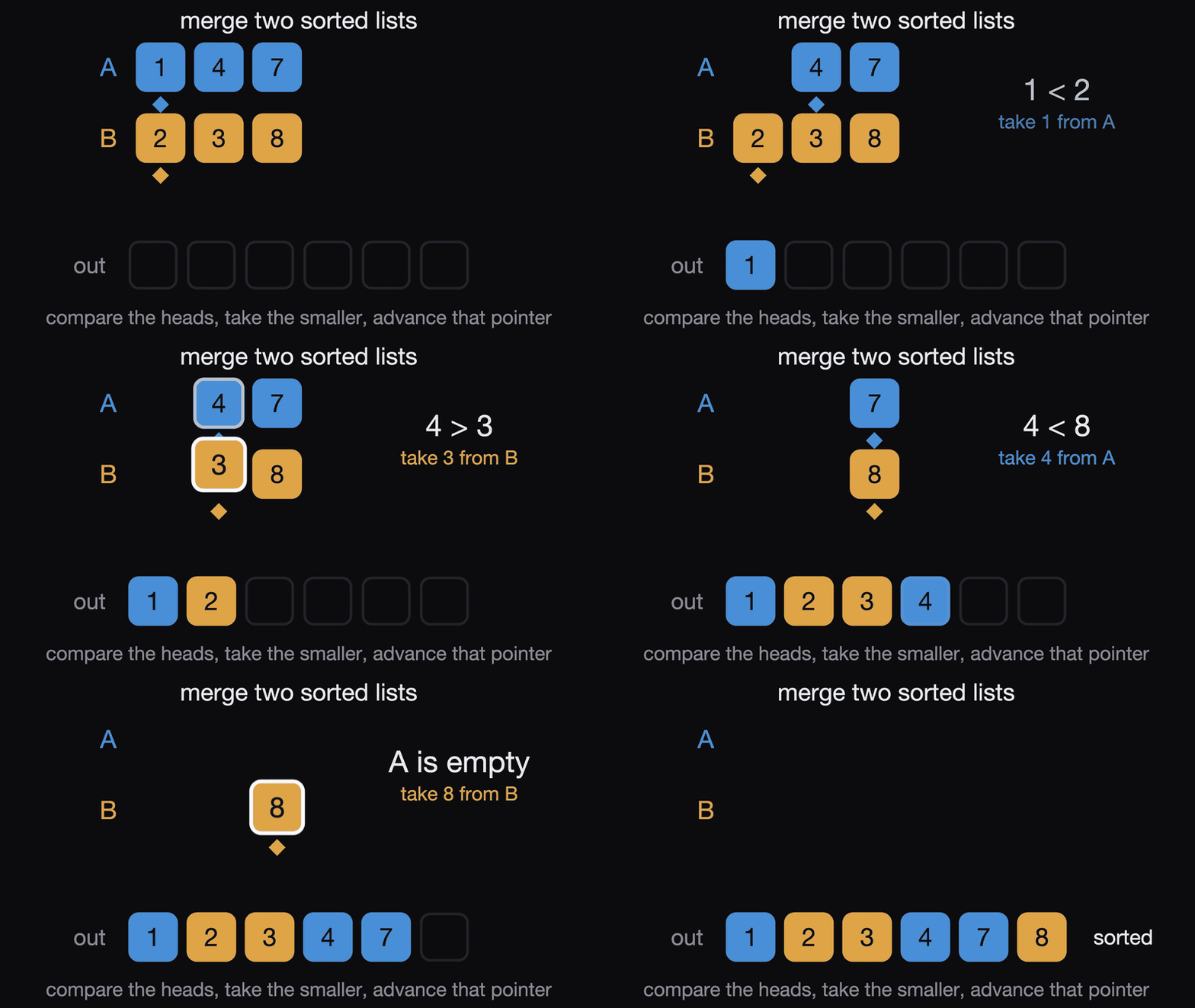
examples/merge_sorted.py: the merge is simulated in Python, then each step becomes keyframes.
Key features
- The scene is a pure function of time.
state(t)resolves every property att. Nothing accumulates between frames, so every frame renders independently and in parallel, and a scrub to anytis exact. - Pydantic models are the schema. JSON is the product contract; the Python API is sugar over the same
models.
buttery schemaprints the JSON schema an agent can build against. - Properties are expressions, not values. Tweens, keyframes,
sin(6 * T), and references to other objects' properties (ring.x = dot.ref.x) form a dependency DAG, so edges follow nodes for free. Shorthand strings like"dot.r + 0.5"parse into the same tree, noeval. - Built for agents.
validate/state/preview/renderas a CLI, a Python API, and an MCP server. Every call returns{"ok": true, ...}or a structured error list, never a bare stack trace. A Claude Code skill is included. - Explainer primitives.
circle rect line text group, and acodeblock that syntax-highlights Python and lets spans select by token, line, or character range. - Validation up front. Structural checks from pydantic (unknown fields, arity, colors) plus semantic checks: unique ids, references resolve, no dependency cycles.
- Real motion blur. A skia-python renderer samples sub-frames across a configurable shutter, uses every
core, and writes an
.mp4through ffmpeg or a PNG sequence without it.
More examples
❯ Use buttery to show a red-black tree left rotation one step at a time.
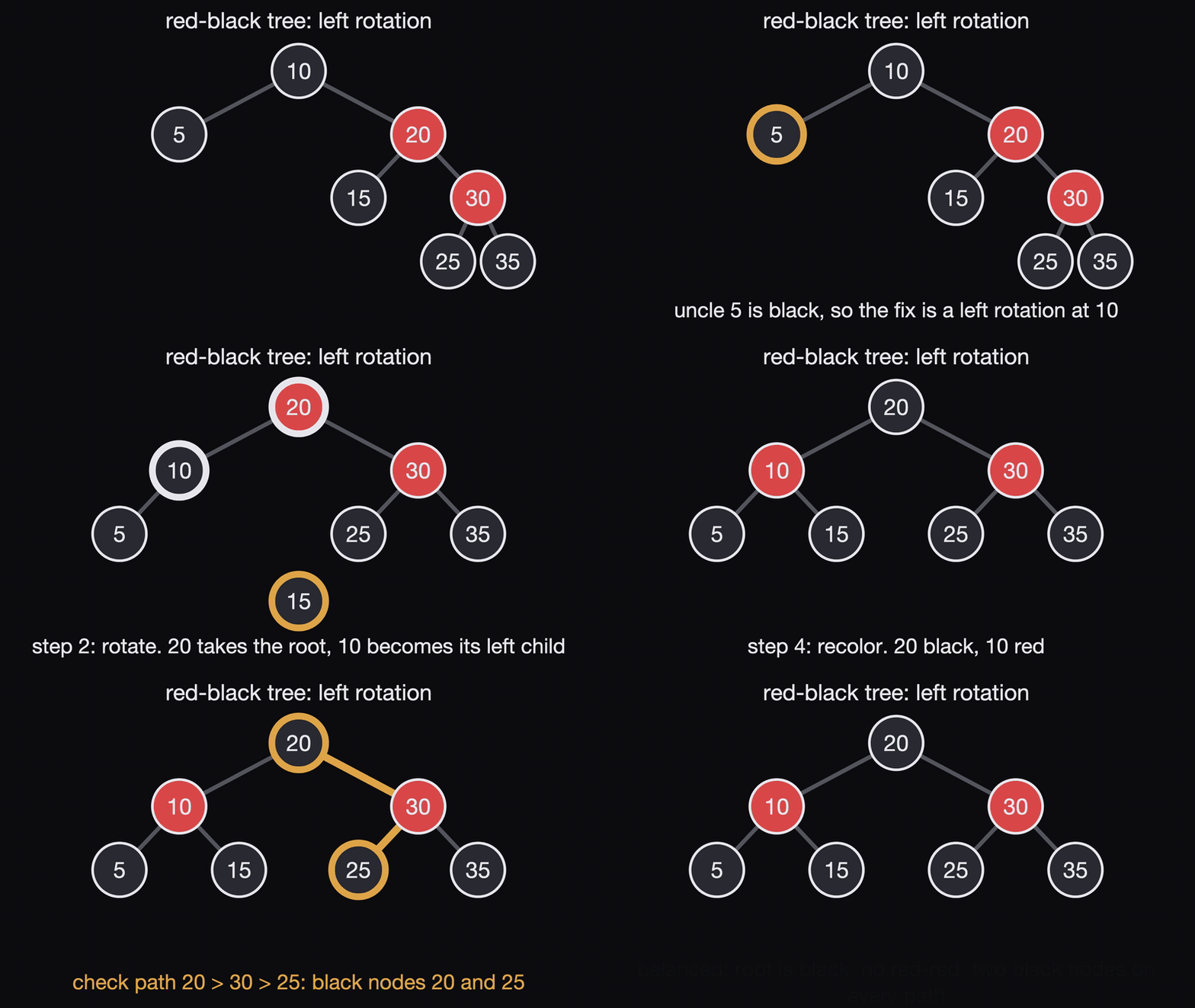
examples/rb_rotation.py: nodes are groups, edges are lines whose endpoints reference the nodes, so the
edges follow the rotation for free. The before/after trees are two tuples; the script diffs them.
❯ Use buttery to show every token color of the syntax highlighter, one kind per beat.
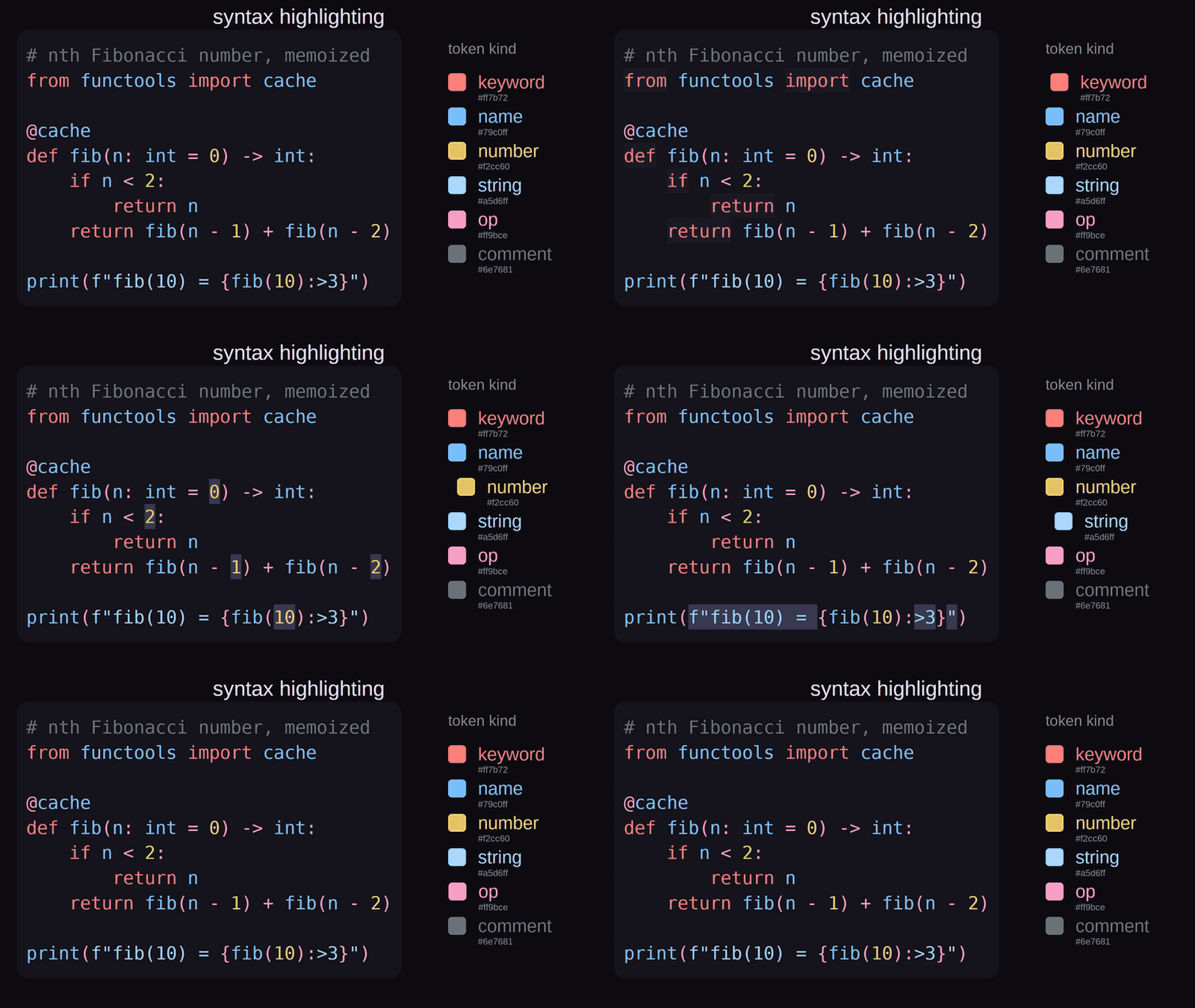
examples/syntax_theme.py: a custom theme colors all six token kinds; the legend walks them one per beat and
every token of that kind pulses in the code.
Architecture
Agent tool surface   validate / state / preview / render     (tools.py, cli.py, mcp_server.py)
Authoring            Python sugar  <->  JSON                 (objects.py, expr.py, parse.py)
Core                 Scene, primitives, expression DAG       (scene.py, evaluate.py)
Renderer             skia-python, motion blur via sub-frames  (render.py)
Install
pip install buttery    # or: uv add buttery
brew install ffmpeg    # for .mp4 output (PNG sequences work without it)
The renderer is skia-python, which ships large platform wheels; expect a heavier install than the code size suggests.
From a clone:
uv sync                # Python 3.11+, pydantic, skia-python, numpy, mcp
uv run pytest
Python
from buttery import *

dot = Circle("dot", r=0.3, fill="coral")
dot.x = tween(-3, 3, at=0, dur=1.5, ease="out_cubic")
dot.y = 0.2 * sin(6 * T)

ring = Circle("ring", fill=None, stroke="white")
ring.x = dot.ref.x
ring.r = dot.ref.r + 0.5

scene = Scene(duration=3).add(dot, ring, Text("label", content="Hello", y=-1.6))
scene.state(1.0)                       # plain data
scene.preview(1.0, path="p.png")       # quick low-res PNG
scene.render("out.mp4")                # motion blur, all cores, ffmpeg
scene.save("scene.json")               # the same thing as JSON
obj.prop reads the stored expression; obj.ref.prop makes a reference to it (the spec's dot.r + 0.5
became dot.ref.r + 0.5 because a plain attribute read cannot be both a value and a reference).
JSON
{
  "duration": 3,
  "objects": [
    {"id": "dot", "type": "circle", "r": 0.3, "fill": "coral",
     "x": {"op": "tween", "keys": [[0, -3], [1.5, 3]], "ease": "out_cubic"},
     "y": {"op": "mul", "args": [0.2, {"op": "sin", "args": [{"op": "mul", "args": [6, "t"]}]}]}},
    {"id": "ring", "type": "circle", "fill": null, "stroke": "white", "x": "dot.x", "r": "dot.r + 0.5"}
  ]
}
Shorthand strings like "dot.r + 0.5" parse (no eval) into the same op tree. uv run buttery schema
prints the JSON schema from Scene.model_json_schema().
Coordinates: world units, origin at center, y up. The frame is view_width (default 8) units wide.
Primitives: circle rect line text code group. text wraps at max_width and honors newlines. code is a
monospace block on a fixed character grid; its spans select characters by line, by Python token, or by
chars range and give them their own fill, background and opacity; theme: "default" (or a kind -> color
mapping) syntax-highlights Python tokens. Ops: add sub mul div neg sin cos abs min max clamp smoothstep noise.
Eases: linear in_quad out_quad in_out_quad out_cubic in_out_cubic spring. Colors: hex or CSS names;
fill/stroke can be tweened between colors.
Agent surface
uv run buttery validate scene.json
uv run buttery state scene.json --t 1.25
uv run buttery preview scene.json --t 1.25 --out p.png --scale 0.25
uv run buttery render scene.json out.mp4 [--no-motion-blur --samples 8 --shutter 0.5 --workers N]
uv run buttery mcp            # MCP server on stdio: same four tools + scene://schema resource
Every call returns {"ok": true, ...} or {"ok": false, "errors": [{"path", "message", "object", "property", "t"}]}.
Never a bare stack trace.
Claude Code skill: skill/ (symlink or copy it into ~/.claude/skills/buttery). Register the MCP server with
claude mcp add buttery -- uv run --directory /path/to/this/repo buttery mcp.
Or from the published packages, no checkout needed: claude mcp add buttery -- npx -y buttery-mcp
(the buttery-mcp npm shim runs uvx buttery mcp; see npm/).
Validation and evaluation rules
- Structural validation is pydantic (unknown fields rejected, arity checked, colors checked).
- Semantic validation: unique ids (global across groups), references resolve to numeric animatable properties, no dependency cycles, tween key kinds match the property kind.
- Evaluation compiles each expression to a closure once, walks the DAG in dependency order, and never mutates the scene.
- Motion blur:
samplessub-frames spread acrossshutter× frame interval, averaged (0.5 = 180° shutter).
Layout
src/buttery/
  expr.py        AST models (Op, Tween, Ref), operator overloading, sugar (T, sin, tween, keyframes, ...)
  parse.py       shorthand parser -> AST, constant folding
  objects.py     Circle, Rect, Line, Text, Code (+ Span), Group
  code.py        Python tokenizer, line / token / chars selection -> character ranges, highlight themes
  scene.py       Scene, semantic checks, state(t)
  evaluate.py    compile + topological evaluation
  render.py      skia rasterizer, motion blur, parallel render, ffmpeg
  tools.py       validate / state / preview / render (JSON in, JSON out)
  cli.py         `buttery` command
  mcp_server.py  MCP server
examples/        bounce.py, squash_bounce.py, merge_sorted.py, rb_rotation.py, code_walk.py, syntax_theme.py (Python) and their .json, launch_demo.json
skill/           Claude Code skill
tests/
Not in v1
Equations/LaTeX, 3D or cameras, GUI, audio, plugins, manim parity.
1 maintainer

Metadata
1 maintainer
Release files for buttery 0.3.2
For a detailed explanation of source distributions (sdists) and built distributions (wheels), please see the package formats documentation.
Source distribution (sdist)
| File | Size | Uploaded | Provenance | |
|---|---|---|---|---|
| buttery-0.3.2.tar.gz | 4.1 MB | With provenance | Details |
Built distribution (wheel)
| File | Interpreter | ABI | Platform | Reset |
|---|---|---|---|---|
| buttery-0.3.2-py3-none-any.whl | Python 3 | none | any | Details |
Total release size: 4.2 MB
Release files / buttery-0.3.2.tar.gz
| Download URL | buttery-0.3.2.tar.gz |
|---|---|
| Size | 4.1 MB |
| Tags | Source |
|
SHA-256 checksum How to use checksums |
85f175a46369c4ae95a787aee3d15cf1b46b085b36bc575c8cebe7767260bd7c
|
|
BLAKE2b-256 checksum How to use checksums |
1869bbe0d5f634e9e6df8a486652cc4bf4c89aaf3945b527b15ce40b3a6b2da8
|
| Upload date | |
|
Uploaded using Trusted Publishing? What is trusted publishing? |
Yes |
| Uploaded via |
twine/7.0.0 CPython/3.13.14
|
Provenance
Provenance describes where a file came from. On PyPI, provenance is shared via attestations, which provide a verifiable record of the build or publishing details. View details, limitations and caveats.


PyPI Publish Attestation
PyPI verified that this artifact, at this checksum, originated from the publisher listed below.
Signed by GitHub Actions, verified by PyPI on Sep 9, 2026.
Transparency logRelease files / buttery-0.3.2-py3-none-any.whl
| Download URL | buttery-0.3.2-py3-none-any.whl |
|---|---|
| Size | 39.2 kB |
| Tags | Python 3 |
|
SHA-256 checksum How to use checksums |
9c97b7cdf0f9879b9ac96c4cdc0140d6d84b19e5ff546809fa22ff951d56df23
|
|
BLAKE2b-256 checksum How to use checksums |
eec0e5691ac0a36a8fa64dac7a3336e6fa8acd2c8dd7020e6918f22ddd2be241
|
| Upload date | |
|
Uploaded using Trusted Publishing? What is trusted publishing? |
Yes |
| Uploaded via |
twine/7.0.0 CPython/3.13.14
|
Provenance
Provenance describes where a file came from. On PyPI, provenance is shared via attestations, which provide a verifiable record of the build or publishing details. View details, limitations and caveats.
PyPI Publish Attestation
PyPI verified that this artifact, at this checksum, originated from the publisher listed below.
Signed by GitHub Actions, verified by PyPI on Sep 9, 2026.
Transparency logSecurity for buttery 0.3.2
Provenance
Provenance describes where a file came from. On PyPI, provenance is shared via attestations, which provide a verifiable record of the build or publishing details. View details, limitations and caveats.
Full provenance
All 2 files in this release have been uploaded with provenance metadata.
Attestation for buttery-0.3.2.tar.gz
PyPI Publish Attestation
PyPI verified that this artifact, at this checksum, originated from the publisher listed below.
Signed by GitHub Actions, verified by PyPI on Sep 9, 2026.
Transparency logA note on package security
PyPI is a repository for distributing packages, not a service for auditing them. While third-party security researchers and our staff do their best to detect and remove malicious packages, PyPI cannot guarantee the quality, security or suitability of any given package.
To learn more about protecting yourself from malicious actors, visit our package security documentation.














