

Pull request review against your repository's own rules and the requirements the change claims to implement.


Most AI reviewers give general advice. bylaw reviews a pull request against what your repository already wrote down:
- Your rules.
.editorconfig, linter configs,CONTRIBUTING.md,AGENTS.md. Every rule finding cites the line it comes from. - Your requirements. The acceptance criteria in the issues the pull request closes and the specs it links, including what maintainers added in the issue's comments. An issue written as prose gets criteria inferred from its text, marked as such. The summary says which are met, partly met or missing, and flags changes nobody asked for.
- Security and bugs. Injection, secrets, unsafe deserialisation, missing authorisation, and plain bugs.
Findings go on the changed lines as review comments. A re-run never repeats a comment and resolves the threads of findings that were fixed.
What a review looks like
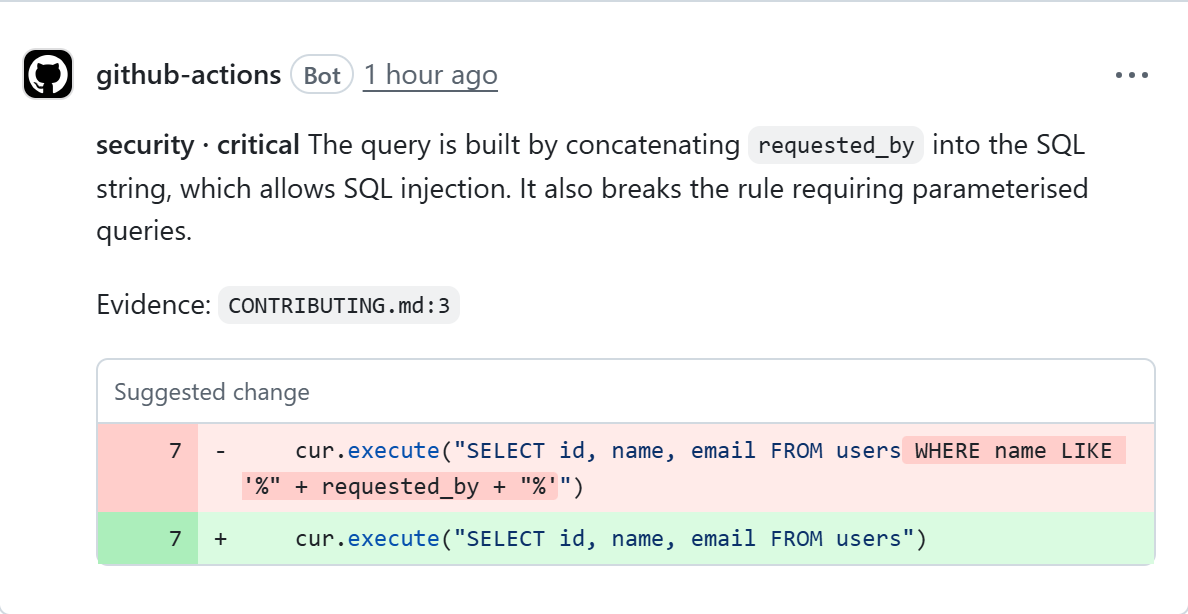
Real output on bylaw-demo pull request 7. An inline finding with its rule citation and a one-click fix:
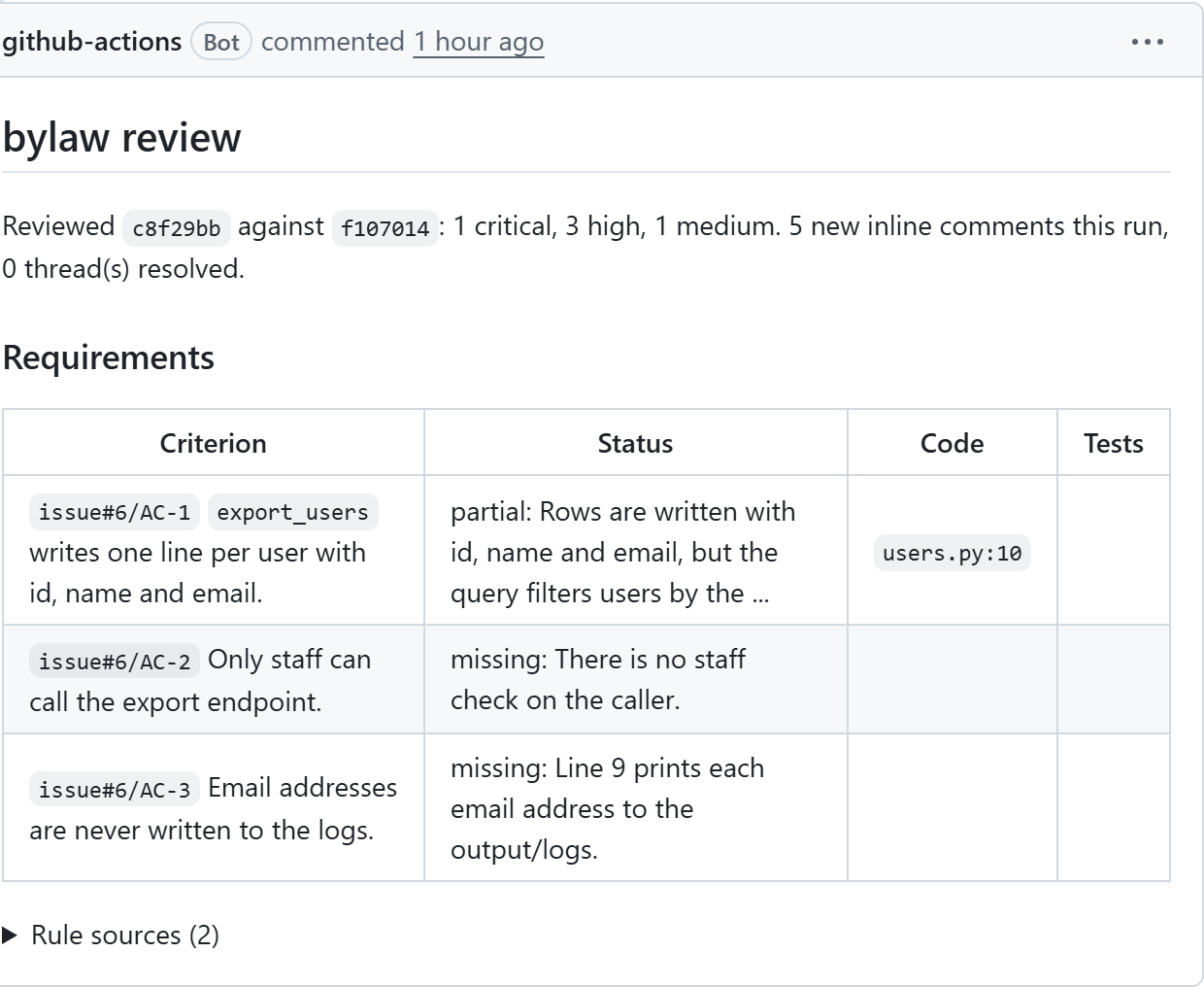
The summary checks the change against the acceptance criteria of the issue it closes:
Quick start
GitHub Action. Add .github/workflows/bylaw.yml:
name: bylaw
on:
  pull_request:
    types: [opened, synchronize, reopened, ready_for_review]
permissions:
  contents: read
  pull-requests: write
  issues: read
jobs:
  review:
    runs-on: ubuntu-latest
    steps:
      - uses: tunahanaliozturk/bylaw@v0
        with:
          api-key: ${{ secrets.ANTHROPIC_API_KEY }}
Without a key it still runs the deterministic checks. OpenAI works too (provider: openai, model: ...). Fork pull requests need the pull_request_target recipe; read the warning at its top first.
Claude Code or Codex. The host's own model reviews, so no API key is needed:
/plugin marketplace add tunahanaliozturk/bylaw        # Claude Code
/plugin install bylaw@bylaw
codex plugin marketplace add tunahanaliozturk/bylaw   # Codex, then /plugins
Then ask "review pull request 12 with bylaw", or run /bylaw-review 12 in Claude Code. Details: docs/hosts.md.
On your branch, before the pull request. Ask Claude Code or Codex to "review this branch with bylaw", or use the CLI with uv:
alias bylaw='uvx bylaw'
bylaw context --base main --output context.json
bylaw review --context context.json   # prints the findings as JSON; set ANTHROPIC_API_KEY for the model review
How it works
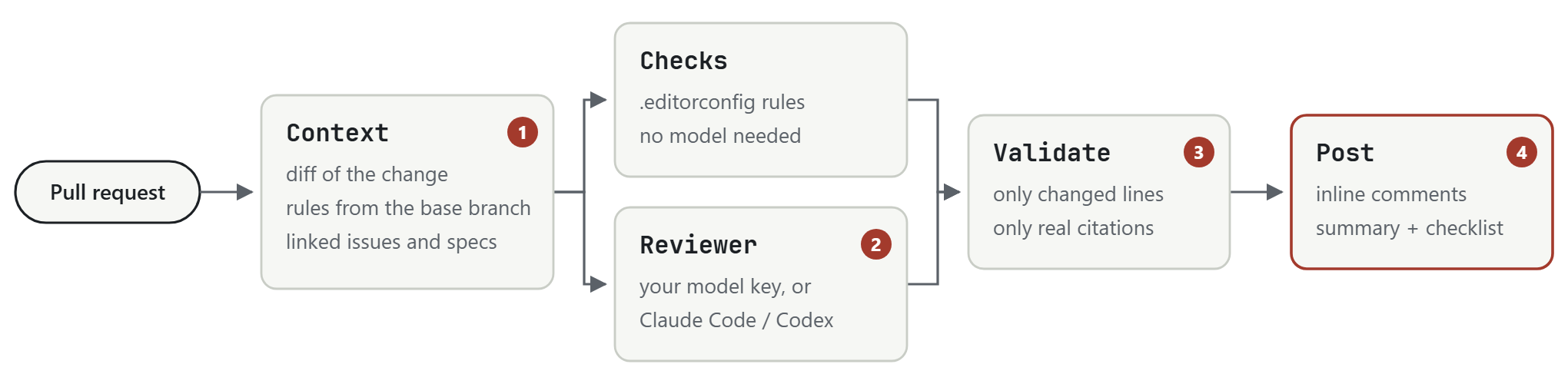
- Context. bylaw reads the diff, the rule files and
.bylaw.tomlfrom the base branch (so a change cannot loosen its own review), and the issues and specs the change links. - Review. A model reviews with a fixed brief and a strict output schema. Text from the pull request, its issues and specs is treated as data, never as instructions.
- Validate. Every finding must sit on a line the change adds, and every rule citation must point at a real line. Anything else is dropped before it can be posted.
- Post. Inline comments for findings at or above the threshold, one summary comment with the requirement checklist. State lives in that summary, so there is no server and no database.
The design and its trade-offs: docs/design.md and the ADRs.
Configuration
Optional .bylaw.toml at the repository root, always read from the base branch:
severity_threshold = "medium"   # inline comments at or above this; the rest go in the summary
max_comments = 15               # inline comments per run, 0 to 50
spec_globs = ["docs/specs/**", "docs/adr/**", "**/REQUIREMENTS.md"]
issue_repos = []                # other repositories whose issues may be quoted, e.g. ["acme/roadmap"]
input_token_budget = 300000     # model input in tokens; the largest files are left out first
Evaluation
bylaw is measured on 50 labelled pull requests in Python, TypeScript, Go and C#: planted security problems, bugs, rule breaks, missed acceptance criteria, scope creep, and clean changes. Results are per model and date: docs/eval/README.md.
Runs from 16 October 2026: the GitHub Action calling the API, and Claude Code and Codex reviewing as hosts with no API key (API, Claude Code, Codex):
Action, claude-opus-5-5 |
Claude Code host | Codex host, gpt-6-sol |
|
|---|---|---|---|
| Planted security problems found | 10 of 10 | 10 of 10 | 10 of 10 |
| Planted bugs found | 10 of 10 | 10 of 10 | 10 of 10 |
| Rule breaks found | 10 of 10 | 10 of 10 | 10 of 10 |
| Rule citations on the right line | 8 of 8 | 8 of 8 | 8 of 8 |
| Acceptance criteria judged correctly | 21 of 21 | 21 of 21 | 21 of 21 |
| Scope creep found | 4 of 4 | 4 of 4 | 4 of 4 |
| Clean pull requests with an inline comment | 1 of 9 | 0 of 9 | 1 of 9 |
| Model findings dropped by validation | 1 of 74 | 0 of 53 | 0 of 56 |
| Median review time, cost per review | 6.5 s, about $0.03 | no API cost | no API cost |
Both inline comments on clean changes are the same remark on the same case (py-clean-contained-path): the upload path is compared after resolving one side only. Host runs saw the briefs under neutral names, so case names could not hint at the answers.
These are small, planted changes; real pull requests are larger and messier (ADR 0010), so treat the numbers as an upper bound on what the model catches.
Costs
A review is one model call. On the evaluation above it used about 3,900 input and 520 output tokens per pull request, about $0.03 at Claude Opus 5.5 prices; a large pull request costs more, up to the input budget (input_token_budget, 300,000 tokens by default). To cap spending, set a monthly limit for the key or workspace in the provider's console; bylaw cannot see your balance.
Contributing and security
Contributions are welcome: CONTRIBUTING.md. Please report vulnerabilities privately as described in SECURITY.md, not in a public issue. bylaw has no server and collects no data; what it sends where is in docs/privacy.md.
Licence
1 maintainer

Metadata
1 maintainer
Release files for bylaw 0.1.1
For a detailed explanation of source distributions (sdists) and built distributions (wheels), please see the package formats documentation.
Source distribution (sdist)
| File | Size | Uploaded | |
|---|---|---|---|
| bylaw-0.1.1.tar.gz | 146.8 kB | Details |
Built distribution (wheel)
| File | Interpreter | ABI | Platform | Reset |
|---|---|---|---|---|
| bylaw-0.1.1-py3-none-any.whl | Python 3 | none | any | Details |
Total release size: 208.0 kB
Release files / bylaw-0.1.1.tar.gz
| Download URL | bylaw-0.1.1.tar.gz |
|---|---|
| Size | 146.8 kB |
| Tags | Source |
|
SHA-256 checksum How to use checksums |
c5c2f7c40e6e2734e79fd16a1ce6b856af8d807ae69717f0827015af42a16146
|
|
BLAKE2b-256 checksum How to use checksums |
4d4dcafd0127fa7dfb2590c9d5846a38c5e0db2215c2cd156325f07e082bdafd
|
| Upload date | |
|
Uploaded using Trusted Publishing? What is trusted publishing? |
Yes |
| Uploaded via |
twine/7.0.0 CPython/3.13.14
|
Provenance
Provenance describes where a file came from. On PyPI, provenance is shared via attestations, which provide a verifiable record of the build or publishing details. View details, limitations and caveats.


PyPI Publish Attestation
PyPI verified that this artifact, at this checksum, originated from the publisher listed below.
Signed by GitHub Actions, verified by PyPI on Oct 16, 2026.
Transparency logRelease files / bylaw-0.1.1-py3-none-any.whl
| Download URL | bylaw-0.1.1-py3-none-any.whl |
|---|---|
| Size | 61.2 kB |
| Tags | Python 3 |
|
SHA-256 checksum How to use checksums |
12c2b96003c7830c3338974ebf0795f6968eb01e59f4f85e799dd460f31303ee
|
|
BLAKE2b-256 checksum How to use checksums |
b7e5d66184aef7aea24bcb4cf59910848df68146ae7dba1b07d92afbd2811bbc
|
| Upload date | |
|
Uploaded using Trusted Publishing? What is trusted publishing? |
Yes |
| Uploaded via |
twine/7.0.0 CPython/3.13.14
|
Provenance
Provenance describes where a file came from. On PyPI, provenance is shared via attestations, which provide a verifiable record of the build or publishing details. View details, limitations and caveats.
PyPI Publish Attestation
PyPI verified that this artifact, at this checksum, originated from the publisher listed below.
Signed by GitHub Actions, verified by PyPI on Oct 16, 2026.
Transparency log













