
CAKE: Confidence in Assignments via K-partition Ensembles
Verified details
These details have been verified by PyPIProject links
GitHub Statistics
Maintainers

Project description
CAKE: Confidence in Assignments via K-partition Ensembles



|
📄 Published in Machine Learning with Applications |
CAKE is an open-source Python package for ensemble-based confidence estimation of clustering assignments, enabling the detection of stable core members and ambiguous boundary points in unlabeled data.
Motivation
Clustering assigns each data point to a group, but it does not tell us how reliable that assignment is.
While global validation metrics assess overall quality, they provide little insight into the trustworthiness of individual assignments.
Ensemble-based clustering improves robustness by aggregating multiple partitions. However, most ensemble-style uncertainty measures focus primarily on cross-run agreement (e.g., aligned vote counts or dispersion of labels across runs). Agreement alone is not sufficient: a point may be consistently assigned due to systematic bias or rigid decision boundaries, even if it is weakly integrated into the cluster structure.
Conversely, purely geometric signals such as the Silhouette score evaluate local separation within a single run but ignore cross-run instability. A point may appear geometrically well placed in one partition, yet switch clusters across runs because it lies near a boundary or because multiple partitions explain it nearly equally well.
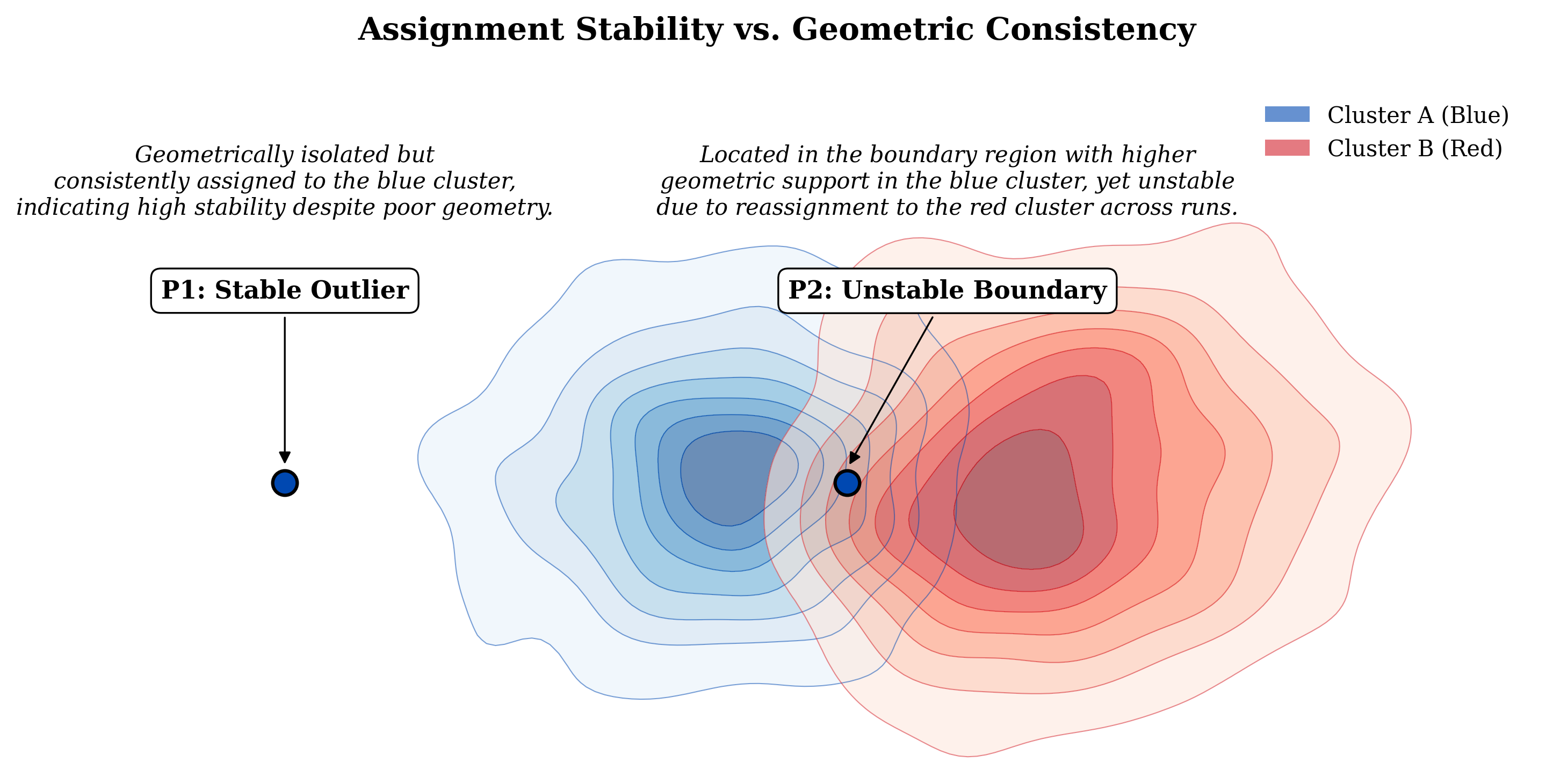
These complementary failure modes motivate a confidence signal that jointly accounts for both assignment stability and consistency of geometric support at the point level.
CAKE (Confidence in Assignments via K-partition Ensembles) provides a principled, per-instance confidence score by fusing two complementary statistics computed over a clustering ensemble:
- 🔁 Assignment Stability: pairwise agreement across runs after optimal label alignment, using the Hungarian algorithm.
- 📐 Geometric Consistency: aggregated Silhouette statistics across runs.
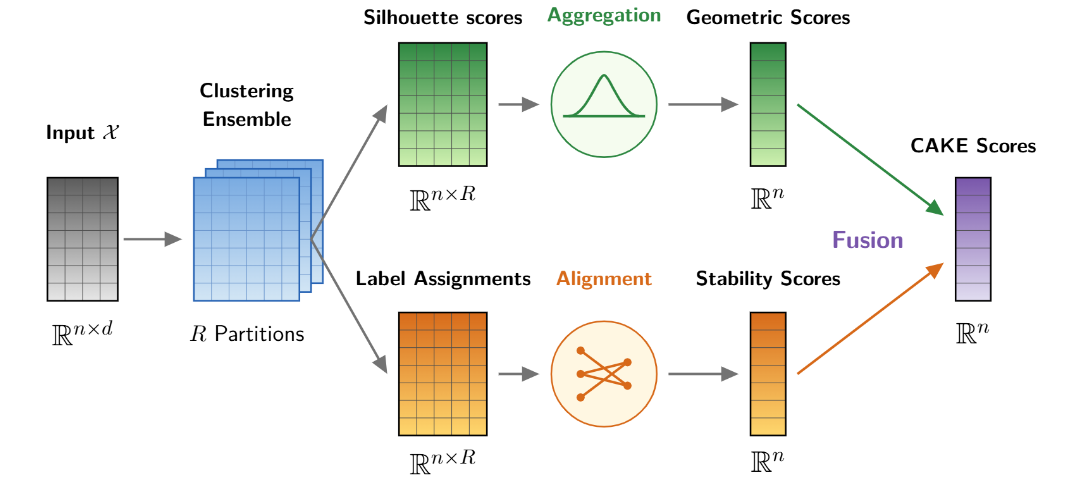
These components are combined into a single, interpretable score in [0, 1], enabling:
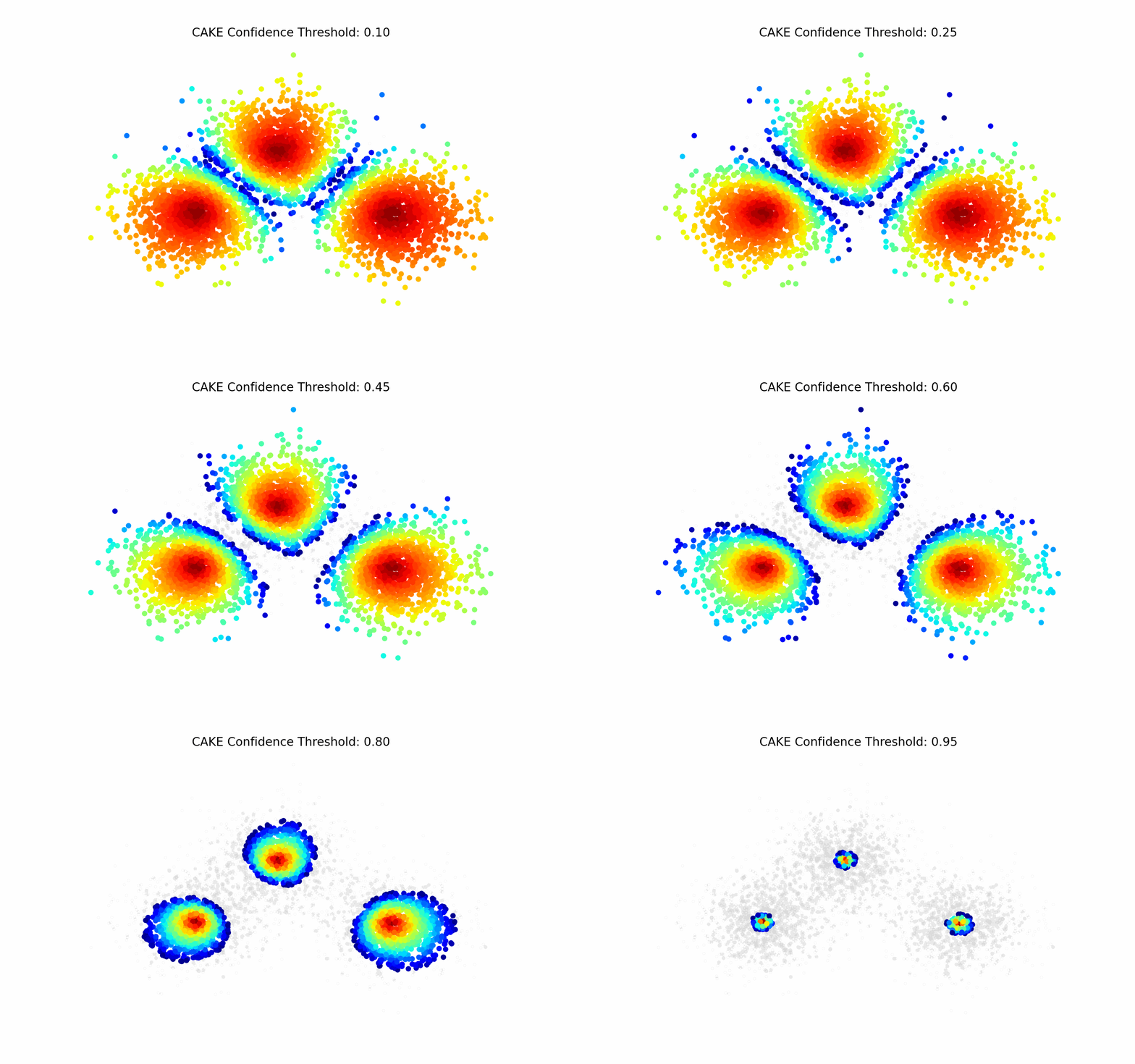
- Identification of stable core members.
- Detection of ambiguous boundary points.
- Filtering of unreliable assignments.
- Ranking of instances by clustering confidence.
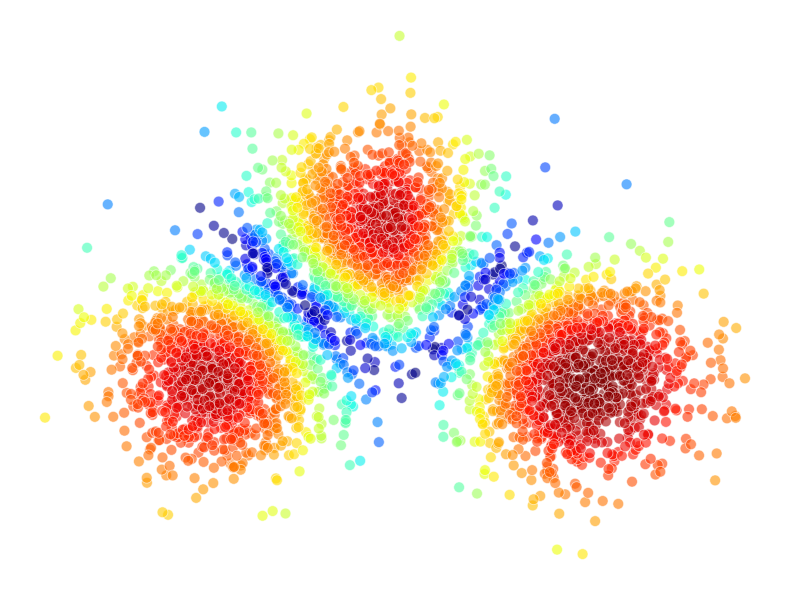
CAKE scores on synthetic data. Red ↑; Blue ↓.
Citation
If you find this work useful, please consider citing:
Semoglou, A., & Pavlopoulos, J. (2026). CAKE: Confidence in Assignments via K-partition Ensembles.
Machine Learning with Applications, 24, 100915. https://doi.org/10.1016/j.mlwa.2026.100915
@article{semoglou2026cake,
  title   = {CAKE: Confidence in Assignments via K-partition Ensembles},
  author  = {Semoglou, Aggelos and Pavlopoulos, John},
  journal = {Machine Learning with Applications},
  volume  = {24},
  pages   = {100915},
  year    = {2026},
  doi     = {10.1016/j.mlwa.2026.100915},
  url     = {https://doi.org/10.1016/j.mlwa.2026.100915}
}
The preprint is also available on arXiv: https://arxiv.org/abs/2602.18435
Installation
Install CAKE from PyPI:
pip install cake-ensemble
Ιmport the main functions in Python as:
from cake_ensemble import (
    sil_samples,
    sil_samples_stats,
    align_labels,
    pairwise_stability,
    cake,
    consensus_labels,
    kmeans_ensemble,
    cake_with_consensus,
)
API Reference
CAKE provides utilities for computing sample-level silhouette statistics, aligning clustering labels, measuring assignment stability, computing CAKE confidence scores, deriving consensus labels, and building KMeans ensembles.
sil_samples
Computes silhouette scores for each sample, either exactly using scikit-learn or approximately using distances to cluster centroids.
sil_samples(X, labels, approximation=False, centers=None)
Inputs
-
X: array-like of shape(n_samples, n_features)
Input data matrix. -
labels: array-like of shape(n_samples,)
Cluster label assigned to each sample. -
approximation: bool, defaultFalse
IfFalse, computes exact silhouette scores.
IfTrue, computes a faster centroid-based approximation. -
centers: array-like of shape(n_clusters, n_features)or None, defaultNone
Optional cluster centers used whenapproximation=True.
If not provided, centers are computed fromXandlabels.
Returns
silhouette_scores: array of shape(n_samples,)
Silhouette score for each sample.
sil_samples_stats
Computes sample-level silhouette statistics across multiple clustering runs.
sil_samples_stats(X, labels_list, approximation=False, centers_list=None)
Inputs
-
X: array-like of shape(n_samples, n_features)
Input data matrix. -
labels_list: list of array-like, each of shape(n_samples,)
List of label vectors from multiple clustering runs. -
approximation: bool, defaultFalse
Whether to use centroid-based approximate silhouette scores. -
centers_list: list of array-like or None, defaultNone
Optional list of cluster-center arrays, one per clustering run.
Used whenapproximation=True.
Returns
-
mean_silhouette: array of shape(n_samples,)
Mean silhouette score of each sample across the ensemble. -
std_silhouette: array of shape(n_samples,)
Standard deviation of each sample’s silhouette score across the ensemble.
align_labels
Aligns the labels of one clustering solution to another using the Hungarian algorithm.
align_labels(target, source)
Inputs
-
target: array-like of shape(n_samples,)
Reference label vector. -
source: array-like of shape(n_samples,)
Label vector to be remapped so that it best matchestarget.
Returns
aligned_labels: array of shape(n_samples,)
The source labels remapped to match the target label space.
pairwise_stability
Computes pointwise assignment stability across all pairs of clustering runs.
pairwise_stability(labels_runs)
Inputs
labels_runs: list of array-like, each of shape(n_samples,)
List of cluster label vectors from multiple clustering runs.
Returns
assignment_stability: array of shape(n_samples,)
For each sample, the fraction of run-pairs where the sample receives the same aligned label.
cake
Computes CAKE confidence scores for each sample in a clustering ensemble.
cake(X, labels_list, method='product', approximation=False, centers_list=None, geom_norm='clip')
Inputs
-
X: array-like of shape(n_samples, n_features)
Input data matrix. -
labels_list: list of array-like, each of shape(n_samples,)
List of cluster label vectors from multiple clustering runs. -
method: str, default'product'
Method used to combine assignment stability and geometric stability.
Options:'product'or'harmonic_mean'. -
approximation: bool, defaultFalse
Whether to use centroid-based approximate silhouette scores. -
centers_list: list of array-like or None, defaultNone
Optional list of cluster centers, one per clustering run.
Used whenapproximation=True. -
geom_norm: str, default'clip'
Strategy for mapping the geometric component to[0, 1].
'clip'uses max(mean silhouette − std silhouette, 0).
'affine'maps the raw value from[-1, 1]to[0, 1].
Returns
-
cake_scores: array of shape(n_samples,)
Final CAKE confidence score for each sample. -
assignment_stability: array of shape(n_samples,)
Pairwise label-agreement stability across clustering runs. -
geometric_stability: array of shape(n_samples,)
Silhouette-based geometric reliability score. -
summary: pandas DataFrame
Per-sample table containing mean silhouette, silhouette standard deviation, geometric stability, assignment stability, and CAKE score.
consensus_labels
Computes consensus clustering labels from multiple clustering runs using label alignment and majority vote.
consensus_labels(labels_list, method='medoid')
Inputs
-
labels_list: list of array-like, each of shape(n_samples,)
List of cluster label vectors from multiple clustering runs. -
method: str, default'medoid'
Consensus strategy.
'medoid'selects the most representative run as reference, aligns all runs to it, and computes majority-vote labels.
'best_ref'tries every run as reference and keeps the one with the highest average consensus strength.
Returns
-
consensus: array of shape(n_samples,)
Consensus cluster label for each sample. -
consensus_strength: array of shape(n_samples,)
Fraction of aligned runs voting for the selected consensus label. -
reference_index: int
Index of the selected reference run.
Note: majority-vote consensus does not guarantee that all reference cluster labels appear in the final consensus.
kmeans_ensemble
Builds a KMeans clustering ensemble by running KMeans multiple times with different random seeds.
kmeans_ensemble(
    X,
    n_clusters,
    n_runs=50,
    random_state=1,
    init='random',
    n_init=1,
    max_iter=300,
    tol=1e-4,
    algorithm='lloyd',
    return_models=False
)
Inputs
-
X: array-like of shape(n_samples, n_features)
Input data matrix. -
n_clusters: int
Number of clusters for each KMeans run. -
n_runs: int, default50
Number of KMeans runs in the ensemble. -
random_state: int or None, default1
Base random seed used to generate run-specific seeds. -
init: str or array-like, default'random'
KMeans initialization strategy. -
n_init: int or'auto', default1
Number of initializations per KMeans run.
For ensemble diversity,n_init=1is recommended. -
max_iter: int, default300
Maximum number of iterations for each KMeans run. -
tol: float, default1e-4
Convergence tolerance. -
algorithm: str, default'lloyd'
KMeans algorithm. -
return_models: bool, defaultFalse
IfTrue, also returns the fitted KMeans models.
Returns
-
labels_list: list of arrays
One label vector per KMeans run. Each array has shape(n_samples,). -
centers_list: list of arrays
Cluster centers for each KMeans run. -
ensemble_summary: pandas DataFrame
Per-run metadata including run index, seed, inertia, and number of iterations. -
models: list of fitted KMeans models
Returned only whenreturn_models=True.
cake_with_consensus
Computes CAKE confidence scores together with consensus clustering labels.
cake_with_consensus(
    X,
    labels_list,
    cake_method='product',
    consensus_method='medoid',
    approximation=False,
    centers_list=None,
    geom_norm='clip'
)
Inputs
-
X: array-like of shape(n_samples, n_features)
Input data matrix. -
labels_list: list of array-like, each of shape(n_samples,)
List of cluster label vectors from multiple clustering runs. -
cake_method: str, default'product'
Method used to combine assignment stability and geometric stability.
Options:'product'or'harmonic_mean'. -
consensus_method: str, default'medoid'
Consensus strategy passed toconsensus_labels.
Options:'medoid'or'best_ref'. -
approximation: bool, defaultFalse
Whether to use centroid-based approximate silhouette scores. -
centers_list: list of array-like or None, defaultNone
Optional list of cluster centers, one per clustering run.
Used whenapproximation=True. -
geom_norm: str, default'clip'
Strategy for normalizing the geometric stability component.
Options:'clip'or'affine'.
Returns
-
cake_scores: array of shape(n_samples,)
Final CAKE confidence score for each sample. -
consensus: array of shape(n_samples,)
Consensus cluster label for each sample. -
consensus_strength: array of shape(n_samples,)
Fraction of aligned runs voting for the consensus label. -
assignment_stability: array of shape(n_samples,)
Pairwise assignment stability across the ensemble. -
geometric_stability: array of shape(n_samples,)
Silhouette-based geometric reliability score. -
summary: pandas DataFrame
Per-sample table containing consensus labels, consensus strength, CAKE components, and final CAKE score. -
reference_index: int
Index of the reference run selected by the consensus method.
Quick Start
This example builds a KMeans ensemble and then computes CAKE confidence scores using cake.
from sklearn.datasets import make_blobs
from cake_ensemble import kmeans_ensemble, cake

# Create example data
X, _ = make_blobs(
    n_samples=300,
    centers=3,
    n_features=2,
    cluster_std=1.0,
    random_state=42,
)

# Build a KMeans ensemble
labels_list, centers_list, ensemble_summary = kmeans_ensemble(
    X,
    n_clusters=3,
    n_runs=50,
    random_state=1,
)

# Compute CAKE scores
cake_scores, assignment_stability, geometric_stability, summary = cake(
    X,
    labels_list,
    method="product",
    approximation=True,
    centers_list=centers_list,
    geom_norm="clip",
)

print(summary.head())
The returned summary is a pandas DataFrame with one row per data point:
| Mean Silhouette | STD Silhouette | Geometric Stability | Assignment Stability | CAKE | |
|---|---|---|---|---|---|
| 0 | 0.871807 | 0.176727 | 0.695080 | 0.865306 | 0.601457 |
| 1 | 0.886966 | 0.169302 | 0.717664 | 0.800000 | 0.574131 |
| 2 | 0.806492 | 0.023170 | 0.783321 | 0.832653 | 0.652235 |
| 3 | 0.842851 | 0.069890 | 0.772961 | 0.817143 | 0.631619 |
| 4 | 0.771558 | 0.196408 | 0.575151 | 0.800000 | 0.460120 |
The CAKE column contains the final confidence score for each clustering assignment. Higher values indicate assignments that are both stable across the ensemble and geometrically well supported.
Complete code examples demonstrating core functionality can be found in the demos section of the repository.
Acknowledgments
This work was supported by Archimedes Research Unit, Athena Research Center.
License
This project is licensed under the MIT License.
Links
-
Published article: ScienceDirect
-
Preprint: arXiv:2602.18435
-
Package: PyPI
Project details
Verified details
These details have been verified by PyPIProject links
GitHub Statistics
Maintainers


Download files
Download the file for your platform. If you're not sure which to choose, learn more about installing packages.
Source Distribution
Built Distribution
Filter files by name, interpreter, ABI, and platform.
If you're not sure about the file name format, learn more about wheel file names.
Copy a direct link to the current filters
File details
Details for the file cake_ensemble-0.1.3.tar.gz.
File metadata
- Download URL: cake_ensemble-0.1.3.tar.gz
- Upload date:
- Size: 16.4 kB
- Tags: Source
- Uploaded using Trusted Publishing? Yes
- Uploaded via: twine/6.1.0 CPython/3.13.12
File hashes
| Algorithm | Hash digest | |
|---|---|---|
| SHA256 |
bf0b54961129c127f531d5222e0a5a570caee5c761c119320d0930e5df8d7375
|
|
| MD5 |
cdcf3035764cac49588357ea38704c7d
|
|
| BLAKE2b-256 |
4e81e8696b6b531d59b69661c97f1b32572c5ea3b00bb95eb505ff424330de0e
|
Provenance
The following attestation bundles were made for cake_ensemble-0.1.3.tar.gz:
Publisher:
python-publish.yml on semoglou/cake
-
Statement:
-
Statement type:
https://in-toto.io/Statement/v1 -
Predicate type:
https://docs.pypi.org/attestations/publish/v1 -
Subject name:
cake_ensemble-0.1.3.tar.gz -
Subject digest:
bf0b54961129c127f531d5222e0a5a570caee5c761c119320d0930e5df8d7375 - Sigstore transparency entry: 1554946691
- Sigstore integration time:
-
Permalink:
semoglou/cake@2190ed4ba2bbaf118828c95f7d7b219c69a77d35 -
Branch / Tag:
refs/tags/v0.1.3 - Owner: https://github.com/semoglou
-
Access:
public
-
Token Issuer:
https://token.actions.githubusercontent.com -
Runner Environment:
github-hosted -
Publication workflow:
python-publish.yml@2190ed4ba2bbaf118828c95f7d7b219c69a77d35 -
Trigger Event:
release
-
Statement type:
File details
Details for the file cake_ensemble-0.1.3-py3-none-any.whl.
File metadata
- Download URL: cake_ensemble-0.1.3-py3-none-any.whl
- Upload date:
- Size: 12.9 kB
- Tags: Python 3
- Uploaded using Trusted Publishing? Yes
- Uploaded via: twine/6.1.0 CPython/3.13.12
File hashes
| Algorithm | Hash digest | |
|---|---|---|
| SHA256 |
a8e5d17f507ef649ab3a81af59379edfbb3535a2f798f737a7af2b748e375007
|
|
| MD5 |
de80614a95407b4db44a4ebc2d347488
|
|
| BLAKE2b-256 |
6a5165855f4cfdddefc2efcdc315f3cd5b2f7f9557f455d38ad0653e23cba3b0
|
Provenance
The following attestation bundles were made for cake_ensemble-0.1.3-py3-none-any.whl:
Publisher:
python-publish.yml on semoglou/cake
-
Statement:
-
Statement type:
https://in-toto.io/Statement/v1 -
Predicate type:
https://docs.pypi.org/attestations/publish/v1 -
Subject name:
cake_ensemble-0.1.3-py3-none-any.whl -
Subject digest:
a8e5d17f507ef649ab3a81af59379edfbb3535a2f798f737a7af2b748e375007 - Sigstore transparency entry: 1554946725
- Sigstore integration time:
-
Permalink:
semoglou/cake@2190ed4ba2bbaf118828c95f7d7b219c69a77d35 -
Branch / Tag:
refs/tags/v0.1.3 - Owner: https://github.com/semoglou
-
Access:
public
-
Token Issuer:
https://token.actions.githubusercontent.com -
Runner Environment:
github-hosted -
Publication workflow:
python-publish.yml@2190ed4ba2bbaf118828c95f7d7b219c69a77d35 -
Trigger Event:
release
-
Statement type:






