
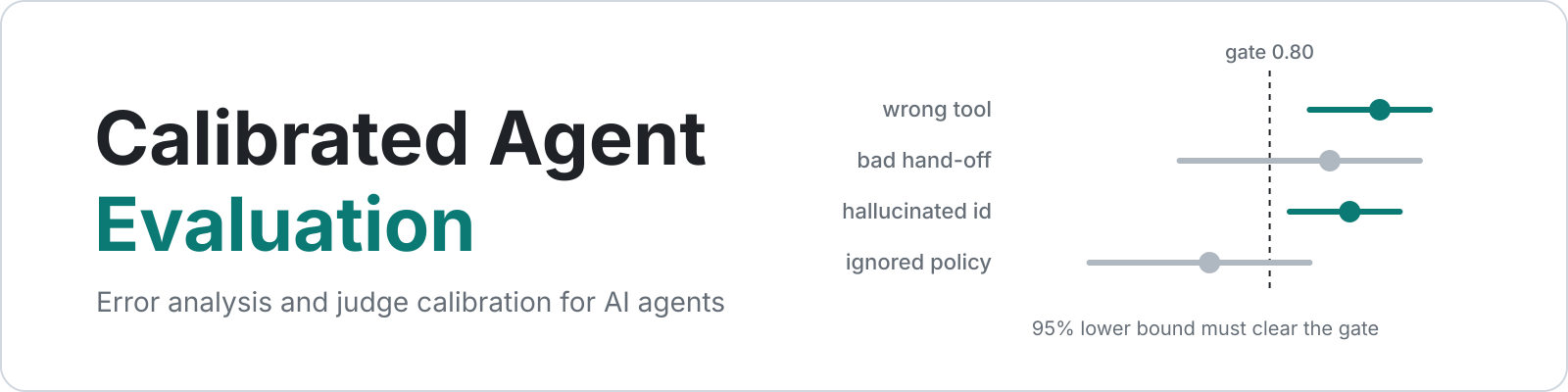
Find out how often your AI agent fails, with a number you can defend.




Documentation · Quickstart · Lifecycle guide · CLI reference · Contributing
An LLM judge reports that 12% of your agent's runs fail. How wrong is the judge, and how wide is that 12% once you count its mistakes? Calibrated Agent Evaluation answers both questions. It takes your agent's traces through error analysis, certifies a judge against human labels, corrects the measured failure rate for the judge's own error, and gates CI on the interval's lower bound.
It grades what the agent did (a normalized trace), so a custom loop, an LLM with MCP tools, a Strands agent and a multi-agent crew all go through the same pipeline. It is a library and CLI you run yourself, offline on a laptop or inside a corporate network. There is no hosted service.
What it checks that a raw judge score skips
- Judge certification. A judge is certified only when the 95% lower bounds on both its true-positive and true-negative rates reach 0.80, measured on gold labels that are used once.
- Corrected failure rates. The judge's measured rate is corrected for its error (Rogan–Gladen), with an interval that carries the uncertainty of the human gold and the judge. The correction is refused when the judge is too close to chance.
- Enough labels. Good–Turing coverage tells you when labeling has stopped finding new failure modes, and a planner sizes the gold set and the CI sample before you start.
- Fixes that held. A fix is accepted against a target registered before the change, with McNemar tests and a Holm-corrected panel of guard metrics.
- Crews. In a multi-agent run, the span that caused a failure is kept apart from the span where it showed.
It does not label traces for you (a human writes the gold) and it never gates on subjective
qualities such as tone. calibrated-agent-evaluation prefer ranks those instead.
Install
pip install calibrated-agent-evaluation
Or uv add calibrated-agent-evaluation, or uv tool install calibrated-agent-evaluation for the
CLI alone. Python 3.11.5 or later. The base install depends only on pydantic. Everything that needs
a third-party package is an opt-in extra:
pip install "calibrated-agent-evaluation[ui,stats,langfuse]"
| Extra | Adds |
|---|---|
ui |
the trace-review web app for human labeling |
stats |
judge calibration, corrected rates and failure-mode clustering |
langfuse |
Langfuse as the trace store |
inspect |
Inspect AI logs, agents and judge models |
strands |
running and capturing Strands agents |
bedrock |
Amazon Bedrock input generation and embeddings |
agentcore |
the Amazon Bedrock AgentCore plug-in |
calibrated-agent-evaluation doctor lists what is installed. The full set is in the
installation guide.
Quickstart
The bundled sample corpus runs end to end in a temporary directory, with no keys or network:
$ calibrated-agent-evaluation quickstart
Seeded 6 agent traces + 9 gold labels into an offline local store

First-pass result: 5 of 6 traces have a labeled failure.
Failure modes found:
    - trusted_broken_policy_tool: 2
    - dropped_material_fact: 1
    - misread_amount: 1
    - vacancy_threshold_margin_mishandled: 1
calibrated-agent-evaluation quickstart --certify goes further. It seeds 848 traces and writes a
judge kit with recorded model replies, then prints the commands that certify the judge, run its
bias battery and gate CI, all offline. Then bring your own traces from
OpenTelemetry (OpenInference or OpenLLMetry), Inspect AI, Strands, Langfuse, JSONL or Parquet:
choose your integration path.
How it works

Each stage is one subcommand, run in this order. Error analysis comes first: you look at real
traces, label them, and name the failure modes before anything is scored. A judge then has to pass
both trust gates before judge will run it, and run fails the build when a failure mode's
pass-rate 95% lower bound falls below the threshold. The
stage map covers each
stage, and
how the numbers work
explains the statistics, with every method cited.
Skills plugin
skills/ is a Claude Code and Kiro plugin that helps a coding agent drive the pipeline: it drafts
the taxonomy, the judge prompt or the review session, then hands off to the CLI command that
enforces the gate. Load it for one session with claude --plugin-dir <path-to-checkout>, or
install it from inside Claude Code:
/plugin marketplace add <path-to-checkout>
/plugin install calibrated-agent-evaluation@calibrated-agent-evaluation
For Kiro, see skills/README.md.
Documentation
- Why calibrate and how it compares with alternatives
- The lifecycle guide, from defining behavior to gating in production
- Calibrate a judge and gate a pull request in CI
- Methods and citations
- Python API and CLI reference
The project is at 0.1.0. Before 1.0, a minor release may change the API (versioning policy).
Contributing
CONTRIBUTING.md covers the development setup, the code layout and the checks a
change must pass (just check). Coding agents should read AGENTS.md.
Security
See CONTRIBUTING for how to report a security issue, and SECURITY.md for the security policy and the security model.
License
This project is licensed under the Apache-2.0 License. See LICENSE and NOTICE. Vendored code and third-party fixture data are listed with their copyright notices and full license texts in THIRD-PARTY-LICENSES.
1 maintainer

Metadata
1 maintainer
Release files for calibrated-agent-evaluation 0.1.0
For a detailed explanation of source distributions (sdists) and built distributions (wheels), please see the package formats documentation.
Source distribution (sdist)
| File | Size | Uploaded | Provenance | Actions |
|---|---|---|---|---|
| calibrated_agent_evaluation-0.1.0.tar.gz | 1.7 MB | With provenance | Details for calibrated_agent_evaluation-0.1.0.tar.gz |
Built distribution (wheel)
| File | Interpreter | ABI | Platform | Actions Reset |
|---|---|---|---|---|
| calibrated_agent_evaluation-0.1.0-py3-none-any.whl | Python 3 | none | any | Details for calibrated_agent_evaluation-0.1.0-py3-none-any.whl |
Total release size: 3.6 MB
Release files / calibrated_agent_evaluation-0.1.0.tar.gz
| Download URL | calibrated_agent_evaluation-0.1.0.tar.gz |
|---|---|
| Size | 1.7 MB |
| Tags | Source |
|
SHA-256 checksum How to use checksums |
c38c1d55473c524d62f6e3cad030a3b8bc904b5539ed6708127c178bb294f3cc
|
|
BLAKE2b-256 checksum How to use checksums |
d2740930c46de44539383daff08ace930e3024e494e6931564b056454d1ac754
|
| Upload date | |
|
Uploaded using Trusted Publishing? What is trusted publishing? |
Yes |
| Uploaded via |
twine/7.0.0 CPython/3.13.16
|
Provenance
Provenance describes where a file came from. On PyPI, provenance is shared via attestations, which provide a verifiable record of the build or publishing details. View details, limitations and caveats.


PyPI Publish Attestation
PyPI verified that this artifact, at this checksum, originated from the publisher listed below.
Signed by GitHub Actions, verified by PyPI on Nov 20, 2026.
Transparency logRelease files / calibrated_agent_evaluation-0.1.0-py3-none-any.whl
| Download URL | calibrated_agent_evaluation-0.1.0-py3-none-any.whl |
|---|---|
| Size | 2.0 MB |
| Tags | Python 3 |
|
SHA-256 checksum How to use checksums |
76e3d692e517de743dda31d3c2a72bfb7789cc2c25f08ae9f003175d979691bb
|
|
BLAKE2b-256 checksum How to use checksums |
b689cfce4a2bf36bbb1e3b0f8fc53f3d7a98d94ce4eaddf214eed4511c0f7faf
|
| Upload date | |
|
Uploaded using Trusted Publishing? What is trusted publishing? |
Yes |
| Uploaded via |
twine/7.0.0 CPython/3.13.16
|
Provenance
Provenance describes where a file came from. On PyPI, provenance is shared via attestations, which provide a verifiable record of the build or publishing details. View details, limitations and caveats.
PyPI Publish Attestation
PyPI verified that this artifact, at this checksum, originated from the publisher listed below.
Signed by GitHub Actions, verified by PyPI on Nov 20, 2026.
Transparency logSecurity for calibrated-agent-evaluation 0.1.0
Provenance
Provenance describes where a file came from. On PyPI, provenance is shared via attestations, which provide a verifiable record of the build or publishing details. View details, limitations and caveats.
Full provenance
Both files in this release have been uploaded with provenance metadata.
Attestation for calibrated_agent_evaluation-0.1.0.tar.gz
PyPI Publish Attestation
PyPI verified that this artifact, at this checksum, originated from the publisher listed below.
Signed by GitHub Actions, verified by PyPI on Nov 20, 2026.
Transparency logA note on package security
PyPI is a repository for distributing packages, not a service for auditing them. While third-party security researchers and our staff do their best to detect and remove malicious packages, PyPI cannot guarantee the quality, security or suitability of any given package.
To learn more about protecting yourself from malicious actors, visit our package security documentation.













