
calyxos



A reactive dependency graph computation engine for Python. calyxos turns ordinary methods into memoized, dependency-aware nodes that automatically cache results, track dependencies at runtime, and selectively recompute only what changed. Early cutoff stops recomputation cascades when intermediate results haven't actually changed, and @map_node fans out computation per-element so a single document change doesn't rebuild an entire pipeline. Inspired by Jane Street's Incremental library, built for Python's object model.
from calyxos import node, NodeFlag, set_value, get_graph

class Portfolio:
    @node(NodeFlag.STORED)
    def spot(self) -> float:
        return 100.0

    @node()
    def market_value(self) -> float:
        return self.spot() * 1000  # dependency tracked automatically

    @node()
    def tax(self) -> float:
        return self.market_value() * 0.15

p = Portfolio()
print(p.tax())          # 15000.0 — computed once, cached

set_value(p, "spot", 120.0)
print(p.tax())          # 18000.0 — only affected nodes recomputed
Installation
pip install calyxos
From source:
git clone https://github.com/krish-shahh/calyxos.git
cd calyxos
pip install -e ".[dev]"
Requirements: Python 3.10+. Zero runtime dependencies (stdlib only).
Optional extras:
pip install calyxos[tui]    # interactive TUI inspector (rich)
pip install calyxos[mlx]    # MLX tensor backend (Apple Silicon)
pip install calyxos[viz]    # Graphviz visualization
Benchmarks
Measured on a simulated pipeline where each node sleeps 200ms. The fan-out graph has 4 independent branches (API, auth, database, UI) each with 3 transforms, merging to one report node (13 derived nodes total). Only the API input is changed between runs.
| scenario | engine | computed | skipped | time | speedup |
|---|---|---|---|---|---|
| cold start | calyxos | 13 | 0 | 2,658ms | |
| naive | 13 | 0 | 2,645ms | ||
| mutate 1 of 4 inputs | calyxos | 4 | 9 | 818ms | 3.2x |
| naive | 13 | 0 | 2,649ms | ||
| no-change rerun | calyxos | 0 | 13 | 0.1ms | 32,011x |
| naive | 13 | 0 | 2,645ms |
Cold start costs the same for both. After that, calyxos recomputes only the affected branch (3 nodes) plus the merge node. The other 9 nodes are served from cache. On a no-change rerun, every node is cached and the result returns in microseconds.
Reproduce with python test_efficiency.py from the repo root.
Claude Code / AI Agents
AI coding agents hit a common scaling problem: when an orchestrator fans work out to subagents, each subagent redundantly recomputes the same expensive intermediate results. The usual workaround is writing state to files (INVESTIGATION.md, PLAN.md) and passing them between agents, but that's fragile, unstructured, and has no dependency tracking.
calyxos replaces the file-passing hack with a shared computation graph backed by SQLite. One agent writes results into the graph, other agents read cached values without recomputing anything. Dependency tracking means that when an input changes, only the affected branch recomputes while unrelated branches return instantly from cache.
from calyxos import node, NodeFlag, set_value
from calyxos.storage.sqlite import SQLiteStorage
from calyxos.core.persistence import save_object, load_object

class CodeReviewPipeline:
    @node(NodeFlag.STORED)
    def codebase(self) -> str:
        return "main@abc123"

    @node()
    def parse(self) -> dict:
        # expensive: AST parsing, symbol extraction
        return parse_codebase(self.codebase())

    @node()
    def analysis(self) -> dict:
        return run_analysis(self.parse())

    @node()
    def plan(self) -> list:
        return generate_plan(self.analysis())

# Investigator agent: build the graph and persist it
pipeline = CodeReviewPipeline()
pipeline.plan()  # materialize all nodes
save_object(pipeline, SQLiteStorage(".cache/review.db"), "review-1")

# Executor agent (separate process): load and read cached results
pipeline2 = CodeReviewPipeline()
load_object(pipeline2, SQLiteStorage(".cache/review.db"), "review-1")
pipeline2.plan()  # instant — served from cache, 0 recomputation

# Later: codebase changed, only affected nodes recompute
set_value(pipeline, "codebase", "main@def456")
pipeline.plan()  # recomputes parse -> analysis -> plan, skips unaffected branches
The headless CLI lets subagents query graph state without running Python:
# Check if anything needs recomputation
calyxos stats --db .cache/review.db --key review-1

# Read a specific node's cached value
calyxos node analysis --db .cache/review.db --key review-1

# Set an input and see what gets invalidated
calyxos set codebase '"main@def456"' --db .cache/review.db --key review-1
In benchmarks, a no-change rerun returns in 0.1ms vs 2,645ms naive (32,011x faster). Mutating 1 of 4 inputs in a fan-out graph recomputes 4 of 13 nodes (3.2x faster) while the other 9 are served from cache.
TUI Inspector
calyxos ships with a built-in terminal UI for exploring computation graphs interactively.
Run the demos (benchmark + inspector):
calyxos demo          # core reactive graph benchmark + TUI
calyxos mlx-demo      # MLX tensor backend benchmark + TUI
Inspect your own objects in code:
from calyxos import node, NodeFlag, set_value, inspect

class MyModel:
    @node(NodeFlag.CAN_SET)
    def x(self) -> float: return 10.0

    @node()
    def result(self) -> float: return self.x() ** 2

m = MyModel()
m.result()       # compute the graph
inspect(m)       # drop into the TUI
Commands inside the TUI:
| Command | What it does |
|---|---|
graph |
Show all nodes with status, values, flags |
flow |
Layered DAG view of the full graph |
node <name> |
Inspect a single node (deps, dependents, flags, TTL, error) |
tree <name> |
Dependency tree from a node |
set <name> <value> |
Set a value, shows which nodes were invalidated |
eval <name> |
Evaluate a node |
stats |
Graph statistics (includes error count) |
invalid |
List all dirty nodes |
errors |
List all errored nodes |
retry |
Clear error state for recomputation |
gc |
Remove orphaned per-element map nodes |
quit |
Exit |
Headless CLI (non-interactive, for scripts and subagents):
All TUI commands are also available as CLI subcommands that operate on a persisted SQLite graph. Every command requires --db <path> and --key <graph-id>:
calyxos graph   --db data.db --key my-graph        # show all nodes
calyxos stats   --db data.db --key my-graph        # graph statistics
calyxos node    --db data.db --key my-graph output  # inspect one node
calyxos tree    --db data.db --key my-graph output  # dependency tree
calyxos flow    --db data.db --key my-graph        # layered DAG view
calyxos set     --db data.db --key my-graph x 42   # set value (uses json.loads, not eval)
calyxos eval    --db data.db --key my-graph output  # evaluate a node
calyxos invalid --db data.db --key my-graph        # list dirty nodes
calyxos errors  --db data.db --key my-graph        # list errored nodes
calyxos retry   --db data.db --key my-graph        # clear errors for retry
calyxos gc      --db data.db --key my-graph        # remove orphaned map nodes
--db and --key can appear anywhere in the argument list. Values for set are parsed with json.loads (not eval) for safety when called programmatically.
MLX Backend (Apple Silicon)
calyxos includes an execution backend for MLX that brings incremental recomputation to tensor workloads on Apple Silicon. When you change one weight in an 8-stage transformer pipeline, only the affected stages rerun. Everything else returns cached lazy arrays. A single mx.eval() call fuses the result.
pip install calyxos[mlx]
from calyxos.ml.mlx_graph import MLXGraph
import mlx.core as mx

g = MLXGraph()

# register inputs
x = g.var("x", mx.ones((4, 4)))
w = g.var("w", mx.random.normal((4, 4)))

# register computation nodes
h = g.node("h", lambda: g["x"].value @ g["w"].value, inputs=["x", "w"])
out = g.node("out", lambda: mx.relu(g["h"].value), inputs=["h"])

# evaluate (single mx.eval call, fused on GPU/ANE)
g.eval("out")
print(out.value)

# mutate one input — only downstream nodes recompute
g["w"].set(mx.random.normal((4, 4)))
print(g.stale_nodes())   # ['h', 'out'] — x is unchanged
g.eval("out")             # only h and out rerun
Run the MLX demo (simplified transformer benchmark + TUI):
calyxos mlx-demo
The MLX TUI inspector has its own commands tailored for tensor graphs (set <var> random, eval, stale, flow).
Benchmark results (dim=512, seq=256, Apple Silicon):
- ~1.5x speedup when mutating a single mid-graph weight
- ~30% less peak Metal memory vs full rebuild
The backend uses version-based staleness detection (no array hashing), preserves MLX's lazy evaluation semantics, and never calls mx.eval() until you ask for it.
Core Concepts
The @node Decorator
The unified @node decorator is the primary API. Flags control behavior:
| Flag | Meaning |
|---|---|
| (none) | Pure computed node. Cached, recomputed when deps change. |
CAN_SET |
Value can be explicitly set via set_value(). |
CAN_OVERRIDE |
Value can be temporarily overridden in a context or layer. |
STORED |
Persistent node (implies CAN_SET). Saved via storage backends. |
from calyxos import node, NodeFlag

class Model:
    @node(NodeFlag.STORED)
    def learning_rate(self) -> float:
        return 0.01                          # persistent input

    @node(NodeFlag.CAN_SET, NodeFlag.CAN_OVERRIDE)
    def temperature(self) -> float:
        return 1.0                           # settable + overridable

    @node()
    def output(self) -> float:
        return self.learning_rate() * self.temperature()  # pure computed
The legacy @fn and @stored decorators still work. @fn = @node(), @stored = @node(NodeFlag.STORED).
Dependency Tracking
Dependencies are captured at runtime by recording which nodes are accessed during evaluation. No static analysis or declarations needed.
class Pipeline:
    @node(NodeFlag.STORED)
    def raw_data(self) -> list:
        return [1, 2, 3]

    @node()
    def processed(self) -> list:
        return [x * 2 for x in self.raw_data()]  # dep recorded automatically

    @node()
    def summary(self) -> float:
        return sum(self.processed()) / len(self.processed())
Per-Element Mapping with @map_node
@map_node(source) applies a function independently to each element of a collection, creating per-element nodes in the dependency graph. When the collection changes, only new or modified elements are recomputed — unchanged elements return their cached result.
from calyxos import node, NodeFlag, set_value, map_node

class Pipeline:
    @node(NodeFlag.STORED)
    def documents(self) -> list[str]:
        return ["doc_a", "doc_b", "doc_c"]

    @map_node("documents")
    def processed(self, doc: str) -> str:
        return doc.upper()  # expensive per-document transform

    @node()
    def report(self) -> str:
        return ", ".join(self.processed())

p = Pipeline()
print(p.report())  # "DOC_A, DOC_B, DOC_C"

# Add a document — only "doc_d" is computed, the rest are cached
set_value(p, "documents", ["doc_a", "doc_b", "doc_c", "doc_d"])
print(p.report())  # "DOC_A, DOC_B, DOC_C, DOC_D"
Per-element nodes can depend on other nodes too. If a shared config changes, all element nodes are invalidated, but early cutoff skips elements whose result didn't actually change:
class Pipeline:
    @node(NodeFlag.STORED)
    def multiplier(self) -> int:
        return 2

    @node(NodeFlag.STORED)
    def numbers(self) -> list[int]:
        return [1, 2, 3]

    @map_node("numbers")
    def scaled(self, n: int) -> int:
        return n * self.multiplier()  # each element depends on multiplier

p = Pipeline()
print(p.scaled())  # [2, 4, 6]

set_value(p, "multiplier", 10)
print(p.scaled())  # [10, 20, 30]
Lazy Invalidation & Early Cutoff
When a node's value changes, calyxos marks all transitive dependents as invalid but does not recompute them eagerly. Recomputation happens lazily on next access.
set_value(pipeline, "raw_data", [10, 20, 30])
# processed and summary are now invalid, but NOT recomputed yet

pipeline.summary()  # triggers recomputation of processed, then summary
Value-equality guard: set_value() short-circuits when the new value matches the existing cached value (is identity check, then ==). Re-setting the same value is a no-op — no invalidation cascade, no wasted work.
set_value(p, "spot", 100.0)  # spot is already 100.0
# Nothing happens — dependents remain valid and cached
Early cutoff: When a dirty node is recomputed and produces the same result as before, calyxos stops the cascade. Downstream nodes that depend on the unchanged intermediate are re-validated without running their compute functions.
class Model:
    @node(NodeFlag.CAN_SET)
    def raw_input(self) -> int:
        return 5

    @node()
    def clamped(self) -> int:
        return max(0, min(10, self.raw_input()))  # clamps to [0, 10]

    @node()
    def expensive_report(self) -> str:
        return f"value={self.clamped()}"  # only reruns if clamped changes

m = Model()
m.expensive_report()  # "value=5"

set_value(m, "raw_input", 15)
m.expensive_report()  # "value=10" — clamped changed (5→10), report recomputes

set_value(m, "raw_input", 20)
m.expensive_report()  # "value=10" — clamped unchanged (still 10), report skipped
What-If Analysis with Contexts
Contexts let you temporarily override node values for scenario analysis. Overrides revert automatically on exit. Contexts are nestable.
model = Model()
graph = get_graph(model)

# Base case
print(model.output())  # 0.01

# Scenario: what if temperature is 2.0?
with graph.context() as ctx:
    ctx.override(model, "temperature", 2.0)
    print(model.output())  # 0.02 — dependents recompute

# Automatically reverted
print(model.output())  # 0.01

# Nested scenarios
with graph.context() as outer:
    outer.override(model, "temperature", 2.0)
    with graph.context() as inner:
        inner.override(model, "temperature", 5.0)
        print(model.output())  # 0.05
    print(model.output())  # 0.02 — inner reverted, outer still active
print(model.output())  # 0.01 — both reverted
Sensitivity Analysis with Layers
Layers are like contexts but preserve computed state after exit. Re-entering a layer restores the cached computation without rerunning anything. This is ideal for sensitivity analysis where you bump an input, compute results, exit, then re-enter later.
graph = get_graph(model)
layer = graph.layer("bump_temp")

with layer:
    set_value(model, "temperature", 2.0)
    result = model.output()  # computed once

# Base case restored
print(model.output())  # 0.01

# Re-enter: cached, no recomputation
with layer:
    print(model.output())  # 0.02 — instant, from snapshot
Cross-Object Dependencies
Nodes on different objects can depend on each other. calyxos tracks these cross-object edges and propagates invalidation across object boundaries.
class Market:
    @node(NodeFlag.STORED)
    def spot(self) -> float:
        return 100.0

class Instrument:
    def __init__(self, market: Market):
        self.market = market

    @node()
    def price(self) -> float:
        return self.market.spot() * 1.05  # cross-object dependency

mkt = Market()
inst = Instrument(mkt)
print(inst.price())  # 105.0

set_value(mkt, "spot", 200.0)
print(inst.price())  # 210.0 — automatically invalidated and recomputed
Internally, objects are tracked via weak references so they can be garbage collected normally.
Reverse Propagation
Nodes can define a get_changes callback for bidirectional binding. Setting a derived node's value propagates upstream to modify the appropriate input.
from calyxos import NodeChange

class Model:
    @node(NodeFlag.CAN_SET)
    def x(self) -> float:
        return 1.0

    @node(
        NodeFlag.CAN_SET,
        get_changes=lambda self, val: [NodeChange(self, "x", val / 2)]
    )
    def two_x(self) -> float:
        return self.x() * 2

m = Model()
print(m.two_x())  # 2.0

set_value(m, "two_x", 10.0)  # reverse-propagates: x = 5.0
print(m.x())      # 5.0
print(m.two_x())  # 10.0
Disconnect
The disconnect() context manager suppresses dependency tracking. Useful for reading node values for logging or debugging without creating spurious edges.
from calyxos import disconnect

class Logger:
    @node(NodeFlag.STORED)
    def data(self) -> int:
        return 42

    @node()
    def result(self) -> int:
        with disconnect():
            print(f"[log] data={self.data()}")  # no dependency created
        return 99  # independent of data
Error Handling & Retry
If compute_fn() raises an exception, calyxos captures it on the node. Subsequent accesses re-raise the stored error until the node is retried or its inputs change.
graph = get_graph(model)

try:
    model.flaky_fetch()
except ConnectionError:
    pass

# Inspect error state
print(graph.get_error_nodes())  # [Node(method=flaky_fetch, ...)]

# Retry all errored nodes (clears error, marks dirty)
graph.retry_errors()
model.flaky_fetch()  # recomputes
TTL & Cache Eviction
Nodes can have a time-to-live. After the TTL expires, the cached value is treated as stale and recomputed on next access.
@node(ttl=3600)  # 1 hour
def embedding(self) -> list[float]:
    return call_embedding_api(self.text())

# Force-expire all TTL nodes
graph.evict_expired()
Automatic Profiling
The Profiler hooks into evaluate_node automatically — no manual start_timer / stop_timer calls.
from calyxos import Profiler

prof = Profiler(model)
prof.enable()               # attach to the graph

model.expensive_pipeline()  # automatically timed

prof.print_profile_report() # table + optimization hints
prof.disable()              # detach
Parallel Execution
DistributedExecutor evaluates independent nodes concurrently using a thread pool.
from calyxos import DistributedExecutor

executor = DistributedExecutor(model, workers=4)
results = executor.execute()  # evaluates all nodes, parallelising within stages
Async Evaluation
@async_fn and @async_map_node use asyncio.gather to evaluate independent branches concurrently — ideal for pipelines that call external APIs.
from calyxos import async_fn, async_map_node

class Pipeline:
    @node(NodeFlag.STORED)
    def urls(self) -> list[str]:
        return ["http://a.com/api", "http://b.com/api"]

    @async_map_node("urls")
    async def fetched(self, url: str) -> dict:
        async with aiohttp.ClientSession() as s:
            async with s.get(url) as r:
                return await r.json()

p = Pipeline()
results = asyncio.run(p.fetched())  # all URLs fetched concurrently
Storage & Persistence
Only @node(NodeFlag.STORED) values are persisted. Derived values recompute from inputs on load, guaranteeing determinism. Storage keys are user-supplied strings that remain stable across process restarts.
from calyxos import SQLiteStorage, JSONStorage
from calyxos.core.persistence import save_object, load_object

backend = SQLiteStorage("data.db")

# Save with a stable key
save_object(model, backend, key="pipeline-main")

# In a different process / after restart
model2 = MyPipeline()
load_object(model2, backend, key="pipeline-main")
# Stored values restored, derived values recompute lazily
Implement the StorageBackend protocol for custom backends.
Graph Visualization
Render computation graphs as images using Graphviz. Install the optional dependency with pip install calyxos[viz].
from calyxos import GraphDebugger

dbg = GraphDebugger(model)

# Render to file
dbg.render("my_graph", directory=".", fmt="png")

# Get a graphviz.Digraph for programmatic use
dot = dbg.to_graphviz(show_values=True, show_counts=True, rankdir="BT")
dot.render("output", format="svg")
Node colors indicate state at a glance:
| Color | Meaning |
|---|---|
| Green | Stored / settable input node |
| Blue | Pure computed / derived node |
| Red border | Invalid (dirty) node |
| Gold | Currently overridden in a context or layer |
Dashed edges indicate cross-object dependencies.
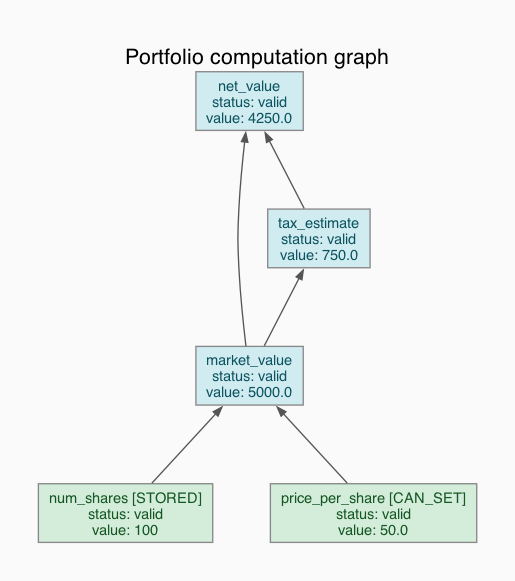
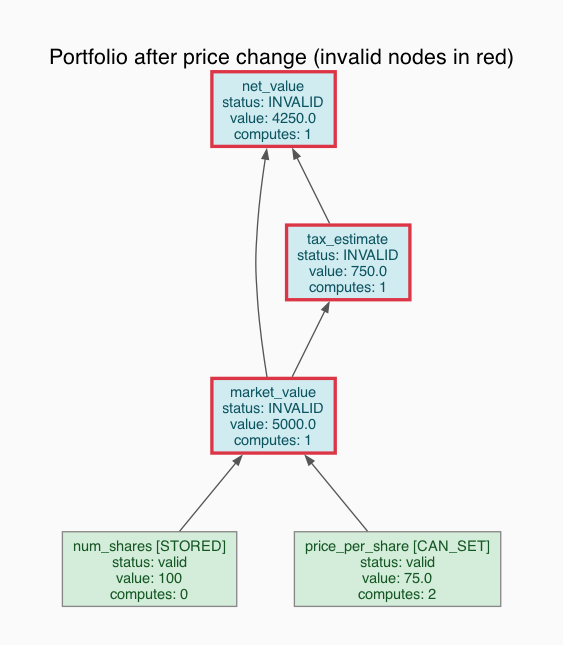
Jupyter notebooks get inline SVG rendering automatically via _repr_svg_.
Graph Introspection
from calyxos import GraphDebugger, is_overridden, get_node_flags

dbg = GraphDebugger(model)

# Dependency tree (text)
print(dbg.dump_dependency_tree("output"))

# All nodes involved in a computation
print(dbg.list_computing_nodes("output"))

# Node status (validity, flags, override state)
print(dbg.get_node_status("temperature"))

# Check override state
print(is_overridden(model, "temperature"))

# Get flags
print(get_node_flags(model, "temperature"))
Architecture
calyxos is organized into four layers:
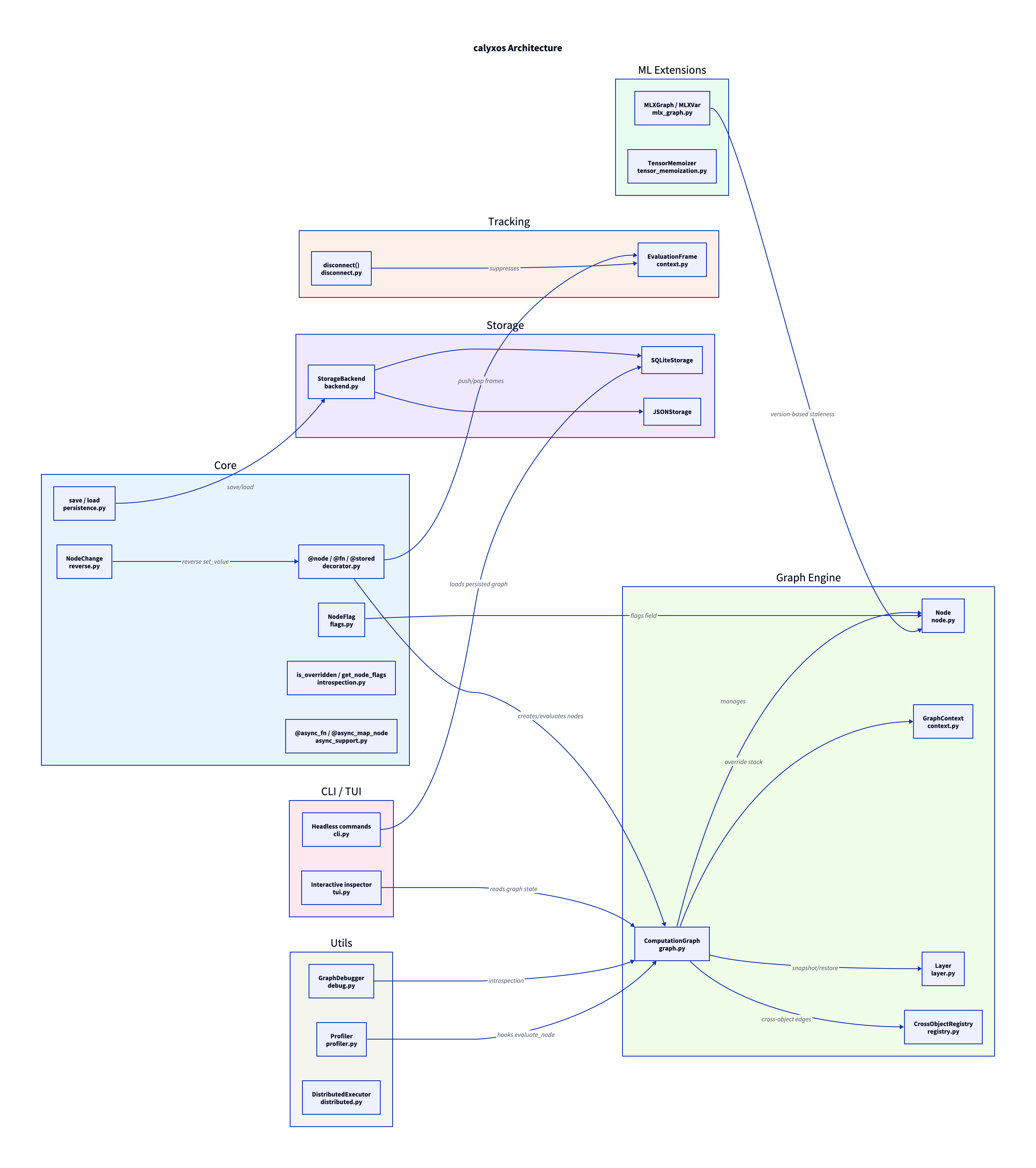
D2 sources live in docs/ — re-render with d2 docs/architecture.d2 docs/architecture.png.
src/calyxos/
├── core/                    # Decorators, flags, reverse propagation
│   ├── decorator.py         # @node, @fn, @stored, set_value, get_graph
│   ├── flags.py             # NodeFlag enum (CAN_SET, CAN_OVERRIDE, STORED)
│   ├── reverse.py           # NodeChange for bidirectional binding
│   ├── introspection.py     # is_overridden, get_node_flags, etc.
│   └── persistence.py       # save/load utilities
├── graph/                   # Computation graph engine
│   ├── graph.py             # ComputationGraph (evaluation, invalidation)
│   ├── node.py              # Node dataclass (value, flags, edges)
│   ├── context.py           # GraphContext for temporary overrides
│   ├── layer.py             # Layer for persistent computation snapshots
│   └── registry.py          # CrossObjectRegistry (weak-ref tracking)
├── tracking/                # Runtime dependency tracking
│   ├── context.py           # EvaluationFrame stack (contextvars)
│   └── disconnect.py        # disconnect() context manager
├── storage/                 # Pluggable persistence backends
│   ├── backend.py           # StorageBackend protocol
│   ├── sqlite.py            # SQLiteStorage
│   └── json_storage.py      # JSONStorage
├── ml/                      # ML extensions
│   ├── mlx_graph.py         # MLX execution backend (MLXGraph, MLXVar, MLXNode)
│   └── tensor_memoization.py # Tensor memoization utilities
└── utils/                   # Debugging, profiling, analysis
    ├── debug.py             # GraphDebugger
    ├── profiler.py          # Performance profiling
    ├── distributed.py       # Parallelization analysis
    └── gradient_tracking.py # Autodiff integration
Key Design Decisions
- Runtime tracking over static analysis: Dependencies are discovered by recording node accesses during execution, not by parsing AST. This handles conditional deps, loops, and polymorphism correctly.
- Lazy invalidation with early cutoff: Changing a value marks dependents dirty but doesn't recompute. On access, dirty nodes verify whether their inputs actually changed before running
compute_fn. If no input changed, the cached value is re-validated without recomputation, and the cutoff propagates upward. - Value-equality guard:
set_value()compares new values against cached values and short-circuits when they match, preventing invalidation cascades from no-op mutations. - Per-element fan-out with GC:
@map_nodecreates independent sub-nodes for each collection element. When elements are removed, their orphaned nodes are garbage collected automatically. - Error capture and retry: If
compute_fnraises, the exception is stored on the node. Subsequent accesses re-raise it cleanly.graph.retry_errors()clears error state for recomputation. - TTL-based expiry: Nodes can have a time-to-live. Expired values are treated as stale and recomputed on next access.
- Async-native:
@async_fnand@async_map_nodeuseasyncio.gatherto evaluate independent branches concurrently. - Instance-scoped graphs: Each object has its own computation graph. Cross-object edges use weak references.
- Zero dependencies: Core uses only Python stdlib (threading, contextvars, hashlib, dataclasses).
Examples
# Getting started with @node, flags, caching
python examples/reactive_basics.py

# Contexts for what-if scenario analysis
python examples/what_if_analysis.py

# Layers for sensitivity analysis (bump-and-recompute)
python examples/sensitivity_analysis.py

# Cross-object deps, reverse propagation, introspection
python examples/financial_instrument.py

# Graphviz visualization (requires: pip install graphviz)
python examples/graph_visualization.py

# MLX incremental benchmark (requires: pip install calyxos[mlx])
python benchmarks/mlx_incremental.py
Development
# Install dev dependencies
pip install -e ".[dev]"

# Run tests
python -m pytest tests/ -v

# Type checking
mypy src/calyxos/

# Linting
ruff check src/calyxos/
The test suite includes 145 tests covering:
- Core memoization and argument handling
- Dependency tracking (conditional, diamond, cross-object)
- Invalidation propagation (selective, lazy, cross-graph)
- Value-equality guard and early cutoff optimization
@map_nodeper-element caching, dependency tracking, and GC- Error handling (capture, re-raise, retry)
- TTL / cache eviction
- Automatic profiler instrumentation
- Parallel execution with
DistributedExecutor.execute() - Async evaluation (
@async_fn,@async_map_node) - Contexts (override, revert, nesting, exception safety)
- Layers (snapshot, restore, re-entry, independence)
- Reverse propagation (basic, chained, recursion limit)
- Storage with stable string keys (SQLite, JSON, cross-process roundtrip)
- Enhanced introspection (tree dumps, node status, flags)
Contributing
- Fork the repository
- Create a feature branch
- Add tests for new functionality
- Ensure
pytest,mypy, andruffpass - Submit a pull request
License
MIT License. See LICENSE for details.
Acknowledgments
calyxos is inspired by:
- Jane Street Incremental — incremental computation for OCaml
- Salsa — incremental computation for Rust
- MobX — reactive state management for JavaScript
- Computational spreadsheets — the original reactive dependency graphs
1 maintainer

Metadata
1 maintainer
Release files for calyxos 0.4.6
For a detailed explanation of source distributions (sdists) and built distributions (wheels), please see the package formats documentation.
Source distribution (sdist)
| File | Size | Uploaded | Provenance | Actions |
|---|---|---|---|---|
| calyxos-0.4.6.tar.gz | 3.5 MB | Without provenance | Details for calyxos-0.4.6.tar.gz |
Built distribution (wheel)
| File | Interpreter | ABI | Platform | Actions Reset |
|---|---|---|---|---|
| calyxos-0.4.6-py3-none-any.whl | Python 3 | none | any | Details for calyxos-0.4.6-py3-none-any.whl |
Total release size: 3.6 MB
Release files / calyxos-0.4.6.tar.gz
| Download URL | calyxos-0.4.6.tar.gz |
|---|---|
| Size | 3.5 MB |
| Tags | Source |
|
SHA-256 checksum How to use checksums |
4d11d0bd9ace127f7678f9f992f5a1d8006e8604a8366d002a806c0d8b4d2a48
|
|
BLAKE2b-256 checksum How to use checksums |
bf4d162d5d6439cbf8cb144103998a8ba7b974bc0ea8294ea92ebc07a39b0307
|
| Upload date | |
|
Uploaded using Trusted Publishing? What is trusted publishing? |
No |
| Uploaded via |
twine/6.2.0 CPython/3.12.12
|
Release files / calyxos-0.4.6-py3-none-any.whl
| Download URL | calyxos-0.4.6-py3-none-any.whl |
|---|---|
| Size | 71.2 kB |
| Tags | Python 3 |
|
SHA-256 checksum How to use checksums |
a09cdf3e091a600a1d178a87c2a011721afd881c4a034f41ec3e46bc0827636c
|
|
BLAKE2b-256 checksum How to use checksums |
2c17fe1e7239cded8f41c0ad0ba9320824ab01dfd6963ad6bcbfcd997bf62e9f
|
| Upload date | |
|
Uploaded using Trusted Publishing? What is trusted publishing? |
No |
| Uploaded via |
twine/6.2.0 CPython/3.12.12
|
Security for calyxos 0.4.6
Provenance
Provenance describes where a file came from. On PyPI, provenance is shared via attestations, which provide a verifiable record of the build or publishing details. View details, limitations and caveats.
No provenance found
None of the files in this release were uploaded with provenance metadata.
A note on package security
PyPI is a repository for distributing packages, not a service for auditing them. While third-party security researchers and our staff do their best to detect and remove malicious packages, PyPI cannot guarantee the quality, security or suitability of any given package.
To learn more about protecting yourself from malicious actors, visit our package security documentation.














