
CANarchy
A stream-first CAN bus toolkit for analysts, security researchers, and AI agents.
Every command emits typed, machine-readable events you can pipe, script, or hand to an agent — with J1939 heavy-vehicle support as a first-class citizen.




What is CANarchy?
CANarchy is a CLI-first runtime for capturing, decoding, and manipulating CAN and CAN-FD traffic. Most CAN tools force a tradeoff: interactive but hard to automate, scriptable but too raw, or protocol-aware but inconsistent across interfaces. CANarchy is built around the opposite constraint — every output is a stream of typed events (--json, --jsonl, --text) you can parse, pipe, or forward to an LLM agent over MCP.
It's for you if you're:
- A security researcher reversing an unknown bus, fuzzing ECUs, or diffing captures for anomalies.
- A heavy-vehicle / J1939 engineer who wants PGN/SPN decoding, TP reassembly, and DM1 fault parsing without dropping to raw IDs.
- Building automation or AI agents that need a stable, machine-readable CAN interface instead of scraping human-formatted text.
Install
pipx install canarchy          # isolated, on PATH everywhere
# or:  pip install --user canarchy
Requires Python 3.12+. Live transport uses python-can (socketcan, virtual bus, UDP multicast, and more).
Try it in 60 seconds — no hardware required
canarchy --version
canarchy doctor --text          # 8 offline health checks; all green = good install

# Stream typed events from the deterministic scaffold backend —
# no hardware, no fixtures, no network. This is the JSONL contract:
CANARCHY_TRANSPORT_BACKEND=scaffold canarchy capture can0 --jsonl
Point it at a real interface once you have one:
canarchy capture can0 --candump                 # human-friendly live view
canarchy capture can0 --jsonl | jq .            # typed events, one per line
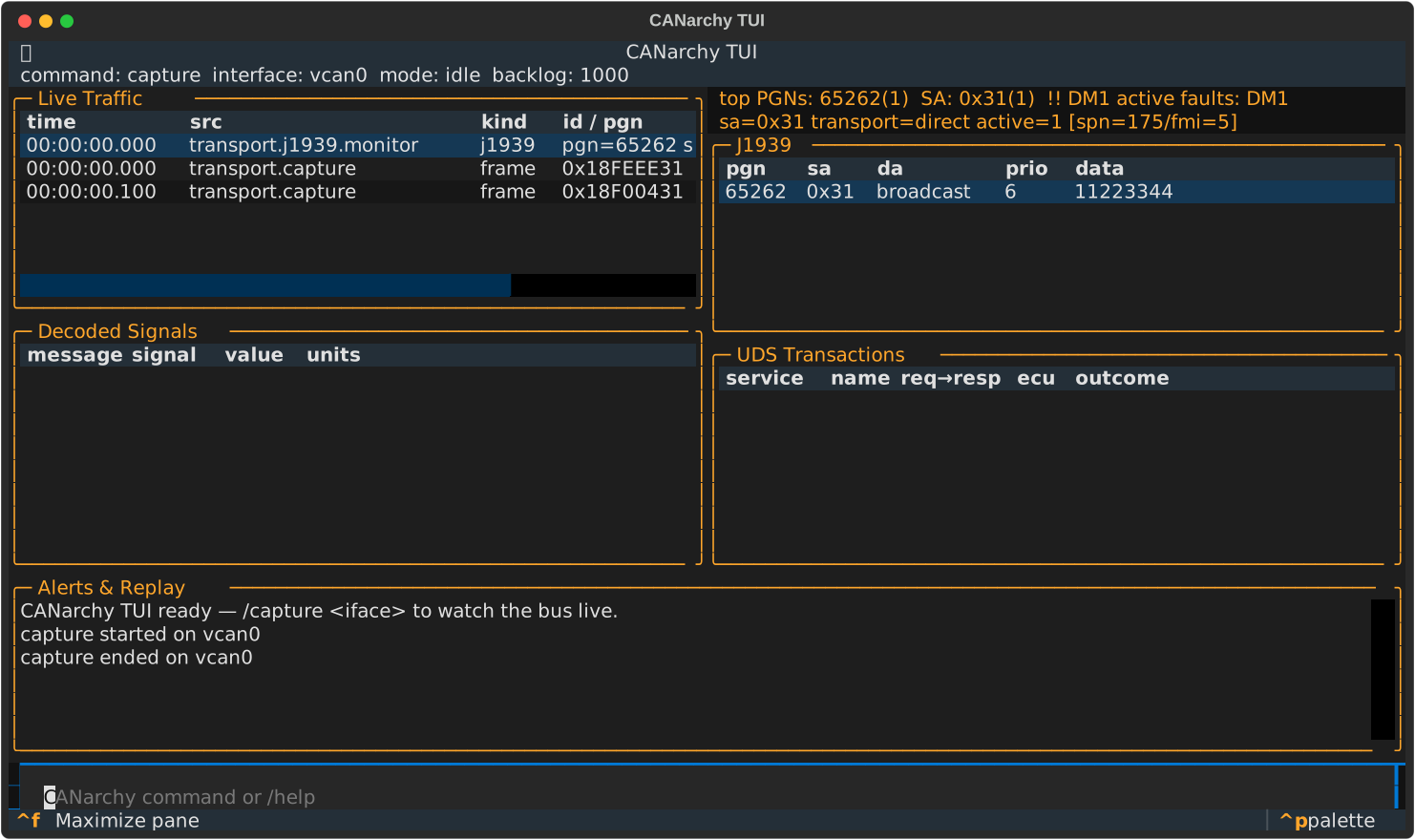
Prefer to explore visually? Launch the full-screen TUI (pictured above) and watch the bus live:
canarchy tui # /capture <iface> to stream; /filter, /sort, /help
Why CANarchy?
The event schema is the stable contract; the CLI wraps it. That one design choice is what sets CANarchy apart from most open-source CAN tooling:
- Structured output is the contract, not an afterthought. Every command — capture, decode, fuzz, reverse-engineer — emits the same canonical JSON envelope. Parse once, reuse everywhere.
- Pipe-first.
--jsonlstreams one typed event per line, so| jq,| grep, or a downstream script Just Works. - J1939 is first-class. PGN decoding, SPN extraction, TP session reassembly, and DM1 fault parsing resolve names from a bundled SAE catalog — not just raw arbitration IDs.
- Agent-ready. A built-in MCP server exposes the toolkit to Claude and other MCP clients, so an agent can drive CAN analysis directly.
| CANarchy | Typical CAN CLI tools | |
|---|---|---|
| Structured output as a core contract | ✅ | ✗ / partial |
| Pipe-friendly typed event stream | ✅ | partial |
| Provider-backed DBC discovery & cache | ✅ | ✗ |
| J1939-first operator workflows | ✅ | partial |
| MCP / agent integration | ✅ | ✗ |
See the full CAN tool feature matrix for an honest, side-by-side comparison with can-utils, SavvyCAN, Caring Caribou, TruckDevil, and others.
What can you do with it?
# Decode a capture against a DBC
canarchy decode --file trace.candump --dbc vehicle.dbc --jsonl

# J1939 heavy-vehicle analysis
canarchy j1939 decode --file trace.candump --text
canarchy j1939 spn 110 --file trace.candump --text     # Engine Coolant Temp
canarchy j1939 dm1  --file trace.candump --text          # active fault codes

# Reverse-engineer an unknown bus: rank likely signals, counters, anomalies
canarchy re signals   --file trace.candump --jsonl
canarchy re anomalies --file trace.candump --baseline known_good.candump --jsonl

# Diff two captures per arbitration ID (rate/timing/entropy deltas)
canarchy compare before.candump after.candump --json

# Active workflows (gated by the active-transmit safety model; --dry-run plans safely)
canarchy generate can0 --count 10 --gap 50 --id 7DF --jsonl
canarchy replay --file trace.candump --rate 2.0 --json

# Pipe events straight into downstream tooling
canarchy j1939 spn 110 --file trace.candump --jsonl \
  | jq '[.payload.value, .payload.units, .payload.timestamp]'
Drive it from an AI agent (MCP)
CANarchy ships a Model Context Protocol server, so an LLM agent can capture, decode, and analyze CAN traffic through the same structured contract the CLI uses.
canarchy mcp install --client claude-desktop   # or: --client claude-code
canarchy mcp serve                             # or run the stdio server directly
Active-transmit tools require an explicit acknowledgement, so an agent can't put frames on a live bus by accident. See the active-transmit safety design.
The full-screen TUI
canarchy tui opens an interactive, full-screen dashboard that streams the bus live:
- Responsive workspaces:
Alt+1–Alt+5switch Traffic, Signals (one row per decoded observation), J1939, UDS, and Findings. Traffic opens as a per-bus, standard/extended-ID summary with counts, rate, changed-byte offsets, and activity;vswitches to the chronological event log. The active table uses the available height; wide terminals show a selected-row inspector, whileEnteropens complete raw hex/bit details on narrow terminals (Escreturns). - Background capture:
/capture <iface>starts streaming;/stop(orx) ends it. - Interactive:
/filter traffic 'id==0x123'(alsopgn==andsa==),/sort traffic <column>, arrow-key row navigation,F4to freeze inspection or return live,F3to expand activity,spaceto pause the feed,[/]to resize the backlog,ctrl+fto maximize a table. Other panes keep/filter <pane> <text>and/sort <pane> <column>. - Type any real CANarchy command at the prompt — event output folds into the panes, while stats, DBC inspection, diagnostics, reference lookups, errors, and help appear in a scrollable result view. Press
F2to switch views orEscto return to the panes.
Full command catalog (click to expand)
Fully implemented and tested:
Transport
capture,send,filter,stats— transport workflows with livepython-canand deterministic scaffold backends;statsreports per-ID frequency/timing, DLC distribution, and a bus-load estimatecompare— diff two or more plain CAN captures per arbitration ID and identifier type (standard/extended): frame-count/rate deltas, cycle-time drift, payload-entropy deltas against a baseline, each identifier flagged (rate-drop, rate-spike, entropy-collapse, timing-drift, new/dropped)capture-info— fast capture metadata without loading every framegenerate— cangen-style frame generation (fixed, random, incrementing)simulate— deterministic, profile-driven mix of classic CAN, J1939, and DM1 traffic (no hardware)gateway— bridge frames between two interfaces (uni- and bidirectional)replay,sequence replay— deterministic replay planning from candump files, and YAML/JSON multi-message coordinated transmit
Databases (DBC / ARXML / KCD / SYM via cantools)
decode,encode— database-backed signal decode/encode;encoderesolves SAE PGN/SPN display names for round-tripsdbc inspect(incl.--layout,--search),dbc signals— database and signal inspectiondbc convert— convert databases between DBC / KCD / SYMdbc generate-c— C source/header/fuzzer generation from a databasedbc provider list,dbc search,dbc fetch,dbc cache list|prune|refresh— provider-backed DBC discovery and cache workflows
J1939
j1939 monitor,decode,pgn,spn,tp,dm1,faults,summary,inventory,compare,map— operator workflows across live, file-backed, and decoded views; faults resolve SPN names and FMI descriptions from the bundled SAE catalog
UDS
uds scan,trace,services,subservices,ecu-reset,tester-present,security-seed,dump-dids,read-memory,auto— diagnostic discovery and active workflows
Reverse engineering
re signals,re counters,re entropy— file-backed candidate ranking, annotated with J1939 PGN/source-address context, transport-protocol awarere correlate— correlate candidate fields against timestamped reference seriesre anomalies— inter-frame-timing and unexpected/dropped-ID anomaly detection; against a baseline it also flags per-ID rate drop/spike (suppression/injection) and payload-entropy collapse (plateau/frozen-value attacks)re corpus— cross-capture coverage, cycle-time drift, and signal-stability analysisre match-dbc,re shortlist-dbc— provider-backed DBC candidate ranking against captures
Datasets
datasets provider list,search,inspect,fetch,download,cache list|refresh— public CAN dataset provider workflowsdatasets convert,stream,replay— dataset conversion and bounded streaming/replay
Diagnostics over other transports
doip discovery,services,ecu-reset,tester-present,security-seed,dump-dids— DoIP UDP discovery and active diagnostic workflowsxcp scan,info,dump— XCP slave discovery, capability interrogation, and bounded memory dump
Visualization, front ends, and extensions
plot— signal time-series plots to PNG/SVG/HTML (pip install canarchy[plot])web serve— read-only browser dashboard over the JSONL envelope (HTTP + WebSocket)shell— interactive REPL and--commandscripting modetui— full-screen terminal dashboard with background live captureplugins list|info|enable|disable— Python entry-point plugin discovery and togglesskills provider list,search,fetch,cache list|refresh— repository-backed CANarchy skill discovery, caching, and provenance
Active-transmit fuzzing (gated by the active-transmit safety design; --dry-run is the safe planning path)
fuzz payload,fuzz replay,fuzz arbitration-id,fuzz identify— payload/replay/ID-walk fuzzing and bisecting a fuzz log to the culprit framefuzz signal,fuzz spn— DBC-signal and J1939-SPN-aware mutation with sentinel coveragefuzz guided— response-feedback coverage-guided fuzzing with a persisted seed corpus and independent, incremental payload/response evidence archives
Session, export, and utilities
session save,load,show,verify,annotate,attach,bundle,import— research records with input provenanceexport— structured artifact exportdoctor— local environment health checks (Python,python-can, vendor backends, caches, MCP, config)mcp serve,mcp install— Model Context Protocol server and client-config helpercompletion {bash,zsh,fish}— emit a shell completion script--log-level,--quiet— global stderr logging controls (place before the subcommand)
Default transport backend is python-can; set CANARCHY_TRANSPORT_BACKEND=scaffold for deterministic offline behavior.
The structured contract
Every successful command returns a stable envelope:
{ "ok": true, "command": "capture", "data": {}, "warnings": [], "errors": [] }
Failures return structured errors with actionable hints (and a documented error-code catalog):
{
  "ok": false,
  "command": "decode",
  "data": {},
  "warnings": [],
  "errors": [
    { "code": "DBC_LOAD_FAILED", "message": "Failed to parse DBC file.", "hint": "Validate the DBC syntax and line endings." }
  ]
}
Use --candump for a human-oriented live view; use --jsonl when feeding scripts or agents — every line is a typed event from the canonical schema. Set CANARCHY_PYTHON_CAN_INTERFACE to choose an interface type, or CANARCHY_TRANSPORT_BACKEND=scaffold for deterministic offline behavior.
Documentation
- Getting Started · Cookbook — task-oriented recipes
- Event Schema — the canonical envelope for all structured output
- Command spec · Architecture
- CAN Tool Feature Matrix — comparison to other OSS CAN tools
- J1939 Heavy Vehicle Demo · Troubleshooting
- Full docs site: hexsecs.github.io/canarchy
Install from source (development)
CANarchy uses uv for environment, dependency, and packaging workflows.
git clone https://github.com/hexsecs/canarchy && cd canarchy
uv sync                          # create the venv and install from the checkout
uv run canarchy --help
uv tool install --editable .     # optional: put `canarchy` on your PATH; edits take effect live
Run the test suite end to end:
uv run python -m unittest discover -s tests -v
Shell completions for bash, zsh, and fish come from canarchy completion <shell> — see Getting Started.
Community & contributing
CANarchy is GPL-3.0-licensed and welcomes contributions.
- ⭐ Star the repo if it's useful — it genuinely helps others find it.
- Contributing guide — local development, branch flow, and PR gates
- Code of Conduct
- Security Policy — reporting concerns and safe active-bus operation
⚠️ CANarchy can transmit on live buses. Only operate against vehicles, ECUs, and networks you own or are explicitly authorized to test. Active-transmit commands require explicit acknowledgement by design.
Philosophy
- The CLI is the contract.
- Protocol semantics over raw frames.
- Structured output over formatted text.
- Reproducible workflows over ad-hoc interaction.
Versioning follows SemVer; see the changelog and release workflow. src/canarchy/__init__.py is the authoritative version source.
1 maintainer

Metadata
1 maintainer
Release files for canarchy 0.10.0
For a detailed explanation of source distributions (sdists) and built distributions (wheels), please see the package formats documentation.
Source distribution (sdist)
| File | Size | Uploaded | |
|---|---|---|---|
| canarchy-0.10.0.tar.gz | 1.4 MB | Details |
Built distribution (wheel)
| File | Interpreter | ABI | Platform | Reset |
|---|---|---|---|---|
| canarchy-0.10.0-py3-none-any.whl | Python 3 | none | any | Details |
Total release size: 2.0 MB
Release files / canarchy-0.10.0.tar.gz
| Download URL | canarchy-0.10.0.tar.gz |
|---|---|
| Size | 1.4 MB |
| Tags | Source |
|
SHA-256 checksum How to use checksums |
77689b7b3dab578bad5b3b1d4f035967dba6ba25c20066095bbb94d80a1c9928
|
|
BLAKE2b-256 checksum How to use checksums |
616901c40a36a4dca389c3e2fa4518aaa57cf231b6a57cedf8836412a998ebe1
|
| Upload date | |
|
Uploaded using Trusted Publishing? What is trusted publishing? |
Yes |
| Uploaded via |
twine/7.0.0 CPython/3.13.14
|
Provenance
Provenance describes where a file came from. On PyPI, provenance is shared via attestations, which provide a verifiable record of the build or publishing details. View details, limitations and caveats.


PyPI Publish Attestation
PyPI verified that this artifact, at this checksum, originated from the publisher listed below.
Signed by GitHub Actions, verified by PyPI on Oct 1, 2026.
Transparency logRelease files / canarchy-0.10.0-py3-none-any.whl
| Download URL | canarchy-0.10.0-py3-none-any.whl |
|---|---|
| Size | 551.4 kB |
| Tags | Python 3 |
|
SHA-256 checksum How to use checksums |
9fd766d6f5b565ec2de39e5bdb6944e07daf9695a3837c386e504e92c55be8bd
|
|
BLAKE2b-256 checksum How to use checksums |
d6be61cde3c9c2ecb58789de5bd0ea622c9d7c96db4916c908d82f6f84f316a1
|
| Upload date | |
|
Uploaded using Trusted Publishing? What is trusted publishing? |
Yes |
| Uploaded via |
twine/7.0.0 CPython/3.13.14
|
Provenance
Provenance describes where a file came from. On PyPI, provenance is shared via attestations, which provide a verifiable record of the build or publishing details. View details, limitations and caveats.
PyPI Publish Attestation
PyPI verified that this artifact, at this checksum, originated from the publisher listed below.
Signed by GitHub Actions, verified by PyPI on Oct 1, 2026.
Transparency log













