
candlebench


Do classic candlestick patterns have a real intraday edge? candlebench tests 66 patterns by turning every signal into a mechanical trade. It charges each trade the spread quoted at that time of day, and compares the result with random entries taken on the same days. A pattern counts only if it beats that control, makes money after costs, and holds up on dates it was not chosen on.
The same test runs on any signal you write: see Testing your own signal.
Live: interactive two-year results · interactive synthetic demo · results site
The answer
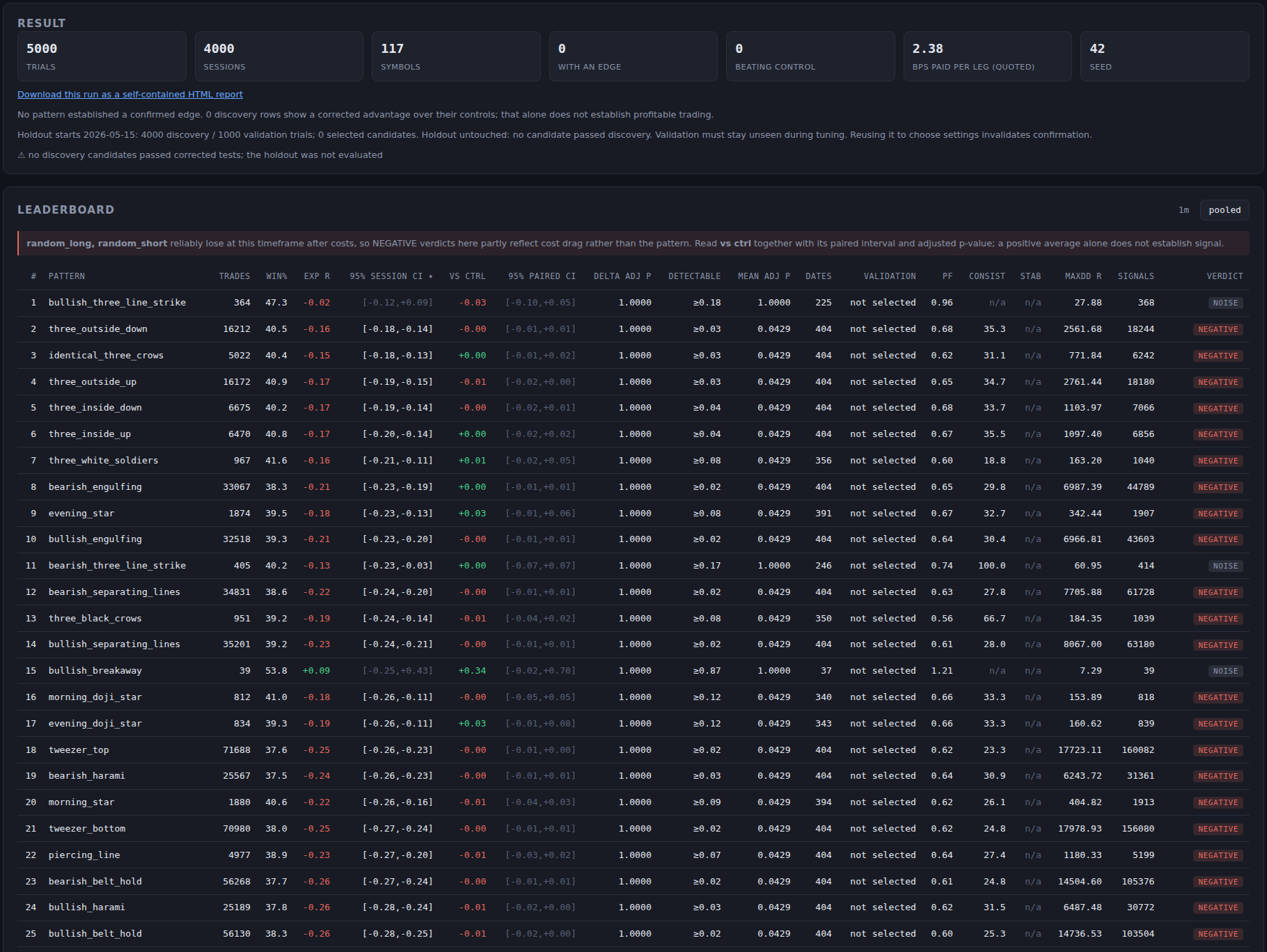
The run covers two years of 1-minute bars (October 2024 to October 2026) for 117 liquid US stocks and ETFs: 5,000 sampled symbol-days on 501 market dates and 1,021,358 pattern trades, charged an average quoted spread of 2.39 bps per leg. Four earlier runs came first (20 patterns on 50 symbols twice, 66 on 100, and 66 on 117 before the data was brought to one common date range), so the multiple-comparison correction counts five experiments.
- No pattern earns
EDGE. None of the 66 has positive expectancy after costs, and 59 have 95% intervals entirely below zero. - No pattern beats random entry, even before costs. Compared in gross R with its own stop-matched random entries, no row survives multiple-comparison correction.
- Random entry itself loses about 0.34R per trade at 1m, almost all of it spread. Before costs, the two controls sit at +0.015R and +0.009R.
- "No edge" has a size. Each row reports the smallest advantage its test would catch 80% of the time. For the 19 patterns with over 20,000 trades that is 0.018R to 0.034R, so an advantage over random entry larger than that would very likely have been found. Rare patterns report 0.085R or more; the rarest, the abandoned babies, trade too seldom to measure.
- The same holds at 5, 15 and 60 minutes. A second run over the same two years and 117 symbols sampled 5,000 symbol-days per timeframe (227,879 pattern trades, 2.21 bps per leg). No pattern beats its matched controls at any of the three. Random entry loses 0.15R to 0.25R net there, less than at 1m because the spread is a smaller share of a wider stop. At 5m the tweezers would reveal an advantage of 0.05R; at 1h, trades are too few to rule out less than about 0.2R. Interactive · report.
An earlier version of this project reported that eight patterns beat random entry on signal alone and lost only to costs. That came from a measurement bias the project later found in its own method; the next section explains it.
How it is checked
The method has to find nothing where nothing exists. candlebench.synthetic
generates a random walk that no pattern can predict, and
a calibration run counts how often each
test passes on it anyway.
It exposed two real flaws, and both are fixed:
- Net R rewards wide stops. Costs are a fixed number of bps, and R divides by the distance to the stop, so a pattern with a wider stop pays fewer R for the same spread. Compared with random entry in net R, wide-stop patterns "won" with no signal at all: 38 of 800 rows across ten seeds, at least one in every run.
- A control with a different stop is not a fair control. Even before costs, a tighter stop is caught more often by the rule that a bar touching both levels is a stop. Each pattern trade is now compared with its own matched control. The control has the same direction and stop distance and the same exit code, and enters on a random bar one to five bars later. Entering earlier turned out to be a trap: those bars were selected by the pattern itself, and a control placed five bars before a tweezer top lost 0.56R on pure noise.
With both fixes, 1 row in 800 passes on the random walk, in 1 run of 10, which is what a 5% familywise error rate predicts. Profitability is still tested net of costs.
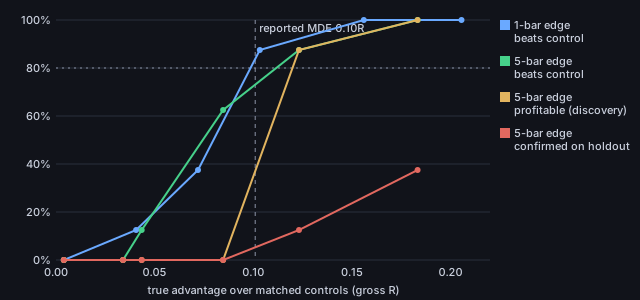
Finding nothing in noise is half the check; a method that never finds anything passes it too. The power study plants edges of known size in independent synthetic markets and runs the real-data design over them. With all 66 patterns, an advantage of 0.144R was caught every time and 0.097R half the time, bracketing the 0.11R limit each row reports. It also shows that making money needs a gross edge above about 0.3R, and that a single 20% holdout confirms only large edges; walk-forward confirmation pools every fold's out-of-sample trades and confirms far more.
Other safeguards:
| Concern | What the code does |
|---|---|
| Lucky draws | Every pattern trade is paired with a random-entry control in the same session, with the same direction and stop distance. Matched-rate random-entry rows show what random entry loses at each timeframe. |
| Correlated trades | Bootstrap intervals resample whole market dates, not individual trades. |
| Many comparisons | Holm correction across every row and timeframe, plus a declared-experiment multiplier. A run warns when bootstrap resolution makes passing impossible. |
| Overfitting | The newest 20% of dates are held out. Only discovery candidates are tested on them, and EDGE needs both samples. |
| Flattering fills | Entry is on the next bar. A bar touching both stop and target counts as a stop unless it opened past the target. Gaps fill at the open. |
| Optimistic costs | The quoted model samples NBBO spreads per symbol and time of day, because the open runs about 4x midday. Borrowed buckets and estimates are reported separately from observed ones. |
| Tiny samples | A verdict needs at least 30 trades and 10 independent dates; a 3-trade "+0.95R" stays INSUFFICIENT. |
Quick start
The demo needs no API key or download:
python -m venv .venv && source .venv/bin/activate
pip install candlebench   # or, from a clone: pip install -e .
candlebench demo          # synthetic market -> full run -> dashboard on :8765
Linux wheels for Python 3.11 to 3.13 include the compiled C++ trade walk. Elsewhere pip builds it if a C++ compiler is present and otherwise installs the Python walk, which gives the same trades more slowly.
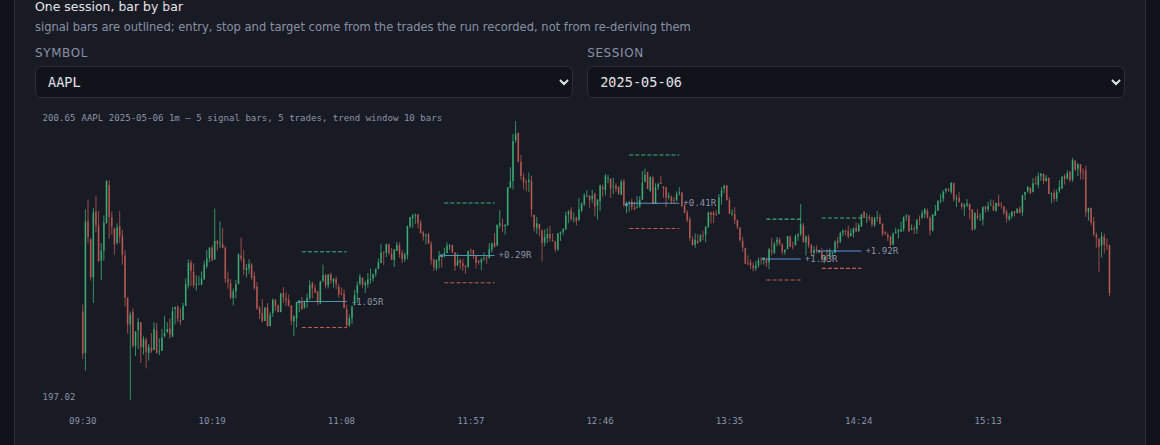
The demo generates eight symbols of synthetic 1m bars and runs every pattern at three timeframes in a few seconds. It then opens the dashboard on that run. Every leaderboard row drills down to its equity curve, its per-symbol and time-of-day breakdowns, and each session's chart with the trades drawn on it.
Sharing a result
candlebench report out.json           # out.html: one self-contained file, no scripts
candlebench site out.json --out app/  # the interactive dashboard as static files
docker build -t candlebench-demo .    # or served live and read-only
docker run --rm -p 8765:8765 candlebench-demo
fly deploy                            # the same container on Fly.io (fly.toml)
candlebench site exports the full dashboard for one run as plain files, so
any static host serves it with no server. A browser test sends every query to
the live server and to the exported copy and requires identical answers.
A report holds the summary, a leaderboard per timeframe, and a drill-down for
every pattern. Trades appear only as R multiples and dates, never as prices, so
a report built from licensed market data can be published. The dashboard can
download any saved run as a report. serve --read-only shows saved runs but
refuses to start work, and only a read-only server will listen beyond loopback.
The results site is rebuilt
by CI on every push.
With real market data
Two years of intraday history come from Alpaca's free market-data API. Yahoo Finance needs no key but serves only about a month. Keys are read from the environment only, never from a config file or the browser.
export ALPACA_API_KEY=... ALPACA_SECRET_KEY=...
# in config/backtest.toml: source = "alpaca", and model = "quoted" for real spreads
candlebench fetch                     # download and cache bars
candlebench quotes --sessions 4       # sample NBBO spreads into a table
candlebench run -v --json out.json    # terminal leaderboard; trades go to out.parquet
candlebench serve                     # dashboard
A 200-trial run over two years of 1m bars takes about 20 seconds and peaks under
1 GiB of memory; the published 5,000-trial run over 117 symbols and 66 patterns
took 7 to 25 minutes on one shared core and peaked at 4.0 GiB. Its trade file is 40 MB, so
the published trade files sit on the
data release
rather than in git; docs/results/ keeps the JSON summaries.
Testing your own signal
Most backtests compare a strategy with doing nothing, which a strategy can beat
by accident: the market drifted, the stops were wide, the costs were left out.
candlebench test holds any signal to the comparison the patterns faced. Each
trade is paired with a random entry on the same session, in the same direction
and at the same stop distance, so the signal is credited only for choosing
when to enter. It is charged the same costs, corrected for multiple testing,
and confirmed on held-out dates.
A signal is a Python file that registers a detector, as the built-in patterns do. This one is examples/breakout_20.py:
from candlebench.patterns import pattern
from candlebench.patterns.context import lag, rolling_max

@pattern("breakout_20", bias="bull", bars_required=21)
def breakout_20(geom, thresholds):
    # True on a bar that closes above the highest high of the 20 before it.
    return geom.close > lag(rolling_max(geom.high, 20))
geom holds one session's bars as numpy arrays, and the detector returns one
boolean per bar. The trade enters at the next bar's open, with its stop just
beyond the extreme of the last bars_required bars. bias="bear" sells instead.
The example ships with the repository, not the package: clone it, or save the
code above as breakout_20.py.
candlebench test examples/breakout_20.py --synthetic   # offline random walk: no edge can exist
candlebench test examples/breakout_20.py -v            # on the cached market bars
The leaderboard is followed by one verdict per signal and timeframe in plain words, and a null result says how large an edge it rules out. From the synthetic run above:
breakout_20 at 1m: NEGATIVE: averages -0.09R a trade after costs over 763 trades on 61
dates (corrected p 0.001), and +0.00R a trade against its matched random entries.
breakout_20 at 5m: NOISE: no confirmed edge over 117 trades on 54 dates: -0.01R a trade
against its matched random entries, -0.10R after costs. An advantage of 0.11R or more
over random entry would have been caught 80% of the time.
The 1m line is the comparison doing its job: the breakout loses money, but no more than random entry does, so what it loses is the cost of trading, not a signal that points the wrong way.
Several files can be tested at once, and --json, --csv and --html work as
for run. The dashboard (serve, site) shows the built-in patterns only.
Engineering
- About 1,400 tests, including 32 headless-Chromium tests. CI runs them on Python 3.11 and 3.12, along with Pylint and a clean-environment wheel install.
- Every run says what produced it. Reports carry the git commit, package versions, a hash of the effective config, and a content hash of every cached file the run read, so two runs that disagree can be told apart.
- Browser input is untrusted. Every field is type-, range- and path-checked before it reaches a file path or a DataFrame. Malformed requests get a 400 or 404 with a reason, never a traceback.
- Nothing half-written is ever published. Bar caches, trade files and run reports are written to a temporary file and renamed. A run becomes the latest only after its report, trades and archive copy are all saved. An incomplete refresh keeps the cached history rather than shortening it.
- Unavailable is never zero. A missing statistic is
Noneand is shown asn/a. A cost that was estimated is never labelled observed. - A C++ trade walk, checked against the Python one. The signal-to-exit loop cannot be vectorised, since whether a signal trades depends on where the last trade exited, so it runs in C++ through pybind11 when a compiler is present. A parity test holds every trade equal to the Python walk's to the last bit; without a compiler the package installs and runs the Python walk.
- Standard-library web server, no frontend build. The dashboard is one dependency-free page with hand-drawn SVG charts. CI also builds the demo container and checks that it serves read-only.
candlebench/
  bars.py  alpaca.py  ticks.py  synthetic.py   data sources, validation, Parquet cache
  quotes.py  costs.py                          observed spreads and the fallback estimator
  patterns/                                    20 detectors and the random controls
  sampling.py  engine.py  runner.py            paired trials -> trades -> results
  _enginecore.cpp                              optional C++ trade walk behind engine.py
  metrics.py  leaderboard.py                   clustered bootstrap, Holm, detection limits, verdicts
  report.py  site.py                           shareable HTML report, static interactive export
  web/                                         loopback server, dashboard, run history
scripts/null_calibration.py                    false-positive check on a random walk
scripts/detection_power.py                     power curve from planted edges
Documentation
- Write-up: the result, the bias the project found in its own first answer, and testing your own signal, in one short read.
- Guide: commands, the trade and cost models, reading the leaderboard, configuration, data sources and historical measurements.
- Experiment reports: null calibration, detection power, matched-control entry window, robustness to clustered volatility and rare patterns, walk-forward confirmation, trade-management sweep and stop-buffer sweep.
- Data and cost measurements.
stock.py: a separate companion script that scores one ticker for long-term, swing and day trading from current fundamentals and technicals. It shares no code with candlebench.
Limits
This measures 66 textbook patterns under one mechanical trade rule: a stop at the pattern's extreme, a fixed reward multiple and a holding cap. It does not show that no candlestick-based strategy could work. The universe is 117 liquid stocks and ETFs that exist today, so it carries survivorship bias. Quotes are sampled, not complete, and the tested history covers two years. Read the guide's caveats before relying on any number here.
MIT licensed.
1 maintainer

Metadata
1 maintainer
Release files for candlebench 0.9.1
For a detailed explanation of source distributions (sdists) and built distributions (wheels), please see the package formats documentation.
Source distribution (sdist)
| File | Size | Uploaded | Provenance | |
|---|---|---|---|---|
| candlebench-0.9.1.tar.gz | 234.5 kB | With provenance | Details |
Built distributions (wheels)
Total release size: 5.0 MB
Release files / candlebench-0.9.1.tar.gz
| Download URL | candlebench-0.9.1.tar.gz |
|---|---|
| Size | 234.5 kB |
| Tags | Source |
|
SHA-256 checksum How to use checksums |
5046f2b3a125b5b15432b6c595a1e015f28b074120a942c288e7cd1688f02de3
|
|
BLAKE2b-256 checksum How to use checksums |
7fa5c7925fc04fe9f11d97efa94cc283a22cef27d840c22ef8842e436a4ca8d7
|
| Upload date | |
|
Uploaded using Trusted Publishing? What is trusted publishing? |
Yes |
| Uploaded via |
twine/7.0.0 CPython/3.13.14
|
Provenance
Provenance describes where a file came from. On PyPI, provenance is shared via attestations, which provide a verifiable record of the build or publishing details. View details, limitations and caveats.


PyPI Publish Attestation
PyPI verified that this artifact, at this checksum, originated from the publisher listed below.
Signed by GitHub Actions, verified by PyPI on Oct 18, 2026.
Transparency logRelease files / candlebench-0.9.1-cp314-cp314-win_amd64.whl
| Download URL | candlebench-0.9.1-cp314-cp314-win_amd64.whl |
|---|---|
| Size | 446.7 kB |
| Tags | CPython 3.14 Windows x86-64 |
|
SHA-256 checksum How to use checksums |
1402e8fceda8f8a531e318cba8afe7dd037f87ef0fd8884083199d6a477dac27
|
|
BLAKE2b-256 checksum How to use checksums |
058a8436dbe2565a4e83461176ca19bfbe45004d9d6f8b9dde7b1cacdbe649ac
|
| Upload date | |
|
Uploaded using Trusted Publishing? What is trusted publishing? |
Yes |
| Uploaded via |
twine/7.0.0 CPython/3.13.14
|
Provenance
Provenance describes where a file came from. On PyPI, provenance is shared via attestations, which provide a verifiable record of the build or publishing details. View details, limitations and caveats.
PyPI Publish Attestation
PyPI verified that this artifact, at this checksum, originated from the publisher listed below.
Signed by GitHub Actions, verified by PyPI on Oct 18, 2026.
Transparency logRelease files / candlebench-0.9.1-cp314-cp314-manylinux_2_24_x86_64.manylinux_2_28_x86_64.whl
| Download URL | candlebench-0.9.1-cp314-cp314-manylinux_2_24_x86_64.manylinux_2_28_x86_64.whl |
|---|---|
| Size | 261.9 kB |
| Tags | CPython 3.14 Linux glibc 2.24+ x86-64 Linux glibc 2.28+ x86-64 |
|
SHA-256 checksum How to use checksums |
cb5e03c15b907381685e074aa962a023d191c6ab3530365a7bfaf7848f947b85
|
|
BLAKE2b-256 checksum How to use checksums |
780a20fccaef8f3a9263b9d70049c94905912f139fd296e09c8c5d85a5da3aac
|
| Upload date | |
|
Uploaded using Trusted Publishing? What is trusted publishing? |
Yes |
| Uploaded via |
twine/7.0.0 CPython/3.13.14
|
Provenance
Provenance describes where a file came from. On PyPI, provenance is shared via attestations, which provide a verifiable record of the build or publishing details. View details, limitations and caveats.
PyPI Publish Attestation
PyPI verified that this artifact, at this checksum, originated from the publisher listed below.
Signed by GitHub Actions, verified by PyPI on Oct 18, 2026.
Transparency logRelease files / candlebench-0.9.1-cp314-cp314-macosx_12_0_x86_64.whl
| Download URL | candlebench-0.9.1-cp314-cp314-macosx_12_0_x86_64.whl |
|---|---|
| Size | 246.5 kB |
| Tags | CPython 3.14 macOS 12.0+ x86-64 |
|
SHA-256 checksum How to use checksums |
eb717e3a546342951ca3b004dab5632f1261e742b827ad0e55d030da80d70ad3
|
|
BLAKE2b-256 checksum How to use checksums |
073dc9689dbba9cba922580c2a667def75c884408523f128b96cfda92554c896
|
| Upload date | |
|
Uploaded using Trusted Publishing? What is trusted publishing? |
Yes |
| Uploaded via |
twine/7.0.0 CPython/3.13.14
|
Provenance
Provenance describes where a file came from. On PyPI, provenance is shared via attestations, which provide a verifiable record of the build or publishing details. View details, limitations and caveats.
PyPI Publish Attestation
PyPI verified that this artifact, at this checksum, originated from the publisher listed below.
Signed by GitHub Actions, verified by PyPI on Oct 18, 2026.
Transparency logRelease files / candlebench-0.9.1-cp314-cp314-macosx_12_0_arm64.whl
| Download URL | candlebench-0.9.1-cp314-cp314-macosx_12_0_arm64.whl |
|---|---|
| Size | 244.0 kB |
| Tags | CPython 3.14 macOS 12.0+ ARM64 |
|
SHA-256 checksum How to use checksums |
eae6f519cf54fc9b3df6478bf80728f78cb555811f6c9f6057fa0c2b43ec8a80
|
|
BLAKE2b-256 checksum How to use checksums |
2bf2c428aa33d52d9698180f1e53a300d8a4c23419cc24e8cc687918e8d11def
|
| Upload date | |
|
Uploaded using Trusted Publishing? What is trusted publishing? |
Yes |
| Uploaded via |
twine/7.0.0 CPython/3.13.14
|
Provenance
Provenance describes where a file came from. On PyPI, provenance is shared via attestations, which provide a verifiable record of the build or publishing details. View details, limitations and caveats.
PyPI Publish Attestation
PyPI verified that this artifact, at this checksum, originated from the publisher listed below.
Signed by GitHub Actions, verified by PyPI on Oct 18, 2026.
Transparency logRelease files / candlebench-0.9.1-cp313-cp313-win_amd64.whl
| Download URL | candlebench-0.9.1-cp313-cp313-win_amd64.whl |
|---|---|
| Size | 437.6 kB |
| Tags | CPython 3.13 Windows x86-64 |
|
SHA-256 checksum How to use checksums |
a77798d1b16a7d5b2e0e8b7734e53933e07d9ebc130379136450ac4301cc11db
|
|
BLAKE2b-256 checksum How to use checksums |
5bd2f0e244888bcf7cbdf6972d8e130712e111183bafb9ecaf058de09485352e
|
| Upload date | |
|
Uploaded using Trusted Publishing? What is trusted publishing? |
Yes |
| Uploaded via |
twine/7.0.0 CPython/3.13.14
|
Provenance
Provenance describes where a file came from. On PyPI, provenance is shared via attestations, which provide a verifiable record of the build or publishing details. View details, limitations and caveats.
PyPI Publish Attestation
PyPI verified that this artifact, at this checksum, originated from the publisher listed below.
Signed by GitHub Actions, verified by PyPI on Oct 18, 2026.
Transparency logRelease files / candlebench-0.9.1-cp313-cp313-manylinux_2_24_x86_64.manylinux_2_28_x86_64.whl
| Download URL | candlebench-0.9.1-cp313-cp313-manylinux_2_24_x86_64.manylinux_2_28_x86_64.whl |
|---|---|
| Size | 261.6 kB |
| Tags | CPython 3.13 Linux glibc 2.24+ x86-64 Linux glibc 2.28+ x86-64 |
|
SHA-256 checksum How to use checksums |
ac2a2791249aba253e84db46dcab2569d72b440509d92c7cee46724f15fd601b
|
|
BLAKE2b-256 checksum How to use checksums |
f5b65b666496d31cbe736d93339d90e75960ae6927a884ed249b0450f5fef314
|
| Upload date | |
|
Uploaded using Trusted Publishing? What is trusted publishing? |
Yes |
| Uploaded via |
twine/7.0.0 CPython/3.13.14
|
Provenance
Provenance describes where a file came from. On PyPI, provenance is shared via attestations, which provide a verifiable record of the build or publishing details. View details, limitations and caveats.
PyPI Publish Attestation
PyPI verified that this artifact, at this checksum, originated from the publisher listed below.
Signed by GitHub Actions, verified by PyPI on Oct 18, 2026.
Transparency logRelease files / candlebench-0.9.1-cp313-cp313-macosx_12_0_x86_64.whl
| Download URL | candlebench-0.9.1-cp313-cp313-macosx_12_0_x86_64.whl |
|---|---|
| Size | 246.4 kB |
| Tags | CPython 3.13 macOS 12.0+ x86-64 |
|
SHA-256 checksum How to use checksums |
c7037a192501508b12e0be85ccb2e4011eca0792f8d3a6650cedfdb7973bb247
|
|
BLAKE2b-256 checksum How to use checksums |
1d0cd2eae3239623e2e3916a91928d2f4267d37a33bd274be74f48c2ffb17c15
|
| Upload date | |
|
Uploaded using Trusted Publishing? What is trusted publishing? |
Yes |
| Uploaded via |
twine/7.0.0 CPython/3.13.14
|
Provenance
Provenance describes where a file came from. On PyPI, provenance is shared via attestations, which provide a verifiable record of the build or publishing details. View details, limitations and caveats.
PyPI Publish Attestation
PyPI verified that this artifact, at this checksum, originated from the publisher listed below.
Signed by GitHub Actions, verified by PyPI on Oct 18, 2026.
Transparency logRelease files / candlebench-0.9.1-cp313-cp313-macosx_12_0_arm64.whl
| Download URL | candlebench-0.9.1-cp313-cp313-macosx_12_0_arm64.whl |
|---|---|
| Size | 243.9 kB |
| Tags | CPython 3.13 macOS 12.0+ ARM64 |
|
SHA-256 checksum How to use checksums |
a27b44e5bd0d9612ec3f60fb51708ca3d2c94e108346723e62226375655f3aae
|
|
BLAKE2b-256 checksum How to use checksums |
798af48160acfc686971455930e56e4fa8807824caf01fd8a4a093c8d2dff125
|
| Upload date | |
|
Uploaded using Trusted Publishing? What is trusted publishing? |
Yes |
| Uploaded via |
twine/7.0.0 CPython/3.13.14
|
Provenance
Provenance describes where a file came from. On PyPI, provenance is shared via attestations, which provide a verifiable record of the build or publishing details. View details, limitations and caveats.
PyPI Publish Attestation
PyPI verified that this artifact, at this checksum, originated from the publisher listed below.
Signed by GitHub Actions, verified by PyPI on Oct 18, 2026.
Transparency logRelease files / candlebench-0.9.1-cp312-cp312-win_amd64.whl
| Download URL | candlebench-0.9.1-cp312-cp312-win_amd64.whl |
|---|---|
| Size | 437.5 kB |
| Tags | CPython 3.12 Windows x86-64 |
|
SHA-256 checksum How to use checksums |
414e986ebb1ded49a7b54fb4e0e44258ec7f3539f0877cb3a488b2473e250316
|
|
BLAKE2b-256 checksum How to use checksums |
74daf09fc4b7daf8f5ffa4e009c0f8f098a9e207cecacba80f0672e07b7868a5
|
| Upload date | |
|
Uploaded using Trusted Publishing? What is trusted publishing? |
Yes |
| Uploaded via |
twine/7.0.0 CPython/3.13.14
|
Provenance
Provenance describes where a file came from. On PyPI, provenance is shared via attestations, which provide a verifiable record of the build or publishing details. View details, limitations and caveats.
PyPI Publish Attestation
PyPI verified that this artifact, at this checksum, originated from the publisher listed below.
Signed by GitHub Actions, verified by PyPI on Oct 18, 2026.
Transparency logRelease files / candlebench-0.9.1-cp312-cp312-manylinux_2_24_x86_64.manylinux_2_28_x86_64.whl
| Download URL | candlebench-0.9.1-cp312-cp312-manylinux_2_24_x86_64.manylinux_2_28_x86_64.whl |
|---|---|
| Size | 261.6 kB |
| Tags | CPython 3.12 Linux glibc 2.24+ x86-64 Linux glibc 2.28+ x86-64 |
|
SHA-256 checksum How to use checksums |
97c1289921bba81d6225eabf755e6a97cc8e96fc03e68bd1bbff2e6b41534a58
|
|
BLAKE2b-256 checksum How to use checksums |
91070c1873f6ae61935f2d505bf0fdcf37f0d2e3e2a1c0ca5f64cf331814cb0f
|
| Upload date | |
|
Uploaded using Trusted Publishing? What is trusted publishing? |
Yes |
| Uploaded via |
twine/7.0.0 CPython/3.13.14
|
Provenance
Provenance describes where a file came from. On PyPI, provenance is shared via attestations, which provide a verifiable record of the build or publishing details. View details, limitations and caveats.
PyPI Publish Attestation
PyPI verified that this artifact, at this checksum, originated from the publisher listed below.
Signed by GitHub Actions, verified by PyPI on Oct 18, 2026.
Transparency logRelease files / candlebench-0.9.1-cp312-cp312-macosx_12_0_x86_64.whl
| Download URL | candlebench-0.9.1-cp312-cp312-macosx_12_0_x86_64.whl |
|---|---|
| Size | 246.2 kB |
| Tags | CPython 3.12 macOS 12.0+ x86-64 |
|
SHA-256 checksum How to use checksums |
aaf71ade6ad0b53d1e00e64fc5402812d2ef6de3590d43077dd7a51ac9db2825
|
|
BLAKE2b-256 checksum How to use checksums |
ccf7a92c6d788b2c178b5a7136b99eb3a4ef5a65846e1bf69e1d6c60c006882e
|
| Upload date | |
|
Uploaded using Trusted Publishing? What is trusted publishing? |
Yes |
| Uploaded via |
twine/7.0.0 CPython/3.13.14
|
Provenance
Provenance describes where a file came from. On PyPI, provenance is shared via attestations, which provide a verifiable record of the build or publishing details. View details, limitations and caveats.
PyPI Publish Attestation
PyPI verified that this artifact, at this checksum, originated from the publisher listed below.
Signed by GitHub Actions, verified by PyPI on Oct 18, 2026.
Transparency logRelease files / candlebench-0.9.1-cp312-cp312-macosx_12_0_arm64.whl
| Download URL | candlebench-0.9.1-cp312-cp312-macosx_12_0_arm64.whl |
|---|---|
| Size | 243.8 kB |
| Tags | CPython 3.12 macOS 12.0+ ARM64 |
|
SHA-256 checksum How to use checksums |
a7e46f77ab312267668338605f917c4546b8daaebe7307159b215546484ff391
|
|
BLAKE2b-256 checksum How to use checksums |
9650c92f5d9ba4205cdd68052cfaa50b494522e3dd7371143a26537c82d4d4fd
|
| Upload date | |
|
Uploaded using Trusted Publishing? What is trusted publishing? |
Yes |
| Uploaded via |
twine/7.0.0 CPython/3.13.14
|
Provenance
Provenance describes where a file came from. On PyPI, provenance is shared via attestations, which provide a verifiable record of the build or publishing details. View details, limitations and caveats.
PyPI Publish Attestation
PyPI verified that this artifact, at this checksum, originated from the publisher listed below.
Signed by GitHub Actions, verified by PyPI on Oct 18, 2026.
Transparency logRelease files / candlebench-0.9.1-cp311-cp311-win_amd64.whl
| Download URL | candlebench-0.9.1-cp311-cp311-win_amd64.whl |
|---|---|
| Size | 434.8 kB |
| Tags | CPython 3.11 Windows x86-64 |
|
SHA-256 checksum How to use checksums |
7d3c9ba9963937abf343bbf48e8e34b5b3299a92d31c5d3ab14750d9c418683f
|
|
BLAKE2b-256 checksum How to use checksums |
2f39fc819b8de99dea22d3edd5f59bf2cb4bd78f6085d570acb638c462968be0
|
| Upload date | |
|
Uploaded using Trusted Publishing? What is trusted publishing? |
Yes |
| Uploaded via |
twine/7.0.0 CPython/3.13.14
|
Provenance
Provenance describes where a file came from. On PyPI, provenance is shared via attestations, which provide a verifiable record of the build or publishing details. View details, limitations and caveats.
PyPI Publish Attestation
PyPI verified that this artifact, at this checksum, originated from the publisher listed below.
Signed by GitHub Actions, verified by PyPI on Oct 18, 2026.
Transparency logRelease files / candlebench-0.9.1-cp311-cp311-manylinux_2_24_x86_64.manylinux_2_28_x86_64.whl
| Download URL | candlebench-0.9.1-cp311-cp311-manylinux_2_24_x86_64.manylinux_2_28_x86_64.whl |
|---|---|
| Size | 261.1 kB |
| Tags | CPython 3.11 Linux glibc 2.24+ x86-64 Linux glibc 2.28+ x86-64 |
|
SHA-256 checksum How to use checksums |
9ee983165e0fd03fd1cb27f15f7c863aeebccb8b5de21bd19e77d86d231ae3f5
|
|
BLAKE2b-256 checksum How to use checksums |
0d4a5c81bea7a7ea6f9616c86f05a09c794d97c07e217a6665fac0a84e48e7c6
|
| Upload date | |
|
Uploaded using Trusted Publishing? What is trusted publishing? |
Yes |
| Uploaded via |
twine/7.0.0 CPython/3.13.14
|
Provenance
Provenance describes where a file came from. On PyPI, provenance is shared via attestations, which provide a verifiable record of the build or publishing details. View details, limitations and caveats.
PyPI Publish Attestation
PyPI verified that this artifact, at this checksum, originated from the publisher listed below.
Signed by GitHub Actions, verified by PyPI on Oct 18, 2026.
Transparency logRelease files / candlebench-0.9.1-cp311-cp311-macosx_12_0_x86_64.whl
| Download URL | candlebench-0.9.1-cp311-cp311-macosx_12_0_x86_64.whl |
|---|---|
| Size | 243.4 kB |
| Tags | CPython 3.11 macOS 12.0+ x86-64 |
|
SHA-256 checksum How to use checksums |
6c0c2679cc0eaa5d08f1e0f03a7ae1b983a44614d64a765b89b95988c823ff8e
|
|
BLAKE2b-256 checksum How to use checksums |
07b09fa1af98c0029cf8cdb4dda5e664a75e4b2161486bbbd918fc2a202651ac
|
| Upload date | |
|
Uploaded using Trusted Publishing? What is trusted publishing? |
Yes |
| Uploaded via |
twine/7.0.0 CPython/3.13.14
|
Provenance
Provenance describes where a file came from. On PyPI, provenance is shared via attestations, which provide a verifiable record of the build or publishing details. View details, limitations and caveats.
PyPI Publish Attestation
PyPI verified that this artifact, at this checksum, originated from the publisher listed below.
Signed by GitHub Actions, verified by PyPI on Oct 18, 2026.
Transparency logRelease files / candlebench-0.9.1-cp311-cp311-macosx_12_0_arm64.whl
| Download URL | candlebench-0.9.1-cp311-cp311-macosx_12_0_arm64.whl |
|---|---|
| Size | 241.5 kB |
| Tags | CPython 3.11 macOS 12.0+ ARM64 |
|
SHA-256 checksum How to use checksums |
d40e7d975177041aca50cc3c1483b4500f37f6a77c6ec82613e0804fd7fb07cf
|
|
BLAKE2b-256 checksum How to use checksums |
2b192e1463e6b413662dcbcb982a0f27def3019243cff2afe19b75c920f3d575
|
| Upload date | |
|
Uploaded using Trusted Publishing? What is trusted publishing? |
Yes |
| Uploaded via |
twine/7.0.0 CPython/3.13.14
|
Provenance
Provenance describes where a file came from. On PyPI, provenance is shared via attestations, which provide a verifiable record of the build or publishing details. View details, limitations and caveats.
PyPI Publish Attestation
PyPI verified that this artifact, at this checksum, originated from the publisher listed below.
Signed by GitHub Actions, verified by PyPI on Oct 18, 2026.
Transparency logSecurity for candlebench 0.9.1
Provenance
Provenance describes where a file came from. On PyPI, provenance is shared via attestations, which provide a verifiable record of the build or publishing details. View details, limitations and caveats.
Full provenance
All 17 files in this release have been uploaded with provenance metadata.
Attestation for candlebench-0.9.1.tar.gz
PyPI Publish Attestation
PyPI verified that this artifact, at this checksum, originated from the publisher listed below.
Signed by GitHub Actions, verified by PyPI on Oct 18, 2026.
Transparency logA note on package security
PyPI is a repository for distributing packages, not a service for auditing them. While third-party security researchers and our staff do their best to detect and remove malicious packages, PyPI cannot guarantee the quality, security or suitability of any given package.














