
Reproducible thermophysical datasets from scientific backends with visualization, provenance, and leakage-aware preparation for physics-informed machine-learning and engineering workflows.
Verified details
These details have been verified by PyPIProject links
GitHub Statistics
Maintainers

Project description
Carnopy




Reproducible thermophysical datasets from scientific backends with visualization, provenance, and leakage-aware preparation for physics-informed machine-learning and engineering workflows.
Carnopy turns an explicit YAML sampling specification into immutable CSV and Parquet datasets, diagnostics, metadata, and optional figures. It is available as an automation-friendly CLI, a Python library, and an optional QML desktop workbench.
Carnopy is alpha software. Public interfaces and generated schemas may change before the stable
0.1.0release.
Why Carnopy?
- Reproducible inputs: explicit fluids, backend model, samplers, units, properties, and output formats.
- Traceable outputs: normalized configuration, software and backend versions, reference-state context, artifact hashes, and stable identities.
- Honest failures: invalid thermodynamic states remain visible as row-level diagnostics instead of silently disappearing.
- One scientific core: CLI, Python, and desktop workflows use the same validation, generation, inspection, and rendering contracts.
- ML-ready preparation: deterministic leakage-aware partitions, transformations, diagnostics, and optional array exports without becoming a model-training framework.
Carnopy currently supports pure fluids through CoolProp, the HEOS, PR, and SRK models, and three dataset modes:
| Mode | Generated states |
|---|---|
property_table |
Temperature-pressure state tables |
saturation_table |
Saturated-liquid and saturated-vapor endpoints |
vapor_mass_fraction_table |
Two-phase states over vapor mass fraction |
Carnopy is not a thermodynamic property model, experimental data, backend-independent ground truth, or a process simulator. Generated values are synthetic output from the selected backend and model.
Installation
The commands below are the two primary 0.1.0a4 installation paths. They
become usable when the PyPI badge above reports 0.1.0a4. Until then, the
latest published alpha is 0.1.0a3, while the current 0.1.0a4 source is
release-prepared with the modern QML frontend.
Isolated desktop application
Install the QML desktop workbench in its own uv-managed environment:
uv tool install "carnopy[app]==0.1.0a4"
carnopy-gui
CLI and Python library
Install the base package into your current Python environment:
python -m pip install "carnopy==0.1.0a4"
carnopy --help
Optional capabilities use one extra on the same requirement:
| Extra | Adds |
|---|---|
app |
QML desktop workbench and plotting runtime |
viz |
Matplotlib plotting without the desktop UI |
ml |
SafeTensors preparation exports |
analysis |
Optional scikit-learn preparation diagnostics |
all |
Exact union of all public extras |
For example, use carnopy[viz]==0.1.0a4 instead of carnopy==0.1.0a4 when a
CLI/library environment also needs plotting. PyArrow remains a core dependency
because Parquet is a first-class output format.
carnopy-gui is the canonical desktop command. carnopy-app launches the same
QML application as a compatibility alias for the 0.1.0a4 release.
Try the current source
git clone https://github.com/gcalpay/carnopy.git
cd carnopy
uv sync --locked --extra app --group dev
uv run --locked carnopy-gui
The desktop extra requires PySide6 Essentials 6.11.1 or later within the 6.11 release line. The private native bridge remains qualified against exactly Qt 6.11.1. Qt is an optional third-party dependency with its own licensing terms; Carnopy remains MIT licensed and does not ship a standalone Qt installer.
Quick start
Create, inspect, and visualize a property-table dataset:
carnopy init property_table my-dataset.yaml
# Review or edit the generated YAML.
carnopy generate my-dataset.yaml
carnopy inspect outputs/<run>
carnopy plot outputs/<run> \
  --kind property-curves \
  --property mass_density \
  --x temperature
The normal command-line workflow is:
init → edit → optional validate → generate/sweep → inspect → optional plot → optional prepare
generate always performs authoritative validation. The separate validate
command is useful for scripts and early feedback, but it does not evaluate
thermodynamic rows or authorize a later generation.
Use command-specific help for the complete current interface:
carnopy --help
carnopy init --help
carnopy generate --help
carnopy inspect --help
carnopy plot --help
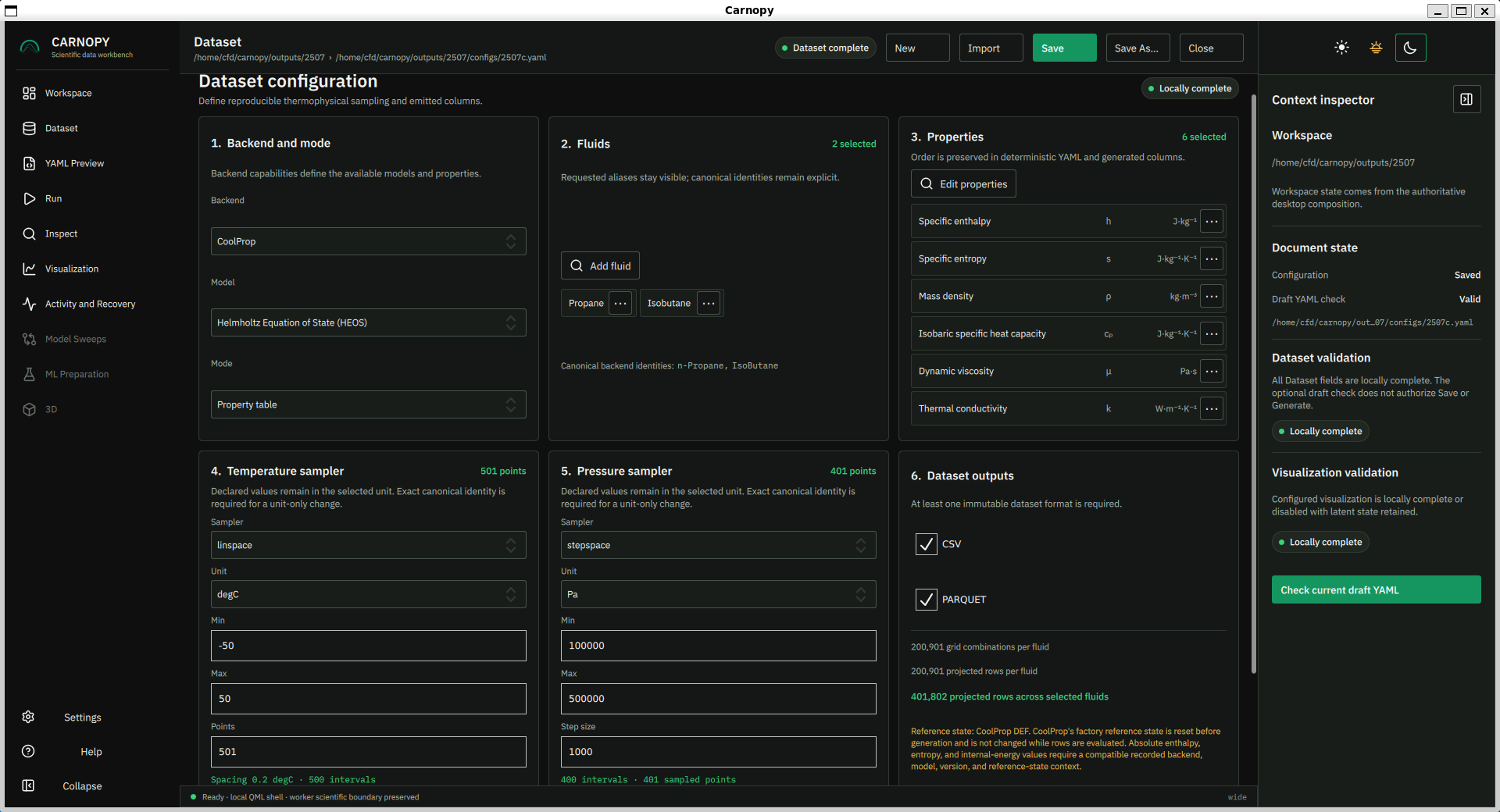
Desktop workflow
Start the workbench with:
carnopy-gui
Its workflow is:
Workspace → Dataset → YAML Preview → Run → Inspect → Visualization
          → Activity and Recovery
- Dataset edits all three dataset modes and projects row counts without importing the scientific stack into the GUI process.
- YAML Preview shows the deterministic complete document. Save and Save As validate those exact bytes in a worker before writing.
- Run validates and generates an exact clean saved snapshot.
- Inspect presents provenance, diagnostics, logical arrays, and bounded order-preserving table pages.
- Visualization verifies recorded configured-plot evidence and supports explicit session rendering from inspected columns.
- Activity and Recovery projects private request records and removes only explicitly selected, rescanned staging artifacts.
Scientific generation, inspection, and Matplotlib rendering run in short-lived workers. The QML process does not import CoolProp, NumPy, pandas, PyArrow, or Matplotlib. PNG and SVG use hash-bound in-app previews; PDF opens only after an explicit revalidation and user action.
To preselect a workspace:
carnopy-gui --workspace /path/to/workspace
Each workspace keeps YAML configurations in configs/, immutable generated
runs in outputs/, and rendered plots in figures/. Opening or importing a
configuration starts in that workspace's configs/ folder.
Qt normally detects its platform integration. On WSLg, Carnopy's auto mode
prefers XCB when both display transports are available because native Wayland
dialogs can detach after selection. Override it only when necessary:
carnopy-gui --qt-platform xcb --workspace /path/to/workspace
Configuration at a glance
Carnopy dataset configurations use YAML schema version 2:
schema_version: 2
document_type: dataset
backend:
  name: coolprop
  model: heos
mode: property_table
fluids: [Propane, Isobutane]

grid:
  temperature:
    kind: linspace
    start: -50
    stop: 50
    num: 101
    unit: degC
  pressure:
    kind: linspace
    start: 101325
    stop: 506625
    num: 41
    unit: Pa

properties:
  - specific_enthalpy
  - mass_density

outputs:
  dataset_formats: [csv, parquet]
Create a concise starter or the exhaustive commented reference:
carnopy init property_table my-dataset.yaml
carnopy init property_table full-reference.yaml --full
Supported public samplers are explicit, linspace, stepspace,
geomspace, and logspace. Supported input units are:
| Coordinate | Units |
|---|---|
| Temperature | K, degC |
| Pressure | Pa, hPa, kPa, MPa, bar, atm |
| Vapor mass fraction | 1 |
All backend calls and generated numeric columns use SI. Carnopy preserves the declared units and sampler definitions in provenance while normalizing the executable scientific specification deterministically.
Backend models
| Model | Meaning | Current limitation |
|---|---|---|
heos |
Helmholtz-energy equations and associated models | Full current property registry, subject to fluid/state support |
pr |
Peng-Robinson cubic equation of state | No transport properties, surface tension, or usable triple point |
srk |
Soave-Redlich-Kwong cubic equation of state | No transport properties, surface tension, or usable triple point |
HEOS is the starter default, not experimental truth. PR and SRK are alternative model assumptions, not accuracy rankings. Model selection changes scientific identity and is recorded in rows, metadata, and reports.
Outputs and provenance
Each immutable dataset run contains selected table files plus mandatory provenance:
outputs/<run>/
├── dataset.csv              # when requested
├── dataset.parquet          # when requested
├── config.original.yaml
├── config.normalized.json
├── config.reference.yaml
├── metadata.json
└── report.json
Runs are staged and then atomically renamed. Existing final or staging paths are never overwritten. Important identities have distinct meanings:
spec_id: canonical executable scientific specification;generation_context_id: specification plus software and artifact context;output_request_id: canonical dataset serialization request;run_id: one execution attempt;- artifact hashes: exact emitted bytes;
visualization_request_id: normalized visualization request.
Metadata records software and backend versions, selected model, CoolProp DEF
reference-state policy, canonical fluids and properties, sampling, failures,
units, constants, and artifact hashes. Failed states remain rows with stable
failure fields and preserved backend diagnostics.
Visualization
Visualization reads emitted columns only. It never calls a thermodynamic backend, smooths, interpolates, extrapolates, or invents states.
Supported plot kinds are property curves, sampled property heatmaps, generic X-Y plots, and emitted-state p-v and T-s diagrams. For example:
carnopy plot outputs/<run> \
  --kind property-curves \
  --property specific_enthalpy \
  --x temperature \
  --series pressure=1bar \
  --series pressure=3bar \
  --display-unit temperature=degC \
  --display-unit specific_enthalpy=kJ/kg
Exact filters and series values never select a nearest neighbor. The p-v plot
derives only specific_volume = 1 / mass_density; the T-s plot uses emitted
temperature and specific entropy. Neither constructs a cycle, process path,
phase envelope, saturation dome, or missing branch.
Configured visualization belongs in an optional top-level visualization:
section and runs only after the immutable dataset is finalized. Images are
written outside the dataset run with a .plot.json provenance sidecar and a
visualization-report.json. Supported formats are PNG, SVG, and PDF.
Model sweeps and ML preparation
Model sweeps generate ordinary immutable child runs and compare their emitted values without extra thermodynamic evaluation during comparison:
carnopy init model_sweep sweep.yaml
carnopy sweep sweep.yaml
Preparation reads an existing immutable run or sweep bundle and never calls a thermodynamic backend:
carnopy init preparation preparation.yaml
carnopy prepare outputs/<run> --config preparation.yaml --out prepared
Parquet remains the canonical prepared table. Optional NumPy and SafeTensors files are derived ML-consumption exports. Leakage-aware scenarios keep an exact thermodynamic-state hash in one partition, and transformations fit on training data only. Optional scikit-learn baselines are disposable diagnostics; Carnopy does not train, tune, register, or deploy production models.
Implemented behavior and reviewed research directions are separated in the ML preparation roadmap.
Python API
The public API intentionally remains narrow:
from carnopy import generate_dataset, load_config, validate_config

loaded = load_config("my-dataset.yaml")
validation = validate_config("my-dataset.yaml")
result = generate_dataset(
    "my-dataset.yaml",
    output_root="outputs",
    figures_root="figures",
)
Public helpers also cover model sweeps, preparation, and explicit visualization. CLI handlers and desktop controllers call the same core logic rather than maintaining separate scientific implementations.
Scientific limitations
- CoolProp is the only current backend; pure fluids only.
- Supported CoolProp models are HEOS, Peng-Robinson, and Soave-Redlich-Kwong.
- Generated data is backend output, not experimental evidence.
- Specific enthalpy, entropy, and internal energy depend on reference state.
- Carnopy resets every requested fluid to CoolProp
DEFbefore generation and records that policy. - Absolute reference-dependent values are not directly comparable across incompatible model/reference contexts.
- PR/SRK transport properties, surface tension, and triple-point temperature are rejected because the cubic backends do not provide the required capability.
- Mixtures, additional backends, ORC generation, ML training, web services, databases, native 3D, and standalone desktop installers are deferred.
See the official CoolProp documentation and high-level API reference for backend behavior.
Future Scope
Carnopy's current contracts remain intentionally narrower than its longer-term direction. Future work may add:
- additional thermophysical property libraries and databases;
- simulation-backend and thermodynamic-cycle-calculator adapters;
- experimental and operational data with explicit source, uncertainty, licensing, and validation status;
- user-supplied datasets through validated schema and provenance imports; and
- preparation outputs for training physics-informed machine-learning models, while model training remains outside Carnopy.
These are roadmap directions, not capabilities promised by the current alpha. Each source type requires an explicit scientific, provenance, and validation contract before implementation.
Development and contribution
Carnopy uses a src/ layout, Hatchling, standalone uv, Ruff, strict mypy, and
pytest. pyproject.toml and uv.lock are authoritative.
uv sync --locked --extra all --group dev
uv lock --check
uv run --locked ruff check .
uv run --locked ruff format --check .
uv run --locked mypy src/carnopy
uv run --locked pytest
Read CONTRIBUTING.md before proposing a public or scientific contract change. Use GitHub Issues for reproducible bugs, scientific discrepancies, and focused feature requests. Report vulnerabilities privately through the security policy.
The implemented desktop ownership and worker boundary are documented in DESKTOP_ARCHITECTURE.md. The generated Graphify artifacts are navigation aids only and must pass the repository freshness gate before use.
Release status
The latest published alpha is 0.1.0a3. The current source reports the
release-prepared 0.1.0a4 and contains the accepted QML parity application.
Stage 3 implementation, remote CI, the complete local gate, and native
acceptance have passed. The public Graphify navigation artifacts have been
refreshed from the accepted Stage 3 architecture. The tag, PyPI publication,
GitHub prerelease, and post-release Zenodo DOI belong to the separate
human-controlled 0.1.0a4 release process.
License
Carnopy is distributed under the MIT License.
Project details
Verified details
These details have been verified by PyPIProject links
GitHub Statistics
Maintainers
Release history Release notifications | RSS feed


Download files
Download the file for your platform. If you're not sure which to choose, learn more about installing packages.
Source Distribution
Built Distribution
Filter files by name, interpreter, ABI, and platform.
If you're not sure about the file name format, learn more about wheel file names.
Copy a direct link to the current filters
File details
Details for the file carnopy-0.1.0a4.tar.gz.
File metadata
- Download URL: carnopy-0.1.0a4.tar.gz
- Upload date:
- Size: 1.1 MB
- Tags: Source
- Uploaded using Trusted Publishing? Yes
- Uploaded via: twine/6.1.0 CPython/3.13.13
File hashes
| Algorithm | Hash digest | |
|---|---|---|
| SHA256 |
7f97d6a45874ca26441417fc4744b208a2d4cc7820daf4e0aa930fc9372f36b6
|
|
| MD5 |
f8cf9a4931c6f3d2e778cdfd5c734c70
|
|
| BLAKE2b-256 |
895121ceccf9a97551fab39d88f0400a84600c6e26e69d50597bf0a57a5918ac
|
Provenance
The following attestation bundles were made for carnopy-0.1.0a4.tar.gz:
Publisher:
publish.yml on gcalpay/carnopy
-
Statement:
-
Statement type:
https://in-toto.io/Statement/v1 -
Predicate type:
https://docs.pypi.org/attestations/publish/v1 -
Subject name:
carnopy-0.1.0a4.tar.gz -
Subject digest:
7f97d6a45874ca26441417fc4744b208a2d4cc7820daf4e0aa930fc9372f36b6 - Sigstore transparency entry: 2292733715
- Sigstore integration time:
-
Permalink:
gcalpay/carnopy@70e2f2ac53bfcf850ef69796d819a0033900fc64 -
Branch / Tag:
refs/tags/v0.1.0a4 - Owner: https://github.com/gcalpay
-
Access:
public
-
Token Issuer:
https://token.actions.githubusercontent.com -
Runner Environment:
github-hosted -
Publication workflow:
publish.yml@70e2f2ac53bfcf850ef69796d819a0033900fc64 -
Trigger Event:
push
-
Statement type:
File details
Details for the file carnopy-0.1.0a4-py3-none-any.whl.
File metadata
- Download URL: carnopy-0.1.0a4-py3-none-any.whl
- Upload date:
- Size: 881.7 kB
- Tags: Python 3
- Uploaded using Trusted Publishing? Yes
- Uploaded via: twine/6.1.0 CPython/3.13.13
File hashes
| Algorithm | Hash digest | |
|---|---|---|
| SHA256 |
de631583cd598e434fa52d43d06a5ecd0b563f58b6565028aee808dee74b2bbb
|
|
| MD5 |
98b2448aa6f0d5eb406fcbef7b899fcf
|
|
| BLAKE2b-256 |
a2f3dfaca5a72eb893d85acca7166559cb70e679eca238fa32678cda410fb380
|
Provenance
The following attestation bundles were made for carnopy-0.1.0a4-py3-none-any.whl:
Publisher:
publish.yml on gcalpay/carnopy
-
Statement:
-
Statement type:
https://in-toto.io/Statement/v1 -
Predicate type:
https://docs.pypi.org/attestations/publish/v1 -
Subject name:
carnopy-0.1.0a4-py3-none-any.whl -
Subject digest:
de631583cd598e434fa52d43d06a5ecd0b563f58b6565028aee808dee74b2bbb - Sigstore transparency entry: 2292733935
- Sigstore integration time:
-
Permalink:
gcalpay/carnopy@70e2f2ac53bfcf850ef69796d819a0033900fc64 -
Branch / Tag:
refs/tags/v0.1.0a4 - Owner: https://github.com/gcalpay
-
Access:
public
-
Token Issuer:
https://token.actions.githubusercontent.com -
Runner Environment:
github-hosted -
Publication workflow:
publish.yml@70e2f2ac53bfcf850ef69796d819a0033900fc64 -
Trigger Event:
push
-
Statement type:






