
Invariant-first chunk formation for source-preserving document and code workflows.

Project description
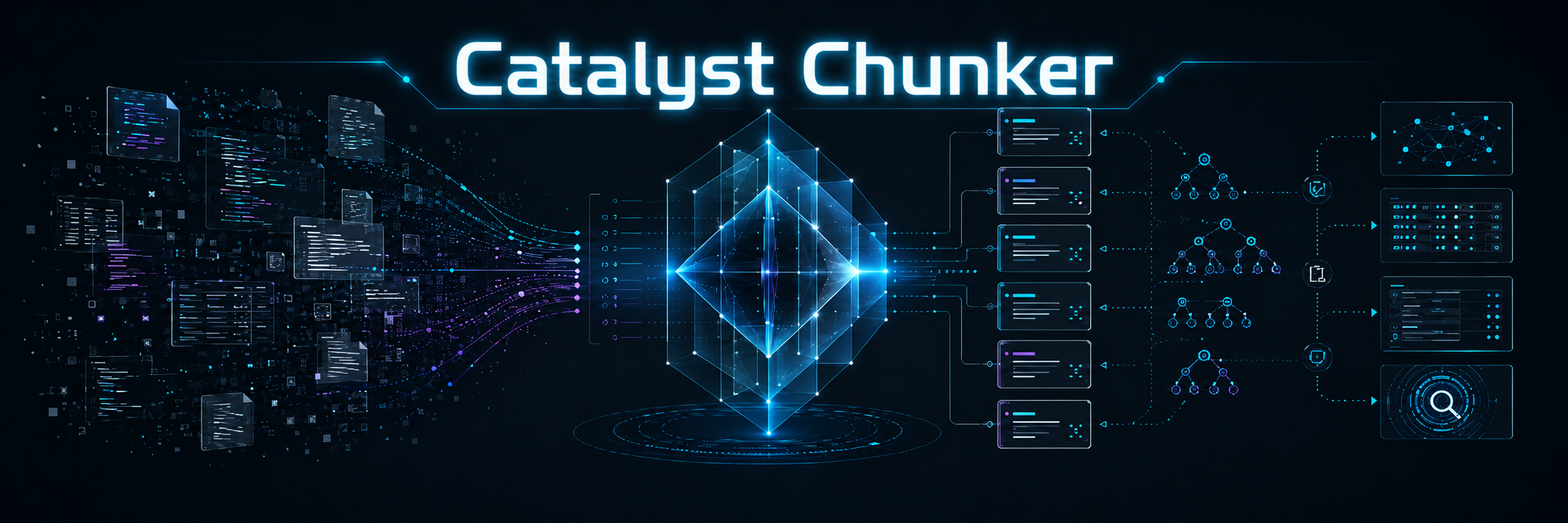
Catalyst Chunker is an invariant-first chunk formation package for retrieval, agentic software, and document/code workflows that need source lineage and auditability.
Catalyst does not treat splitter output, parser output, embeddings, or LLM proposals as source truth. External tools may provide evidence, but accepted chunks are admitted only after Catalyst-native formation, invariant checks, and versioned projection.
Status
0.1.6 is an alpha development release. The package builds as a wheel, exposes a CLI, and passes the local release acceptance suite. Public APIs are usable, but schema and operation names should still be treated as pre-1.0.
The current release gate covers:
- immutable source records, spans, normalization traces, and lineage
- structure-first prose chunking for Markdown/plain text
- recursive fallback only after structural candidate failure
- AST-aware Python code chunking
- Docling, ast-grep, tokenizer, embedding, and LLM candidate ports/adapters behind boundary contracts
- optional semantic refinement as evidence, not authority
- parent/child and sentence-window context recovery projections
- rejected candidate, repair, fallback, and invariant audit records
- retrieval sanity with held-out lexical recall/MRR metrics and relation-context benchmark operations
- governance checks for layer direction, boundary purity, native naming, file size, projection schema fields, and release acceptance
Install
From a local checkout:
python -m pip install -e ".[dev]"
After publication:
python -m pip install catalyst-chunker
Optional extras:
python -m pip install "catalyst-chunker[docling]"
python -m pip install "catalyst-chunker[ast-grep]"
python -m pip install "catalyst-chunker[sentence-transformers]"
The default package has no required runtime dependencies outside the Python standard library.
CLI
catalyst --version
catalyst chunk ./document.md --out ./chunks.jsonl --audit ./audit.json
catalyst inspect-boundaries ./document.md --out ./boundaries.json
catalyst compare-strategies ./document.md --out ./candidate-evaluation.json
catalyst explain-chunk ./chunks.jsonl chk_...
catalyst audit ./audit.json
catalyst retrieval-sanity ./tests/fixtures/retrieval_sanity/heldout_fixtures.json --out ./retrieval-sanity.json
Every public output includes schema_version and projection_kind.
Library Use
from catalyst.operation.commands import chunk_source, emit_projection

result = chunk_source(b"# Title\n\nBody text for retrieval.")
retrieval_records = emit_projection(result, "retrieval")
audit_record = emit_projection(result, "audit")

assert result.invariant_ledger.passed
assert retrieval_records[0]["schema_version"] == "catalyst.retrieval.v1"
assert audit_record["projection_kind"] == "audit"
Python code chunking uses an AST parser boundary adapter:
from catalyst.boundary.adapters.ast_python import PythonAstParser
from catalyst.operation.commands import chunk_parsed_code
from catalyst.projection.views.code_view import CodeProjection
from catalyst.source.records.source_record import SourceRecord

source = SourceRecord.from_bytes(
    b"def helper():\n    return 1\n",
    source_kind="code",
)
parsed = PythonAstParser().parse(source, "python")
result = chunk_parsed_code(parsed)
code_projection = CodeProjection(result.graph, parsed).record()
Agentic And Ollama Use
Catalyst is designed to sit inside an agentic application as a source-preserving internal utility. The recommended pattern is:
- Use Catalyst to admit chunks and emit retrieval/audit projections.
- Give the agent retrieval records plus source spans, warnings, and relation context.
- Keep model suggestions, including Ollama proposals, as boundary-assisted evidence.
- Require audit output for prompt ID, policy ID, model identity, confidence, and rejected alternatives.
Tiny Ollama models such as OpenBMB MiniCPM variants can be useful for boundary-assisted candidate hints, summaries, or local reranking. Catalyst should still receive those outputs through LlmCandidatePort or another boundary adapter. The model output can influence evidence; it does not become an accepted chunk by authority.
Minimal boundary-assisted evidence example:
from catalyst.observation.evidence import EvidenceSet, LlmCandidateObservation
from catalyst.observation.instruments.collect import observe_source
from catalyst.operation.commands import chunk_observed_source, emit_projection
from catalyst.source.records.source_record import SourceRecord

source = SourceRecord.from_bytes(b"Boundary-assisted candidate source.")
base_evidence = observe_source(source)
llm_evidence = LlmCandidateObservation(
    span=source.full_span(),
    proposal_text="candidate source",
    prompt_id="prompt_001",
    policy_id="local_ollama_boundary_assist",
    model_identity="ollama:<model-name>",
    confidence=0.72,
    rejected_alternatives=("too broad",),
).to_observation(source)

result = chunk_observed_source(
    source,
    EvidenceSet(base_evidence.source_id, (*base_evidence.observations, llm_evidence)),
)
audit = emit_projection(result, "audit")
In this pattern the agent can inspect audit["evidence"]["boundary_assisted"] to see which model contributed evidence and which alternatives were rejected.
Projection Schemas
Current public projection kinds:
| Projection | Schema version |
|---|---|
| retrieval | catalyst.retrieval.v1 |
| audit | catalyst.audit.v1 |
| boundary inspection | catalyst.boundaries.v1 |
| candidate evaluation | catalyst.candidate_evaluation.v1 |
| retrieval sanity | catalyst.retrieval_sanity.v1 |
| context recovery benchmark | catalyst.context_recovery_benchmark.v1 |
| parent/child | catalyst.parent_child.v1 |
| sentence window | catalyst.sentence_window.v1 |
| code | catalyst.code.v1 |
| specialized mode admission | catalyst.specialized_mode_admission.v1 |
See Projection Schemas for compatibility rules.
Architecture Guarantees
Catalyst follows the ADR spine in ADRs/ and the applied layer map in Architecture.
Core guarantees:
- source identity and source spans are mandatory
- accepted chunks preserve lineage
- fixed-size slicing is fallback-only and audit-visible
- semantic/LLM evidence cannot override source, structure, or hard invariants
- rejected candidates remain inspectable
- boundary adapters cannot be imported inward
- public records are schema-versioned
Development
Documentation starts at docs/README.md. Contributor setup and verification details live in Contributing and Testing.
python -m pip install -e ".[dev]"
python -m pytest
python governance/tools/enforce_file_size.py
python governance/tools/enforce_native_names.py
python governance/tools/enforce_boundary_purity.py
lint-imports --config .importlinter
python -m compileall -q src tests governance/tools
python -m pip wheel . --no-deps -w dist
The CI workflow runs the same gates.
Documentation
- Quickstart
- CLI Guide
- Library Usage
- Agentic Integration
- API Reference
- Configuration
- Stable IDs
- Error Records
- Architecture
Release
Build and check release artifacts:
python -m build
twine check dist/*
Publish to TestPyPI first:
twine upload --repository testpypi dist/*
Then publish to PyPI:
twine upload dist/*
Before publishing, review RELEASE_CHECKLIST.md and Release.
License
MIT. See LICENSE.
Release history Release notifications | RSS feed


Download files
Download the file for your platform. If you're not sure which to choose, learn more about installing packages.
Source Distribution
Built Distribution
Filter files by name, interpreter, ABI, and platform.
If you're not sure about the file name format, learn more about wheel file names.
Copy a direct link to the current filters
File details
Details for the file catalyst_chunker-0.1.6.tar.gz.
File metadata
- Download URL: catalyst_chunker-0.1.6.tar.gz
- Upload date:
- Size: 1.8 MB
- Tags: Source
- Uploaded using Trusted Publishing? No
- Uploaded via: twine/6.2.0 CPython/3.12.3
File hashes
| Algorithm | Hash digest | |
|---|---|---|
| SHA256 |
146bbe2dce0f09f9a244945fe5d8eb827137ece5e3f772943aff981f929ab80d
|
|
| MD5 |
3f28334f92755373aa05f96645f48a2a
|
|
| BLAKE2b-256 |
a1eda8b234ab2474d6845b9b67b30922e5678c6f9f243a2c94ec69031a6d857a
|
File details
Details for the file catalyst_chunker-0.1.6-py3-none-any.whl.
File metadata
- Download URL: catalyst_chunker-0.1.6-py3-none-any.whl
- Upload date:
- Size: 105.3 kB
- Tags: Python 3
- Uploaded using Trusted Publishing? No
- Uploaded via: twine/6.2.0 CPython/3.12.3
File hashes
| Algorithm | Hash digest | |
|---|---|---|
| SHA256 |
c815dc1fab30382dab64013d848159baa4c2415ee501e3edc915fcedb9353575
|
|
| MD5 |
3b98bcc84483a90454f4b23e9870f9ca
|
|
| BLAKE2b-256 |
4a388a136b9858f559a73e605cd4e75466d3f254612a29944de9b24d7405b0ab
|






