
Generate fictional-but-coherent causal operations worlds (executable sim + ground-truth answer-key) from a natural-language description, for benchmarking causal-discovery agents.

Project description
causal-worlds


Turn a plain-language description of an operation into a fictional causal world with a declared, ground-truth causal graph — then benchmark whether a causal-discovery method can recover it.
Because the structure is declared (not learned from data), it's an answer key: run any discovery method on the generated data and score how well it recovered the world. The worlds are fiction-first — plausible and internally consistent, not models of any real system — so there is no data to leak and nothing to memorize, which is exactly what makes a causal benchmark trustworthy.
📖 The story: Correlation lies — we built a causal world that can prove it, then tried to break it ourselves (Medium).
Correlation lies — and because the world is declared, you can prove it
In the built-in coffee world, overtime and sales rise together (correlation 0.64) — a naive
analyst "discovers" that overtime drives sales. But force overtime with do() and sales doesn't
move: the true causal effect is 0.00. The whole association was a hidden confounder the benchmark
planted — and it knows, so it can score who gets fooled:
import numpy as np
from causal_worlds import build_substrate, worlds

sub = build_substrate(worlds.get("coffee"), standardize=False)
ov, sa = sub.variables.index("overtime"), sub.variables.index("sales")

seen = sub.sample(40_000, seed=0).data
corr = np.corrcoef(seen[:, ov], seen[:, sa])[0, 1]                     # ≈ 0.64  → looks causal
hi = sub.sample(40_000, seed=1, do={"overtime":  1.0}).data[:, sa].mean()
lo = sub.sample(40_000, seed=1, do={"overtime": -1.0}).data[:, sa].mean()
print(round(corr, 2), round((hi - lo) / 2, 2))   # 0.64  0.00  → strong correlation, ZERO causal effect
That's the whole game: a method that only sees the data keeps the mirage; one that can act (and is latent-aware) doesn't. Score any discovery method against the known truth:
from causal_worlds import worlds, grade_spec, InterventionalCiDiscoverer
print(grade_spec(worlds.get("coffee"), InterventionalCiDiscoverer()))
# directed_shd=0  f1=1.0  confounded_reported=0     ← swap in YOUR discoverer
See the world it builds
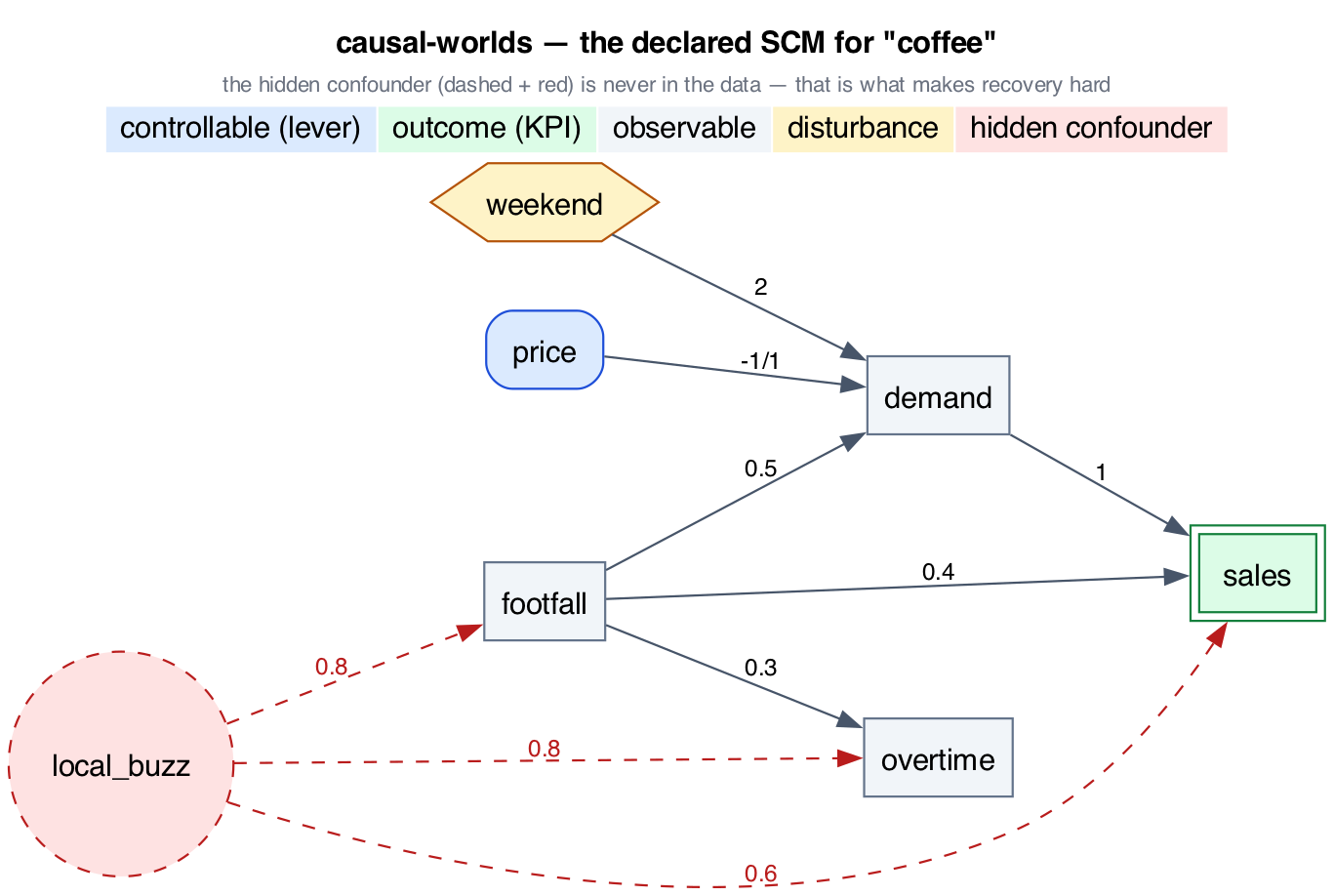
An SCM is a DAG, so look at it. to_mermaid(spec) and to_dot(spec) are zero-dependency string
renderers (or run causal-worlds viz coffee). The hidden confounder is drawn dashed — it's the latent
structure a discovery method never gets to see, and the reason the world is hard:
from causal_worlds import worlds, to_mermaid
print(to_mermaid(worlds.get("coffee")))   # paste into a ```mermaid block — GitHub renders it live
Status — on PyPI, beta. The full loop works: natural language → an admitted causal world, persisted with provenance. A Claude author proposes the world; an independent Gemini judge (a different model family) + statistical gates admit only worlds that are valid, recoverable, faithful, and not guessable from variable names. The engine (specify → sample → grade → score), all grading, and the renderers run with no API key; only authoring needs keys. Shipped: temporal (lagged) worlds, a control track, and a Gymnasium env. See the CHANGELOG.
Causality in three rungs (a 2-minute tour)
That picture isn't decoration — it's a causal model, and causality has exactly three levels (Judea Pearl's Ladder of Causation). causal-worlds lets you stand on each rung with real code, on a world whose true answer you already know.
Rung 1 — Association · what goes with what? In the data, footfall and sales rise together.
But is that footfall → sales, or is the hidden local_buzz (a street festival, good weather) quietly
driving both? From the data alone you cannot tell — two things moving together always have a
hidden third suspect. That gap is the whole difficulty of causality.
substrate = build_substrate(worlds.get("coffee"))
data = substrate.sample(2000, seed=0)                  # just watch the world
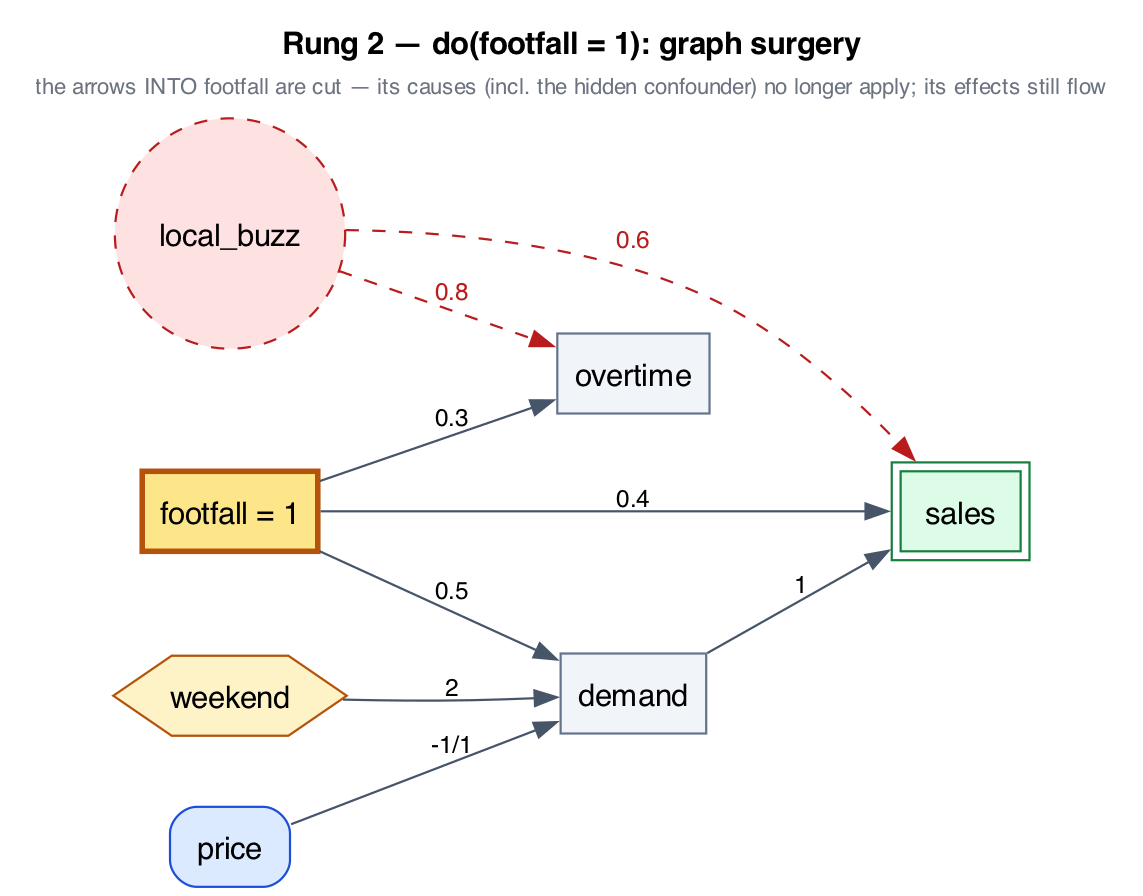
Rung 2 — Intervention · what if I act? Don't watch a variable — set it. do() is surgery on
the graph: it cuts every arrow pointing into the variable and keeps every arrow pointing out, so
what then moves sales is the real effect, mirage removed. The data slopes sales on footfall
at 1.56 — but do(footfall) reveals the true effect is only 0.90 (the data overstated it by
0.66, the confounder again); and for the pure-mirage pair above, do(overtime) gives exactly 0.00.
hi = sub.sample(40_000, seed=1, do={"footfall":  1.0}).data[:, sa].mean()
lo = sub.sample(40_000, seed=1, do={"footfall": -1.0}).data[:, sa].mean()
print(round((hi - lo) / 2, 2))   # 0.9  — the true causal effect, vs the 1.56 the raw data suggested
You can see the surgery — to_dot(spec, do={"footfall": 1.0}) (or causal-worlds viz coffee --format dot) draws the mutilated graph: every arrow into footfall is gone, its arrows out
remain. Our do() is verified genuine surgery, not statistical conditioning (docs/scope.md):
Rung 3 — Counterfactual · what would have happened? "We sold what we sold last Saturday — would
we have sold more had we set price differently, that same Saturday?" That needs the full model,
with that specific day's hidden local_buzz held fixed. Because causal-worlds declares the entire
SCM, it's exact — Pearl's abduction → action → prediction:
from causal_worlds import counterfactual
cf = counterfactual(worlds.get("coffee"), do={"price": 3.0}, seed=0)
print(cf.factual["sales"], "->", cf.counterfactual["sales"])   # what happened -> what would have
print(cf.effect["sales"])                                       # the change attributable to the act
(Same noise, same hidden local_buzz, only price changed — so the difference is caused by the
act. On a weekend unit the price → demand sign is flipped, so the counterfactual can surprise you.)
Why this makes a benchmark. A method that only sees (Rung 1) keeps the local_buzz mirage as a
real overtime → sales edge; only a latent-aware method that does (Rung 2) escapes it — which is
exactly the crossover result. New to causality? This is the tour — read the
diagrams, run the snippets, and you've climbed all three rungs.
Install
pip install causal-worlds              # or: uv add causal-worlds
pip install 'causal-worlds[discover]'  # + the baseline discovery stack (PC/GES/FCI/GIES)
pip install 'causal-worlds[llm]'       # + natural-language authoring (Claude + Gemini)
The base install (engine, grading, renderers, built-in worlds, CLI) needs only typer, pydantic,
numpy.
60-second quickstart (no API key)
causal-worlds worlds                     # list built-in worlds: coffee, ecommerce
causal-worlds viz coffee                 # print the SCM as Mermaid (--format dot for Graphviz)
causal-worlds gate coffee                # run the validity gates -> admitted=True
causal-worlds grade coffee               # grade the reference discoverer -> directed_shd=0 ...
causal-worlds score benchmark/v0.6/world_01   # grade the reference on a shipped benchmark world
New to it? Walk through the getting-started guide or run the examples (each prints its expected output, so you can read without running).
Benchmark your own discoverer
Implement one method — recover(substrate, *, seed) -> set[(src, dst)] — and grade it against any
world's answer key:
from causal_worlds import grade_spec, worlds

class MyDiscoverer:
    def recover(self, substrate, *, seed):
        sample = substrate.sample(2000, seed=seed)        # observational data...
        flows = substrate.sample(2000, seed=seed, do={"price": 1.0})  # ...or interventional
        return {("price", "demand")}                       # your recovered edges

print(grade_spec(worlds.get("coffee"), MyDiscoverer()))
Or from the CLI on a persisted world: causal-worlds score <bundle> --discoverer your_pkg:YourClass.
Benchmark a controller (Stage 2 — control)
The same worlds are a control benchmark: pick lever values to maximise an objective. Because the mechanisms are declared, the best the levers can do is computable — a by-construction optimal policy (scope §1a) — so a policy is graded by regret against it, no external data needed.
from causal_worlds import default_objective, grade_control, worlds

spec = worlds.get("coffee")
objective = default_objective(spec)                  # controllables raise the outcome KPI, quadratic cost
report = grade_control(spec, objective, {"price": 3.0}, seed=7)   # your policy here
print(report.regret)                                 # regret vs the declared optimum (0 = optimal play)
A pluggable Controller is graded by grade_controller. Or drive it as a Gymnasium env
(pip install 'causal-worlds[gym]') where the regime shifts between steps (a perturbation):
from causal_worlds.gym import ControlEnv
env = ControlEnv(worlds.get("coffee"))               # action = lever values; reward = objective
obs, info = env.reset(seed=0)                          # info["optimal_reward"] / info["regret"] per step
Author a world from a description (needs [llm] + keys)
Set ANTHROPIC_API_KEY and GEMINI_API_KEY (see .env.example; the CLI auto-loads a
local .env), then:
causal-worlds generate "a coffee chain with weekend swings and variable lead times" ./my-world
causal-worlds viz ./my-world             # ...then look at what it built
Or describe one conversationally — causal-worlds elicit ./my-world asks the minimal clarifying
questions (entities & roles, what drives what, regimes, hidden causes, the objective), shows the
accumulating brief, and authors once it's complete. In Python:
from causal_worlds import generate
from causal_worlds.author import build_claude_author
from causal_worlds.judge import build_gemini_judge

world = generate(
    "a hospital ED with triage staffing and bed pressure",
    author=build_claude_author(complexity="hard"),   # easy | standard | hard | adversarial
    judge=build_gemini_judge(),                       # independent model family
)
print(world.report.difficulty, world.report.grade)
By default authoring is benchmark mode: a world is rejected if it is guessable from its variable
names/roles (the published benchmark must not be name-guessable, so intuitive operations often fail
on purpose). To just describe a world and get it, use playground mode — --playground on the
CLI, or anti_cliche=False in Python. It keeps the faithfulness check and still reports difficulty
(now advisory), but never rejects on guessability:
causal-worlds generate "a regional power grid with rooftop solar and time-of-use pricing" ./grid --playground
(With the observability extra + Langfuse keys, every generate → author → gate run is traced.)
What the benchmark shows
Across the 26-world hardened benchmark/v0.6 set, with an information-fair
comparison (the +do methods get the same interventional budget as the latent-aware reference):
latent-awareness — not interventions — is the dividing line. PC + interventions still scores the
hidden-confounded pair as causal just as often as observational PC — confounded-kept 30 vs 29
(summed over the 26 worlds, seed-averaged); only the latent-aware rule reaches 0 (ΔF1 +0.37, 95%
CI [0.33, 0.42]). It's an identifiability result, not
"we beat the toolbox." Full table, bootstrap CIs, and the honest caveats (admission circularity,
simulated-DAG leakage, difficulty-as-descriptor, anti-cliché role leakage) are in
docs/findings.md.
What you get per world
- An executable SCM — sample observational data and
do()-intervene, deterministically by seed. - A time-series dataset — the observed variables (the input to a discovery method).
- An answer key — the declared causal edges + the hidden-confounded pairs, derived from the spec.
- A manifest — full provenance (models, grader version, seed, difficulty) and an honesty label.
Concepts
- Spec / IR — variables (with roles, incl. hidden), linear-Gaussian mechanisms, regime sign-flips.
- Answer key — directed edges over observed variables + the hidden-confounded pairs; derived from the spec, never stored separately, so they can't disagree.
- Gates — T1 validity · T2 sample-sanity · T3 faithfulness (grader-independent) · T4 anti-cliché (named prior recovers < half and a name+role-blind prior stays near chance). All must pass to admit.
- Reference grader — an interventional-CI discoverer that uses
do()data to tell confounding from causation, where PC/GES/GIES/FCI (which assume causal sufficiency) cannot.
Depth: docs/foundations.md (are these worlds truly causal? — the three
rungs, grounded in Pearl/Wright/Haavelmo) · docs/scope.md ·
docs/hld.md · docs/lld.md ·
docs/architecture.md · docs/findings.md ·
docs/validation.md.
Roadmap
Shipped: NL authoring · independent judge + anti-cliché gate · artifact persistence · the baseline
crossover · a structural-difficulty axis · a 26-world hardened benchmark (v0.6) · temporal worlds
(lagged edges + autoregression) and time-series grading (PCMCI+, LPCMCI, VARLiNGAM, Granger) ·
conversational elicitation · the control track (by-construction optimal policy, regret, and
regret-under-perturbation) + a Gymnasium env · graph renderers (Mermaid / DOT).
Next: nonlinearity (#10) and a temporal
benchmark set (n>1). Tracked as issues.
Why this is the unoccupied intersection
Today's tools each own one corner — natural-language authoring × executable causal simulator × ground-truth answer-key for discovery is the gap:
| Tool | Corner it owns | What it lacks (for this job) |
|---|---|---|
| G-Sim | LLM authors a sim + calibrates to data | needs real data; aimed at fidelity, not a declared answer-key |
| DEVS-Gen | NL → executable discrete-event ops sim | no declared causal-graph answer-key |
| SD-SCM | LLM fills mechanisms → counterfactuals | needs a user-supplied DAG; tabular, not an executable sim |
| TimeGraph | known-graph time-series for discovery | parametric/templated; no natural-language authoring |
Built on the shoulders of pgmpy, DoWhy, CausalPlayground, causal-learn, and Gymnasium.
Contributing
Issues and PRs welcome. The bar: make validate green (ruff select=ALL, mypy strict, pytest with
a coverage floor) — see docs/engineering.md. Atomic, conventional commits.
License
Release history Release notifications | RSS feed


Download files
Download the file for your platform. If you're not sure which to choose, learn more about installing packages.
Source Distribution
Built Distribution
Filter files by name, interpreter, ABI, and platform.
If you're not sure about the file name format, learn more about wheel file names.
Copy a direct link to the current filters
File details
Details for the file causal_worlds-0.34.0.tar.gz.
File metadata
- Download URL: causal_worlds-0.34.0.tar.gz
- Upload date:
- Size: 9.6 MB
- Tags: Source
- Uploaded using Trusted Publishing? No
- Uploaded via: uv/0.11.14 {"installer":{"name":"uv","version":"0.11.14","subcommand":["publish"]},"python":null,"implementation":{"name":null,"version":null},"distro":{"name":"macOS","version":null,"id":null,"libc":null},"system":{"name":null,"release":null},"cpu":null,"openssl_version":null,"setuptools_version":null,"rustc_version":null,"ci":null}
File hashes
| Algorithm | Hash digest | |
|---|---|---|
| SHA256 |
de3bf7318ef8c481f1b6dbd7ed95d89afecec5ab89d871962f20923b3e7d5727
|
|
| MD5 |
eaa3b5bba246ed8e83453e51605868cb
|
|
| BLAKE2b-256 |
17337c7f31ed99181319b01b36c04a12bf54752d7b2e949f556771eeeda59f2e
|
File details
Details for the file causal_worlds-0.34.0-py3-none-any.whl.
File metadata
- Download URL: causal_worlds-0.34.0-py3-none-any.whl
- Upload date:
- Size: 89.3 kB
- Tags: Python 3
- Uploaded using Trusted Publishing? No
- Uploaded via: uv/0.11.14 {"installer":{"name":"uv","version":"0.11.14","subcommand":["publish"]},"python":null,"implementation":{"name":null,"version":null},"distro":{"name":"macOS","version":null,"id":null,"libc":null},"system":{"name":null,"release":null},"cpu":null,"openssl_version":null,"setuptools_version":null,"rustc_version":null,"ci":null}
File hashes
| Algorithm | Hash digest | |
|---|---|---|
| SHA256 |
c3176dab956906c577d51272308a3ea6f9690d069648bec886b368c2a135bbcc
|
|
| MD5 |
e952a381d4d1b6a36d0ba9f2e74c90ca
|
|
| BLAKE2b-256 |
c94e7ddad23aa6cdcd3c12240232dbed2fae0cba19a1e1cd1ba9c0551338cc5a
|






