
Python Package for Uplift Modeling and Causal Inference with Machine Learning Algorithms


Project description





Disclaimer
This project is stable and being incubated for long-term support. It may contain new experimental code, for which APIs are subject to change.
Causal ML: A Python Package for Uplift Modeling and Causal Inference with ML
Causal ML is a Python package that provides a suite of uplift modeling and causal inference methods using machine learning algorithms based on recent
research. It provides a standard interface that allows user to estimate the Conditional Average Treatment Effect (CATE) or Individual Treatment
Effect (ITE) from experimental or observational data. Essentially, it estimates the causal impact of intervention T on outcome Y for users
with observed features X, without strong assumptions on the model form. Typical use cases include
-
Campaign targeting optimization: An important lever to increase ROI in an advertising campaign is to target the ad to the set of customers who will have a favorable response in a given KPI such as engagement or sales. CATE identifies these customers by estimating the effect of the KPI from ad exposure at the individual level from A/B experiment or historical observational data.
-
Personalized engagement: A company has multiple options to interact with its customers such as different product choices in up-sell or messaging channels for communications. One can use CATE to estimate the heterogeneous treatment effect for each customer and treatment option combination for an optimal personalized recommendation system.
The package currently supports the following methods
- Tree-based algorithms
- Uplift tree/random forests on KL divergence, Euclidean Distance, and Chi-Square
- Uplift tree/random forests on Contextual Treatment Selection
- Meta-learner algorithms
- S-learner
- T-learner
- X-learner
- R-learner
- Instrumental variables algorithms
- 2-Stage Least Squares (2SLS)
Installation
Prerequisites
Install dependencies:
$ pip install -r requirements.txt
Install from pip:
$ pip install causalml
Install from source:
$ git clone https://github.com/uber/causalml.git
$ cd causalml
$ python setup.py build_ext --inplace
$ python setup.py install
Quick Start
Average Treatment Effect Estimation with S, T, X, and R Learners
from causalml.inference.meta import LRSRegressor
from causalml.inference.meta import XGBTRegressor, MLPTRegressor
from causalml.inference.meta import BaseXRegressor
from causalml.inference.meta import BaseRRegressor
from xgboost import XGBRegressor
from causalml.dataset import synthetic_data

y, X, treatment, _, _, e = synthetic_data(mode=1, n=1000, p=5, sigma=1.0)

lr = LRSRegressor()
te, lb, ub = lr.estimate_ate(X, treatment, y)
print('Average Treatment Effect (Linear Regression): {:.2f} ({:.2f}, {:.2f})'.format(te[0], lb[0], ub[0]))

xg = XGBTRegressor(random_state=42)
te, lb, ub = xg.estimate_ate(X, treatment, y)
print('Average Treatment Effect (XGBoost): {:.2f} ({:.2f}, {:.2f})'.format(te[0], lb[0], ub[0]))

nn = MLPTRegressor(hidden_layer_sizes=(10, 10),
                 learning_rate_init=.1,
                 early_stopping=True,
                 random_state=42)
te, lb, ub = nn.estimate_ate(X, treatment, y)
print('Average Treatment Effect (Neural Network (MLP)): {:.2f} ({:.2f}, {:.2f})'.format(te[0], lb[0], ub[0]))

xl = BaseXRegressor(learner=XGBRegressor(random_state=42))
te, lb, ub = xl.estimate_ate(X, e, treatment, y)
print('Average Treatment Effect (BaseXRegressor using XGBoost): {:.2f} ({:.2f}, {:.2f})'.format(te[0], lb[0], ub[0]))

rl = BaseRRegressor(learner=XGBRegressor(random_state=42))
te, lb, ub =  rl.estimate_ate(X=X, p=e, treatment=treatment, y=y)
print('Average Treatment Effect (BaseRRegressor using XGBoost): {:.2f} ({:.2f}, {:.2f})'.format(te[0], lb[0], ub[0]))
See the Meta-learner example notebook for details.
Interpretable Causal ML
Causal ML provides methods to interpret the treatment effect models trained as follows:
Meta Learner Feature Importances
from causalml.inference.meta import BaseSRegressor, BaseTRegressor, BaseXRegressor, BaseRRegressor
from causalml.dataset.regression import synthetic_data

# Load synthetic data
y, X, treatment, tau, b, e = synthetic_data(mode=1, n=10000, p=25, sigma=0.5)
w_multi = np.array(['treatment_A' if x==1 else 'control' for x in treatment]) # customize treatment/control names

slearner = BaseSRegressor(LGBMRegressor(), control_name='control')
slearner.estimate_ate(X, w_multi, y)
slearner_tau = slearner.fit_predict(X, w_multi, y)

model_tau_feature = RandomForestRegressor()  # specify model for model_tau_feature

slearner.get_importance(X=X, tau=slearner_tau, model_tau_feature=model_tau_feature,
                        normalize=True, method='auto', features=feature_names)

# Using the feature_importances_ method in the base learner (LGBMRegressor() in this example)
slearner.plot_importance(X=X, tau=slearner_tau, normalize=True, method='auto')

# Using eli5's PermutationImportance
slearner.plot_importance(X=X, tau=slearner_tau, normalize=True, method='permutation')

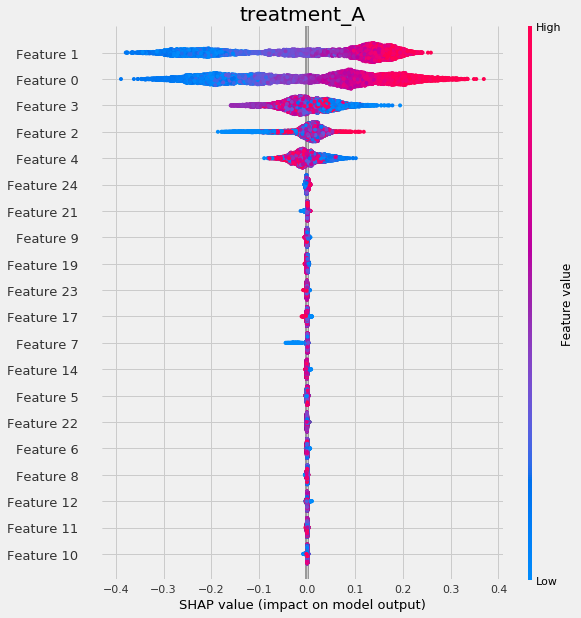
# Using SHAP
shap_slearner = slearner.get_shap_values(X=X, tau=slearner_tau)

# Plot shap values without specifying shap_dict
slearner.plot_shap_values(X=X, tau=slearner_tau)

# Plot shap values WITH specifying shap_dict
slearner.plot_shap_values(shap_dict=shap_slearner)

# interaction_idx set to 'auto' (searches for feature with greatest approximate interaction)
slearner.plot_shap_dependence(treatment_group='treatment_A',
                              feature_idx=1,
                              X=X,
                              tau=slearner_tau,
                              interaction_idx='auto')
See the feature interpretations example notebook for details.
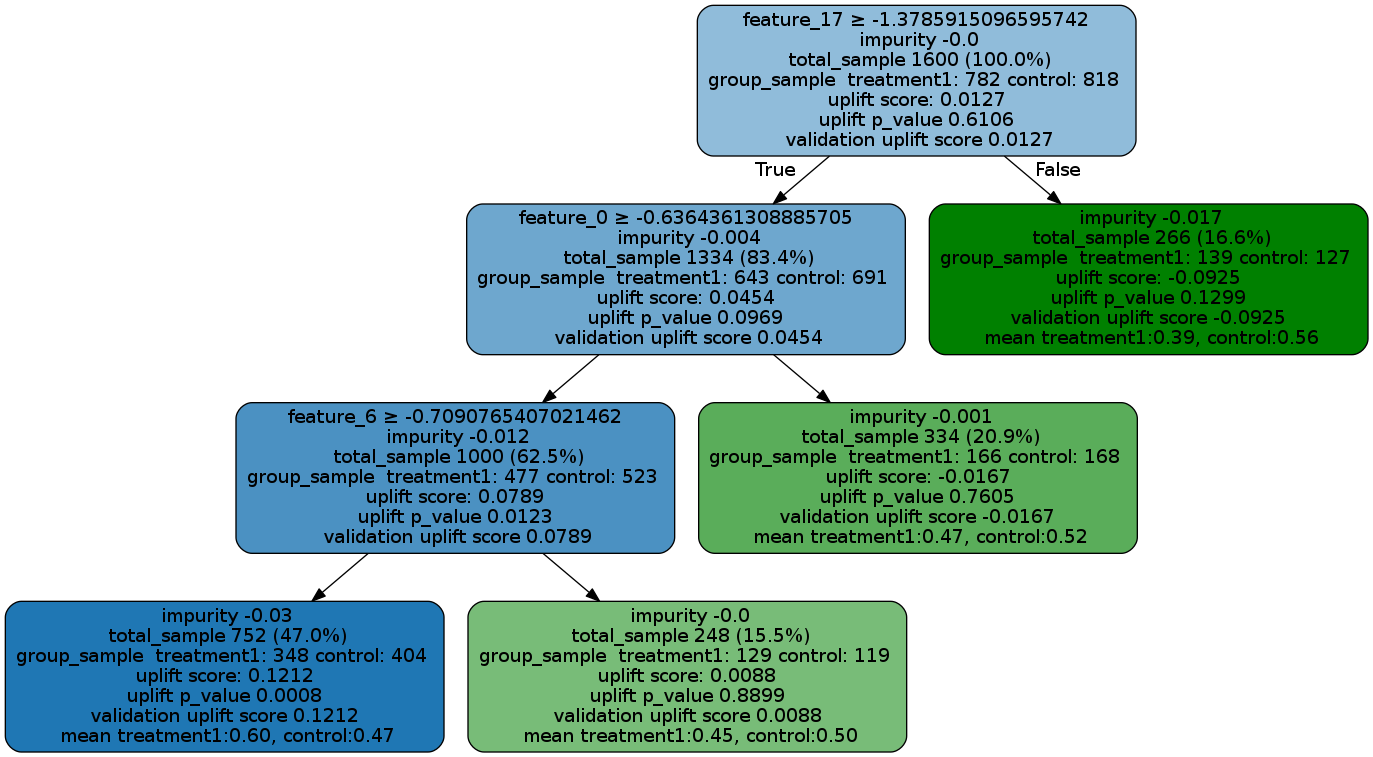
Uplift Tree Visualization
from IPython.display import Image
from causalml.inference.tree import UpliftTreeClassifier, UpliftRandomForestClassifier
from causalml.inference.tree import uplift_tree_string, uplift_tree_plot

uplift_model = UpliftTreeClassifier(max_depth=5, min_samples_leaf=200, min_samples_treatment=50,
                                    n_reg=100, evaluationFunction='KL', control_name='control')

uplift_model.fit(df[features].values,
                 treatment=df['treatment_group_key'].values,
                 y=df['conversion'].values)

graph = uplift_tree_plot(uplift_model.fitted_uplift_tree, features)
Image(graph.create_png())
See the Uplift Tree visualization example notebook for details.
Contributing
We welcome community contributors to the project. Before you start, please read our code of conduct and check out contributing guidelines first.
Versioning
We document versions and changes in our changelog.
License
This project is licensed under the Apache 2.0 License - see the LICENSE file for details.
References
Documentation
Citation
To cite CausalML in publications, you can refer to the following sources:
Whitepaper: CausalML: Python Package for Causal Machine Learning
Bibtex:
@misc{chen2020causalml, title={CausalML: Python Package for Causal Machine Learning}, author={Huigang Chen and Totte Harinen and Jeong-Yoon Lee and Mike Yung and Zhenyu Zhao}, year={2020}, eprint={2002.11631}, archivePrefix={arXiv}, primaryClass={cs.CY} }
Papers
- Nicholas J Radcliffe and Patrick D Surry. Real-world uplift modelling with significance based uplift trees. White Paper TR-2011-1, Stochastic Solutions, 2011.
- Yan Zhao, Xiao Fang, and David Simchi-Levi. Uplift modeling with multiple treatments and general response types. Proceedings of the 2017 SIAM International Conference on Data Mining, SIAM, 2017.
- Sören R. Künzel, Jasjeet S. Sekhon, Peter J. Bickel, and Bin Yu. Metalearners for estimating heterogeneous treatment effects using machine learning. Proceedings of the National Academy of Sciences, 2019.
- Xinkun Nie and Stefan Wager. Quasi-Oracle Estimation of Heterogeneous Treatment Effects. Atlantic Causal Inference Conference, 2018.
Related projects
- uplift: uplift models in R
- grf: generalized random forests that include heterogeneous treatment effect estimation in R
- rlearner: A R package that implements R-Learner
- DoWhy: Causal inference in Python based on Judea Pearl's do-calculus
- EconML: A Python package that implements heterogeneous treatment effect estimators from econometrics and machine learning methods
Release history Release notifications | RSS feed


Download files
Download the file for your platform. If you're not sure which to choose, learn more about installing packages.
Source Distribution
Built Distribution
Filter files by name, interpreter, ABI, and platform.
If you're not sure about the file name format, learn more about wheel file names.
Copy a direct link to the current filters
File details
Details for the file causalml-0.8.0.tar.gz.
File metadata
- Download URL: causalml-0.8.0.tar.gz
- Upload date:
- Size: 3.8 MB
- Tags: Source
- Uploaded using Trusted Publishing? No
- Uploaded via: twine/3.1.1 pkginfo/1.5.0.1 requests/2.23.0 setuptools/46.0.0.post20200309 requests-toolbelt/0.9.1 tqdm/4.43.0 CPython/3.7.6
File hashes
| Algorithm | Hash digest | |
|---|---|---|
| SHA256 |
cf74f04647cd7de39fecaccb09b14e7f22ab9bdf0cb18d963af0e4132059ed14
|
|
| MD5 |
99f69bed608863984b7dfd48c375d09f
|
|
| BLAKE2b-256 |
507cdd3c967b3bd8185c454fe7554f959914d2fb7674cb22467b64fa2b61fc67
|
File details
Details for the file causalml-0.8.0-cp37-cp37m-macosx_10_9_x86_64.whl.
File metadata
- Download URL: causalml-0.8.0-cp37-cp37m-macosx_10_9_x86_64.whl
- Upload date:
- Size: 213.0 kB
- Tags: CPython 3.7m, macOS 10.9+ x86-64
- Uploaded using Trusted Publishing? No
- Uploaded via: twine/3.1.1 pkginfo/1.5.0.1 requests/2.23.0 setuptools/46.0.0.post20200309 requests-toolbelt/0.9.1 tqdm/4.43.0 CPython/3.7.6
File hashes
| Algorithm | Hash digest | |
|---|---|---|
| SHA256 |
7ba0b7060b8fc5160bdd576104267c41fb684a95441991c167746d0971da36ac
|
|
| MD5 |
b92b43474f9a29777eb53f5d3a33a4df
|
|
| BLAKE2b-256 |
fd35a165c970ab9ce4922bf35d02efeec79566a6f28c68a52eb40cd3b48f064e
|






