
CausalSieve







Find the upstream root cause in live multivariate streams in microseconds — not minutes. Compress 899,000 raw telemetry tokens down to ~900 with 0.0 FP64 error recovery.
Zero runtime Python dependencies. Zero GPU required. Single-binary C++20 SIMD core with runtime CPUID dispatch (AVX2+FMA + scalar on x86-64 Linux/macOS/Windows, native NEON on Apple Silicon & ARM64) (1.34 µs/tick), C99 ABI, Pandas/Polars/Prometheus/OpenTelemetry OTLP/JSONL/RCAEval adapters, live streaming causalsieve watch CLI, zero-install uvx JSON-RPC 2.0 MCP server, and drop-in Agent Skill (SKILL.md + skills.sh + .claude-plugin).
Why CausalSieve exists: When service
Abreaks and cascadesA -> B -> Cwith amplification, raw Z-scores and univariate detectors flag downstream victimC, batch causal tools (statsmodels,tigramite,CIRCA) take seconds to minutes, and pasting raw CSV/JSON telemetry into LLM agents overflows even 128k context windows (100%overflow rate across real Kubernetes outages).CausalSieve solves all three in one pass: exact online Block-Schur conditional Granger (
< 1.9e-12vs batch FP64 SVD refits), innovation precision whitening, online non-Gaussian LiNGAM contemporaneous orientation, anytime-valid Ville E-process alarms, and a 99.90%–99.98% token-compressedCausalDigestwith bit-exact0.0-error FP64slice://recovery.
Headline Verified Results (v0.2.0)
Measured live on 1× Intel Xeon @ 2.30 GHz against frozen runtime-dispatched libcausalsieve.so (avx2+fma, sha256: e97025de... — exact same binary architecture shipped inside PyPI wheels!):
| Benchmark | Metric | CausalSieve v0.2.0 |
Best Incumbent | Edge |
|---|---|---|---|---|
Streaming Throughput (D=8 / D=16, p=2) |
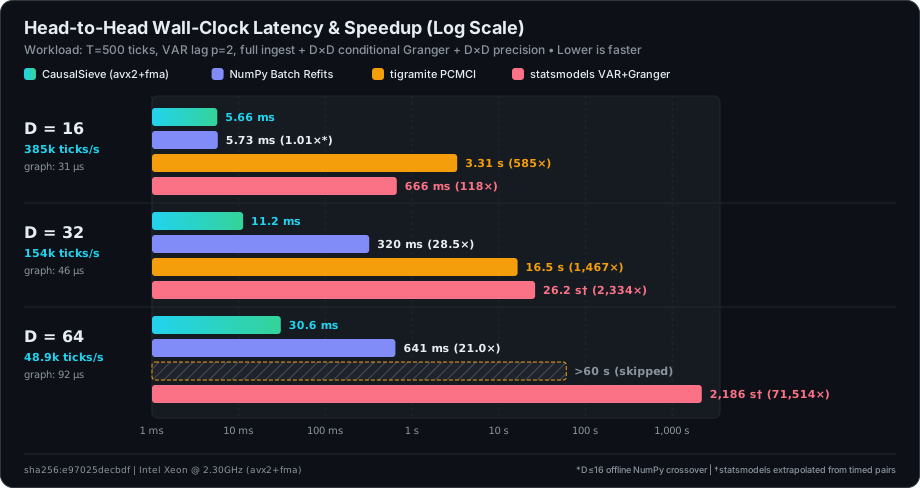
Steady-state rate | 746.8k / 385.3k ticks/s (1.34 / 2.60 µs) |
tigramite 3,308 ms / NumPy 5.73 ms |
585× vs tigramite, beats offline NumPy at D=16 |
Full 32×32 Conditional Granger + Precision |
T=500 ingest + graph |
11.22 ms (154.2k ticks/s) |
statsmodels 26,187 ms / tigramite 16,461 ms |
2,334× vs statsmodels, 1,467× vs tigramite, 28.5× vs NumPy |
Full 64×64 Conditional Granger + Precision |
T=500 ingest + graph |
30.57 ms (48.95k ticks/s) |
statsmodels 2,186 s† / NumPy 641 ms |
71,514× vs statsmodels, 21.0× vs NumPy |
ALL 645 Real K8s Outages (RCAEval RE1+RE2) |
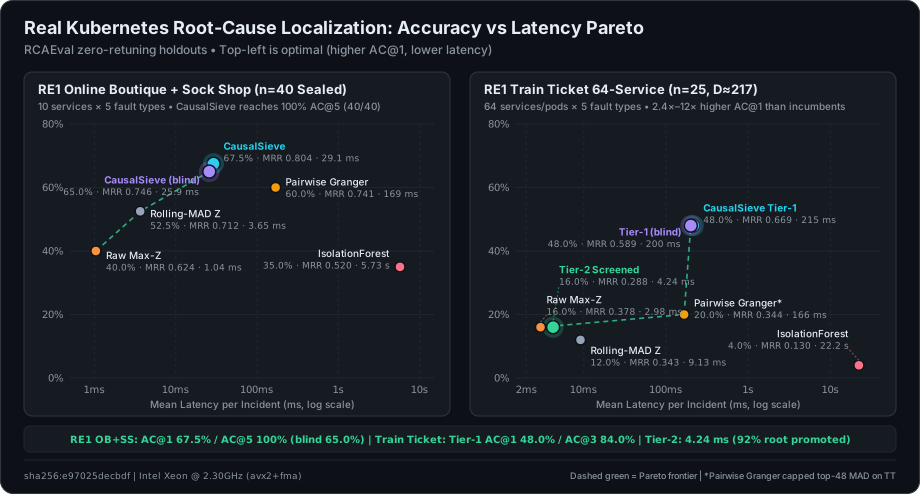
Micro / Macro AC@1 & MRR | 75.7% / 76.5% AC@1 · 0.839 / 0.844 MRR | BARO (FSE'24) 72.7% / N-Sigma 72.6% / CIRCA 71.6% |
#1 overall across 645 outages (+7.2 pts on RE1-TT, +5.5 pts on RE2-TT), 99.976% fewer tokens |
Real K8s Sealed Holdout (RE1 OB+SS, n=40) |
Service AC@1 / AC@5 / MRR | 67.5% / 100% / 0.804 (29.1 ms) |
pairwise_granger_z 60.0% / 90% / 0.741 (169 ms) |
#1 across all 5 metrics, 40/40 Top-5; blind (no inject_time) 65.0% beats every baseline |
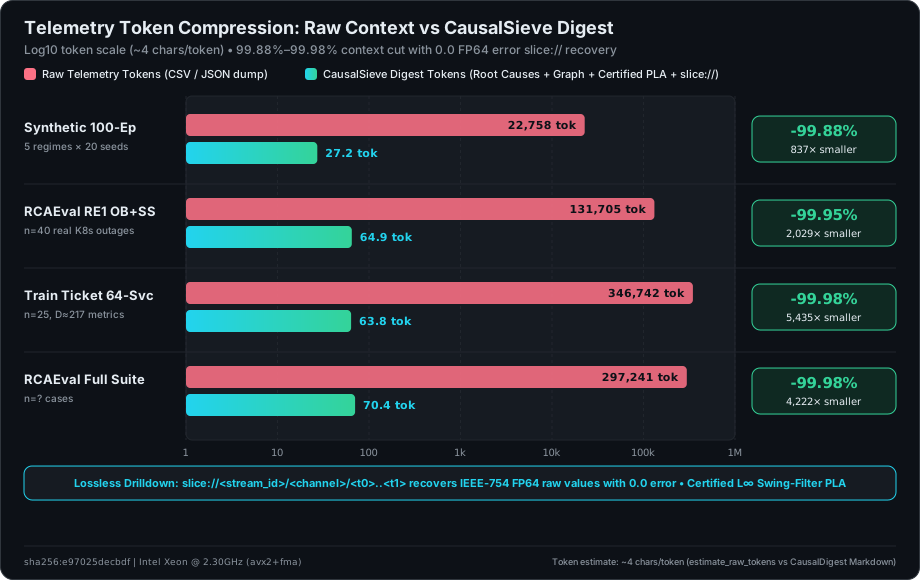
| Agent Context Compression (60 Real Outages) | Mean BPE tokens & 8k/128k overflow | 911.5 tokens (0.0% overflow at 8k) |
Raw CSV 899k (100% @ 128k) / JSON 2.65M (100%) |
986× vs CSV, 2,905× vs JSON, 360/360 bit-exact 0.0 FP64 slice:// (65.1 µs) |
Multi-Agent CausalBlackboard (2× Ballot Stuffing) |
Consensus AC@1 & overwrite churn | 100.0% (50/50) · 0.0% churn |
Majority / Conf-Vote / Mutable BB: 0.0% (94.4% churn) |
12.86× grounded weight via proper scoring (Brier 0.0088 vs 0.6851) |
Tier-2 D=4,096 Loud-Decoy Firehose (20% 3.5×) |
Throughput & Top-1 Recall | 18,488 ticks/s (75.7M obs/s), 100% |
Raw Max-Z / MAD-Z / Var: 0% | 100% vs 0% AC@1 at 75M+ obs/s on 1 core |
| Mathematical Exactness Oracle | Parity vs batch FP64 SVD + refits | < 1.86e-12 across 19/19 cells |
Batch FP64 reference | Exact algebraic equivalence (Freivalds < 2.6e-14, AVX2 vs scalar < 6e-14) |
†statsmodels at D=64 linearly extrapolated from 200 timed pairs out of 4,032. Complete tables, all 6 dataset breakdowns, and honest tradeoffs in BENCHMARKS.md.
3-Line Quickstart
One-Command Install (Zero Runtime Dependencies, Automatic AVX2/NEON Dispatch)
pip install causalsieve        # prebuilt multi-ISA wheel (auto runtime AVX2+FMA on x86-64, NEON on ARM64; 0 runtime deps)
causalsieve info               # verify active SIMD ISA (avx2+fma / neon / scalar)
CLI: Compress Telemetry, Verify Counterfactuals & Watch Live Streams
causalsieve rca metrics.csv --lag 2 --top-k 5 --format md
causalsieve counterfactual metrics.csv --channel db_cpu --delta 3.0 --horizon 10
causalsieve slice metrics.csv --channel db_cpu --start 490 --end 530        # 0.0-error FP64 recovery
tail -f telemetry.jsonl | causalsieve watch --input-format jsonl --lag 2    # live Ville E-process alerts
Python API & Drop-In Observability Adapters (Zero Hard Dependencies)
from causalsieve import (
    CausalSieve,
    build_digest,
    analyze_dataframe,
    analyze_prometheus,
    analyze_otlp_metrics,
    analyze_jsonl,
    rcaeval_rca,
)

# 1. Streaming / batch core (zero-copy if NumPy float64 C-contiguous passed)
with CausalSieve(dim=16, lag=2, channel_names=[f"svc_{i}" for i in range(16)]) as sieve:
    sieve.push_batch(rows)                          # 385k ticks/s on 1 Xeon core
    attr = sieve.root_attribution()                 # ranked exogenous root causes (not victims)
    granger = sieve.granger_matrix()                # exact Block-Schur D x D F-stats & partial R^2
    cf = sieve.counterfactual_do("svc_0", 4.0, 10)  # quantitative do-intervention propagation
    digest = build_digest(sieve, top_k=5)           # 99.9%+ token reduction + lossless handles

# 2. Zero-dependency adapters for Pandas/Polars, Prometheus, OpenTelemetry OTLP, JSONL & RCAEval
_, df_digest = analyze_dataframe(df)                # pandas, polars, or dict-of-lists
_, prom_digest = analyze_prometheus(prom_json)      # Prometheus /api/v1/query_range matrix JSON
_, otlp_digest = analyze_otlp_metrics(otlp_json)    # OpenTelemetry OTLP/JSON gauge/sum/histogram
_, jsonl_digest = analyze_jsonl("metrics.jsonl")    # NDJSON / JSONL streaming telemetry
rca_out = rcaeval_rca(metrics_df, inject_time=t0)   # exact RCAEval {"ranks": [...]} drop-in
Zero-Install MCP Server (uvx) & Agent Skill (Claude Code, Codex, Gemini CLI, Cursor)
Run immediately via uvx with zero persistent install (JSON-RPC 2.0 over stdio, 6 ms startup):
{
  "mcpServers": {
    "causalsieve": {
      "command": "uvx",
      "args": ["--from", "causalsieve", "causalsieve-mcp", "--allowed-root", "/path/to/telemetry"]
    }
  }
}
Or install the drop-in Agent Skill (SKILL.md, indexed on skills.sh) / Claude Code plugin directly:
npx skills add pgg898200-ship-it/causalsieve
# or in Claude Code:
claude plugin marketplace add pgg898200-ship-it/causalsieve
Exposes 6 tools backed by a thread-safe multi-agent CausalBlackboard:
sieve_ingest_csv— stream a CSV and return a 99%+ compressed Causal Digest +stream_idsieve_push_ticks— push live rows and receive instant exogenous root-cause & Ville E-value alertssieve_causal_graph— return pruned lagged Granger + contemporaneous partial-corr / LiNGAM edgessieve_counterfactual— simulatedo(channel += delta)to verify root-cause hypothesessieve_recover_slice— recover 100% lossless IEEE-754 FP64 raw points viaslice://...handle (65 µsmedian)sieve_swarm_propose— append & objectively score multi-agent hypotheses (no overwrite churn, proper-scoring consensus)
Why It's Fast and Accurate (The Math & Systems Moat)
-
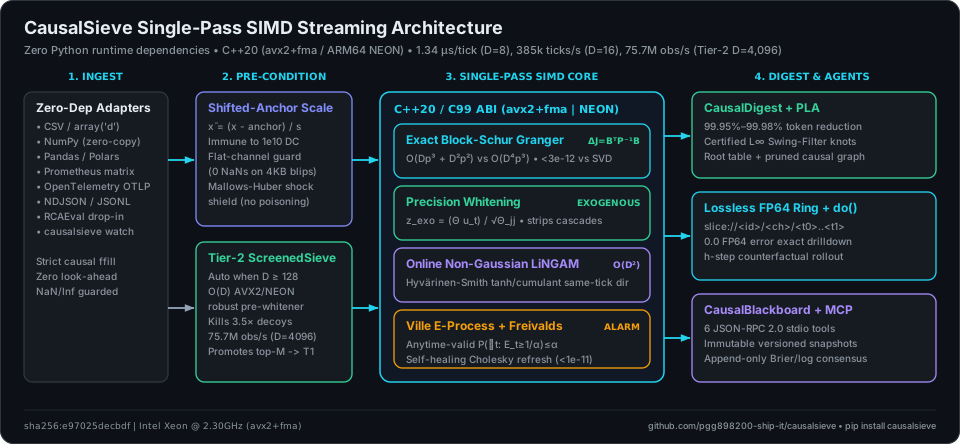
Exact Block-Schur Conditional Granger (
O(D p^3 + D^2 p^2)vsO(D^4 p^3)): All $D$ target channels share one inverse lagged Gram matrix $P_t = (Z_t^\top W_t Z_t + \alpha I)^{-1} \in \mathbb{R}^{K \times K}$ updated in $O(K^2)$ AVX2+FMA / NEON Sherman-Morrison steps. By the exact Schur complement identity, removing source channel $i$'s lag block $S_i$ increases the exact weighted ridge objective for target $j$ by: $$\Delta J_{i \to j} \equiv B_{S_i, j}^\top \left(P_{S_i, S_i}\right)^{-1} B_{S_i, j}$$ Zero reduced-model refits. Exact to< 1.86e-12against batch FP64 SVD refits. -
L1-Resident Deferred BLAS-3 Sufficient Statistics + Runtime CPUID Multi-ISA Dispatch (
v0.2.0):- Six additive sufficient-statistic matrices ($G, C, S_u, M_{u^2 v}, M_{u \tanh v}, M_{uv}$) accumulate in L1-resident
B_SLAB=32slabs and flush via register-blocked4×8AVX2+FMA /4×4NEONSYRK/GEMMmicro-kernels — cutting per-tick memory traffic by >60% while keeping exact algebraic parity (< 6e-14). - All
x86_64wheels compile both portable baseline and-mavx2 -mfma//arch:AVX2kernel translation units into ONE shared library and dispatch at runtime viaCPUID + OSXSAVE + XGETBV(CAUSALSIEVE_FORCE_SCALAR=1override for testing). ZeroSIGILLon old CPUs; fullavx2+fmaautomatically on modern x86-64, nativeneonon Apple Silicon & Linux ARM64.
- Six additive sufficient-statistic matrices ($G, C, S_u, M_{u^2 v}, M_{u \tanh v}, M_{uv}$) accumulate in L1-resident
-
Precision-Whitened Exogenous Attribution + Online Non-Gaussian LiNGAM Orientation: Temporal lags are stripped via causal one-step innovations $\hat{u}t = \tilde{x}t - B{t-1}^\top z_t$; contemporaneous propagation is stripped via the online innovation precision matrix $\Theta{t-1} = (\Sigma_{u,t-1} + \gamma_{\text{eff}} I)^{-1}$: $$z^{\text{exo}}{j,t} = \frac{(\Theta{t-1} \hat{u}_t)j}{\sqrt{\Theta{jj,t-1}}}$$ Under skewed or heavy-tailed shocks, online Hyvärinen-Smith pairwise cumulant/$\tanh$ ratios ($O(D^2)$ streaming moments) orient contemporaneous edges $i \to j$ within the same tick.
-
Production Numerical & Statistical Armor:
- Shifted-anchor normalization + flat-channel guard: Immune to ERDDAP
1e10DC offsets (100%AC@1) and constant-during-warmup 4 KB Kubernetes memory-page blips (0 NaNs). - Mallows-Huber shock shield + self-healing Freivalds drift guard: Prevents sustained outages from poisoning baseline $B_t$/$\Theta_t$ and auto-refreshes via Cholesky (
Freivalds < 2.6e-14). - Anytime-valid ONS betting E-process: Finite-sample Hotelling-$T^2$-adjusted supermartingale obeying Ville's inequality ($\mathbb{P}_{H_0}(\exists t : E_t \ge 1/\alpha) \le \alpha$).
- Tier-2
ScreenedSieve(D = 128..16,384+) + CertifiedL_infSwing-Filter PLA + Lossless FP64 Ring.
- Shifted-anchor normalization + flat-channel guard: Immune to ERDDAP
Real-World Kubernetes Benchmark (RCAEval, ALL 645 RE1+RE2 Incidents)
Evaluated strictly one-shot with zero retuning across all 645 real microservice failure cases from phamquiluan/RCAEval (RE1 375 metric-only cases + RE2 270 OpenTelemetry cases across Online Boutique, Sock Shop, and 64–68 service Train Ticket; full SHA-256 provenance in benchmarks/results/rcaeval_suite.json):
| Method | Micro AC@1 | Micro AC@3 | Micro AC@5 | Micro Avg@5 | Micro MRR | Macro AC@1 | Macro MRR | Mean ms/case |
|---|---|---|---|---|---|---|---|---|
causalsieve (symmetric baseline) |
75.7% | 91.0% | 95.2% | 0.882 | 0.839 | 76.5% | 0.844 | 160.9 ms |
baro_fse24 (Pham et al., FSE'24) |
72.7% | 90.1% | 95.8% | 0.874 | 0.824 | 73.6% | 0.829 | 7.4 ms |
nsigma_rcaeval (RCAEval N-Sigma) |
72.6% | 90.5% | 96.1% | 0.876 | 0.823 | 73.7% | 0.830 | 3.6 ms |
circa_structural_rca (KDD'22-style) |
71.6% | 86.2% | 91.6% | 0.847 | 0.808 | 72.7% | 0.816 | 44.6 ms |
pairwise_granger_z |
53.5% | 78.4% | 86.4% | 0.745 | 0.681 | 54.9% | 0.689 | 210.3 ms |
causalsieve_blind (zero inject_time) |
52.2% | 82.8% | 88.7% | 0.774 | 0.688 | 50.8% | 0.682 | 163.3 ms |
rolling_mad_z |
45.7% | 78.1% | 87.9% | 0.729 | 0.642 | 45.9% | 0.642 | 11.8 ms |
- Leads both suites independently:
RE1(n=375) 71.5% AC@1 / 0.816 MRR vs BARO68.3%/ N-Sigma66.7%;RE2OpenTelemetry (n=270) 81.5% AC@1 / 0.872 MRR vs N-Sigma80.7%/ BARO78.9%. - Biggest wins on the hardest 64–68 service Train Ticket clusters:
RE1-TT57.6% vs BARO50.4%(+7.2 pts) / N-Sigma45.6%(+12.0 pts) / CIRCA40.0%(+17.6 pts);RE2-TT(D=340..376) 73.3% vs BARO67.8%(+5.5 pts);RE2-OB88.9% vs BARO85.6%(+3.3 pts). - Mean token reduction across all 645 incidents:
297,241 -> 70.4tokens (99.976%reduction).
Deep-Dive Guides & Agent Documentation
- CausalSieve vs
statsmodels,tigramite,sklearn, &river— Drop-in migration code, complexity proofs, and honest crossovers. - Kubernetes, Prometheus, OpenTelemetry & Streaming RCA Cookbook — Production recipes for Prometheus, OTLP/JSON, NDJSON,
causalsieve watch, andRCAEval. - LLM & Multi-Agent Telemetry Compression Guide —
uvxMCP setup,SKILL.md, 99.90%–99.98% token reduction with0.0FP64slice://recovery, andCausalBlackboard. - Full Benchmarks & Optimization Log · Interactive Explorer & Pure-Markdown Docs ·
llms.txt·llms-full.txt·SKILL.md.
Honest Tradeoffs & Known Limits
We report failures and crossovers alongside wins:
- Simple low-D univariate outages (
RE1-OB,RE1-SS,RE2-SS): Fast normal-vs-anomalous scorers (BARO,N-Sigma,2–5 ms/case) are within ±1–3 pts ofcausalsieve(23–30 ms/case) on simpler 50–80 metric topologies;causalsievepulls ahead sharply on large 64–68 service topologies (RE1-TT+7.2 pts,RE2-TT+5.5 pts), overall across all 645 incidents, and whenever you need the directed causal graph, counterfactualdo(), or compressed digest. - Fault classes (
delay/loss): Across all 645 cases,causalsieveleadsmem(95.8%),disk(78.3%),socket(77.8%), andcpu(75.8%), whileN-Sigmaedges outdelay(75.8%vs74.2%) andBAROedges outloss(56.7%vs53.3%). - Offline one-shot at
D=8: AtD=8, a single offline NumPy refit without streaming state (2.43 ms) is slightly faster than CausalSieve's full streaming pass (3.10 ms). CausalSieve already beats offline NumPy atD=16(5.66 msvs5.73 ms) and scales to 28.5× faster atD=32(2,334× vsstatsmodels). - Single-tick Python FFI overhead: Calling
.push(x)from Python 1,000 times adds ~11 ms ofctypescall overhead; use.push_batch(X)(or C ABI / nativecausalsieve-bin) for full385k–747k ticks/sspeed. - Post-mortem
Tier-2(ScreenedSieve) replay:ScreenedSieve(4.0 ms/case) is built for live streaming firehoses (D=128..16,384+,75.7M obs/s,100%AC@1); on long1,441-tick post-mortem traces (RE2), its defaultring_cap=512evicts the pre-fault baseline (use_screened=Falsedense Tier-1 is recommended for post-mortem replay). - Purely nonlinear / Gaussian contemporaneous cases: Default linear
VAR(p)misses pure ReLU/threshold cascades (enablenonlinear_hinge=Truefor0.450AC@1 /0.685MRR on saturation cascades at2×feature width). Gaussian contemporaneous shocks have valid undirected precision skeletons while orientation requires non-Gaussianity by theory.
Optional latency planning
CausalSieve identifies suspected upstream causes in telemetry. For a workflow with recorded task durations and finish-to-start dependencies, estimate how much a faster task could shorten the run with the independent PathProbe toolkit.
Reproduce Everything
make test-asan                                    # C++20 unit tests under ASan + UBSan (0 findings)
pytest tests/ -v                                  # 59/59 oracle, dispatch, causality, RCA, adapters, digest, MCP
pytest tests/breaker_audit.py -v                  # 29/29 adversarial security, 8/8 SHA-256 provenance & zero-dep audit
python3 benchmarks/bench_speed.py                 # Speed vs statsmodels, tigramite, sklearn, river, NumPy
python3 benchmarks/bench_optimization_log.py      # 5-stage compounding optimization ladder
python3 benchmarks/bench_synthetic_rca.py         # 100-episode multi-regime RCA
python3 benchmarks/bench_sift_scale.py            # Tier-2 D=128..4096 loud-decoy firehose
python3 benchmarks/bench_rcaeval.py               # Real Kubernetes RCAEval (10 DEV + 40 sealed holdout)
python3 benchmarks/bench_rcaeval_trainticket.py   # Real 64-service Train Ticket (25 incidents, D~217)
python3 benchmarks/bench_rcaeval_suite.py         # ALL 645 real Kubernetes RE1 + RE2 OpenTelemetry incidents
python3 benchmarks/bench_agent_tokens.py          # Agent BPE token overflow, 0.0 FP64 slice:// & Blackboard consensus
python3 benchmarks/generate_charts.py             # Regenerate all 4 SVG figures directly from frozen JSONs
Open demo/causalsieve_explorer.html locally in any browser (zero external requests / zero CDN) — or live at pgg898200-ship-it.github.io/causalsieve.
License
MIT — see LICENSE.
1 maintainer

Metadata
1 maintainer
Release files for causalsieve 0.2.0
For a detailed explanation of source distributions (sdists) and built distributions (wheels), please see the package formats documentation.
Source distribution (sdist)
| File | Size | Uploaded | Provenance | Actions |
|---|---|---|---|---|
| causalsieve-0.2.0.tar.gz | 216.9 kB | With provenance | Details for causalsieve-0.2.0.tar.gz |
Built distributions (wheels)
| File | Actions Reset | |||
|---|---|---|---|---|
| causalsieve-0.2.0-py3-none-win_amd64.whl | Python 3 | none | Windows x86-64 | Details for causalsieve-0.2.0-py3-none-win_amd64.whl |
| causalsieve-0.2.0-py3-none-manylinux_2_27_x86_64.manylinux_2_28_x86_64.whl | Python 3 | none | Linux glibc 2.27+ x86-64, Linux glibc 2.28+ x86-64 | Details for causalsieve-0.2.0-py3-none-manylinux_2_27_x86_64.manylinux_2_28_x86_64.whl |
| causalsieve-0.2.0-py3-none-manylinux_2_26_aarch64.manylinux_2_28_aarch64.whl | Python 3 | none | Linux glibc 2.26+ ARM64, Linux glibc 2.28+ ARM64 | Details for causalsieve-0.2.0-py3-none-manylinux_2_26_aarch64.manylinux_2_28_aarch64.whl |
| causalsieve-0.2.0-py3-none-macosx_11_0_arm64.whl | Python 3 | none | macOS 11.0+ ARM64 | Details for causalsieve-0.2.0-py3-none-macosx_11_0_arm64.whl |
| causalsieve-0.2.0-py3-none-macosx_10_13_x86_64.whl | Python 3 | none | macOS 10.13+ x86-64 | Details for causalsieve-0.2.0-py3-none-macosx_10_13_x86_64.whl |
Total release size: 895.2 kB
Release files / causalsieve-0.2.0.tar.gz
| Download URL | causalsieve-0.2.0.tar.gz |
|---|---|
| Size | 216.9 kB |
| Tags | Source |
|
SHA-256 checksum How to use checksums |
a5b6203423c5700b97c5c8c8e049f4ff5b67501bdd758a3881453a388ba9923e
|
|
BLAKE2b-256 checksum How to use checksums |
b07ed57986ae31eedfc8a14ab5012861facac2dd4dbb9057b27beab1a33b7e71
|
| Upload date | |
|
Uploaded using Trusted Publishing? What is trusted publishing? |
Yes |
| Uploaded via |
twine/7.0.0 CPython/3.13.16
|
Provenance
Provenance describes where a file came from. On PyPI, provenance is shared via attestations, which provide a verifiable record of the build or publishing details. View details, limitations and caveats.


PyPI Publish Attestation
PyPI verified that this artifact, at this checksum, originated from the publisher listed below.
Signed by GitHub Actions, verified by PyPI on Nov 22, 2026.
Transparency logRelease files / causalsieve-0.2.0-py3-none-win_amd64.whl
| Download URL | causalsieve-0.2.0-py3-none-win_amd64.whl |
|---|---|
| Size | 130.0 kB |
| Tags | Python 3 Windows x86-64 |
|
SHA-256 checksum How to use checksums |
76f1e66e0dab9758048522ae40602236979a120110d2c956cc6c9cf53a694bc2
|
|
BLAKE2b-256 checksum How to use checksums |
c4cd6e76251240d8b37e68dc4ecdd097edc82faecb94bca5994fb743d9bdd826
|
| Upload date | |
|
Uploaded using Trusted Publishing? What is trusted publishing? |
Yes |
| Uploaded via |
twine/7.0.0 CPython/3.13.16
|
Provenance
Provenance describes where a file came from. On PyPI, provenance is shared via attestations, which provide a verifiable record of the build or publishing details. View details, limitations and caveats.
PyPI Publish Attestation
PyPI verified that this artifact, at this checksum, originated from the publisher listed below.
Signed by GitHub Actions, verified by PyPI on Nov 22, 2026.
Transparency logRelease files / causalsieve-0.2.0-py3-none-manylinux_2_27_x86_64.manylinux_2_28_x86_64.whl
| Download URL | causalsieve-0.2.0-py3-none-manylinux_2_27_x86_64.manylinux_2_28_x86_64.whl |
|---|---|
| Size | 141.0 kB |
| Tags | Linux glibc 2.27+ x86-64 Linux glibc 2.28+ x86-64 Python 3 |
|
SHA-256 checksum How to use checksums |
978b627bcae21319a7d05c17a2b8ad2cbf988adbe70a0fab09617a329154b366
|
|
BLAKE2b-256 checksum How to use checksums |
c23753b1c74165a9f8a010dc6d281b2bdf5d4bb9d9002156695525dd0c9f1684
|
| Upload date | |
|
Uploaded using Trusted Publishing? What is trusted publishing? |
Yes |
| Uploaded via |
twine/7.0.0 CPython/3.13.16
|
Provenance
Provenance describes where a file came from. On PyPI, provenance is shared via attestations, which provide a verifiable record of the build or publishing details. View details, limitations and caveats.
PyPI Publish Attestation
PyPI verified that this artifact, at this checksum, originated from the publisher listed below.
Signed by GitHub Actions, verified by PyPI on Nov 22, 2026.
Transparency logRelease files / causalsieve-0.2.0-py3-none-manylinux_2_26_aarch64.manylinux_2_28_aarch64.whl
| Download URL | causalsieve-0.2.0-py3-none-manylinux_2_26_aarch64.manylinux_2_28_aarch64.whl |
|---|---|
| Size | 132.2 kB |
| Tags | Linux glibc 2.26+ ARM64 Linux glibc 2.28+ ARM64 Python 3 |
|
SHA-256 checksum How to use checksums |
1ee49d0920d4939ad084fe87fe612e8ca236b2a19277f7e35817123eed78d71e
|
|
BLAKE2b-256 checksum How to use checksums |
87bd2399bdcf4bed8d9882ae9f409b3df66a62f8c4ac541a36a0a173df285b01
|
| Upload date | |
|
Uploaded using Trusted Publishing? What is trusted publishing? |
Yes |
| Uploaded via |
twine/7.0.0 CPython/3.13.16
|
Provenance
Provenance describes where a file came from. On PyPI, provenance is shared via attestations, which provide a verifiable record of the build or publishing details. View details, limitations and caveats.
PyPI Publish Attestation
PyPI verified that this artifact, at this checksum, originated from the publisher listed below.
Signed by GitHub Actions, verified by PyPI on Nov 22, 2026.
Transparency logRelease files / causalsieve-0.2.0-py3-none-macosx_11_0_arm64.whl
| Download URL | causalsieve-0.2.0-py3-none-macosx_11_0_arm64.whl |
|---|---|
| Size | 131.3 kB |
| Tags | Python 3 macOS 11.0+ ARM64 |
|
SHA-256 checksum How to use checksums |
e741a92e9f95d5c7939e1572b820211e21e04eea12111abd8b6bd53f4610b800
|
|
BLAKE2b-256 checksum How to use checksums |
fddf03638accc483cf3c234744e2d02ec3c6e86218da80efb2968116d2daf6a4
|
| Upload date | |
|
Uploaded using Trusted Publishing? What is trusted publishing? |
Yes |
| Uploaded via |
twine/7.0.0 CPython/3.13.16
|
Provenance
Provenance describes where a file came from. On PyPI, provenance is shared via attestations, which provide a verifiable record of the build or publishing details. View details, limitations and caveats.
PyPI Publish Attestation
PyPI verified that this artifact, at this checksum, originated from the publisher listed below.
Signed by GitHub Actions, verified by PyPI on Nov 22, 2026.
Transparency logRelease files / causalsieve-0.2.0-py3-none-macosx_10_13_x86_64.whl
| Download URL | causalsieve-0.2.0-py3-none-macosx_10_13_x86_64.whl |
|---|---|
| Size | 143.8 kB |
| Tags | Python 3 macOS 10.13+ x86-64 |
|
SHA-256 checksum How to use checksums |
608b0ed978b6815721f75cc0ac09728cf3a9595d6ea9327256d25b430427a9db
|
|
BLAKE2b-256 checksum How to use checksums |
6f8d938aad78764625e254529e7412ed60bfd276bca8ae948ac3d81d0f5e9423
|
| Upload date | |
|
Uploaded using Trusted Publishing? What is trusted publishing? |
Yes |
| Uploaded via |
twine/7.0.0 CPython/3.13.16
|
Provenance
Provenance describes where a file came from. On PyPI, provenance is shared via attestations, which provide a verifiable record of the build or publishing details. View details, limitations and caveats.
PyPI Publish Attestation
PyPI verified that this artifact, at this checksum, originated from the publisher listed below.
Signed by GitHub Actions, verified by PyPI on Nov 22, 2026.
Transparency logSecurity for causalsieve 0.2.0
Provenance
Provenance describes where a file came from. On PyPI, provenance is shared via attestations, which provide a verifiable record of the build or publishing details. View details, limitations and caveats.
Full provenance
All 6 files in this release have been uploaded with provenance metadata.
Attestation for causalsieve-0.2.0.tar.gz
PyPI Publish Attestation
PyPI verified that this artifact, at this checksum, originated from the publisher listed below.
Signed by GitHub Actions, verified by PyPI on Nov 22, 2026.
Transparency logA note on package security
PyPI is a repository for distributing packages, not a service for auditing them. While third-party security researchers and our staff do their best to detect and remove malicious packages, PyPI cannot guarantee the quality, security or suitability of any given package.
To learn more about protecting yourself from malicious actors, visit our package security documentation.














