

CaveAgent: Transforming LLMs into Stateful Runtime Operators


"From text-in-text-out to (text&object)-in-(text&object)-out"
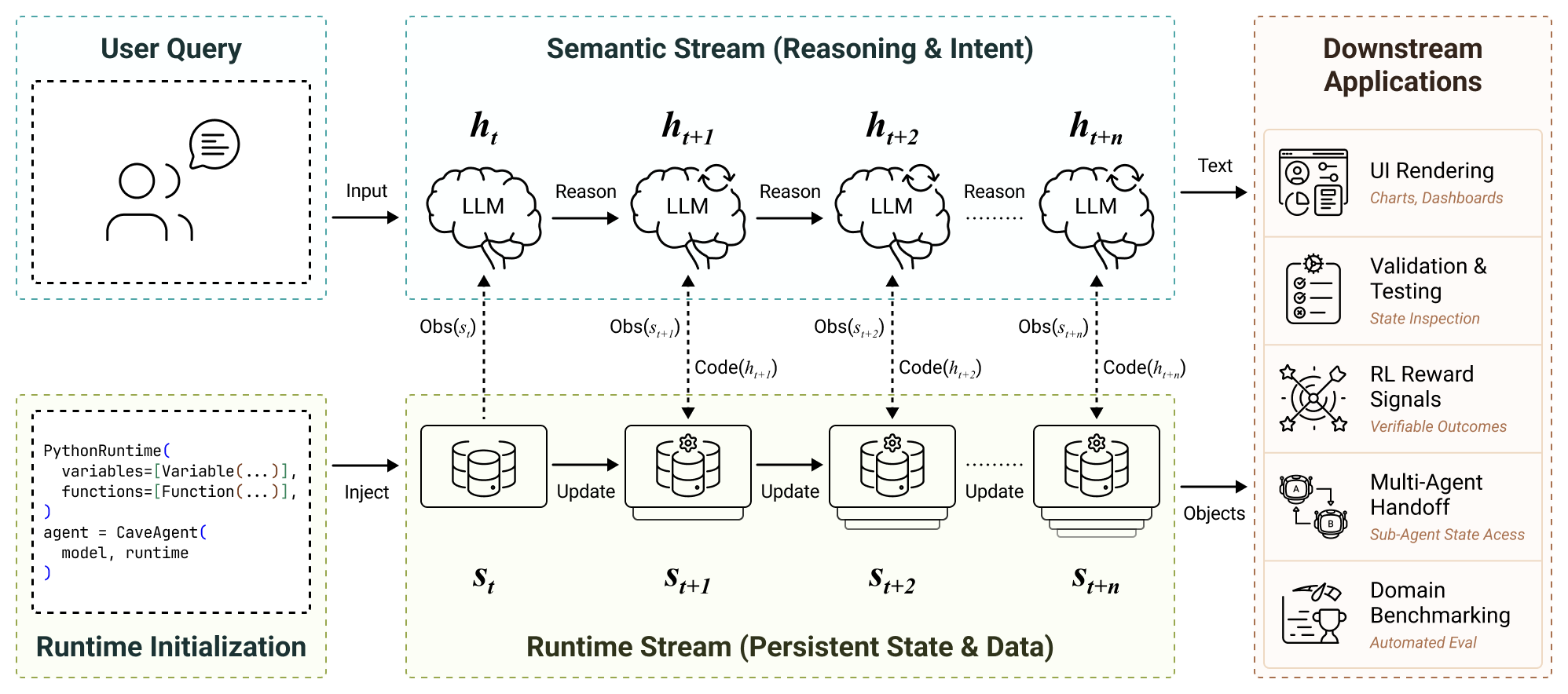
Most LLM agents operate under a text-in-text-out paradigm, with tool interactions constrained to JSON primitives. CaveAgent breaks this with Stateful Runtime Management—a persistent Python runtime with direct variable injection and retrieval:
- Inject any Python object into the runtime—DataFrames, models, database connections, custom class instances—as first-class variables the LLM can manipulate
- Persist state across turns without serialization; objects live in the runtime, not in the context window
- Retrieve manipulated objects back as native Python types for downstream
https://github.com/user-attachments/assets/0e4a23b0-1afb-4408-8d87-ae1e13388aae
Table of Contents
- Installation
- Hello World
- Runtimes
- Examples
- Agent Skills
- Context Compaction
- Large Outputs
- Run Budgets
- API Resilience
- Features
- Configuration
- LLM Provider Support
Installation
pip install 'cave-agent[all]'
Choose your installation:
# OpenAI support
pip install 'cave-agent[openai]'

# 100+ LLM providers via LiteLLM
pip install 'cave-agent[litellm]'

# Process-isolated kernel runtime (IPyKernelRuntime)
pip install 'cave-agent[ipykernel]'
Hello World
import asyncio
from cave_agent import CaveAgent
from cave_agent.runtime import IPythonRuntime, Variable, Function
from cave_agent.models import LiteLLMModel

model = LiteLLMModel(model_id="model-id", api_key="your-api-key", custom_llm_provider="openai")


async def main():
    def reverse(s: str) -> str:
        """Reverse a string"""
        return s[::-1]

    runtime = IPythonRuntime(
        variables=[
            Variable("secret", "!dlrow ,olleH", "A reversed message"),
            Variable("greeting", "", "Store the reversed message"),
        ],
        functions=[Function(reverse)],
    )
    agent = CaveAgent(model, runtime=runtime)
    response = await agent.run("Reverse the secret")
    print(await runtime.retrieve("secret"))  # Hello, world!
    print(response.content)  # Agent's text response


asyncio.run(main())
Runtimes
CaveAgent provides two runtime backends. Both share the same API for injecting functions, variables, and types — choose based on your trust and isolation requirements.
IPythonRuntime (default)
Code runs in the same process via an embedded IPython shell. Injected objects (DataFrames, DB connections, custom classes) are accessed directly — no serialization overhead.
from cave_agent.runtime import IPythonRuntime, Function, Variable

runtime = IPythonRuntime(
    functions=[Function(my_func)],
    variables=[Variable("data", my_dataframe, "Input data")],
)
agent = CaveAgent(model, runtime=runtime)
Best for: trusted environments, internal tools, when you need zero-overhead access to complex Python objects.
IPyKernelRuntime (process-isolated)
Code runs in a separate IPython kernel process. If the code crashes (segfault, OOM, infinite loop), the host process stays alive — just reset the kernel and continue.
pip install 'cave-agent[ipykernel]'
from cave_agent.runtime import IPyKernelRuntime, Function, Variable

async with IPyKernelRuntime(
    functions=[Function(my_func)],
    variables=[Variable("data", [1, 2, 3], "Input data")],
) as runtime:
    agent = CaveAgent(model, runtime=runtime)
    response = await agent.run("Analyze the data")
Injected objects are serialized via dill, which supports local functions, closures, lambdas, and most Python objects.
The subprocess starts on the first code execution, not at construction, so a conversation that never produces a code block never spawns a kernel. start() is available and idempotent if you would rather pay the ~1s up front; teardown is explicit either way (async with or stop()). stop() lets a request already in flight finish before releasing the kernel — call interrupt() first if you need it to stop immediately.
Best for: untrusted code execution, multi-tenant environments, sandboxed agent workflows.
Comparison
| IPythonRuntime | IPyKernelRuntime | |
|---|---|---|
| Isolation | Same process | Separate process |
| Crash impact | Host process dies | Kernel restarts, host survives |
| Object injection | Direct reference, zero-copy | Serialized via dill |
| Startup | Instant | ~1s, deferred to the first code execution |
| Local functions / closures | Always works | Works (via dill) |
| Requires | (included) | pip install 'cave-agent[ipykernel]' |
Examples
Data Visualization
from cave_agent import CaveAgent
from cave_agent.runtime import IPythonRuntime, Variable
from cave_agent.models import LiteLLMModel

model = LiteLLMModel(model_id="model-id", api_key="your-api-key", custom_llm_provider="openai")

# 1. Inject — real DB connection & chart config manager
runtime = IPythonRuntime(
    variables=[
        Variable("engine", database_engine),  # SQLAlchemy Engine
        Variable("echarts_config_manager", EChartsConfigManager()),  # Chart collector
    ]
)
agent = CaveAgent(model, runtime=runtime)

# 2. Query — LLM sees object types, not data
await agent.run("Show me the air quality trend for the past week")

# LLM generates & executes:
#   df = pd.read_sql("SELECT * FROM air_quality WHERE ...", engine)
#   echarts_config_manager.add_config({
#       "title": {"text": "Air Quality - Past Week"},
#       "xAxis": {"data": dates},
#       "series": [{"name": "PM2.5", "type": "line", "data": ...}]
#   })

# 3. Retrieve — get real chart configs for rendering
mgr = await runtime.retrieve("echarts_config_manager")  # Real Python object
configs = mgr.get_configs()

for config in configs:
    render_echarts(config)  # Render directly in web UI
Function Calling
# Inject functions and variables into runtime
runtime = IPythonRuntime(
    variables=[Variable("tasks", [], "User's task list")],
    functions=[Function(add_task), Function(complete_task)],
)
agent = CaveAgent(model, runtime=runtime)

await agent.run("Add 'buy groceries' to my tasks")
print(await runtime.retrieve("tasks"))  # [{'name': 'buy groceries', 'done': False}]
See examples/basic_usage.py for a complete example.
Stateful Object Interactions
# Inject objects with methods - LLM can call them directly
runtime = IPythonRuntime(
    types=[Type(Light), Type(Thermostat)],
    variables=[
        Variable("light", Light("Living Room"), "Smart light"),
        Variable("thermostat", Thermostat(), "Home thermostat"),
    ],
)
agent = CaveAgent(model, runtime=runtime)

await agent.run("Dim the light to 20% and set thermostat to 22°C")
light = await runtime.retrieve("light")  # Object with updated state
See examples/object_methods.py for a complete example.
Multi-Agent Coordination
# Sub-agents with their own runtimes
cleaner_agent = CaveAgent(
    model,
    runtime=IPythonRuntime(
        variables=[
            Variable("data", [], "Input"),
            Variable("cleaned_data", [], "Output"),
        ]
    ),
)

analyzer_agent = CaveAgent(
    model,
    runtime=IPythonRuntime(
        variables=[
            Variable("data", [], "Input"),
            Variable("insights", {}, "Output"),
        ]
    ),
)

# Orchestrator controls sub-agents as first-class objects
orchestrator = CaveAgent(
    model,
    runtime=IPythonRuntime(
        variables=[
            Variable("raw_data", raw_data, "Raw dataset"),
            Variable("cleaner", cleaner_agent, "Cleaner agent"),
            Variable("analyzer", analyzer_agent, "Analyzer agent"),
        ]
    ),
)

# Inject → trigger → retrieve
await orchestrator.run("Clean raw_data using cleaner, then analyze using analyzer")
insights = await analyzer_agent.runtime.retrieve("insights")
See examples/multi_agent.py for a complete example.
Real-time Streaming
Events are frozen dataclasses with named, typed fields — match on the type:
from cave_agent import (
    CodeEvent,
    ExecutionResultEvent,
    StoppedEvent,
    TextEvent,
    ThinkingChunkEvent,
)

async for event in agent.stream_events("Analyze this data"):
    match event:
        case ThinkingChunkEvent():  # reasoning streams live (o1/o3, DeepSeek-R1, …)
            print(event.content, end="")
        case TextEvent():
            print(event.content, end="")
        case CodeEvent():
            print(f"\nExecuting: {event.code}")
        case ExecutionResultEvent():
            print(f"{'Result' if event.success else 'Error'}: {event.output}")
        case StoppedEvent():
            print(
                f"\n{event.stop_reason} · {event.steps} steps · "
                f"{event.usage.total_tokens} tokens · {event.elapsed:.1f}s"
            )
If you stop before StoppedEvent, close the stream explicitly; break does
not close a named async iterator:
from contextlib import aclosing

stream = agent.stream_events("Analyze this data")
async with aclosing(stream):
    async for event in stream:
        if should_stop(event):
            break
To render a run in the terminal, wrap it — the agent core has no notion of display:
from cave_agent.renderers import TerminalRenderer, render_run

async for event in TerminalRenderer().render(agent.stream_events(q)):
    ...  # rendered, and still yielded to you

response = await render_run(agent, q)  # or just: display + AgentResponse
Reasoning models. When the model exposes a reasoning trace (OpenAI o1/o3, DeepSeek-R1, Qwen/Moonshot reasoning, …), CaveAgent streams it live as ThinkingChunkEvents (before the answer), then seals the segment with one ThinkingEvent carrying the full trace and its measured duration. Reasoning is captured, kept out of the code-block parser, and never sent back on the wire.
See examples/stream.py for a complete example.
Security Rules
# Block dangerous operations with AST-based validation
rules = [
    ImportRule({"os", "subprocess", "sys"}),  # also blocks os.path, subprocess.run, ...
    FunctionRule({"eval", "exec", "open"}),  # also catches aliasing: f = open; f(...)
    AttributeRule({"__globals__", "__builtins__"}),
    RegexRule(r"rm\s+-rf|sudo\s+", "Block shell escapes"),
]
runtime = IPythonRuntime(security_checker=SecurityChecker(rules))
⚠️
SecurityCheckeris advisory hardening, not a sandbox. Static AST analysis cannot catch every obfuscation (dynamic reflection, C-extension escapes, etc.). For genuinely untrusted code, run inside a real isolation boundary — a container with seccomp/gVisor and OS resource limits — and use the process-isolatedIPyKernelRuntime. Treat these rules as defense-in-depth.
More Examples
- Basic Usage: Function calling and object processing
- Runtime State: State management across interactions
- Object Methods: Class methods and complex objects
- Multi-Turn: Conversations with state persistence
- Multi-Agent: Data pipeline with multiple agents
- Stream: Streaming responses and events
- Large Output: Oversize output kept in the runtime and reused next turn
Agent Skills
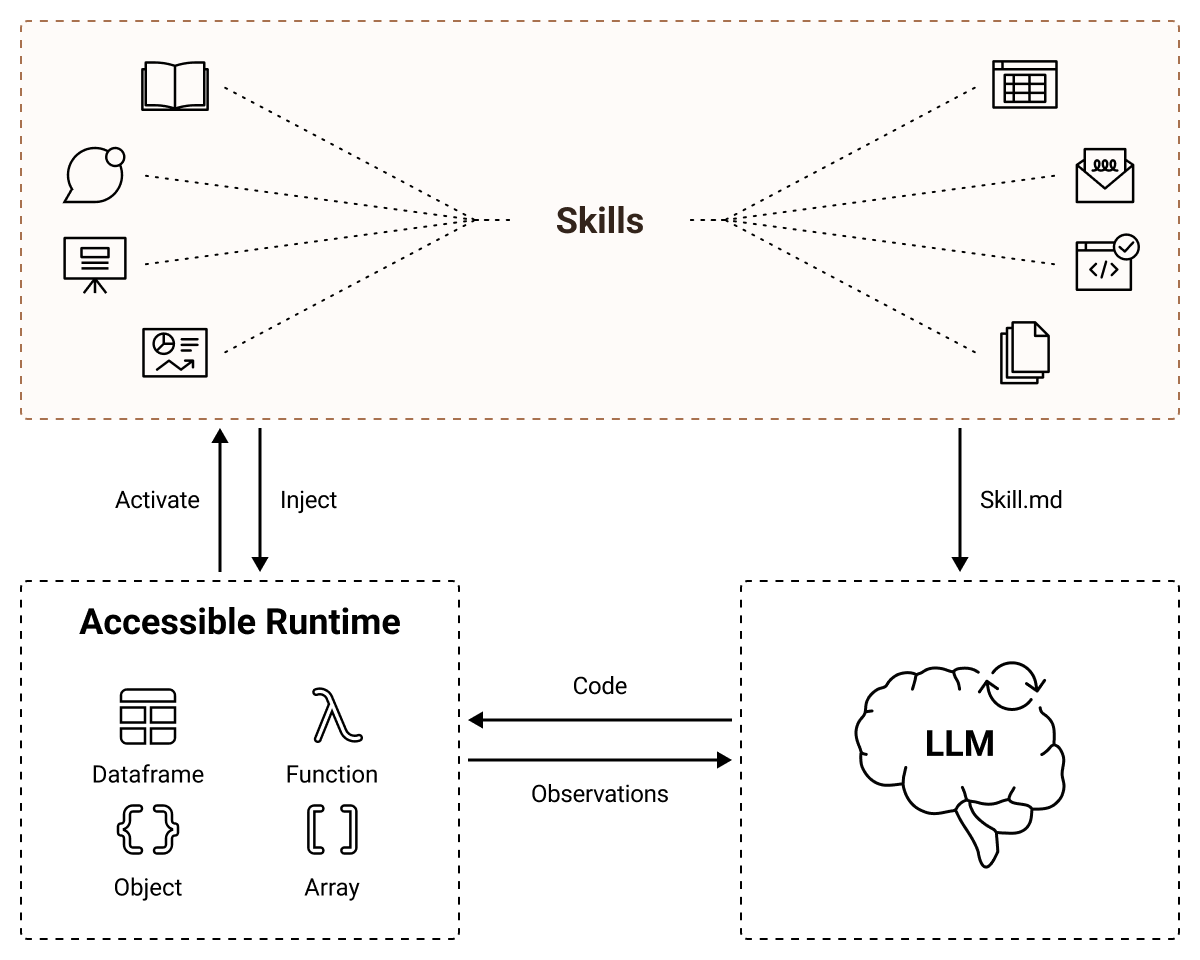
CaveAgent implements the Agent Skills open standard—a portable format for packaging instructions that agents can discover and use. Originally developed by Anthropic and now supported across the AI ecosystem (Claude, Gemini CLI, Cursor, VS Code, and more), Skills enable agents to acquire domain expertise on-demand.
Creating a Skill
A Skill is a directory containing a SKILL.md file with YAML frontmatter:
my-skill/
├── SKILL.md           # Required: Skill definition and instructions
└── injection.py       # Optional: Functions/variables/types to inject (CaveAgent extension)
SKILL.md structure:
---
name: data-processor
description: Process and analyze datasets with statistical methods. Use when working with data analysis tasks.
---

# Data Processing Instructions

## Quick Start
Use the injected functions to analyze datasets...

## Workflows
1. Activate the skill to read its instructions
2. Apply statistical analysis using the provided functions
3. Return structured results
Required fields: name (max 64 chars, lowercase with hyphens) and description (max 1024 chars)
Optional fields: license, compatibility, metadata
How Skills Load (Progressive Disclosure)
Skills use progressive disclosure to minimize context usage:
| Level | When Loaded | Content |
|---|---|---|
| Metadata | At startup | name and description from YAML frontmatter (~100 tokens) |
| Instructions | When activated | SKILL.md body with guidance (loaded on-demand) |
Using Skills
from pathlib import Path
from cave_agent import CaveAgent, Skill
from cave_agent.skills import SkillDiscovery
from cave_agent.runtime import Function, Variable

# Create skills directly
skill = Skill(
    name="my-skill",
    description="A custom skill",
    body_content="# Instructions\nFollow these steps...",
    functions=[Function(my_func)],
    variables=[Variable("config", value={})],
)
agent = CaveAgent(model=model, skills=[skill])

# Or load from files
skill = SkillDiscovery.from_file(Path("./my-skill/SKILL.md"))
agent = CaveAgent(model=model, skills=[skill])

# Or load from directory
skills = SkillDiscovery.from_directory(Path("./skills"))
agent = CaveAgent(model=model, skills=skills)
When skills are loaded, the agent gains access to the activate_skill(skill_name) runtime function to activate a skill and load its instructions.
Injection Module (CaveAgent Extension)
CaveAgent extends the Agent Skills standard with injection.py, allowing skills to provide functions, variables, and types. These exports are registered as hidden runtime bindings at agent construction, while their names and usage stay out of the context until the skill instructions are activated:
from cave_agent.runtime import Function, Variable, Type
from dataclasses import dataclass


def analyze_data(data: list) -> dict:
    """Analyze data and return statistics."""
    return {"mean": sum(data) / len(data), "count": len(data)}


@dataclass
class AnalysisResult:
    mean: float
    count: int
    status: str


CONFIG = {"threshold": 0.5, "max_items": 1000}

__exports__ = [
    Function(analyze_data, description="Analyze data statistically"),
    Variable("CONFIG", value=CONFIG, description="Analysis configuration"),
    Type(AnalysisResult, description="Result structure"),
]
activate_skill() reveals the instructions. Runtime ownership of the exports means name collisions fail during construction and reset() restores them consistently on both backends.
See examples/skill_data_processor.py for a complete example.
Context Compaction
Long conversations inevitably fill up the model's context window. CaveAgent implements a multi-tier compaction strategy inspired by Claude Code's context management system.
How it works:
Token usage exceeds threshold?
        |
        v
  Tier 1: Microcompact (no LLM, instant)
  Clear old execution results, keep recent 6.
  Tokens under threshold? → done
        |
        v
  Tier 2: Full Compact (LLM summarization)
  Summarize older messages, keep recent half.
  Uses dual-phase prompt: <analysis> (discarded) + <summary> (kept).
The system message (index 0) is always preserved. A circuit breaker stops attempting LLM summarization after 3 consecutive failures and closes itself again after a cooldown, so a transient provider blip doesn't disable summarization for the rest of the session. A failed or skipped summary leaves unsummarized history in place; provider failure is never treated as permission to drop turns.
Re-compaction is incremental. A long conversation gets compacted more than once. Rather than feed its own summary back through the summarizer each time — a telephone game that loses fidelity every pass — the existing summary is handed over verbatim and only the turns after it are transcribed, with the model asked to update it. When nothing new followed, the LLM call is skipped entirely.
Oversized summary inputs are folded in batches. The compactor splits a request that exceeds its configured window, and also adapts when the provider returns PromptTooLongError. Each completed batch updates the prior summary before the next one, including when one individual message must be split.
Two refinements keep it accurate before an API token count is available:
- CJK-aware estimation. Chinese / Japanese / Korean text tokenizes more densely than the
chars/4heuristic, so every character is charged according to its class; mixed-language messages do not depend on an arbitrary density threshold. - Emergency recovery. If a request still overflows the window despite proactive compaction, an aggressive path (keep the most recent quarter, summarize the rest) runs and the call is retried once — see API Resilience.
agent = CaveAgent(
    model,
    runtime=runtime,
    context_window=128_000,  # triggers compaction at ~77% usage
)
Large Outputs
Execution output beyond max_exec_output is not discarded. The full text is
bound to a runtime variable and the model receives a marker naming it, plus a
leading preview:
<persisted-output>
Output too large (412093 chars) to inline. The full text is in the runtime
variable `_output_1` (a str). Slice it (`_output_1[:2000]`), search it
(`[l for l in _output_1.splitlines() if 'error' in l]`), or re-parse it —
do not re-run the code to see it.

Preview (first 2000 chars):
...
</persisted-output>
Because the runtime is Python, that variable is a first-class object the model can slice, grep or feed back into pandas — no file round-trip, and no re-running a query that may be slow, expensive, or not reproducible at all. Compaction later strips the preview but keeps the declaration line, since it is the only pointer back to the data.
Each oversize output gets its own name (_output_1, _output_2, …). A marker
sitting in history is a pointer, so a shared name would not "keep the newest" —
it would silently re-point every earlier marker at data it never described.
Run Budgets
Beyond max_steps and max_run_time, a run can be bounded by cost. Budgets are
cumulative and checked at step boundaries — the crossing step completes and is
recorded, the next one does not start:
agent = CaveAgent(model, runtime=runtime, max_total_tokens=200_000)

response = await agent.run("...")
if response.stop_reason is StopReason.BUDGET_EXHAUSTED:
    ...
max_input_tokens and max_output_tokens bound each side independently.
Compaction's own LLM calls are excluded from the totals, so leave headroom on
compaction-heavy sessions.
API Resilience
CaveAgent is built to survive transient failures, provider quirks, and context overflow without dropping the run.
Typed error handling. Provider SDK errors are classified into a provider-agnostic hierarchy so each is handled correctly instead of blindly retried:
- Transient (429 / 5xx / 408 / connection errors) → retried up to 5 times with exponential backoff + jitter (0.5s, 1s, 2s, 4s, 8s);
Retry-Afteris honored when present. - Billing exhausted (
insufficient_quota, credit balance, HTTP 402, …) → never retried — a top-up, not time, is what fixes it. - Context too long → routed to compaction, not retry (below).
Reactive context-overflow recovery. If the model still rejects a prompt as too long (the local estimate under-counted), the agent aggressively compacts — keeps the most recent quarter, summarizes the rest — and retries the call once, instead of failing.
Streaming liveness. A sliding idle-timeout watchdog (stream_idle_timeout, default 120s) abandons a stalled stream — catching stalls transport timeouts miss (proxy keep-alives / provider pings keep the socket readable while no token arrives). It bounds the gap between chunks, not the total response, so raising it for slow models does not affect fast ones. A first-chunk connect failure is retried before any content is emitted; a mid-stream drop salvages what streamed and asks the model to resume. If nothing streamed at all, the run ends with StopReason.MODEL_ERROR rather than raising — a server streaming to a browser gets a terminal event it can forward, not an exception through its response middleware.
Output truncation recovery. When the model's response is cut off (finish_reason="length"), the agent appends the partial response and asks the model to continue from the cutoff — up to 3 times. A code block split across that boundary is rejoined and executed as one block.
The first code block, whatever the chunking. Parsing stops at the fence closing the first block, so a response that arrives as one large delta behaves exactly like one streamed a token at a time. Anything after that fence is left for the next turn.
A fragment is never an answer. Both ways a turn can be incomplete — the output cap and a stream that stops producing — end the run as MODEL_ERROR with completed=False if recovery runs out, rather than presenting truncated text as a finished answer. The partial content is still on response.content.
Failures keep their identity. StopReason separates MODEL_ERROR (the provider), RUNTIME_ERROR (the Python runtime), and INTERNAL_ERROR (a defect in the agent, emitted and re-raised). A stream consumed to termination ends with a StoppedEvent, including cancellation. Explicitly closing the async generator early cannot emit during GeneratorExit; it repairs history with an interruption marker instead.
Execution timeouts need a preemptible runtime. max_exec_timeout is enforced by interrupting the running cell, which only a PreemptibleRuntime (i.e. IPyKernelRuntime) can do. If code catches the interrupt, its kernel is terminated and registered bindings are restored in a lazily started replacement; recovery may briefly delay the timeout event, but expired code is not left running. Passing the option with the in-process IPythonRuntime raises ValueError at construction rather than offering a deadline that could abandon the code but never stop it.
Resource lifecycle. Every model implements aclose() (and works as an async with context manager) to release its HTTP connection pool cleanly.
Features
- Code-based function calling — the LLM writes and runs Python against injected objects, not rigid JSON tool schemas
- Stateful runtime — inject/retrieve real Python objects (DataFrames, connections, class instances) with state persisting across turns; expose class schemas for type-aware code generation
- Two runtimes — in-process
IPythonRuntimeor crash-isolatedIPyKernelRuntime - Reasoning models — streams
o1/ DeepSeek-R1 reasoning live asThinkingChunkEvents - Execution control — step, wall-clock and cumulative-token budgets, plus per-execution / stream-idle timeouts
Skills, compaction, resilience, security, multi-agent, and provider support each have a dedicated section above.
Awesome Blogs
We thank these community to post our work.
- CaveAgent让LLM学会了“跑代码”,你能把Agent变成Jupyter里的“老司机”
- Token消耗减半性能满分!状态化运行时管理能力让智能体性能飞升
- Stateful environment to LLMs
- TEKTA-AI
Configuration
| Parameter | Type | Default | Description |
|---|---|---|---|
| model | Model | required | LLM model instance (OpenAIModel or LiteLLMModel) |
| runtime | Runtime | None | IPythonRuntime (default) or IPyKernelRuntime (process-isolated) |
| skills | List[Skill] | None | List of skill objects to load |
| max_steps | int | 10 | Maximum execution steps per run |
| max_run_time | float | None | None | Wall-clock budget (seconds) for the whole run, checked at turn boundaries. None disables |
| context_window | int | 128000 | Model context window in tokens; sizes the default compactor's trigger |
| compactor | Compactor | None | None | Compaction policy. Defaults to a Compactor over the same model |
| max_exec_output | int | 5000 | Characters of execution output inlined. Beyond this the full text is kept in the runtime and the model gets a marker + preview |
| exec_output_preview_chars | int | 2000 | Leading characters shown inline with that marker. 0 suppresses the preview |
| persisted_output_prefix | str | _output |
Stem for the runtime variables holding oversize outputs (_output_1, _output_2, …) |
| max_total_tokens | int | None | None | Cumulative token budget for the run → StopReason.BUDGET_EXHAUSTED |
| max_input_tokens | int | None | None | Cumulative prompt-token budget |
| max_output_tokens | int | None | None | Cumulative completion-token budget |
| max_exec_timeout | float | None | None | Per-execution deadline. Requires IPyKernelRuntime; kernel recovery may briefly delay the timeout event |
| stream_idle_timeout | float | None | 120.0 | Max seconds between two stream chunks before the model call is abandoned (catches stalls transport timeouts miss). None disables |
| instructions | str | default | User instructions defining agent role and behavior |
| system_instructions | str | default | System-level execution rules and examples |
| system_prompt_template | str | default | Custom system prompt template |
| python_block_identifier | str | python | Code block language identifier |
| messages | List[Message] | None | Initial message history |
LLM Provider Support
CaveAgent supports multiple LLM providers:
OpenAI-Compatible Models
from cave_agent.models import OpenAIModel

model = OpenAIModel(
    model_id="gpt-4",
    api_key="your-api-key",
    base_url="https://api.openai.com/v1",  # or your custom endpoint
    # Set True only for endpoints such as Azure asynchronous filtering;
    # CaveAgent will wait for the terminal verdict before executing code.
    filters_asynchronously=False,
)

# Release the HTTP connection pool when tearing down a long-lived model,
# or use it as an async context manager:
await model.aclose()
# async with OpenAIModel(model_id="gpt-4", api_key="...") as model:
#     ...
LiteLLM Models (Recommended)
LiteLLM provides unified access to hundreds of LLM providers:
from cave_agent.models import LiteLLMModel

# OpenAI
model = LiteLLMModel(
    model_id="gpt-4",
    api_key="your-api-key",
    custom_llm_provider="openai",
    # Set True only when this endpoint delivers filter verdicts after content.
    filters_asynchronously=False,
)

# Anthropic Claude
model = LiteLLMModel(
    model_id="claude-3-sonnet-20240229", api_key="your-api-key", custom_llm_provider="anthropic"
)

# Google Gemini
model = LiteLLMModel(model_id="gemini/gemini-pro", api_key="your-api-key")
Contributing
Contributions are welcome! Please feel free to submit a PR. For more details, see CONTRIBUTING.md.
Citation
If you use CaveAgent in your research, please cite:
@article{ran2026caveagent,
  title={CaveAgent: Transforming LLMs into Stateful Runtime Operators},
  author={Ran, Maohao and Wan, Zhenglin and Lin, Cooper and Zhang, Yanting and others},
  journal={arXiv preprint arXiv:2601.01569},
  year={2026}
}
License
MIT License
1 maintainer

Metadata
1 maintainer
Release files for cave-agent 0.8.0
For a detailed explanation of source distributions (sdists) and built distributions (wheels), please see the package formats documentation.
Source distribution (sdist)
| File | Size | Uploaded | |
|---|---|---|---|
| cave_agent-0.8.0.tar.gz | 422.6 kB | Details |
Built distribution (wheel)
| File | Interpreter | ABI | Platform | Reset |
|---|---|---|---|---|
| cave_agent-0.8.0-py3-none-any.whl | Python 3 | none | any | Details |
Total release size: 561.9 kB
Release files / cave_agent-0.8.0.tar.gz
| Download URL | cave_agent-0.8.0.tar.gz |
|---|---|
| Size | 422.6 kB |
| Tags | Source |
|
SHA-256 checksum How to use checksums |
99b195f65ef7e74a6c88932db94e5361620489ec8b2af23dab0960e61594efd5
|
|
BLAKE2b-256 checksum How to use checksums |
2d41aaa2616fbccdbcc6c25d487e81f17e070024c91000b4a1126ef2c68890ae
|
| Upload date | |
|
Uploaded using Trusted Publishing? What is trusted publishing? |
No |
| Uploaded via |
uv/0.11.32 {"installer":{"name":"uv","version":"0.11.32","subcommand":["publish"]},"python":null,"implementation":{"name":null,"version":null},"distro":{"name":"Ubuntu","version":"24.04","id":"noble","libc":null},"system":{"name":null,"release":null},"cpu":null,"openssl_version":null,"setuptools_version":null,"rustc_version":null,"ci":null}
|
Release files / cave_agent-0.8.0-py3-none-any.whl
| Download URL | cave_agent-0.8.0-py3-none-any.whl |
|---|---|
| Size | 139.3 kB |
| Tags | Python 3 |
|
SHA-256 checksum How to use checksums |
202206fef40c72d888823e2e28474b14b123be23f43e40fead9ad8f31f8173b1
|
|
BLAKE2b-256 checksum How to use checksums |
4a55ca83bcabd5335b6be0eeef83055d73da3f0f037ee0246441dbd80db2f0fe
|
| Upload date | |
|
Uploaded using Trusted Publishing? What is trusted publishing? |
No |
| Uploaded via |
uv/0.11.32 {"installer":{"name":"uv","version":"0.11.32","subcommand":["publish"]},"python":null,"implementation":{"name":null,"version":null},"distro":{"name":"Ubuntu","version":"24.04","id":"noble","libc":null},"system":{"name":null,"release":null},"cpu":null,"openssl_version":null,"setuptools_version":null,"rustc_version":null,"ci":null}
|














