
Slack message-turn bridge to AI coding agents (Claude Code / Codex / Copilot) running on your Mac
Verified details
These details have been verified by PyPIProject links
GitHub Statistics
Maintainers

Project description

cc-agent-messenger
English | 日本語


Reply to your AI coding agents from Slack on your phone, while they keep working in VS Code or an interactive CLI. A small resident bot bridges a Slack channel to the live Claude Code session (and, headlessly, to Codex / Copilot), so you can ask for status, choose the next step, or get pinged when a long job finishes — as complete message turns, not live terminal mirroring.
⚠️ Security & responsibility. This tool runs commands in response to Slack messages (RCE-adjacent). It is built for a single trusted operator on a trusted machine. Enabling hands-free auto-reply grants auto-execution of the reply command — a conscious risk you accept. No warranty; use at your own risk. See SECURITY.md.
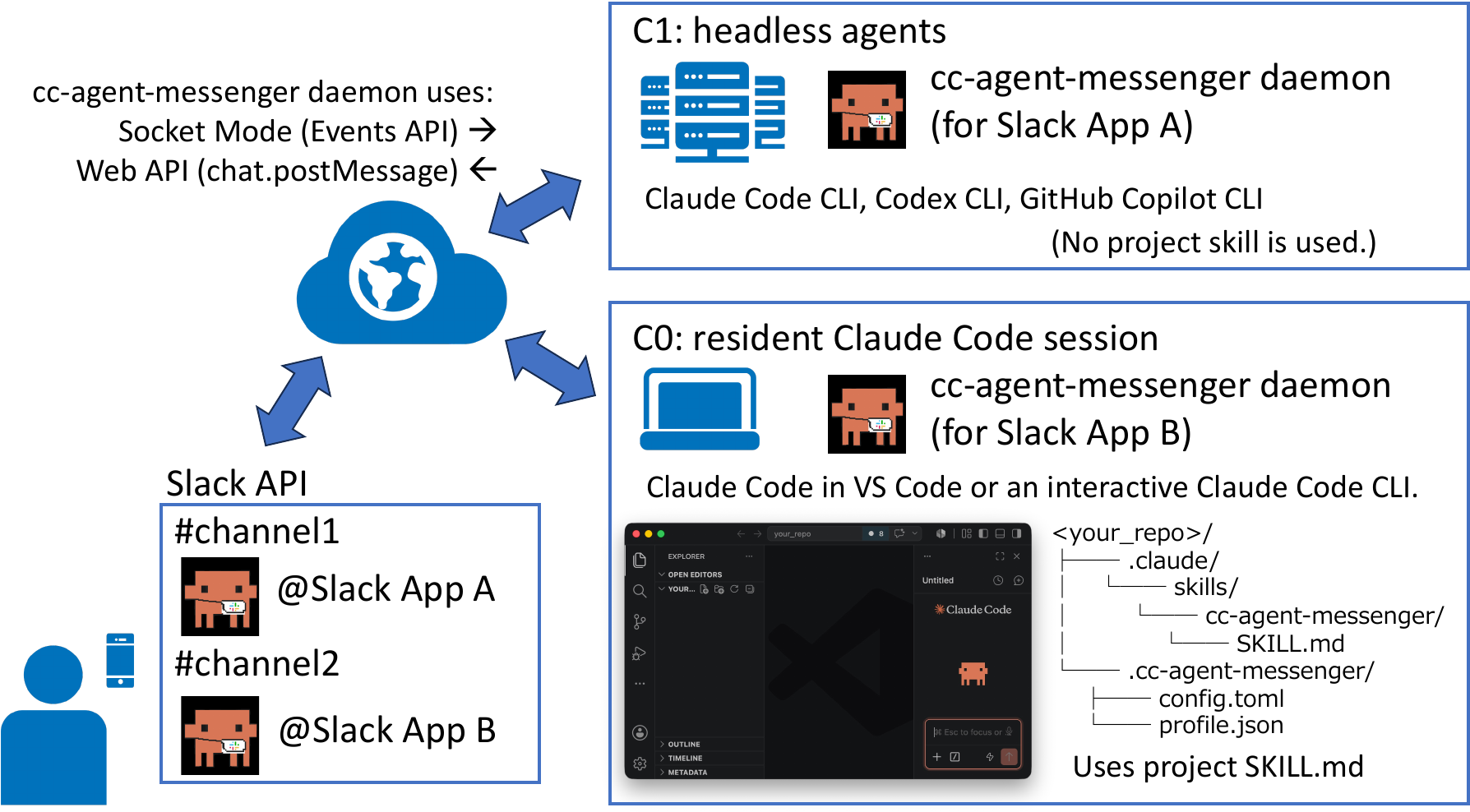
Each Slack app connects to its daemon over Socket Mode. C0 uses a project skill in a resident Claude Code session; C1 runs headless agent turns without that skill. Click the diagram for the PDF.
Demo
What it looks like from your phone — a Slack thread where you @-mention the bot
and the resident Claude Code session in VS Code or the interactive CLI answers (commands start with !;
plain words and emoji/button taps work too):
  you →  @bot !status
  bot →  Running. Watching experiment X — epoch 12/50, loss 0.34 (stable).

  you →  @bot !options
  bot →  Next steps:
           1: lower the learning rate and continue
           2: keep going
           3: pause
         (tap a button, say "1", or react 1️⃣)

  you →  !select 1
  bot →  OK — lowering the learning rate to 1e-4 and continuing.

  bot →  (later, unprompted)  ✅ Experiment X finished. Send !results for the summary.
What it does
- Inbound: a Slack message in your private channel is authorized and appended
to a local file; your resident Claude Code session — either a VS Code window or
an interactive
claudeCLI (C0) — watches it withtail -F, wakes, interprets the command, and replies. Optional C1 instead lets the daemon spawn a headless agent per Slack turn; upgrading does not enable C1 automatically. - Outbound: the reply is posted by the project's own bot, @-mentioning you, so your phone gets a push.
- Per-repository identity:
default_agentnames the default C0 sender; optional[[agent]].display_namenames each routed C0/C1 sender (falling back to stablename). Requires the Slackchat:write.customizescope. - Agents: Claude Code via the live session (C0); Codex and Copilot via headless CLIs (C1). (C1 is also available for Claude.)
Requirements
- macOS or Linux/WSL, VS Code + the Claude Code extension, Python ≥ 3.11,
uv. - A Slack workspace + one private channel, and a Slack app (Socket Mode).
- For Codex/Copilot: their own CLIs installed + authenticated (
codex,@github/copilot). Claude via C0 needs no extra CLI.
Install
uv tool install cc-agent-messenger
# or from source:
uv tool install git+https://github.com/noboru2000/cc-agent-messenger
Update & uninstall
Check your installed version and upgrade to the latest PyPI release:
cc-agent-messenger --version                 # installed version
uv tool upgrade cc-agent-messenger           # -> upgrades, or "Nothing to upgrade"
Nothing to upgrade means you already have the latest. The latest available is the
PyPI badge above, https://pypi.org/project/cc-agent-messenger/, or
uv pip index versions cc-agent-messenger. (pipx: pipx upgrade cc-agent-messenger;
pip: pip install -U cc-agent-messenger.)
After upgrading, re-run cc-agent-messenger init in the same project to refresh
the skill, then cc-agent-messenger restart (= stop + start the daemon). init
keeps your existing bot settings — tokens, owner, channel, and profile.json are
preserved; only the skill is refreshed (it prints what it refreshed vs kept). No VS
Code window reload is needed — re-arm the live session in place (see
docs/SETUP.md §7 → Copy-paste prompts).
Uninstall:
cc-agent-messenger uninstall            # remove the project skill + .gitignore block (keeps config)
cc-agent-messenger uninstall --purge    # also delete .cc-agent-messenger/ (config, profile, audit)
uv tool uninstall cc-agent-messenger    # remove the global CLI
Quickstart
cd your-project
cc-agent-messenger init          # scaffolds the skill, config template, gitignore, allowlist
# 1) create a Slack app (Socket Mode + scopes + Event Subscriptions); see docs/SETUP.md
# 2) fill .cc-agent-messenger/config.toml with your tokens + channel id
cc-agent-messenger daemon        # run the resident bot

# verify the return path:
cc-agent-messenger ping          # -> {"status":"alive"}
cc-agent-messenger send --text "test"   # -> posts to your channel; phone gets a push
Then, in your VS Code Claude Code session, invoke the cc-agent-messenger skill
to start watching the channel and replying. Add the printed allow-rule to
.claude/settings.json to make replies hands-free.
What init adds to .gitignore
init writes a # cc-agent-messenger block with exactly these two entries —
generated runtime + secrets that must never be committed:
| Entry | Why |
|---|---|
.cc-agent-messenger/ |
everything the bot generates: config.toml (Slack tokens), profile.json, audit log, KILL_SWITCH, the send.sock socket, and tmp/.slack_message (the inbound event the Monitor tails) |
.claude/skills/cc-agent-messenger/ |
the skill init copies from the installed package — regenerated on every init, so it isn't committed |
Only the cc-agent-messenger skill folder is ignored under .claude/, not
.claude/ itself — your own Claude Code assets (settings.json, your skills and
commands) stay committable. If a project has nothing else under .claude/, it
simply won't appear in the repo. (Upgrading from a version that also ignored
tmp/ + *.sock? Re-running init keeps those lines — your existing
config.toml may still write inbound events there — and just adds the skill entry.)
Commands
CLI: cc-agent-messenger <init | uninstall | daemon | restart | send | ping | status | stop | kill on|off | doctor | pending | ack | monitors | watch | keepalive | commands> — see cc-agent-messenger --help. restart = stop + start the daemon
(enables a no-reload upgrade). watch / keepalive register on the running daemon —
the same scheduler as Slack !watch / !keepalive; commands [--all] lists every
command. doctor --slack probes the live bot (auth, granted scopes — flags a
missing reactions:write — channel membership, Socket Mode); add --live for an
active 👀→✅ receipt self-test (posts a probe to the channel).
From Slack (@bot + a leading !, deterministic, no Slack slash registration —
or plain words / buttons / emoji):
- Ask/act:
!status,!results,!issues,!options,!select 2,!continue,!doctor,!help. - Pause/redirect:
!pause(soft halt — channel stays open;!continueresumes). The hard freeze is the CLI-only kill switch. - Away & keep-alive:
!away MR:10m ["what to report"]/!back;!keepalive MR:10m | off.MR:= minimum report interval (you hear at least every N; a real reply postpones the next), default10mwhen omitted. - Scheduled monitors:
!watch <id> every:5m ["items"](e.g. SSH a GPU box for util/mem/temp + loss, with threshold alerts) /!watch <id> off/!watch off(stop all) /!watch list.every:= fixed cadence.
Full reference in docs/USAGE.md.
Limitations
- Session-bound: the live (C0) bridge works only while the interactive Claude session, its host, and the skill's Monitor remain running. It is not a 24/7 service by itself.
- Copilot/Codex replies come from a headless CLI turn, separate from their VS Code GUI panels.
Docs
- docs/SETUP.md — Slack app creation, invite, config, run, E2E, troubleshooting.
- docs/USAGE.md — Slack command reference (
!status,!options, …), keywords, and expected behavior once it is running. - docs/ARCHITECTURE.md — the C0 loop, the egress chokepoint, the four input surfaces, the security model.
License & author
MIT © 2026 Noboru Harada.
Author / maintainer: Noboru Harada <noboru@ieee.org>. Security reports: see SECURITY.md. Bugs / features: open an issue.
Project details
Verified details
These details have been verified by PyPIProject links
GitHub Statistics
Maintainers
Release history Release notifications | RSS feed


Download files
Download the file for your platform. If you're not sure which to choose, learn more about installing packages.
Source Distribution
Built Distribution
Filter files by name, interpreter, ABI, and platform.
If you're not sure about the file name format, learn more about wheel file names.
Copy a direct link to the current filters
File details
Details for the file cc_agent_messenger-0.7.1.tar.gz.
File metadata
- Download URL: cc_agent_messenger-0.7.1.tar.gz
- Upload date:
- Size: 673.1 kB
- Tags: Source
- Uploaded using Trusted Publishing? Yes
- Uploaded via: twine/6.1.0 CPython/3.13.12
File hashes
| Algorithm | Hash digest | |
|---|---|---|
| SHA256 |
4614086c8a610dd83add32c1b947c11859f3e1fbaad7b52b772de5621c5c8fb0
|
|
| MD5 |
07d7dfc14b42b93c1583cf5c2caab5fc
|
|
| BLAKE2b-256 |
697e8138c8c32d9255f7e1d7bfa0ea180c7df08953ea7b9952deba0317fdfe3f
|
Provenance
The following attestation bundles were made for cc_agent_messenger-0.7.1.tar.gz:
Publisher:
release.yml on noboru2000/cc-agent-messenger
-
Statement:
-
Statement type:
https://in-toto.io/Statement/v1 -
Predicate type:
https://docs.pypi.org/attestations/publish/v1 -
Subject name:
cc_agent_messenger-0.7.1.tar.gz -
Subject digest:
4614086c8a610dd83add32c1b947c11859f3e1fbaad7b52b772de5621c5c8fb0 - Sigstore transparency entry: 2147915434
- Sigstore integration time:
-
Permalink:
noboru2000/cc-agent-messenger@a1d85217f2d3fb26366844f33f114701d2129c4b -
Branch / Tag:
refs/tags/v0.7.1 - Owner: https://github.com/noboru2000
-
Access:
public
-
Token Issuer:
https://token.actions.githubusercontent.com -
Runner Environment:
github-hosted -
Publication workflow:
release.yml@a1d85217f2d3fb26366844f33f114701d2129c4b -
Trigger Event:
release
-
Statement type:
File details
Details for the file cc_agent_messenger-0.7.1-py3-none-any.whl.
File metadata
- Download URL: cc_agent_messenger-0.7.1-py3-none-any.whl
- Upload date:
- Size: 70.6 kB
- Tags: Python 3
- Uploaded using Trusted Publishing? Yes
- Uploaded via: twine/6.1.0 CPython/3.13.12
File hashes
| Algorithm | Hash digest | |
|---|---|---|
| SHA256 |
635953ca9765e419b90c120b4a6801fc5c17679237dcaba24dc1c17038faa5fe
|
|
| MD5 |
c034dc07ec58f7f5129812b7e3db1687
|
|
| BLAKE2b-256 |
e6f0ba222e7a6704606831117d2a742cca80930c9c24126b063759e59fe20274
|
Provenance
The following attestation bundles were made for cc_agent_messenger-0.7.1-py3-none-any.whl:
Publisher:
release.yml on noboru2000/cc-agent-messenger
-
Statement:
-
Statement type:
https://in-toto.io/Statement/v1 -
Predicate type:
https://docs.pypi.org/attestations/publish/v1 -
Subject name:
cc_agent_messenger-0.7.1-py3-none-any.whl -
Subject digest:
635953ca9765e419b90c120b4a6801fc5c17679237dcaba24dc1c17038faa5fe - Sigstore transparency entry: 2147915479
- Sigstore integration time:
-
Permalink:
noboru2000/cc-agent-messenger@a1d85217f2d3fb26366844f33f114701d2129c4b -
Branch / Tag:
refs/tags/v0.7.1 - Owner: https://github.com/noboru2000
-
Access:
public
-
Token Issuer:
https://token.actions.githubusercontent.com -
Runner Environment:
github-hosted -
Publication workflow:
release.yml@a1d85217f2d3fb26366844f33f114701d2129c4b -
Trigger Event:
release
-
Statement type:






