
Multi-agent code audit for Claude Code in which no finding reaches your code unverified

Project description





CCA-Audit
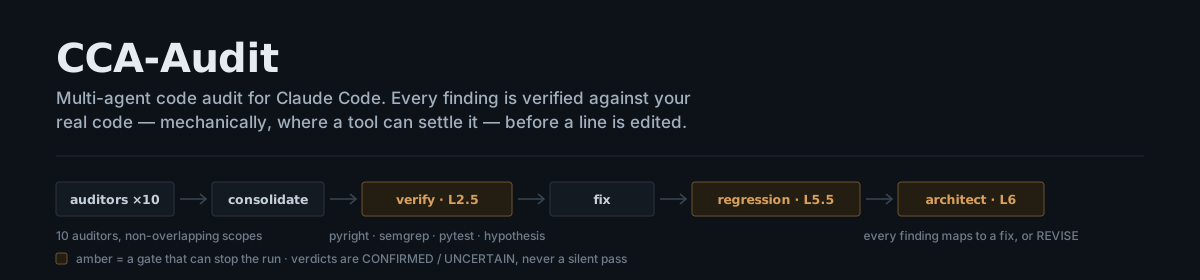
A multi-agent code auditor for Claude Code in which no finding reaches your code unverified.
Ten specialised auditors read your diff in parallel. Their findings are deduplicated, then each one is
re-derived against the real code — mechanically, by pyright, clippy, semgrep, pytest or
hypothesis wherever a tool can settle the claim, and by adversarial review where none can. Only
findings that survive that gate are eligible to be fixed. The fix is then checked for scope creep,
and the whole change is gated on a mapping proving every confirmed finding has a fix and every edit
has a finding.
Python and Rust have deterministic settlers. Each language gets the claim vocabulary that
actually carries information in it — Rust does not get nullability, because the code compiled;
it gets panic_path, overflow and error_swallow instead. Any other language, and any claim type
a backend does not declare, escalates rather than being settled by a tool built for something else.
The design constraint throughout: a check that could not run must never be indistinguishable from a check that passed.
Verified in the field
Two upstream results, both from hunt mode, both checkable in under a minute.
SciPy — merged upstream
Hunt mode was pointed at scipy/scipy (~14.8k stars) and found a
copy-paste defect in signal.decimate's complex-coefficient guard:
elif (any(np.iscomplex(system.poles))
      or any(np.iscomplex(system.poles))   # <- should be system.zeros
      or np.iscomplex(system.gain)):
The guard exists to route complex-coefficient filters away from
zpk2sos, which cannot represent them. Because it tested the poles twice and never the zeros, adltifilter with real poles and complex zeros was not recognised as complex, was forced throughzpk2sos, and raisedValueError: complex value with no matching conjugateon valid input.
| Submitted upstream | PR #25654, 18 Jul 2026 |
| Merged | 23 Jul 2026 by a SciPy maintainer — approved "LGTM", labelled defect |
| What shipped | the one-line fix and our regression test, test_complex_zeros_real_poles_iir_dlti |
| Latent for | ~3 years 3 months — introduced by gh-17881 (Apr 2023) |
The defect is sharper than its one-line diff suggests: gh-17881 was itself titled "Fix handling on
user-supplied filters in signal.decimate" and added complex-filter support. The typo silently
defeated half of the feature that PR shipped — complex poles worked, complex zeros crashed — and
survived review, three years of releases, and the surrounding test suite, which covered the working
half only. It is still live in the current release, 1.18.0.
To be precise about what that means: the fix was ours and it was merged into a core scientific library after maintainer review. What we did not do is submit it autonomously — SciPy's AI policy requires a human to check generated code and open the PR, and requires the PR prose to be the contributor's own words. Both were honoured, and the AI-assistance disclosure is in the PR body.
Polymarket py-sdk — reported, fixed by the maintainers
Hunt mode was pointed at Polymarket/py-sdk — a third-party SDK, ~70 stars, actively maintained — and found a client-side price-validation defect:
_resolve_priceand_resolve_protected_market_pricevalidated prices by decimal-place count rather than tick-grid membership. The two agree on power-of-ten ticks and diverge on0.005and0.0025markets, where a price like0.007has three decimals, passes validation, is signed into the EIP-712 order, and is only then rejected by the exchange.
| Reported upstream | issue #162, 14 Jul 2026 |
| Fixed upstream | PR #181, merged 21 Jul 2026 — body states "Fixes #162" |
| Author of the fix | a Polymarket maintainer, independently |
| Issue status | closed as completed |
To be precise about what that means: here the upstream fix was written by a Polymarket maintainer, not submitted by us — an outside bug report was specific enough that the maintainers implemented and shipped it themselves.
How the finding survived to that point: /audit-fix hunt surfaced four candidates; the adversarial
2-of-3 verifier killed the flashiest one (already fixed in an open upstream PR) and one
deliberate-by-design finding; the survivor was reproduced against ~23,000 exhaustive price/tick cases
before a line was written.
Neither result was cherry-picked from a benchmark: both targets were third-party repos nobody here wrote, and in both cases the finding had to survive the same adversarial gate before it left the machine.
It audits itself, and the self-audit finds things
The most recent release, v3.5, shipped through five task reviews and a whole-branch review. CCA was
then pointed at it. It found two Critical defects that the entire review process had missed:
- CI had never executed the feature's test suite. The workflow installed an extra that omitted
mpmath; both test filesimportorskipit, so ~25 tests — including the integrity gate, the feature's central safety guarantee — skipped silently on all four Python versions.2 skippedbecame31 passed. - One environment variable made correct code confirm as defective.
CCA_SUBSTRATE_TOL=1e-20drove the deliberately-correct test fixture to raise a violation at a measured relative error of8.3e-18— ordinary float64 noise. That verdict would have been binding: protected from being overturned, exempt from the adversarial panel, and feeding an automated fix plan.
Both were confirmed by execution rather than by re-reading, and both now carry red→green regression tests. The full round is PR #22.
What is actually different
Multi-agent review is common. These parts are not:
Mechanical verification, not a second opinion. A finding is classified into a claim type and
settled by the tool that can actually decide it — pyright for definedness/nullability/type,
semgrep for taint, a pytest repro for crash impact, hypothesis for arithmetic. The verdict
carries a machine-produced artifact. An LLM may not overturn an artifact-backed verdict; it
adjudicates only what no tool could settle.
Asymmetric verdicts, stated honestly. Each settler can only conclude what its evidence supports.
semgrep can prove a sink is absent but never that an injection is real. The numeric checker can
confirm with a falsifying example but never refute, because a property holding across a bounded
search is the absence of a counterexample, not proof of correctness. A clean run is UNCERTAIN, not
a green pass.
Anti-regression on the fix itself. After fixes land, a differential pass verifies each hunk maps to its finding and introduced no behaviour change beyond it. Scope creep and regression risk are kicked back.
Fix→finding mapping as a merge gate. The architect gate emits a table proving every confirmed finding has a fix and every edit traces to a finding. An orphan finding or a phantom edit forces REVISE.
Risk-tiered, not user-tiered. Trivial diffs run cheap; money, auth, and numeric diffs are forced to the full adversarial treatment. You do not choose the tier by asserting your change is safe.
Honest limits
A verification tool that cannot state where it is blind is asking for trust it has not earned. These are enforced as tests, not disclaimers:
-
The numeric substrate check cannot see sign or formula errors. It is decorrelated on evaluation and correlated on transcription: both substrates faithfully compute whatever structure was written down, so a flipped sign survives into both and they agree. That class belongs to the property helpers.
test_sign_trap_does_not_violateasserts this. -
Its integrity gate proves the returned value, not every intermediate. A target that delegates to an unpatched second module can return a high-precision-typed value carrying float64 precision. Measured: the gate passes a reference of
0.0where the true answer is0.5.test_gate_does_not_catch_cross_module_precision_lossasserts this. -
A property is authored by the same agent that raised the finding, so a wrong declared relation produces a real counterexample to a wrong claim. A confirmation obliges you to re-read the relation, not just the verdict.
-
Deterministic coverage is per-language, and a language without a backend gets none. Ask the tool rather than trusting this table —
python -m cca_checks capabilities --file <F>reports what it can settle on your machine, including which tools are missing.settled deterministically by Python definedness·nullability·type·taint·clock_leakast+pyright+semgrepRust clock_leak·panic_path·overflow·error_swallow·unsafe_op·tainttree-sitter + clippy+semgrepeverything else nothing — every claim escalates to LLM adjudication — A claim about a file no backend covers, or a claim type the covering backend does not declare, returns
UNCERTAINbefore any checker runs. It cannot be refuted by a tool built for another language:test_language_guard.pyasserts this over every claim type. -
Rust does not get
definedness,typeornullability, and that is not a gap. Those defects do not survive to review in a language that compiled — the name resolved, the types checked, andOptionis not a nullable pointer. Porting them would have doubled the claim vocabulary while refuting almost everything by construction. -
The Rust clock check reads syntax, not semantics. tree-sitter does not expand macros. A clock read inside a
macro_rules!body is invisible to it, as is one reaching the file through a globuse. Both therefore block refutation rather than being ignored — a file must not earn aFALSE_POSITIVEcarrying an authoritativesourceprecisely by being hard to read.test_clock_check_rust.pyasserts both. -
clippy needs the crate to build. A crate that does not compile produces no lint diagnostics at all, which reads exactly like a clean crate — so an un-buildable crate is
UNCERTAINeverywhere, never a refutation.test_clippy_check.py::test_a_stream_that_proves_nothing_returns_noneasserts the whole cascade. -
Release-mode wrapping overflow is not provable by a debug test. Rust panics on overflow in debug and wraps silently in release; a
cargo testartifact can only demonstrate the first. The second is the more dangerous half and is disclosed rather than claimed. -
A
panic_pathorunsafe_opfinding can never be CONFIRMED by clippy. A lint sees the construct, not whether it is reachable with a value the caller controls —.unwrap()on a value built two lines above is correct code. Those two mirrortaint: they refute a false premise and inform adjudication, and a confirmation has to come from a repro that actually panics.
Pipeline
flowchart LR
    A["Step 0\nDetect Files"] --> B["Step 0.5\nLanguage + Domain"]
    B --> T["Step 0.6\nTier Select\nFAST/STANDARD/DEEP"]
    T --> C["Step 1\nParallel Auditors"]
    C --> D["Step 2\nConsolidate + Dedup"]
    D --> V["Step 2.5\nVerify findings\n(anti-hallucination)"]
    V --> E["Step 3\nFix Plan"]
    E --> F["Step 4\nImplement\n(P1 red→green)"]
    F --> G["Step 5\nRe-verify\n(tests + lint)"]
    G --> R["Step 5.5\nRegression Diff\n(anti-regression)"]
    R --> H["Step 6\nArchitect Gate\n+ fix→finding map"]
    H --> I["Step 7\nCommit"]
FAST runs three core auditors and skips the regression gate — but still verifies every P1 before fixing it. No finding is edited into your code unverified, on any tier.
The auditors
Each has a non-overlapping scope, so findings do not duplicate and no auditor arbitrates another's domain.
Core (FAST runs only the first three):
| Auditor | Scope | Does NOT check |
|---|---|---|
| Security (single authority) | OWASP Top 10, injection, auth, secrets, CVEs | Runtime bugs, code quality |
| Bug | Null refs, error handling, races, resource leaks | Security, style |
| Code Quality | Type safety, DRY, complexity, naming, dead code | Security, runtime, performance |
| Performance | Slow queries, hot paths, memory, pooling | Security, style |
| Documentation | Missing docs, stale comments contradicting new code | TODOs, debug statements |
| Environment | Config completeness, format validation, naming | Secrets (Security owns those) |
Conditional, dispatched only when the diff touches their concern:
| Auditor | Runs when | Checks |
|---|---|---|
| High-Stakes / Safety | money / auth / delete / irreversible paths | Bounds, guards, kill-switches, idempotency |
| Numerical / Units | non-trivial arithmetic | Sign, units, scaling, rounding, conversions |
| Data-Integrity | migrations / SQL / schema | Migration+grant, type assumptions, safe accessors |
| Dependency | a manifest or lockfile changed | Maintenance health, licences, unused deps, pin breakers |
| Deployability | deployable code / units / migrations | Generated files, pin/lock breakers, service↔scheduler pairing, deploy-target assumptions |
Plus the verification agents: fp-check (anti-hallucination), differential-review (anti-regression), and the read-only architect-reviewer final gate.
Hunt mode — auditing code you did not write
/audit-fix reviews your diff. Hunt mode turns the same pipeline on a codebase you did not
write — a dependency, a repo you are evaluating, a legacy service — to find pre-existing defects:
/audit-fix hunt src/payments        # a whole subtree, no diff required
/audit-fix hunt path/to/file.py     # or specific files
What changes:
- Whole-file audit. "Pre-existing bugs are the target" replaces "only audit the diff." Age is not evidence of correctness.
- A target-viability pre-flight runs first, before a single auditor is spawned: is the repo alive, does it accept contributions, is there a test harness, is the language one this pipeline audits well. An archived or deprecated repo is rejected up front — auditing a corpse burns the run and produces a fix nobody can merge.
- Forced DEEP tier, so every finding faces the adversarial 2-of-3 verifier.
- Upstream-duplicate check. L2.5 searches the target's own issues and PRs; a bug someone already
reported is dropped as
DUPLICATErather than re-submitted.
The output is a finding you can stand behind: reproduced with a failing test, not already known upstream, and survivable under adversarial review. That is the process that produced both field results above — the merged SciPy fix and the Polymarket report.
Install
pip install cca-audit
cca-audit install          # run from the root of the project you want to audit
That copies the auditor agents into .claude/agents/ and /audit-fix into .claude/commands/, and
puts the cca_checks verifier (python -m cca_checks) on the same interpreter. Re-run
cca-audit install to upgrade — files you have customized are preserved as <name>.md.bak rather
than overwritten.
Install without pip (shell script, requires git)
# Unix/macOS
curl -fsSL https://raw.githubusercontent.com/GiulioDER/cca-audit/master/claude-code/install.sh | bash
# Windows PowerShell
irm https://raw.githubusercontent.com/GiulioDER/cca-audit/master/claude-code/install.ps1 | iex
Same result: it clones the repo to a temp directory and copies the same files. Both paths read the
markdown from cca_checks/plugin/, so there is one copy on disk and they cannot drift.
For the deterministic verification layer, have pyright, pytest and semgrep on your PATH.
Without them the definedness / nullability / type / taint claim types fall back to LLM-only
verification — no crash, no regression.
numeric is the exception: it fails closed rather than falling back. On DEEP, a NUM-* P1 may
not enter the fix plan on an LLM-sourced verdict — it carries a Hypothesis artifact or it is escalated
as UNCERTAIN. DEEP is forced for every high-stakes or numeric diff and for all of hunt mode, so
without the numeric extra, arithmetic findings on money-path code cannot be auto-fixed at all.
That is deliberate — a sign error reads fluently, so a second LLM opinion is not evidence — but it is
a hard stop, not graceful degradation.
The extras carry it:
pip install 'cca-audit[verify]'    # the whole deterministic layer in one install
pip install 'cca-audit[numeric]'   # just hypothesis + mpmath + pytest
pip install 'cca-audit[rust]'      # just the tree-sitter Rust grammar
From a clone, the editable equivalents are pip install -e ".[verify]" / -e ".[numeric]".
pyright, semgrep and the Rust toolchain are not pip extras: the first two install
separately, and cargo/clippy belong to the project you are auditing. Check what you actually
have with python -m cca_checks capabilities --file <a source file> — it names the missing tool for
any claim type it cannot settle here, rather than leaving you to infer it from an escalation.
Worked example: examples/sign-trap — a real sign error, the property that
catches it, and the resulting artifact.
Usage
/audit-fix                 # audit + fix uncommitted changes (tier auto-selected)
/audit-fix deferred        # second pass: fix P3 items deferred by the previous round
/audit-fix no-fix          # audit + verify only
/audit-fix p1-only         # fix only P1 Critical findings
/audit-fix fast | deep     # override the auto-selected tier
/audit-fix commit 3        # audit the last 3 commits
/audit-fix files src/app.py
/audit-fix hunt src/       # audit code you did NOT write
You normally do not pick a tier — the pipeline does.
| Tier | When (auto) | Auditors | Verification gates | P1 fix style |
|---|---|---|---|---|
| FAST | trivial, low-stakes, non-deploy diff | 3 core | L2.5 on P1 only | direct |
| STANDARD | normal diff | all 6 core + conditional | L2.5 + L5.5 + mapping | red→green test |
| DEEP | high-stakes / numeric / hunt / forced | all of STANDARD | + adversarial 2-of-3 on high-stakes P1 | red→green test |
| Priority | Criteria | Action |
|---|---|---|
| P1 Critical | Security, data corruption, auth bypass, injection, unsafe money/irreversible handling | Fix before deploy, with a red→green test |
| P2 High | DRY divergence, stale misleading comments, config inconsistencies, unit mismatches | Fix now |
| P3 | Cosmetic, style, naming, unused params | Deferred to round 2 |
Round 2 (/audit-fix deferred) reads the deferred list from the previous commit, re-checks each item
is still relevant, fixes what remains and marks the rest stale — so no audit leaves a tail.
Engineering
| Tests | 378, on every push and PR |
| Python | 3.10, 3.11, 3.12, 3.13 — full matrix in CI |
| Packaging | wheel built and smoke-installed into a clean venv in CI |
| Lint | ruff, zero warnings |
| Types | pyright |
| Design of record | docs/v3-design.md, versioned slices v3.0 → v3.5 |
Every deterministic-verification slice ships with a written spec and an implementation plan under
docs/superpowers/, including the measured dead ends — approaches that were
tried, failed, and are recorded so they are not re-attempted.
Documentation
- Pipeline Diagram — a walkthrough of each step
- Auditor Scopes — the full non-overlapping scope matrix
- Configuration — tiers, domain dispatch, project context
- Extending — adding a custom auditor
- v3 Design — the design of record for the deterministic verification layer
- Security Policy — this tool executes code from the repository under audit
- Changelog · Contributing
Writing
- Fluency isn't evidence — why a sign error survives review, and how a counterexample settles it
- Why AI code review hallucinates — and the two gates that close it
- The benchmark memorization gap — what a passing benchmark score actually measures
License


Download files
Download the file for your platform. If you're not sure which to choose, learn more about installing packages.
Source Distribution
Built Distribution
Filter files by name, interpreter, ABI, and platform.
If you're not sure about the file name format, learn more about wheel file names.
Copy a direct link to the current filters
File details
Details for the file cca_audit-0.8.0.tar.gz.
File metadata
- Download URL: cca_audit-0.8.0.tar.gz
- Upload date:
- Size: 199.5 kB
- Tags: Source
- Uploaded using Trusted Publishing? No
- Uploaded via: twine/6.2.0 CPython/3.14.6
File hashes
| Algorithm | Hash digest | |
|---|---|---|
| SHA256 |
6270513a35f023465a5e954d45f78ebf13446ead5d906ca798d10647508ea4d1
|
|
| MD5 |
41a09770cd5e257233f418b3126e6b69
|
|
| BLAKE2b-256 |
6f03208b34ce13d9a77ed1170f686ca9b729df24f8386264074c65fd107d6904
|
File details
Details for the file cca_audit-0.8.0-py3-none-any.whl.
File metadata
- Download URL: cca_audit-0.8.0-py3-none-any.whl
- Upload date:
- Size: 165.4 kB
- Tags: Python 3
- Uploaded using Trusted Publishing? No
- Uploaded via: twine/6.2.0 CPython/3.14.6
File hashes
| Algorithm | Hash digest | |
|---|---|---|
| SHA256 |
2cc9e7ad08ffe54cb56dd28e3437d963cd96c10ca1e3d92942de874abb909940
|
|
| MD5 |
9aa0ba9b0e6834eea6b8f6da2e0cbb68
|
|
| BLAKE2b-256 |
68441834d072fe89e92e2772d4fdde311d840e2b240e0689293554ce24de7844
|






