
cehrbert_data
cehrbert_data is the ETL tool that generates the pretraining and finetuning datasets for CEHRbERT, which is a large language model developed for the structured EHR data, the work has been published at https://proceedings.mlr.press/v158/pang21a.html.
Patient Representation
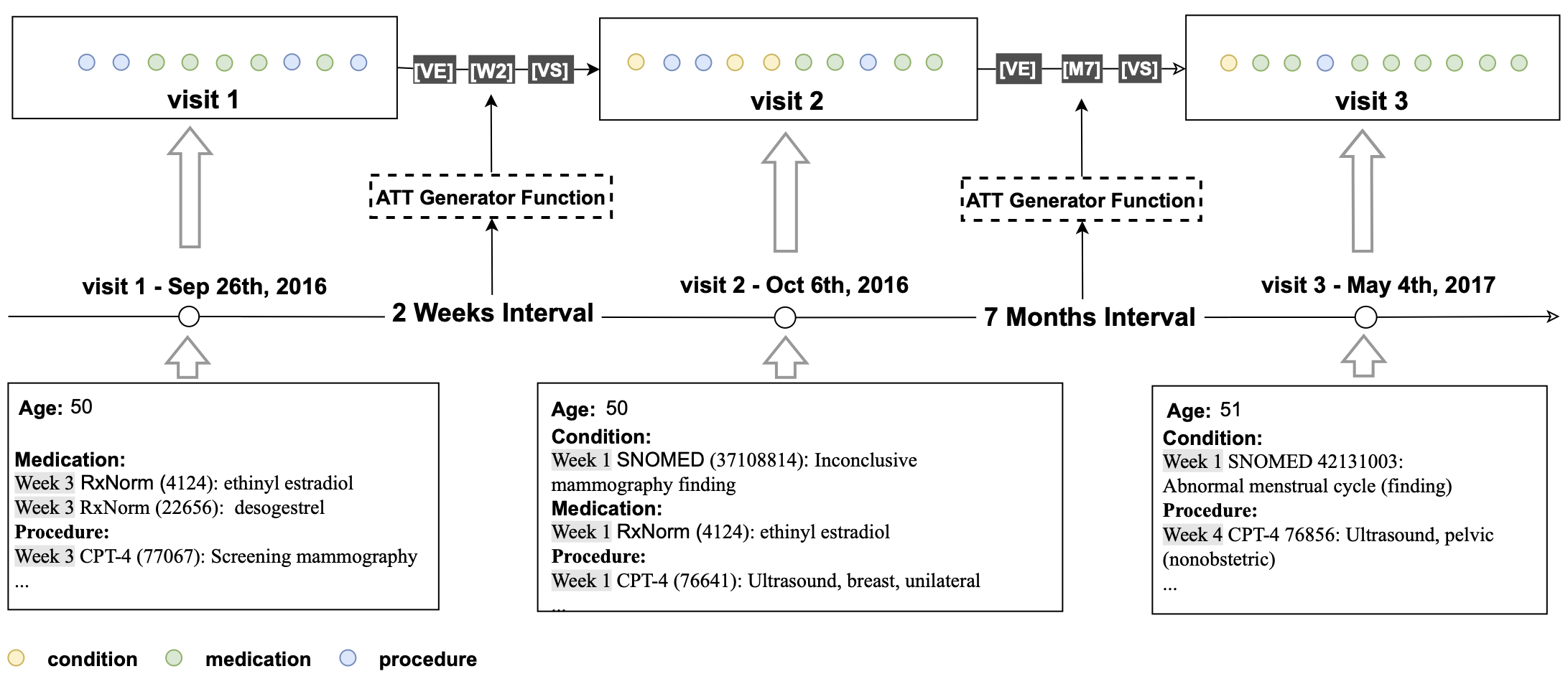
For each patient, all medical codes were aggregated and constructed into a sequence chronologically. In order to incorporate temporal information, we inserted an artificial time token (ATT) between two neighboring visits based on their time interval. The following logic was used for creating ATTs based on the following time intervals between visits, if less than 28 days, ATTs take on the form of $W_n$ where n represents the week number ranging from 0-3 (e.g. $W_1$); 2) if between 28 days and 365 days, ATTs are in the form of $M_n$ where n represents the month number ranging from 1-11 e.g $M_{11}$;
- beyond 365 days then a LT (Long Term) token is inserted. In addition, we added two more special tokens — VS and VE to represent the start and the end of a visit to explicitly define the visit segment, where all the concepts associated with the visit are subsumed by VS and VE.
Pre-requisite
The project is built in python 3.10, and project dependency needs to be installed
Create a new Python virtual environment
python3.10 -m venv .venv;
source .venv/bin/activate;
Build the project
pip install -e .
Download jtds-1.3.1.jar into the spark jars folder in the python environment
cp jtds-1.3.1.jar .venv/lib/python3.10/site-packages/pyspark/jars/
Instructions for Use
1. Download OMOP tables as parquet files
We created a spark app to download OMOP tables from SQL Server as parquet files. You need adjust the properties
in db_properties.ini to match with your database setup.
PYTHONPATH=./: spark-submit tools/download_omop_tables.py -c db_properties.ini -tc person visit_occurrence condition_occurrence procedure_occurrence drug_exposure measurement observation_period concept concept_relationship concept_ancestor -o ~/Documents/omop_test/
We have prepared a synthea dataset with 1M patients for you to test, you could download it at omop_synthea.tar.gz
tar -xvf omop_synthea.tar ~/Document/omop_test/
2. Generate training data for CEHR-BERT
We order the patient events in chronological order and put all data points in a sequence. We insert artificial tokens VS (visit start) and VE (visit end) to the start and the end of the visit. In addition, we insert artificial time tokens (ATT) between visits to indicate the time interval between visits. This approach allows us to apply BERT to structured EHR as-is. The sequence can be seen conceptually as [VS] [V1] [VE] [ATT] [VS] [V2] [VE], where [V1] and [V2] represent a list of concepts associated with those visits.
PYTHONPATH=./: spark-submit spark_apps/generate_training_data.py -i ~/Documents/omop_test/ -o ~/Documents/omop_test/cehr-bert -tc condition_occurrence procedure_occurrence drug_exposure -d 1985-01-01 --is_new_patient_representation -iv
3. Generate hf readmission prediction task
If you don't have your own OMOP instance, we have provided a sample of patient sequence data generated using Synthea
at sample/hf_readmissioon in the repo
PYTHONPATH=./:$PYTHONPATH spark-submit spark_apps/prediction_cohorts/hf_readmission.py -c hf_readmission -i ~/Documents/omop_test/ -o ~/Documents/omop_test/cehr-bert -dl 1985-01-01 -du 2020-12-31 -l 18 -u 100 -ow 360 -ps 0 -pw 30 --is_new_patient_representation
Contact us
If you have any questions, feel free to contact us at CEHR-BERT@lists.cumc.columbia.edu
Citation
Please acknowledge the following work in papers
Chao Pang, Xinzhuo Jiang, Krishna S. Kalluri, Matthew Spotnitz, RuiJun Chen, Adler Perotte, and Karthik Natarajan. "Cehr-bert: Incorporating temporal information from structured ehr data to improve prediction tasks." In Proceedings of Machine Learning for Health, volume 158 of Proceedings of Machine Learning Research, pages 239–260. PMLR, 04 Dec 2021.
1 maintainer

Metadata
1 maintainer
Release files for cehrbert-data 0.2.1
For a detailed explanation of source distributions (sdists) and built distributions (wheels), please see the package formats documentation.
Source distribution (sdist)
| File | Size | Uploaded | |
|---|---|---|---|
| cehrbert_data-0.2.1.tar.gz | 1.9 MB | Details |
Built distribution (wheel)
| File | Interpreter | ABI | Platform | Reset |
|---|---|---|---|---|
| cehrbert_data-0.2.1-py3-none-any.whl | Python 3 | none | any | Details |
Total release size: 3.3 MB
Release files / cehrbert_data-0.2.1.tar.gz
| Download URL | cehrbert_data-0.2.1.tar.gz |
|---|---|
| Size | 1.9 MB |
| Tags | Source |
|
SHA-256 checksum How to use checksums |
53d8bd9adb11fb4ab20fd73c010a42e4196778d20241aa0446f8e2f7e81107f7
|
|
BLAKE2b-256 checksum How to use checksums |
44679d9708ee4201b56ec4eee0d98be456c9c3c3016ac14010a099ffd581ece7
|
| Upload date | |
|
Uploaded using Trusted Publishing? What is trusted publishing? |
Yes |
| Uploaded via |
twine/7.0.0 CPython/3.13.14
|
Provenance
Provenance describes where a file came from. On PyPI, provenance is shared via attestations, which provide a verifiable record of the build or publishing details. View details, limitations and caveats.


PyPI Publish Attestation
PyPI verified that this artifact, at this checksum, originated from the publisher listed below.
Signed by GitHub Actions, verified by PyPI on Oct 5, 2026.
Transparency logRelease files / cehrbert_data-0.2.1-py3-none-any.whl
| Download URL | cehrbert_data-0.2.1-py3-none-any.whl |
|---|---|
| Size | 1.5 MB |
| Tags | Python 3 |
|
SHA-256 checksum How to use checksums |
daaa0303e409ba7d398905c9f49635cd55fc957f891921dfebec62a29c33b85c
|
|
BLAKE2b-256 checksum How to use checksums |
c079e5d1471fe55f20babb663be19c74ef9bb889733d96d2dc78fc0e8a16e542
|
| Upload date | |
|
Uploaded using Trusted Publishing? What is trusted publishing? |
Yes |
| Uploaded via |
twine/7.0.0 CPython/3.13.14
|
Provenance
Provenance describes where a file came from. On PyPI, provenance is shared via attestations, which provide a verifiable record of the build or publishing details. View details, limitations and caveats.
PyPI Publish Attestation
PyPI verified that this artifact, at this checksum, originated from the publisher listed below.
Signed by GitHub Actions, verified by PyPI on Oct 5, 2026.
Transparency log













