
This project has been archived by its maintainers, and is no longer receiving any updates.




Celery Crossover (Alpha)
About
Celery crossover aims to make it easier to execute celery tasks from a diffent source code base in the most simple and yet reliable way.
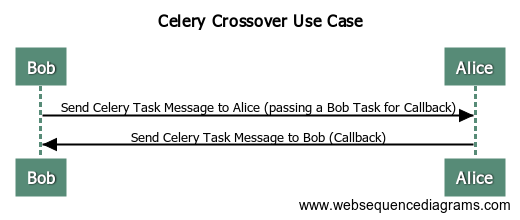
Quick Examples
1) Simple Alice task execution triggered by Bob
Lets suppose Bob is a service that needs Alice to execute the task plus defined on Alice with the following code:
Alice:
- celery_config.py
# -*- coding: utf-8 -*-
from kombu import Exchange, Queue

BROKER_URL = 'redis://localhost:6379/1'
CELERY_QUEUES = [
    Queue('alice_queue', Exchange('alice_queue'), routing_key='alice_queue')
]
- alice.py
# -*- encoding: utf-8 -*-
import crossover
from celery import Celery

app = Celery('tasks')
app.config_from_object('celery_config')

# The line bellow will make Alice's Tasks usable by other services.
crossover.register_router(app)


@app.task(name='plus', queue='alice_queue')
def plus(x, y):
    _add = x + y
    return _add
Bob:
All that Bob need to do is:
- exec_task_on_alice.py
# -*- encoding: utf-8 -*-
from crossover import Client

alice_broker = "redis://localhost:6379/1"
alice_client = Client(broker=alice_broker)

alice_client.plus(x=340, y=210)
2) Alice task execution triggered by Bob with callback (Auto Callback)
In the same scenario described above, lets suppose Bob need to be notified (have a task executed) after Alice is done with the plus task.
For this case, all we have to do is decorate the Alice's task plus with@crossover.callback(auto_callback=True) to have its returned value sent back to Bob. Also, Bob have to define and send to Alice a task to be called by Alice's callback.
That way, Alice and Bob could would be:
Alice:
- alice_celery_config.py
# -*- coding: utf-8 -*-
from kombu import Exchange, Queue

BROKER_URL = 'redis://localhost:6379/1'
CELERY_QUEUES = [
    Queue('alice_queue', Exchange('alice_queue'), routing_key='alice_queue')
]
- alice.py
# -*- encoding: utf-8 -*-
import crossover
from celery import Celery

app = Celery('tasks')
app.config_from_object('alice_celery_config')

# The line bellow will make Alice's Tasks usable by other services.
crossover.register_router(app)


@app.task(name='plus', queue='alice_queue')
@crossover.callback(auto_callback=True)
def plus(x, y):
    _add = x + y
    return _add
Bob:
- bob_celery_conf.py
# -*- coding: utf-8 -*-
from kombu import Exchange, Queue

BROKER_URL = 'redis://localhost:6379/1'

CELERY_QUEUES = [
    Queue('bob_queue', Exchange('bob_queue'), routing_key='bob_queue')
]
- bob.py
# -*- encoding: utf-8 -*-
import crossover
from celery import Celery
from celery.utils.log import get_task_logger

logger = get_task_logger(__name__)

app = Celery('tasks')
app.config_from_object('bob_celery_conf')

crossover.register_router(app)

@app.task(name='plus_callback', queue='bob_queue')
def plus_callback(result):
    logger.info('Got Addition callback = {0}'.format(result))
- exec_task_on_alice.py
# -*- encoding: utf-8 -*-
from crossover import Client
from bob import plus_callback

alice_broker = "redis://localhost:6379/1"
alice_client = Client(broker=alice_broker)

alice_client.plus(x=340, y=210, callback=plus_callback)
3) Alice task execution triggered by Bob with callback (No Auto Callback)
In this case, everything is the same as 2) from Bob's perspective but lets suppose Alice's task cant calculate or
determine a response right away so it needs to pass (or persist) the callback metadata for further execution.
It can be done by using de decorator @crossover.callback with bind_callback_meta=True which will give
to the task function the callback metadata as its first parameters. Following an example of its usage:
- alice.py
# -*- encoding: utf-8 -*-
...

@app.task(name='plus', queue='alice_queue')
@crossover.callback(bind_callback_meta=True)
def plus(callback_meta, x, y):
    logger.info('Execution actual addition task.')
    calculate_addition.delay(callback_meta, x, y):


@app.task(name='calculate_addition', queue='project_1')
def calculate_addition(callback_meta, x, y):
    _add = x + y
    logger.info('Addition {0} + {1} = {2}'.format(x, y, _add))
    crossover.CallBack(callback_meta)(result=_add)
1 maintainer

Metadata
1 maintainer
Release files for celery-crossover 1.1.16
For a detailed explanation of source distributions (sdists) and built distributions (wheels), please see the package formats documentation.
Source distribution (sdist)
| File | Size | Uploaded | Provenance | |
|---|---|---|---|---|
| celery-crossover-1.1.16.tar.gz | 28.7 kB | Without provenance | Details |
Built distribution (wheel)
| File | Interpreter | ABI | Platform | Reset |
|---|---|---|---|---|
| celery_crossover-1.1.16-py3-none-any.whl | Python 3 | none | any | Details |
Total release size: 35.4 kB
Release files / celery-crossover-1.1.16.tar.gz
| Download URL | celery-crossover-1.1.16.tar.gz |
|---|---|
| Size | 28.7 kB |
| Tags | Source |
|
SHA-256 checksum How to use checksums |
654af875548a11222f226d03f92beab1d3e9d93dd2ecf69aa8db6b3fdbeaf749
|
|
BLAKE2b-256 checksum How to use checksums |
fbb8efa4c35a27f6687e042693451ebc2eba486f0eee4777e394df459bb928b5
|
| Upload date | |
|
Uploaded using Trusted Publishing? What is trusted publishing? |
No |
| Uploaded via |
twine/3.4.1 importlib_metadata/4.5.0 pkginfo/1.7.0 requests/2.25.1 requests-toolbelt/0.9.1 tqdm/4.61.1 CPython/3.9.5
|
Release files / celery_crossover-1.1.16-py3-none-any.whl
| Download URL | celery_crossover-1.1.16-py3-none-any.whl |
|---|---|
| Size | 6.8 kB |
| Tags | Python 3 |
|
SHA-256 checksum How to use checksums |
19378f8d57aeac13c93ba4be4f1ec5341353af355913fc7eae2bd94dcf436da5
|
|
BLAKE2b-256 checksum How to use checksums |
c76ebf941187e1ab1791649837c3aeadbe4a88eaa8f7e7b5d4e9d10523fac658
|
| Upload date | |
|
Uploaded using Trusted Publishing? What is trusted publishing? |
No |
| Uploaded via |
twine/3.4.1 importlib_metadata/4.5.0 pkginfo/1.7.0 requests/2.25.1 requests-toolbelt/0.9.1 tqdm/4.61.1 CPython/3.9.5
|
Security for celery-crossover 1.1.16
Provenance
Provenance describes where a file came from. On PyPI, provenance is shared via attestations, which provide a verifiable record of the build or publishing details. View details, limitations and caveats.
No provenance found
None of the files in this release were uploaded with provenance metadata.
A note on package security
PyPI is a repository for distributing packages, not a service for auditing them. While third-party security researchers and our staff do their best to detect and remove malicious packages, PyPI cannot guarantee the quality, security or suitability of any given package.
To learn more about protecting yourself from malicious actors, visit our package security documentation.














