







cellink bridges donor genotypes and single-cell profiles for end-to-end single-cell genetics
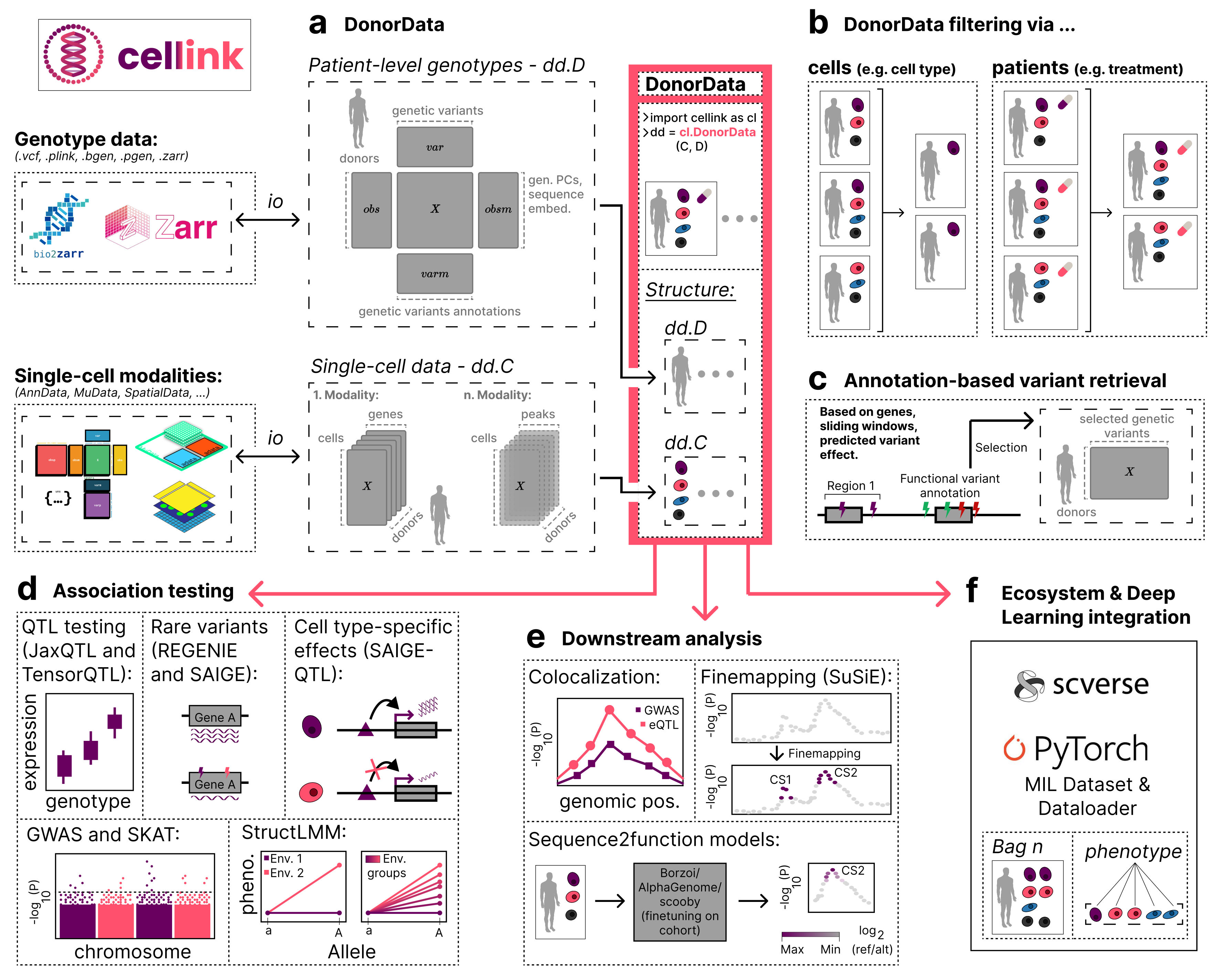
cellink brings single-cell data together with the genomes of the donors the cells come from. It reads genotypes from VCF, PLINK, BGEN and PGEN files, keeps them paired with the cells of the same donors through every selection, and runs genetic analyses on both. Established tools such as PLINK, tensorQTL, SAIGE-QTL, LDSC and MAGMA run directly on your data, and cellink takes care of the file formats and conventions each of them expects.
Data
cellink works on DonorData objects, which link the cells of a cohort to their
donors. In cellink the donor level dd.D holds the genotypes, with one row per donor and one column per variant, and
dd.C holds the cells as an AnnData or MuData. Selecting donors, variants or cells keeps both levels aligned, so
genotypes and expression always describe the same people.
import cellink as cl

genotypes = cl.io.read_plink("cohort")
dd = cl.DonorData(D=genotypes, C=adata, donor_id="individual")
dd = dd[..., dd.C.obs["cell_type"] == "CD4 T", :]
cl.io.write_dd(dd, "cohort.dd.zarr")
DonorData is imported from the DonorData package and is installed with cellink. The
DonorData documentation explains how these objects are built and stored, and
how to add a sample level or the
electronic health records of the donors.
Analyses
Association testing
- eQTL mapping on pseudobulk with jaxQTL or tensorQTL
- eQTL mapping on single cells with SAIGE-QTL
- A simple pseudobulk eQTL mapping
- Rare variant association tests
- Clumping and pruning
- Colocalization
- Writing association tests as formula strings
Heritability, gene programs and GWAS integration
- LD score regression for cell types
- Gene program scoring with sc-linker
- Gene set enrichment with MAGMA
- Disease relevance of single cells from GWAS with scDRS and seismic
- Cell neighborhoods associated with disease with scEPS
- GWAS on spatial data with gsMap
Deep learning
- Predicting single cell coverage from sequence and scoring variants with scooby
- Dataloaders for deep learning, including multiple instance learning over the cells of each donor
Variants
Getting started
Install cellink from PyPI, where it is published as cellink-tools. This also installs DonorData:
pip install cellink-tools
To install the development version from GitHub instead:
pip install git+https://github.com/theislab/cellink.git@main
The installation guide lists the optional extras for the external tools. If you are new to cellink, start with DonorData basics, which reads genotype files into an object, subsets it and saves it without running any analysis.
Documentation
| Installation guide | Requirements and the optional extras (pip install 'cellink-tools[extra-name]') |
| Tutorials | Step by step guides for the analyses above |
| API reference | Every public function and class, organized by module |
| DonorData documentation | The DonorData object, its sample level and its file format |
| Contributing guide | Development setup, tests and the pull request workflow |
| Changelog | What changed in each release |
Contact
If you found a bug, please use the issue tracker.
Release notes
t.b.a
Citation
t.b.a
1 maintainer

Metadata
1 maintainer
Release files for cellink-tools 0.1.0
For a detailed explanation of source distributions (sdists) and built distributions (wheels), please see the package formats documentation.
Source distribution (sdist)
| File | Size | Uploaded | Provenance | Actions |
|---|---|---|---|---|
| cellink_tools-0.1.0.tar.gz | 4.6 MB | With provenance | Details for cellink_tools-0.1.0.tar.gz |
Built distribution (wheel)
| File | Interpreter | ABI | Platform | Actions Reset |
|---|---|---|---|---|
| cellink_tools-0.1.0-py3-none-any.whl | Python 3 | none | any | Details for cellink_tools-0.1.0-py3-none-any.whl |
Total release size: 4.9 MB
Release files / cellink_tools-0.1.0.tar.gz
| Download URL | cellink_tools-0.1.0.tar.gz |
|---|---|
| Size | 4.6 MB |
| Tags | Source |
|
SHA-256 checksum How to use checksums |
c56af17b610cb895aa32e3d958541e5f4d4f881eda43a7f8a1e02712f552cbe3
|
|
BLAKE2b-256 checksum How to use checksums |
dff56cde9dd59cf37c435927cdf984657266035e43ad2660d2a9a62685d81b0f
|
| Upload date | |
|
Uploaded using Trusted Publishing? What is trusted publishing? |
Yes |
| Uploaded via |
twine/7.0.0 CPython/3.13.16
|
Provenance
Provenance describes where a file came from. On PyPI, provenance is shared via attestations, which provide a verifiable record of the build or publishing details. View details, limitations and caveats.


PyPI Publish Attestation
PyPI verified that this artifact, at this checksum, originated from the publisher listed below.
Signed by GitHub Actions, verified by PyPI on Nov 20, 2026.
Transparency logRelease files / cellink_tools-0.1.0-py3-none-any.whl
| Download URL | cellink_tools-0.1.0-py3-none-any.whl |
|---|---|
| Size | 332.7 kB |
| Tags | Python 3 |
|
SHA-256 checksum How to use checksums |
272b817461c136239eff487fa761c20b8dc94c7256f78d664eb6cdd9f6b94639
|
|
BLAKE2b-256 checksum How to use checksums |
16cbbe7cdda3e765d093531236b97f772ce9aad88a942551bcd9b51da5aa6049
|
| Upload date | |
|
Uploaded using Trusted Publishing? What is trusted publishing? |
Yes |
| Uploaded via |
twine/7.0.0 CPython/3.13.16
|
Provenance
Provenance describes where a file came from. On PyPI, provenance is shared via attestations, which provide a verifiable record of the build or publishing details. View details, limitations and caveats.
PyPI Publish Attestation
PyPI verified that this artifact, at this checksum, originated from the publisher listed below.
Signed by GitHub Actions, verified by PyPI on Nov 20, 2026.
Transparency logSecurity for cellink-tools 0.1.0
Provenance
Provenance describes where a file came from. On PyPI, provenance is shared via attestations, which provide a verifiable record of the build or publishing details. View details, limitations and caveats.
Full provenance
Both files in this release have been uploaded with provenance metadata.
Attestation for cellink_tools-0.1.0.tar.gz
PyPI Publish Attestation
PyPI verified that this artifact, at this checksum, originated from the publisher listed below.
Signed by GitHub Actions, verified by PyPI on Nov 20, 2026.
Transparency logA note on package security
PyPI is a repository for distributing packages, not a service for auditing them. While third-party security researchers and our staff do their best to detect and remove malicious packages, PyPI cannot guarantee the quality, security or suitability of any given package.
To learn more about protecting yourself from malicious actors, visit our package security documentation.













