
cellqc: standardized quality control pipeline of single-cell RNA-Seq data
Cellqc standardizes the quality control of single-cell RNA-Seq (scRNA) data, turning Cell Ranger output into clean feature count matrices. It is implemented in Snakemake for reproducibility and scalability.
The pipeline starts from the Cell Ranger filtered matrix and, per sample:
- Ambient RNA — SoupX (default) or DecontX estimates background contamination and subtracts it. Other methods can be run alongside for comparison without touching the counts.
- Filtering — cells are removed on total UMI, detected genes and mitochondrial percentage, with every exclusion attributed to a specific criterion.
- Doublets — DoubletFinder and/or scDblFinder. All callers score every cell; one configured caller decides removal.
- Nuclear fraction — the intronic read fraction per cell, from the Cell Ranger BAM, computed when a BAM is present. Reported, not used for filtering.
Output is .h5ad matrices, a self-contained HTML report, and a presentation-ready PDF slide deck.
Cell calling is Cell Ranger EmptyDrops; cellqc does not re-call cells. Cell-type annotation is out of scope as of v0.2.0 — annotate downstream.
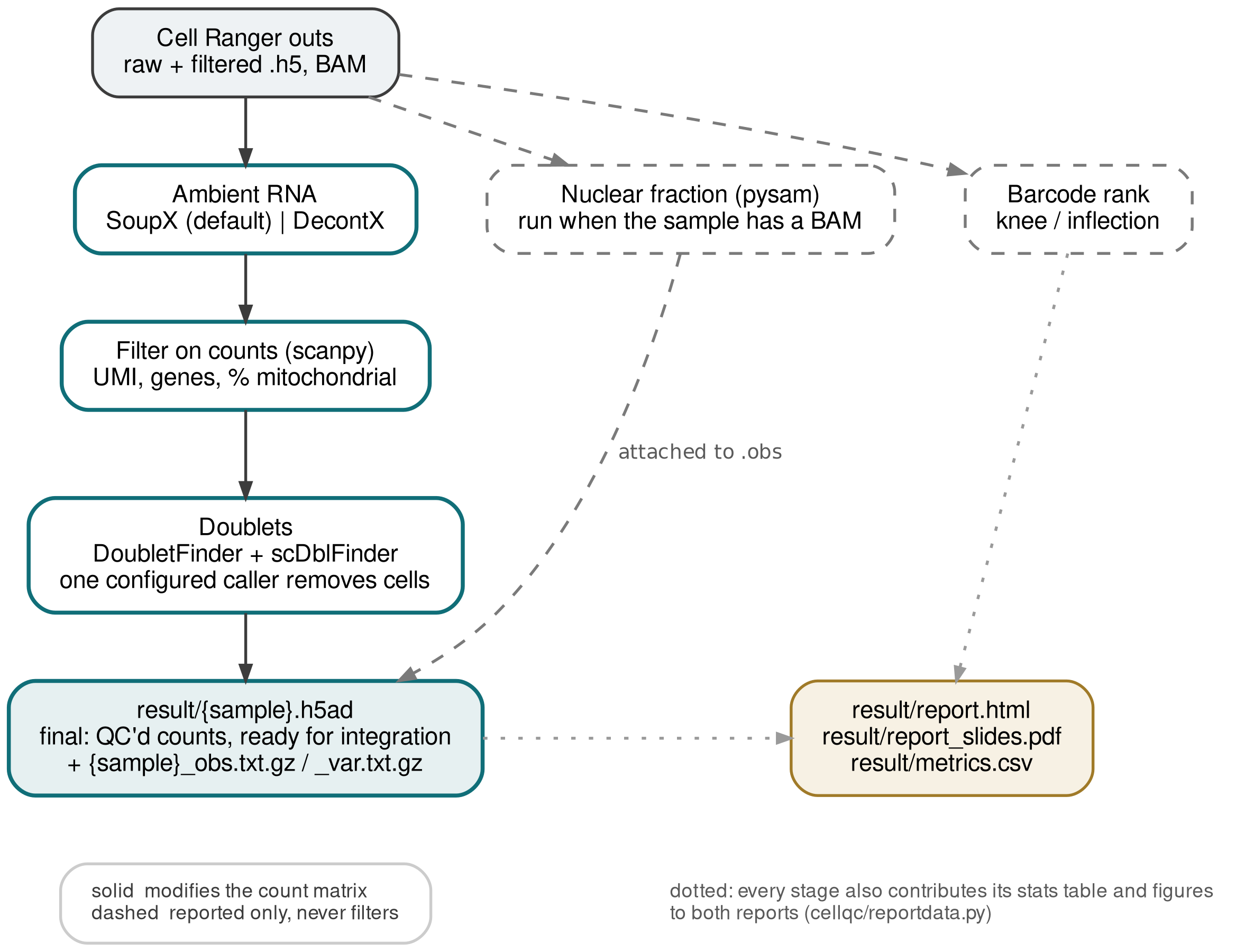
The diagram is generated from source: bash docs/make_figures.sh renders it from docs/workflow.dot.
Installation
From conda (recommended — this pulls the whole analysis stack):
mamba create -n cellqc -c conda-forge -c bioconda cellqc
conda activate cellqc

# DoubletFinder is not packaged for conda; see below
Rscript -e "remotes::install_github('chris-mcginnis-ucsf/DoubletFinder', upgrade=FALSE)"
From the environment file, if you want the exact development environment or are working from a clone:
mamba env create -n cellqc -f envs/cellqc.yaml
conda activate cellqc
Rscript -e "remotes::install_github('chris-mcginnis-ucsf/DoubletFinder', upgrade=FALSE)"
pip install -U cellqc          # or `pip install -e .` from a clone
pip install cellqc on its own installs the CLI and the workflow, but not the analysis stack: scanpy,
pysam and the entire R side come from conda, because pip cannot install R packages. Use one of the two
routes above.
If you would rather avoid the GitHub build entirely, set doublet.run: [scdblfinder] and
doublet.decider: scdblfinder in the config; scDblFinder comes from bioconda.
v0.2.0 removed five of the six GitHub builds v0.1.0 needed (SeuratDisk, harmony, scPred, DropletQC and the
lijinbio/DoubletFinder fork) and all four version pins (Seurat v4, r-matrix, pandas<2, anndata).
Dependent software:
| Software | Role | Source |
|---|---|---|
| Snakemake | workflow engine | conda |
| SoupX | ambient RNA correction (default) | conda |
| DecontX (celda) | ambient RNA correction (alternative) | conda |
| Scanpy / AnnData | filtering, I/O | conda |
| pysam | nuclear fraction from the Cell Ranger BAM | conda |
| Seurat | doublet detection backend | conda |
| zellkonverter | .h5ad -> R, native reader |
conda |
| scDblFinder | doublet detection | conda |
| DropletUtils | 10x matrix I/O | conda |
| tectonic | builds the PDF slide report | conda |
| DoubletFinder | doublet detection (default caller) | GitHub only |
To test the installation:
cellqc -h
Run the pipeline
cellqc requires a sample file and an optional configuration file.
-
The sample file (e.g.
samples.txt) is tab-delimited with headerssample,cellranger, and optionallynreaction.sampleis the sample ID.cellrangeris the Cell Ranger output directory. Relative paths are resolved against the sample file's directory.nreactionis the number of reactions in the library prep, used to infer the expected doublet rate when one Cell Ranger run combines several reactions. Defaults to 1.
-
The configuration file is YAML and optional. The defaults are:
seed: 42                  # every stochastic step is seeded; v0.1.0 seeded nothing
ambient:
  method: soupx           # soupx | decontx | none -- the ONE method applied to the counts
  compare: []             # e.g. [decontx] -- estimated and reported, never applied
nuclear_fraction:         # runs automatically when the sample has an indexed BAM
  numthreads: 12
  cbtag: CB
  retag: RE
  exontag: E
  introntag: N
filterbycount:
  mincount: 500
  minfeature: 300
  mito: 10
doublet:
  run: [doubletfinder, scdblfinder]   # callers to execute
  decider: doubletfinder              # the single caller whose call removes cells
  findpK: false
  numthreads: 5
  pK: 0.01
  rate: 0.1               # 10x multiplet rate at `capacity` cells recovered
  capacity: 13000
Inspection of configuration
ambient— ambient RNA correction
| Parameter | Description |
|---|---|
| ambient.method | The one method whose corrected counts are written: soupx, decontx, or none. |
| ambient.compare | Methods run for their contamination estimate only. They never modify counts; they exist so disagreement between methods is visible. Choosing a correction after seeing which one flatters the downstream result is not supported by design. |
nuclear_fraction
Fraction of intronic reads per cell, intronic / (intronic + exonic), computed from the Cell Ranger BAM
with pysam. There is no skip flag: the step runs for any sample with an indexed
possorted_genome_bam.bam and is dropped for those without, so mixed cohorts work. The result is
reported and plotted against log10(UMI) but is not used for filtering — DropletQC-style empty-drop and
damaged-cell thresholds are sample- and tissue-dependent, so applying them automatically would be
unreviewed auto-filtering.
filterbycount
| Parameter | Description |
|---|---|
| filterbycount.mincount | Minimum total UMI per cell. |
| filterbycount.minfeature | Minimum detected genes per cell. |
| filterbycount.mito | Maximum percentage of mitochondrial counts. |
All three are applied to the ambient-corrected counts, and .obs reports them as total_counts,
n_genes_by_counts and pct_counts_mt. The same three metrics computed on the uncorrected Cell Ranger
counts are carried alongside as raw_total_counts, raw_n_genes_by_counts and raw_pct_counts_mt; they
are informative only, no threshold is applied to them. raw_ means before ambient correction — the
source is filtered_feature_bc_matrix.h5, the same cells, not the all-droplets
raw_feature_bc_matrix.h5. The per-cell fraction the correction removed is
1 - total_counts / raw_total_counts.
doublet
There is no skip flag, for the same reason nuclear_fraction has none: what runs is the list of
callers, and a caller you do not want is left out of doublet.run. Doublet detection itself always runs.
| Parameter | Description |
|---|---|
| doublet.run | Which callers to execute: any of doubletfinder, scdblfinder. Every caller's score and class are written to .obs under namespaced columns. |
| doublet.decider | The single caller whose call removes cells. Keeping the decision with one caller avoids an undeclared ensemble: a union removes more cells than the assumed multiplet rate, an intersection fewer. |
| doublet.findpK | Estimate pK by mean-variance bimodality coefficient (DoubletFinder only). |
| doublet.pK | Preset neighbourhood size, used when findpK: false. |
| doublet.rate, doublet.capacity | Expected doublet fraction is rate * ncell / (nreaction * capacity) — a straight line through the origin in the number of cells recovered. Hard-coded in v0.1.0; exposed so the assumption is visible. See below. |
Why the expected doublet rate is linear in cell yield
Cells are loaded into GEMs at limiting dilution, so the number of cells per droplet is Poisson with mean λ = (cells loaded) / (number of GEMs). Among droplets that contain at least one cell, the fraction holding two or more is
P(≥2 | ≥1) = 1 − λ / (e^λ − 1) ≈ λ/2 for small λ
λ is proportional to how many cells were loaded, and the cells recovered are proportional to λ as well, so
over the loading range the instrument supports, the multiplet fraction is proportional to the number of
cells recovered. That is why the multiplet rate is quoted as a rate per thousand cells rather than as a
single number: 10x Genomics user guides give ≈0.8% multiplets per 1,000 cells recovered (≈8% at 10,000
cells), and scDblFinder's default dbr uses the same rule of thumb at ≈1% per 1,000 cells captured.
Bloom (2018) derives the Poisson treatment exactly, including the correction needed when the mixed cell
types are not in equal proportion.
doublet.rate and doublet.capacity are the two ends of that line: rate multiplets at capacity cells
recovered. The defaults (0.1 at 13,000) give 0.77% per 1,000 cells, i.e. the 10x specification, and
reproduce v0.1.0's hard-coded constants exactly. To use scDblFinder's 1% per 1,000 instead, set
rate: 0.1, capacity: 10000.
Two limits are worth knowing. The linear form is the small-λ limit: the exact Poisson expression bends
below the line as loading increases (at λ = 0.2 it is 9.7% rather than 10%), so the linear rule slightly
over-estimates at high yields. And nreaction divides the fraction because pooled reactions are separate
emulsions — a cell from one reaction cannot share a droplet with a cell from another.
References:
- Bloom JD (2018) Estimating the frequency of multiplets in single-cell RNA sequencing from cell-mixing experiments. PeerJ 6:e5578. https://peerj.com/articles/5578/
- 10x Genomics Chromium Single Cell reagent user guides / technical notes, multiplet rate vs targeted cell recovery (e.g. CG000422).
- McGinnis CS, Murrow LM, Gartner ZJ (2019) DoubletFinder. Cell Systems 8:329–337 — takes
nExpfrom the 10x multiplet-rate table. https://doi.org/10.1016/j.cels.2019.03.003 - Germain P-L et al. (2021) Doublet identification in single-cell sequencing data using scDblFinder. F1000Research 10:979 — "roughly 1% per 1000 cells captured". https://f1000research.com/articles/10-979/v2
Both callers are given the same expected doublet rate, so a difference between them reflects the methods rather than differing priors. Their concordance (2×2 table and Cohen's κ) is reported. Concordance is a consistency measure, not an accuracy measure — with no ground-truth doublets, neither caller can be shown superior on real data.
Note that homotypic doublets are not modelled (modelHomotypic is deliberately not called), so the
expected count over-estimates the detectable doublet count and the step removes slightly more cells than
the true heterotypic count. The bias direction is known, constant, and stated in every report.
Result files
| Path | Contents |
|---|---|
result/{sample}.h5ad |
The final matrix. QC'd counts prepared for integration: sample-prefixed barcodes, unique var names, no raw layer, nuclear fraction attached when available. .obs carries the QC metrics on the corrected counts (total_counts, …) and their pre-correction counterparts (raw_total_counts, …), plus every doublet caller's score/class; .uns records which caller decided removal. |
result/{sample}_obs.txt.gz, result/{sample}_var.txt.gz |
.obs and .var as gzipped TSVs, indexed by barcode and gene. Everything the matrix knows about each cell and each feature, readable without anndata. |
result/metrics.csv |
Every scalar the run produced, one row per sample: Cell Ranger metrics, knee/inflection, ambient contamination per method, per-criterion filter counts, each doublet caller's count and their concordance, nuclear-fraction quartiles, and the retained fraction. Assembled from the same collected data as the reports, so it cannot disagree with them — join on sampleid instead of scraping a number out of the HTML. |
result/report.html |
Self-contained HTML QC report; all figures inlined. |
result/report_slides.pdf |
Presentation-ready beamer deck: Cell Ranger metrics, barcode rank, ambient RNA, QC violins, nuclear fraction, doublet calls, and a limitations slide. |
Per-stage outputs (ambient/, barcoderank/, nuclear_fraction/, filterbycount/, doubletfinder/,
scdblfinder/) keep the statistics tables and figures. Every figure is written as a vector PDF with
editable text alongside a 300 dpi PNG for the HTML report.
The intermediate matrices (filterbycount/{sample}.h5ad, filterdoublet/{sample}.h5ad) are working files.
filterdoublet/'s is marked temp and deleted once result/{sample}.h5ad is written: it held the same
cells and the same counts, differing only in the barcode prefix and the nuclear-fraction columns, so
keeping it wrote every count matrix to disk twice. To keep it, run the workflow through Snakemake directly
with --notemp — the cellqc CLI does not pass Snakemake flags through.
An example
One sample
No sample file needed — -D writes one for you:
cellqc -d out -t 8 \
  -D sample:=:S1 \
  -D cellranger:=:/path/to/cellranger/S1/outs
The cellranger path must be absolute here: -D writes out/samples_<timestamp>.txt, and relative
paths in a sample file are resolved against that file's directory, which is the outdir. Add
-D nreaction:=:2 if the run pooled more than one 10x reaction, and -c config.yaml to change any
threshold. That gives:
out/result/S1.h5ad            the final QC'd matrix
out/result/S1_obs.txt.gz      per-cell QC metrics and doublet scores, indexed by barcode
out/result/S1_var.txt.gz      the feature table, indexed by gene
out/result/report.html        self-contained QC report
out/result/report_slides.pdf  slide deck
Equivalently, with a one-line sample file — this is the form to prefer, because the file is a record of what was run and relative paths work in it:
sample	cellranger	nreaction
S1	/path/to/cellranger/S1/outs	1
cellqc -d out -t 8 -- samples.txt
A cohort
A sample file (e.g. samples.txt) for two samples:
sample	cellranger	nreaction
AMD1	/path/to/cellranger/AMD1/outs	1
AMD2	/path/to/cellranger/AMD2/outs	1
Run it with the installed entry point:
cellqc -d out -t 8 -- samples.txt                 # default parameters
cellqc -d out -t 8 -c config.yaml -- samples.txt  # customized parameters
cellqc -d out -t 8 -n -- samples.txt              # dry run; writes out/config_<timestamp>.yaml
The dry run writes the fully resolved configuration, defaults included, to outdir/config_<timestamp>.yaml
— copy that file, edit it, and pass it back with -c.
To see the jobs Snakemake will run before running them, use the dry run above; snakemake --dag renders
the graph itself if you want a picture of a particular cohort.
Example outputs from the reference run (GSE188280, 13,559 cells) are in docs/tests/:
report.html,
report_slides.pdf and
metrics.csv.
1 maintainer

Download files
Download the file for your platform. If you're not sure which to choose, learn more about installing packages.
Source Distribution
Built Distribution
Filter files by name, interpreter, ABI, and platform.
If you're not sure about the file name format, learn more about wheel file names.
Copy a direct link to the current filters
File details
Details for the file cellqc-0.3.2.tar.gz.
File metadata
- Download URL: cellqc-0.3.2.tar.gz
- Upload date:
- Size: 62.2 kB
- Tags: Source
- Uploaded using Trusted Publishing? No
- Uploaded via:
twine/7.0.0 CPython/3.12.0
File hashes
| Algorithm | Hash digest | |
|---|---|---|
| SHA256 |
1e1e69c08fb5a6065a6278b68c7e63b1ac5750e7a96fbb592ad074f5d01b1204
|
|
| MD5 |
111a82cde3fd33c8446908094b644594
|
|
| BLAKE2b-256 |
6519ef313a07d647017521a44625d533ecd7ddd0b51a110e8e0f5dff1c0e1d27
|
File details
Details for the file cellqc-0.3.2-py3-none-any.whl.
File metadata
- Download URL: cellqc-0.3.2-py3-none-any.whl
- Upload date:
- Size: 62.5 kB
- Tags: Python 3
- Uploaded using Trusted Publishing? No
- Uploaded via:
twine/7.0.0 CPython/3.12.0
File hashes
| Algorithm | Hash digest | |
|---|---|---|
| SHA256 |
bbab8d3792c1ac64de93d053d13fe352157967b69960790880715e84fe462bc7
|
|
| MD5 |
564c4ff609404264e1a058e346ccd3ef
|
|
| BLAKE2b-256 |
e7e78f4b2a399d734e2966ee84d46f1380ad2b678542a10ba095270330cd503f
|














